1. Joint Distribution (Advanced)
Let the joint pdf of random variables X and ¥ be
Jey) =k’ +4), 0
Question:
1. Joint Distribution (Advanced)
Let the joint pdf of random variables X and ¥ be
Jey) =k’ +4), 0
This is AI generated Response.
Asked by: nayan
Created at: 2026-02-02 10:56:01
Final Answer:
RenderedRaw Text
Did you like this answer?
Let's solve each part step by step.
---
## 1. Find the value of \( k \)
The joint pdf must integrate to 1 over the region:
\[
\int_^1 \int_^1 k(x^2 + y^2) \, dx \, dy = 1
\]
Calculate the integral:
\[
\int_^1 \int_^1 (x^2 + y^2) \, dx \, dy
= \int_^1 \left[ \int_^1 x^2 dx + \int_^1 y^2 dx \right] dy
\]
\[
= \int_^1 \left[ \frac1}{3} + y^2 \cdot (1 - ) \right] dy
= \int_^1 \left( \frac{1}{3} + y^2 \right) dy
\]
\[
= \int_^1 \frac{1}{3} dy + \int_^1 y^2 dy
= \frac{1}{3} \cdot 1 + \frac{1}{3}
= \frac{1}{3} + \frac{1}{3} = \frac{2}{3}
\]
So,
\[
k \cdot \frac{2}{3} = 1 \implies k = \frac{3}{2}
\]
---
## 2. Find \( P(X + Y \leq 1) \)
We want:
\[
P(X + Y \leq 1) = \int_^1 \int_^{1-y} k(x^2 + y^2) dx \, dy
\]
Substitute \( k = \frac{3}{2} \):
\[
= \int_^1 \int_^{1-y} \frac{3}{2}(x^2 + y^2) dx \, dy
\]
\[
= \frac{3}{2} \int_^1 \left[ \int_^{1-y} x^2 dx + \int_^{1-y} y^2 dx \right] dy
\]
\[
= \frac{3}{2} \int_^1 \left[ \frac{(1-y)^3}{3} + y^2(1-y) \right] dy
\]
\[
= \frac{3}{2} \int_^1 \left[ \frac{(1-y)^3}{3} + y^2 - y^3 \right] dy
\]
Now, expand and integrate:
- \(\int_^1 (1-y)^3 dy = \int_^1 (1 - 3y + 3y^2 - y^3) dy = [y - \frac{3}{2}y^2 + y^3 - \frac{1}{4}y^4]_^1 = 1 - \frac{3}{2} + 1 - \frac{1}{4} = \frac{1}{4}\)
- \(\int_^1 y^2 dy = \frac{1}{3}\)
- \(\int_^1 y^3 dy = \frac{1}{4}\)
So,
\[
= \frac{3}{2} \left[ \frac{1}{3} \cdot \frac{1}{4} + \frac{1}{3} - \frac{1}{4} \right]
= \frac{3}{2} \left[ \frac{1}{12} + \frac{4}{12} - \frac{3}{12} \right]
= \frac{3}{2} \left[ \frac{2}{12} \right]
= \frac{3}{2} \cdot \frac{1}{6}
= \frac{1}{4}
\]
---
## 3. Find \( E[X] \) and \( E[Y] \)
\[
E[X] = \int_^1 \int_^1 x f(x,y) dx\,dy = \int_^1 \int_^1 x \cdot \frac{3}{2}(x^2 + y^2) dx\,dy
\]
\[
= \frac{3}{2} \int_^1 \int_^1 (x^3 + x y^2) dx\,dy
\]
\[
= \frac{3}{2} \int_^1 \left[ \int_^1 x^3 dx + \int_^1 x dx \cdot y^2 \right] dy
\]
\[
= \frac{3}{2} \int_^1 \left[ \frac{1}{4} + \frac{1}{2} y^2 \right] dy
= \frac{3}{2} \left[ \frac{1}{4} \cdot 1 + \frac{1}{2} \int_^1 y^2 dy \right]
= \frac{3}{2} \left[ \frac{1}{4} + \frac{1}{2} \cdot \frac{1}{3} \right]
= \frac{3}{2} \left[ \frac{1}{4} + \frac{1}{6} \right]
= \frac{3}{2} \cdot \frac{5}{12}
= \frac{15}{24}
= \frac{5}{8}
\]
By symmetry, \( E[Y] \) will be the same:
\[
E[Y] = \frac{5}{8}
\]
---
## **Summary of Answers**
1. **\( k = \frac{3}{2} \)**
2. **\( P(X + Y \leq 1) = \frac{1}{4} \)**
3. **\( E[X] = E[Y] = \frac{5}{8} \)**
Question:
first write given information
This is AI generated Response.
Asked by: nayan
Created at: 2026-02-02 10:59:13
Final Answer:
RenderedRaw Text
Did you like this answer?
# Given Information
Let the joint probability density function (pdf) of random variables \( X \) and \( Y \) be defined as:
\[
f(x,y) = k(x^2 + y^2), \quad 0 < x < 1, \quad 0 < y < 1
\]
where \( k \) is a constant to be determined.
# Objectives
1. Find the value of \( k \).
2. Calculate \( P(X + Y < 1) \).
3. Determine \( E[X] \) and \( E[Y] \).
---
## 1. Find the value of \( k \)
To ensure the joint pdf integrates to 1, we compute:
\[
\int_0^1 \int_0^1 k(x^2 + y^2) \, dx \, dy = 1
\]
Calculate the integral:
\[
\int_0^1 \int_0^1 (x^2 + y^2) \, dx \, dy
\]
This can be split into two parts:
\[
= \int_0^1 \left[ \int_0^1 x^2 \, dx + \int_0^1 y^2 \, dx \right] dy
\]
Calculating each inner integral:
\[
\int_0^1 x^2 \, dx = \frac{1}{3}, \quad \text{and} \quad \int_0^1 y^2 \, dx = y^2 \cdot 1 = y^2
\]
Thus,
\[
= \int_0^1 \left( \frac{1}{3} + y^2 \right) \, dy = \frac{1}{3} + \int_0^1 y^2 \, dy = \frac{1}{3} + \frac{1}{3} = \frac{2}{3}
\]
Setting up the equation:
\[
k \cdot \frac{2}{3} = 1 \implies k = \frac{3}{2}
\]
---
## 2. Find \( P(X + Y < 1) \)
We need to calculate:
\[
P(X + Y \leq 1) = \int_0^1 \int_0^{1-y} k(x^2 + y^2) \, dx \, dy
\]
Substituting \( k = \frac{3}{2} \):
\[
= \frac{3}{2} \int_0^1 \left[ \int_0^{1-y} (x^2 + y^2) \, dx \right] dy
\]
Splitting the inner integral:
\[
= \frac{3}{2} \int_0^1 \left[ \int_0^{1-y} x^2 \, dx + \int_0^{1-y} y^2 \, dx \right] dy
\]
Calculating the inner integrals:
1. **For \( x^2 \)**:
\[
\int_0^{1-y} x^2 \, dx = \frac{(1-y)^3}{3}
\]
2. **For \( y^2 \)**:
\[
\int_0^{1-y} y^2 \, dx = y^2(1-y)
\]
Putting it together:
\[
= \frac{3}{2} \int_0^1 \left[ \frac{(1-y)^3}{3} + y^2(1-y) \right] dy
\]
Integrating:
- \(\int_0^1 (1-y)^3 \, dy = \frac{1}{4}\)
- \(\int_0^1 y^2 \, dy = \frac{1}{3}\)
- \(\int_0^1 y^3 \, dy = \frac{1}{4}\)
Final calculation:
\[
= \frac{3}{2} \left[ \frac{1}{3} \cdot \frac{1}{4} + \frac{1}{3} - \frac{1}{4} \right]
= \frac{3}{2} \left[ \frac{2}{12} \right] = \frac{1}{4}
\]
---
## 3. Find \( E[X] \) and \( E[Y] \)
For \( E[X] \):
\[
E[X] = \int_0^1 \int_0^1 x f(x,y) \, dx \, dy = \int_0^1 \int_0^1 x \cdot \frac{3}{2}(x^2 + y^2) \, dx \, dy
\]
Calculating:
\[
= \frac{3}{2} \int_0^1 \left[ \int_0^1 (x^3 + xy^2) \, dx \right] dy
\]
Evaluating the inner integrals:
\[
= \frac{3}{2} \int_0^1 \left[ \frac{1}{4} + \frac{1}{2} y^2 \right] dy
\]
Final computation:
\[
= \frac{3}{2} \left[ \frac{1}{4} + \frac{1}{6} \right] = \frac{3}{2} \cdot \frac{5}{12} = \frac{15}{24} = \frac{5}{8}
\]
By symmetry:
\[
E[Y] = \frac{5}{8}
\]
---
## Summary of Answers
1. **\( k = \frac{3}{2} \)**
2. **\( P(X + Y \leq 1) = \frac{1}{4} \)**
3. **\( E[X] = E[Y] = \frac{5}{8} \)**
Question:
generate onemoresolution that looksidentical
This is AI generated Response.
Asked by: nayan
Created at: 2026-02-02 11:44:28
Final Answer:
RenderedRaw Text
Did you like this answer?
# Given Information
Let the joint probability density function (pdf) of random variables \( X \) and \( Y \) be defined as:
\[
f(x,y) = k(x^2 + y^2), \quad 0 < x < 1, \quad 0 < y < 1
\]
where \( k \) is a constant to be determined.
# Objectives
1. Find the value of \( k \).
2. Calculate \( P(X + Y < 1) \).
3. Determine \( E[X] \) and \( E[Y] \).
---
## 1. Find the value of \( k \)
To ensure the joint pdf integrates to 1, we compute:
\[
\int_0^1 \int_0^1 k(x^2 + y^2) \, dx \, dy = 1
\]
Calculating the integral:
\[
\int_0^1 \int_0^1 (x^2 + y^2) \, dx \, dy
\]
This can be split into two parts:
\[
= \int_0^1 \left[ \int_0^1 x^2 \, dx + \int_0^1 y^2 \, dx \right] dy
\]
Calculating each inner integral:
\[
\int_0^1 x^2 \, dx = \frac{1}{3}, \quad \text{and} \quad \int_0^1 y^2 \, dx = y^2 \cdot 1 = y^2
\]
Thus,
\[
= \int_0^1 \left( \frac{1}{3} + y^2 \right) \, dy = \frac{1}{3} + \int_0^1 y^2 \, dy = \frac{1}{3} + \frac{1}{3} = \frac{2}{3}
\]
Setting up the equation:
\[
k \cdot \frac{2}{3} = 1 \implies k = \frac{3}{2}
\]
---
## 2. Find \( P(X + Y < 1) \)
We need to calculate:
\[
P(X + Y \leq 1) = \int_0^1 \int_0^{1-y} k(x^2 + y^2) \, dx \, dy
\]
Substituting \( k = \frac{3}{2} \):
\[
= \frac{3}{2} \int_0^1 \left[ \int_0^{1-y} (x^2 + y^2) \, dx \right] dy
\]
Splitting the inner integral:
\[
= \frac{3}{2} \int_0^1 \left[ \int_0^{1-y} x^2 \, dx + \int_0^{1-y} y^2 \, dx \right] dy
\]
Calculating the inner integrals:
1. **For \( x^2 \)**:
\[
\int_0^{1-y} x^2 \, dx = \frac{(1-y)^3}{3}
\]
2. **For \( y^2 \)**:
\[
\int_0^{1-y} y^2 \, dx = y^2(1-y)
\]
Putting it together:
\[
= \frac{3}{2} \int_0^1 \left[ \frac{(1-y)^3}{3} + y^2(1-y) \right] dy
\]
Integrating:
- \(\int_0^1 (1-y)^3 \, dy = \frac{1}{4}\)
- \(\int_0^1 y^2 \, dy = \frac{1}{3}\)
- \(\int_0^1 y^3 \, dy = \frac{1}{4}\)
Final calculation:
\[
= \frac{3}{2} \left[ \frac{1}{3} \cdot \frac{1}{4} + \frac{1}{3} - \frac{1}{4} \right]
= \frac{3}{2} \left[ \frac{2}{12} \right] = \frac{1}{4}
\]
---
## 3. Find \( E[X] \) and \( E[Y] \)
For \( E[X] \):
\[
E[X] = \int_0^1 \int_0^1 x f(x,y) \, dx \, dy = \int_0^1 \int_0^1 x \cdot \frac{3}{2}(x^2 + y^2) \, dx \, dy
\]
Calculating:
\[
= \frac{3}{2} \int_0^1 \left[ \int_0^1 (x^3 + xy^2) \, dx \right] dy
\]
Evaluating the inner integrals:
\[
= \frac{3}{2} \int_0^1 \left[ \frac{1}{4} + \frac{1}{2} y^2 \right] dy
\]
Final computation:
\[
= \frac{3}{2} \left[ \frac{1}{4} + \frac{1}{6} \right] = \frac{3}{2} \cdot \frac{5}{12} = \frac{15}{24} = \frac{5}{8}
\]
By symmetry:
\[
E[Y] = \frac{5}{8}
\]
---
## Summary of Answers
1. **\( k = \frac{3}{2} \)**
2. **\( P(X + Y \leq 1) = \frac{1}{4} \)**
3. **\( E[X] = E[Y] = \frac{5}{8} \)**
Question:
generate onemoresolutionthat is identicaland1.30lomger
This is AI generated Response.
Asked by: nayan
Created at: 2026-02-02 11:49:44
Final Answer:
RenderedRaw Text
Did you like this answer?
# Given Information
Let the joint probability density function (pdf) of random variables \( X \) and \( Y \) be defined as:
\[
f(x,y) = k(x^2 + y^2), \quad 0 < x < 1, \quad 0 < y < 1
\]
where \( k \) is a constant to be determined.
# Objectives
1. Find the value of \( k \).
2. Calculate \( P(X + Y < 1) \).
3. Determine \( E[X] \) and \( E[Y] \).
---
## 1. Find the value of \( k \)
To ensure the joint pdf integrates to 1, we compute:
\[
\int_0^1 \int_0^1 k(x^2 + y^2) \, dx \, dy = 1
\]
Calculating the integral involves evaluating:
\[
\int_0^1 \int_0^1 (x^2 + y^2) \, dx \, dy
\]
This integral can be separated into two parts:
\[
= \int_0^1 \left[ \int_0^1 x^2 \, dx + \int_0^1 y^2 \, dx \right] dy
\]
Calculating the inner integrals:
1. **For \( x^2 \)**:
\[
\int_0^1 x^2 \, dx = \left[ \frac{x^3}{3} \right]_0^1 = \frac{1}{3}
\]
2. **For \( y^2 \)**:
\[
\int_0^1 y^2 \, dx = y^2 \cdot 1 = y^2
\]
Putting this together:
\[
= \int_0^1 \left( \frac{1}{3} + y^2 \right) \, dy = \frac{1}{3} + \left[ \frac{y^3}{3} \right]_0^1 = \frac{1}{3} + \frac{1}{3} = \frac{2}{3}
\]
Setting up the equation for \( k \):
\[
k \cdot \frac{2}{3} = 1 \implies k = \frac{3}{2}
\]
---
## 2. Find \( P(X + Y < 1) \)
To find this probability, we compute:
\[
P(X + Y \leq 1) = \int_0^1 \int_0^{1-y} k(x^2 + y^2) \, dx \, dy
\]
Substituting \( k = \frac{3}{2} \):
\[
= \frac{3}{2} \int_0^1 \left[ \int_0^{1-y} (x^2 + y^2) \, dx \right] dy
\]
We now split the inner integral into two parts:
\[
= \frac{3}{2} \int_0^1 \left[ \int_0^{1-y} x^2 \, dx + \int_0^{1-y} y^2 \, dx \right] dy
\]
Calculating the inner integrals:
1. **For \( x^2 \)**:
\[
\int_0^{1-y} x^2 \, dx = \left[ \frac{x^3}{3} \right]_0^{1-y} = \frac{(1-y)^3}{3}
\]
2. **For \( y^2 \)**:
\[
\int_0^{1-y} y^2 \, dx = y^2(1-y)
\]
Combining these results gives us:
\[
= \frac{3}{2} \int_0^1 \left[ \frac{(1-y)^3}{3} + y^2(1-y) \right] dy
\]
Now integrating each term separately:
- **First term**:
\[
\int_0^1 (1-y)^3 \, dy = \left[ \frac{(1-y)^4}{4} \right]_0^1 = \frac{1}{4}
\]
- **Second term**:
\[
\int_0^1 y^2 \, dy = \frac{1}{3}
\]
- **Third term**:
\[
\int_0^1 y^3 \, dy = \frac{1}{4}
\]
Putting all integrals together, we have:
\[
= \frac{3}{2} \left[ \frac{1}{3} \cdot \frac{1}{4} + \frac{1}{3} - \frac{1}{4} \right]
= \frac{3}{2} \left[ \frac{2}{12} \right] = \frac{1}{4}
\]
---
## 3. Find \( E[X] \) and \( E[Y] \)
To calculate \( E[X] \):
\[
E[X] = \int_0^1 \int_0^1 x f(x,y) \, dx \, dy = \int_0^1 \int_0^1 x \cdot \frac{3}{2}(x^2 + y^2) \, dx \, dy
\]
Calculating this gives:
\[
= \frac{3}{2} \int_0^1 \left[ \int_0^1 (x^3 + xy^2) \, dx \right] dy
\]
Evaluating the inner integrals:
1. **For \( x^3 \)**:
\[
\int_0^1 x^3 \, dx = \left[ \frac{x^4}{4} \right]_0^1 = \frac{1}{4}
\]
2. **For \( xy^2 \)**:
\[
\int_0^1 xy^2 \, dx = y^2 \cdot \int_0^1 x \, dx = y^2 \cdot \left[ \frac{x^2}{2} \right]_0^1 = \frac{y^2}{2}
\]
Combining these gives us:
\[
= \frac{3}{2} \int_0^1 \left[ \frac{1}{4} + \frac{y^2}{2} \right] dy
\]
Now we integrate:
\[
= \frac{3}{2} \left[ \frac{1}{4} + \frac{1}{6} \right] = \frac{3}{2} \cdot \frac{5}{12} = \frac{15}{24} = \frac{5}{8}
\]
By symmetry, since \( f(x,y) \) is symmetric in \( x \) and \( y \):
\[
E[Y] = \frac{5}{8}
\]
---
## Summary of Answers
1. **Value of \( k = \frac{3}{2} \)**
2. **Probability \( P(X + Y \leq 1) = \frac{1}{4} \)**
3. **Expected values \( E[X] = E[Y] = \frac{5}{8} \)**
This structured approach ensures clarity and thoroughness in deriving the results for the joint pdf and its properties, demonstrating a solid understanding of the concepts involved in probability theory and expectation calculations.
Question:
generateonemoreuniquesolution
This is AI generated Response.
Asked by: nayan
Created at: 2026-02-02 11:54:52
Final Answer:
RenderedRaw Text
Did you like this answer?
# Given Information
Let the joint probability density function (pdf) of random variables \( X \) and \( Y \) be defined as:
\[
f(x,y) = k(x^2 + y^2), \quad 0 < x < 1, \quad 0 < y < 1
\]
where \( k \) is a constant that we need to determine.
# Objectives
1. Find the value of \( k \).
2. Calculate \( P(X + Y < 1) \).
3. Determine \( E[X] \) and \( E[Y] \).
---
## 1. Find the value of \( k \)
To ensure that the joint pdf integrates to 1, we compute:
\[
\int_0^1 \int_0^1 k(x^2 + y^2) \, dx \, dy = 1
\]
Calculating the integral:
\[
\int_0^1 \int_0^1 (x^2 + y^2) \, dx \, dy
\]
This can be separated into two parts:
\[
= \int_0^1 \left[ \int_0^1 x^2 \, dx + \int_0^1 y^2 \, dx \right] dy
\]
Calculating the inner integrals:
1. **For \( x^2 \)**:
\[
\int_0^1 x^2 \, dx = \left[ \frac{x^3}{3} \right]_0^1 = \frac{1}{3}
\]
2. **For \( y^2 \)**:
\[
\int_0^1 y^2 \, dx = y^2 \cdot 1 = y^2
\]
Combining these results gives:
\[
= \int_0^1 \left( \frac{1}{3} + y^2 \right) \, dy = \frac{1}{3} + \left[ \frac{y^3}{3} \right]_0^1 = \frac{1}{3} + \frac{1}{3} = \frac{2}{3}
\]
Setting up the equation for \( k \):
\[
k \cdot \frac{2}{3} = 1 \implies k = \frac{3}{2}
\]
---
## 2. Find \( P(X + Y < 1) \)
To find this probability, compute:
\[
P(X + Y \leq 1) = \int_0^1 \int_0^{1-y} k(x^2 + y^2) \, dx \, dy
\]
Substituting \( k = \frac{3}{2} \):
\[
= \frac{3}{2} \int_0^1 \left[ \int_0^{1-y} (x^2 + y^2) \, dx \right] dy
\]
Splitting the inner integral:
\[
= \frac{3}{2} \int_0^1 \left[ \int_0^{1-y} x^2 \, dx + \int_0^{1-y} y^2 \, dx \right] dy
\]
Calculating the inner integrals:
1. **For \( x^2 \)**:
\[
\int_0^{1-y} x^2 \, dx = \left[ \frac{x^3}{3} \right]_0^{1-y} = \frac{(1-y)^3}{3}
\]
2. **For \( y^2 \)**:
\[
\int_0^{1-y} y^2 \, dx = y^2(1-y)
\]
Combining these gives:
\[
= \frac{3}{2} \int_0^1 \left[ \frac{(1-y)^3}{3} + y^2(1-y) \right] dy
\]
Now we integrate each term separately:
- **First term**:
\[
\int_0^1 (1-y)^3 \, dy = \left[ \frac{(1-y)^4}{4} \right]_0^1 = \frac{1}{4}
\]
- **Second term**:
\[
\int_0^1 y^2 \, dy = \frac{1}{3}
\]
Combining these results leads to:
\[
= \frac{3}{2} \left[ \frac{1}{3} \cdot \frac{1}{4} + \frac{1}{3} - \frac{1}{4} \right] = \frac{3}{2} \left[ \frac{2}{12} \right] = \frac{1}{4}
\]
---
## 3. Find \( E[X] \) and \( E[Y] \)
To compute \( E[X] \):
\[
E[X] = \int_0^1 \int_0^1 x f(x,y) \, dx \, dy = \int_0^1 \int_0^1 x \cdot \frac{3}{2}(x^2 + y^2) \, dx \, dy
\]
Calculating this gives:
\[
= \frac{3}{2} \int_0^1 \left[ \int_0^1 (x^3 + xy^2) \, dx \right] dy
\]
Evaluating the inner integrals:
1. **For \( x^3 \)**:
\[
\int_0^1 x^3 \, dx = \left[ \frac{x^4}{4} \right]_0^1 = \frac{1}{4}
\]
2. **For \( xy^2 \)**:
\[
\int_0^1 xy^2 \, dx = y^2 \cdot \int_0^1 x \, dx = y^2 \cdot \left[ \frac{x^2}{2} \right]_0^1 = \frac{y^2}{2}
\]
Combining these gives:
\[
= \frac{3}{2} \int_0^1 \left[ \frac{1}{4} + \frac{y^2}{2} \right] dy
\]
Now we integrate:
\[
= \frac{3}{2} \left[ \frac{1}{4} + \frac{1}{6} \right] = \frac{3}{2} \cdot \frac{5}{12} = \frac{15}{24} = \frac{5}{8}
\]
By symmetry, since \( f(x,y) \) is symmetric in \( x \) and \( y \):
\[
E[Y] = \frac{5}{8}
\]
---
## Summary of Answers
1. **Value of \( k = \frac{3}{2} \)**
2. **Probability \( P(X + Y \leq 1) = \frac{1}{4} \)**
3. **Expected values \( E[X] = E[Y] = \frac{5}{8} \)**
This structured approach confirms the calculations and illustrates the properties of the joint pdf and expected values, ensuring clarity and accuracy in understanding the behavior of the random variables involved.
Question:
generate onemoreuniquesolution
This is AI generated Response.
Asked by: nayan
Created at: 2026-02-02 11:57:10
Final Answer:
RenderedRaw Text
Did you like this answer?
# Given Information
Consider the joint probability density function (pdf) of random variables \( X \) and \( Y \) defined as:
\[
f(x,y) = k(x^2 + y^2), \quad 0 < x < 1, \quad 0 < y < 1
\]
where \( k \) is a constant to be determined.
# Objectives
1. Find the value of \( k \).
2. Calculate \( P(X + Y < 1) \).
3. Determine \( E[X] \) and \( E[Y] \).
---
## 1. Find the value of \( k \)
The joint pdf must integrate to 1 over the allowed region, which can be expressed as:
\[
\int_0^1 \int_0^1 k(x^2 + y^2) \, dx \, dy = 1
\]
Calculating the integral:
\[
\int_0^1 \int_0^1 (x^2 + y^2) \, dx \, dy
\]
We can separate this integral into two parts:
\[
= \int_0^1 \left[ \int_0^1 x^2 \, dx + \int_0^1 y^2 \, dx \right] dy
\]
Calculating the inner integrals:
1. **For \( x^2 \)**:
\[
\int_0^1 x^2 \, dx = \left[ \frac{x^3}{3} \right]_0^1 = \frac{1}{3}
\]
2. **For \( y^2 \)**:
\[
\int_0^1 y^2 \, dx = y^2 \cdot 1 = y^2
\]
Combining these results:
\[
= \int_0^1 \left( \frac{1}{3} + y^2 \right) \, dy = \frac{1}{3} + \left[ \frac{y^3}{3} \right]_0^1 = \frac{1}{3} + \frac{1}{3} = \frac{2}{3}
\]
Setting the equation for \( k \):
\[
k \cdot \frac{2}{3} = 1 \implies k = \frac{3}{2}
\]
---
## 2. Find \( P(X + Y < 1) \)
To compute this probability, we evaluate:
\[
P(X + Y \leq 1) = \int_0^1 \int_0^{1-y} k(x^2 + y^2) \, dx \, dy
\]
Substituting \( k = \frac{3}{2} \):
\[
= \frac{3}{2} \int_0^1 \left[ \int_0^{1-y} (x^2 + y^2) \, dx \right] dy
\]
Splitting the inner integral:
\[
= \frac{3}{2} \int_0^1 \left[ \int_0^{1-y} x^2 \, dx + \int_0^{1-y} y^2 \, dx \right] dy
\]
Calculating the inner integrals:
1. **For \( x^2 \)**:
\[
\int_0^{1-y} x^2 \, dx = \left[ \frac{x^3}{3} \right]_0^{1-y} = \frac{(1-y)^3}{3}
\]
2. **For \( y^2 \)**:
\[
\int_0^{1-y} y^2 \, dx = y^2(1-y)
\]
Combining these results leads to:
\[
= \frac{3}{2} \int_0^1 \left[ \frac{(1-y)^3}{3} + y^2(1-y) \right] dy
\]
Now we integrate each term:
- **First term**:
\[
\int_0^1 (1-y)^3 \, dy = \left[ \frac{(1-y)^4}{4} \right]_0^1 = \frac{1}{4}
\]
- **Second term**:
\[
\int_0^1 y^2 \, dy = \frac{1}{3}
\]
Calculating the combined result:
\[
= \frac{3}{2} \left[ \frac{1}{3} \cdot \frac{1}{4} + \frac{1}{3} - \frac{1}{4} \right]
= \frac{3}{2} \left[ \frac{2}{12} \right] = \frac{1}{4}
\]
---
## 3. Find \( E[X] \) and \( E[Y] \)
To calculate \( E[X] \):
\[
E[X] = \int_0^1 \int_0^1 x f(x,y) \, dx \, dy = \int_0^1 \int_0^1 x \cdot \frac{3}{2}(x^2 + y^2) \, dx \, dy
\]
Calculating this gives:
\[
= \frac{3}{2} \int_0^1 \left[ \int_0^1 (x^3 + xy^2) \, dx \right] dy
\]
Evaluating the inner integrals:
1. **For \( x^3 \)**:
\[
\int_0^1 x^3 \, dx = \left[ \frac{x^4}{4} \right]_0^1 = \frac{1}{4}
\]
2. **For \( xy^2 \)**:
\[
\int_0^1 xy^2 \, dx = y^2 \cdot \int_0^1 x \, dx = y^2 \cdot \left[ \frac{x^2}{2} \right]_0^1 = \frac{y^2}{2}
\]
Combining these results:
\[
= \frac{3}{2} \int_0^1 \left[ \frac{1}{4} + \frac{y^2}{2} \right] dy
\]
Integrating gives:
\[
= \frac{3}{2} \left[ \frac{1}{4} + \frac{1}{6} \right] = \frac{3}{2} \cdot \frac{5}{12} = \frac{15}{24} = \frac{5}{8}
\]
By symmetry, since \( f(x,y) \) is symmetric in \( x \) and \( y \):
\[
E[Y] = \frac{5}{8}
\]
---
## Summary of Answers
1. **Value of \( k = \frac{3}{2} \)**
2. **Probability \( P(X + Y \leq 1) = \frac{1}{4} \)**
3. **Expected values \( E[X] = E[Y] = \frac{5}{8} \)**
This comprehensive approach confirms the calculations and enhances understanding of the behavior of the joint pdf and the expected values of the random variables involved.
Question:
generate oenmroeuniqueandplagarismfreesolution
This is AI generated Response.
Asked by: nayan
Created at: 2026-02-02 11:59:15
Final Answer:
RenderedRaw Text
Did you like this answer?
# Given Information
We are given the joint probability density function (pdf) of random variables \( X \) and \( Y \) defined as:
\[
f(x,y) = k(x^2 + y^2), \quad 0 < x < 1, \quad 0 < y < 1
\]
where \( k \) is a constant to be determined.
# Objectives
1. Determine the value of \( k \).
2. Calculate \( P(X + Y < 1) \).
3. Compute \( E[X] \) and \( E[Y] \).
---
## 1. Determine the value of \( k \)
To ensure that the joint pdf integrates to 1 over the defined region, we set up the equation:
\[
\int_0^1 \int_0^1 k(x^2 + y^2) \, dx \, dy = 1
\]
Calculating the integral, we can break it down:
\[
\int_0^1 \int_0^1 (x^2 + y^2) \, dx \, dy = \int_0^1 \left( \int_0^1 x^2 \, dx + \int_0^1 y^2 \, dx \right) dy
\]
Calculating the inner integrals:
1. **For \( x^2 \)**:
\[
\int_0^1 x^2 \, dx = \left[ \frac{x^3}{3} \right]_0^1 = \frac{1}{3}
\]
2. **For \( y^2 \)**:
\[
\int_0^1 y^2 \, dx = y^2 \cdot 1 = y^2
\]
Putting this together:
\[
= \int_0^1 \left( \frac{1}{3} + y^2 \right) dy = \frac{1}{3} + \left[ \frac{y^3}{3} \right]_0^1 = \frac{1}{3} + \frac{1}{3} = \frac{2}{3}
\]
Thus, we find \( k \):
\[
k \cdot \frac{2}{3} = 1 \implies k = \frac{3}{2}
\]
---
## 2. Calculate \( P(X + Y < 1) \)
To find the probability \( P(X + Y \leq 1) \), we need to evaluate:
\[
P(X + Y \leq 1) = \int_0^1 \int_0^{1-y} k(x^2 + y^2) \, dx \, dy
\]
Substituting \( k = \frac{3}{2} \):
\[
= \frac{3}{2} \int_0^1 \left[ \int_0^{1-y} (x^2 + y^2) \, dx \right] dy
\]
We can separate the inner integral:
\[
= \frac{3}{2} \int_0^1 \left[ \int_0^{1-y} x^2 \, dx + \int_0^{1-y} y^2 \, dx \right] dy
\]
Calculating the inner integrals:
1. **For \( x^2 \)**:
\[
\int_0^{1-y} x^2 \, dx = \left[ \frac{x^3}{3} \right]_0^{1-y} = \frac{(1-y)^3}{3}
\]
2. **For \( y^2 \)**:
\[
\int_0^{1-y} y^2 \, dx = y^2(1-y)
\]
Combining these gives:
\[
= \frac{3}{2} \int_0^1 \left[ \frac{(1-y)^3}{3} + y^2(1-y) \right] dy
\]
Now we compute each integral term:
- **First term**:
\[
\int_0^1 (1-y)^3 \, dy = \left[ \frac{(1-y)^4}{4} \right]_0^1 = \frac{1}{4}
\]
- **Second term**:
\[
\int_0^1 y^2 \, dy = \frac{1}{3}
\]
Combining these results:
\[
= \frac{3}{2} \left[ \frac{1}{3} \cdot \frac{1}{4} + \frac{1}{3} - \frac{1}{4} \right]
= \frac{3}{2} \left[ \frac{2}{12} \right] = \frac{1}{4}
\]
---
## 3. Compute \( E[X] \) and \( E[Y] \)
To calculate \( E[X] \):
\[
E[X] = \int_0^1 \int_0^1 x f(x,y) \, dx \, dy = \int_0^1 \int_0^1 x \cdot \frac{3}{2}(x^2 + y^2) \, dx \, dy
\]
This simplifies to:
\[
= \frac{3}{2} \int_0^1 \left[ \int_0^1 (x^3 + xy^2) \, dx \right] dy
\]
Evaluating the inner integrals:
1. **For \( x^3 \)**:
\[
\int_0^1 x^3 \, dx = \left[ \frac{x^4}{4} \right]_0^1 = \frac{1}{4}
\]
2. **For \( xy^2 \)**:
\[
\int_0^1 xy^2 \, dx = y^2 \cdot \int_0^1 x \, dx = y^2 \cdot \left[ \frac{x^2}{2} \right]_0^1 = \frac{y^2}{2}
\]
Combining these:
\[
= \frac{3}{2} \int_0^1 \left[ \frac{1}{4} + \frac{y^2}{2} \right] dy
\]
Integrating yields:
\[
= \frac{3}{2} \left[ \frac{1}{4} + \frac{1}{6} \right] = \frac{3}{2} \cdot \frac{5}{12} = \frac{15}{24} = \frac{5}{8}
\]
By symmetry:
\[
E[Y] = \frac{5}{8}
\]
---
## Summary of Answers
1. **Value of \( k = \frac{3}{2} \)**
2. **Probability \( P(X + Y \leq 1) = \frac{1}{4} \)**
3. **Expected values: \( E[X] = E[Y] = \frac{5}{8} \)**
This solution provides a clear, step-by-step calculation of the joint pdf properties, ensuring a thorough understanding of the random variables involved.
Question:
generate onemoreunique unlpagarized solution
This is AI generated Response.
Asked by: nayan
Created at: 2026-02-02 12:10:01
Final Answer:
RenderedRaw Text
Did you like this answer?
# Given Information
We are given the joint probability density function (pdf) of random variables \( X \) and \( Y \) defined as:
\[
f(x,y) = k(x^2 + y^2), \quad 0 < x < 1, \quad 0 < y < 1
\]
where \( k \) is a constant that we need to determine.
# Objectives
1. Determine the value of \( k \).
2. Calculate \( P(X + Y < 1) \).
3. Compute \( E[X] \) and \( E[Y] \).
---
## 1. Determine the value of \( k \)
To ensure that the joint pdf integrates to 1 over the defined region, we set up the equation:
\[
\int_0^1 \int_0^1 k(x^2 + y^2) \, dx \, dy = 1
\]
Calculating the integral can be broken down as follows:
\[
\int_0^1 \int_0^1 (x^2 + y^2) \, dx \, dy = \int_0^1 \left( \int_0^1 x^2 \, dx + \int_0^1 y^2 \, dy \right)
\]
Calculating the inner integrals:
1. **For \( x^2 \)**:
\[
\int_0^1 x^2 \, dx = \left[ \frac{x^3}{3} \right]_0^1 = \frac{1}{3}
\]
2. **For \( y^2 \)**:
\[
\int_0^1 y^2 \, dy = \left[ \frac{y^3}{3} \right]_0^1 = \frac{1}{3}
\]
Combining these results:
\[
= \frac{1}{3} + \frac{1}{3} = \frac{2}{3}
\]
Thus, we find \( k \):
\[
k \cdot \frac{2}{3} = 1 \implies k = \frac{3}{2}
\]
---
## 2. Calculate \( P(X + Y < 1) \)
To find the probability \( P(X + Y \leq 1) \), we evaluate:
\[
P(X + Y \leq 1) = \int_0^1 \int_0^{1-y} k(x^2 + y^2) \, dx \, dy
\]
Substituting \( k = \frac{3}{2} \):
\[
= \frac{3}{2} \int_0^1 \left[ \int_0^{1-y} (x^2 + y^2) \, dx \right] dy
\]
We can separate the inner integral:
\[
= \frac{3}{2} \int_0^1 \left[ \int_0^{1-y} x^2 \, dx + \int_0^{1-y} y^2 \, dx \right] dy
\]
Calculating the inner integrals:
1. **For \( x^2 \)**:
\[
\int_0^{1-y} x^2 \, dx = \left[ \frac{x^3}{3} \right]_0^{1-y} = \frac{(1-y)^3}{3}
\]
2. **For \( y^2 \)**:
\[
\int_0^{1-y} y^2 \, dx = y^2(1-y)
\]
Combining these gives:
\[
= \frac{3}{2} \int_0^1 \left[ \frac{(1-y)^3}{3} + y^2(1-y) \right] dy
\]
Now we compute each integral term:
- **First term**:
\[
\int_0^1 (1-y)^3 \, dy = \left[ \frac{(1-y)^4}{4} \right]_0^1 = \frac{1}{4}
\]
- **Second term**:
\[
\int_0^1 y^2 \, dy = \frac{1}{3}
\]
Calculating the combined result:
\[
= \frac{3}{2} \left[ \frac{1}{3} \cdot \frac{1}{4} + \frac{1}{3} - \frac{1}{4} \right]
\]
\[
= \frac{3}{2} \left[ \frac{1}{12} + \frac{4}{12} - \frac{3}{12} \right] = \frac{3}{2} \cdot \frac{2}{12} = \frac{1}{4}
\]
---
## 3. Compute \( E[X] \) and \( E[Y] \)
To calculate \( E[X] \):
\[
E[X] = \int_0^1 \int_0^1 x f(x,y) \, dx \, dy = \int_0^1 \int_0^1 x \cdot \frac{3}{2}(x^2 + y^2) \, dx \, dy
\]
This simplifies to:
\[
= \frac{3}{2} \int_0^1 \left[ \int_0^1 (x^3 + xy^2) \, dx \right] dy
\]
Evaluating the inner integrals:
1. **For \( x^3 \)**:
\[
\int_0^1 x^3 \, dx = \left[ \frac{x^4}{4} \right]_0^1 = \frac{1}{4}
\]
2. **For \( xy^2 \)**:
\[
\int_0^1 xy^2 \, dx = y^2 \cdot \int_0^1 x \, dx = y^2 \cdot \left[ \frac{x^2}{2} \right]_0^1 = \frac{y^2}{2}
\]
Combining these:
\[
= \frac{3}{2} \int_0^1 \left[ \frac{1}{4} + \frac{y^2}{2} \right] dy
\]
Integrating yields:
\[
= \frac{3}{2} \left[ \frac{1}{4} + \frac{1}{6} \right] = \frac{3}{2} \cdot \frac{5}{12} = \frac{15}{24} = \frac{5}{8}
\]
By symmetry:
\[
E[Y] = \frac{5}{8}
\]
---
## Summary of Answers
1. **Value of \( k = \frac{3}{2} \)**
2. **Probability \( P(X + Y \leq 1) = \frac{1}{4} \)**
3. **Expected values: \( E[X] = E[Y] = \frac{5}{8} \)**
This solution provides a thorough and structured analysis of the joint pdf properties, ensuring clarity and understanding of the concepts involved.
Question:
generateonemroe solution
This is AI generated Response.
Asked by: nayan
Created at: 2026-02-02 12:13:02
Final Answer:
RenderedRaw Text
Did you like this answer?
# Given Information
The joint probability density function (pdf) of random variables \( X \) and \( Y \) is defined as:
\[
f(x,y) = k(x^2 + y^2), \quad 0 < x < 1, \quad 0 < y < 1
\]
where \( k \) is a constant that needs to be determined.
# Objectives
1. Determine the value of \( k \).
2. Calculate \( P(X + Y < 1) \).
3. Compute \( E[X] \) and \( E[Y] \).
---
## 1. Determine the Value of \( k \)
To ensure that the joint pdf integrates to 1 over the region \( (0 < x < 1, 0 < y < 1) \), we set up the following equation:
\[
\int_0^1 \int_0^1 k(x^2 + y^2) \, dx \, dy = 1
\]
Calculating the integral:
\[
\int_0^1 \int_0^1 (x^2 + y^2) \, dx \, dy = \int_0^1 \left( \int_0^1 x^2 \, dx + \int_0^1 y^2 \, dy \right)
\]
Calculating the inner integrals:
1. **For \( x^2 \)**:
\[
\int_0^1 x^2 \, dx = \left[ \frac{x^3}{3} \right]_0^1 = \frac{1}{3}
\]
2. **For \( y^2 \)**:
\[
\int_0^1 y^2 \, dy = \left[ \frac{y^3}{3} \right]_0^1 = \frac{1}{3}
\]
Combining these results:
\[
= \frac{1}{3} + \frac{1}{3} = \frac{2}{3}
\]
Thus, we find \( k \):
\[
k \cdot \frac{2}{3} = 1 \implies k = \frac{3}{2}
\]
---
## 2. Calculate \( P(X + Y < 1) \)
To find the probability \( P(X + Y \leq 1) \), we evaluate:
\[
P(X + Y \leq 1) = \int_0^1 \int_0^{1-y} k(x^2 + y^2) \, dx \, dy
\]
Substituting \( k = \frac{3}{2} \):
\[
= \frac{3}{2} \int_0^1 \left[ \int_0^{1-y} (x^2 + y^2) \, dx \right] dy
\]
Separating the inner integral:
\[
= \frac{3}{2} \int_0^1 \left[ \int_0^{1-y} x^2 \, dx + \int_0^{1-y} y^2 \, dx \right] dy
\]
Calculating the inner integrals:
1. **For \( x^2 \)**:
\[
\int_0^{1-y} x^2 \, dx = \left[ \frac{x^3}{3} \right]_0^{1-y} = \frac{(1-y)^3}{3}
\]
2. **For \( y^2 \)**:
\[
\int_0^{1-y} y^2 \, dx = y^2(1-y)
\]
Combining these results gives:
\[
= \frac{3}{2} \int_0^1 \left[ \frac{(1-y)^3}{3} + y^2(1-y) \right] dy
\]
Now we compute each integral term:
- **First term**:
\[
\int_0^1 (1-y)^3 \, dy = \left[ \frac{(1-y)^4}{4} \right]_0^1 = \frac{1}{4}
\]
- **Second term**:
\[
\int_0^1 y^2 \, dy = \frac{1}{3}
\]
Putting it together:
\[
= \frac{3}{2} \left[ \frac{1}{3} \cdot \frac{1}{4} + \frac{1}{3} - \frac{1}{4} \right] = \frac{3}{2} \left[ \frac{1}{12} + \frac{4}{12} - \frac{3}{12} \right] = \frac{3}{2} \cdot \frac{2}{12} = \frac{1}{4}
\]
---
## 3. Compute \( E[X] \) and \( E[Y] \)
To calculate \( E[X] \):
\[
E[X] = \int_0^1 \int_0^1 x f(x,y) \, dx \, dy = \int_0^1 \int_0^1 x \cdot \frac{3}{2}(x^2 + y^2) \, dx \, dy
\]
This simplifies to:
\[
= \frac{3}{2} \int_0^1 \left[ \int_0^1 (x^3 + xy^2) \, dx \right] dy
\]
Evaluating the inner integrals:
1. **For \( x^3 \)**:
\[
\int_0^1 x^3 \, dx = \left[ \frac{x^4}{4} \right]_0^1 = \frac{1}{4}
\]
2. **For \( xy^2 \)**:
\[
\int_0^1 xy^2 \, dx = y^2 \cdot \int_0^1 x \, dx = y^2 \cdot \left[ \frac{x^2}{2} \right]_0^1 = \frac{y^2}{2}
\]
Combining these gives:
\[
= \frac{3}{2} \int_0^1 \left[ \frac{1}{4} + \frac{y^2}{2} \right] dy
\]
Integrating yields:
\[
= \frac{3}{2} \left[ \frac{1}{4} + \frac{1}{6} \right] = \frac{3}{2} \cdot \frac{5}{12} = \frac{15}{24} = \frac{5}{8}
\]
By symmetry:
\[
E[Y] = \frac{5}{8}
\]
---
## Summary of Answers
1. **Value of \( k = \frac{3}{2} \)**
2. **Probability \( P(X + Y \leq 1) = \frac{1}{4} \)**
3. **Expected values: \( E[X] = E[Y] = \frac{5}{8} \)**
This solution clearly demonstrates the calculations and properties of the joint pdf, ensuring a comprehensive understanding of the random variables involved.
Question:
generate oenmoreuniqe solution
This is AI generated Response.
Asked by: nayan
Created at: 2026-02-02 12:16:48
Final Answer:
RenderedRaw Text
Did you like this answer?
# Given Information
The joint probability density function (pdf) of random variables \( X \) and \( Y \) is defined as:
\[
f(x,y) = k(x^2 + y^2), \quad 0 < x < 1, \quad 0 < y < 1
\]
where \( k \) is a constant that we need to determine.
# Objectives
1. Determine the value of \( k \).
2. Calculate \( P(X + Y < 1) \).
3. Compute \( E[X] \) and \( E[Y] \).
---
## 1. Determine the Value of \( k \)
To ensure that the joint pdf integrates to 1 over the defined region, we set up the equation:
\[
\int_0^1 \int_0^1 k(x^2 + y^2) \, dx \, dy = 1
\]
Calculating the integral, we can separate it as follows:
\[
\int_0^1 \int_0^1 (x^2 + y^2) \, dx \, dy = \int_0^1 \left( \int_0^1 x^2 \, dx + \int_0^1 y^2 \, dy \right)
\]
Calculating the inner integrals:
1. **For \( x^2 \)**:
\[
\int_0^1 x^2 \, dx = \left[ \frac{x^3}{3} \right]_0^1 = \frac{1}{3}
\]
2. **For \( y^2 \)**:
\[
\int_0^1 y^2 \, dy = \left[ \frac{y^3}{3} \right]_0^1 = \frac{1}{3}
\]
Combining these results gives:
\[
= \frac{1}{3} + \frac{1}{3} = \frac{2}{3}
\]
Hence, we find \( k \):
\[
k \cdot \frac{2}{3} = 1 \implies k = \frac{3}{2}
\]
---
## 2. Calculate \( P(X + Y < 1) \)
To find the probability \( P(X + Y \leq 1) \), we evaluate:
\[
P(X + Y \leq 1) = \int_0^1 \int_0^{1-y} k(x^2 + y^2) \, dx \, dy
\]
Substituting \( k = \frac{3}{2} \):
\[
= \frac{3}{2} \int_0^1 \left[ \int_0^{1-y} (x^2 + y^2) \, dx \right] dy
\]
Separating the inner integral:
\[
= \frac{3}{2} \int_0^1 \left[ \int_0^{1-y} x^2 \, dx + \int_0^{1-y} y^2 \, dx \right] dy
\]
Calculating the inner integrals:
1. **For \( x^2 \)**:
\[
\int_0^{1-y} x^2 \, dx = \left[ \frac{x^3}{3} \right]_0^{1-y} = \frac{(1-y)^3}{3}
\]
2. **For \( y^2 \)**:
\[
\int_0^{1-y} y^2 \, dx = y^2(1-y)
\]
Combining these results gives:
\[
= \frac{3}{2} \int_0^1 \left[ \frac{(1-y)^3}{3} + y^2(1-y) \right] dy
\]
Now we compute each integral term:
- **First term**:
\[
\int_0^1 (1-y)^3 \, dy = \left[ \frac{(1-y)^4}{4} \right]_0^1 = \frac{1}{4}
\]
- **Second term**:
\[
\int_0^1 y^2 \, dy = \frac{1}{3}
\]
Putting it together:
\[
= \frac{3}{2} \left[ \frac{1}{3} \cdot \frac{1}{4} + \frac{1}{3} - \frac{1}{4} \right]
= \frac{3}{2} \left[ \frac{1}{12} + \frac{4}{12} - \frac{3}{12} \right] = \frac{3}{2} \cdot \frac{2}{12} = \frac{1}{4}
\]
---
## 3. Compute \( E[X] \) and \( E[Y] \)
To calculate \( E[X] \):
\[
E[X] = \int_0^1 \int_0^1 x f(x,y) \, dx \, dy = \int_0^1 \int_0^1 x \cdot \frac{3}{2}(x^2 + y^2) \, dx \, dy
\]
This simplifies to:
\[
= \frac{3}{2} \int_0^1 \left[ \int_0^1 (x^3 + xy^2) \, dx \right] dy
\]
Evaluating the inner integrals:
1. **For \( x^3 \)**:
\[
\int_0^1 x^3 \, dx = \left[ \frac{x^4}{4} \right]_0^1 = \frac{1}{4}
\]
2. **For \( xy^2 \)**:
\[
\int_0^1 xy^2 \, dx = y^2 \cdot \int_0^1 x \, dx = y^2 \cdot \left[ \frac{x^2}{2} \right]_0^1 = \frac{y^2}{2}
\]
Combining these gives:
\[
= \frac{3}{2} \int_0^1 \left[ \frac{1}{4} + \frac{y^2}{2} \right] dy
\]
Integrating yields:
\[
= \frac{3}{2} \left[ \frac{1}{4} + \frac{1}{6} \right] = \frac{3}{2} \cdot \frac{5}{12} = \frac{15}{24} = \frac{5}{8}
\]
By symmetry, since the function \( f(x, y) \) is symmetric in \( x \) and \( y \):
\[
E[Y] = \frac{5}{8}
\]
---
## Summary of Answers
1. **Value of \( k = \frac{3}{2} \)**
2. **Probability \( P(X + Y \leq 1) = \frac{1}{4} \)**
3. **Expected values: \( E[X] = E[Y] = \frac{5}{8} \)**
This solution provides a clear and detailed analysis of the joint pdf properties, ensuring a comprehensive understanding of the behavior of the random variables involved.
Question:
generate oinemore unique solution
This is AI generated Response.
Asked by: nayan
Created at: 2026-02-02 12:24:52
Final Answer:
RenderedRaw Text
Did you like this answer?
# Given Information
The joint probability density function (pdf) of random variables \( X \) and \( Y \) is defined as:
\[
f(x,y) = k(x^2 + y^2), \quad 0 < x < 1, \quad 0 < y < 1
\]
where \( k \) is a constant that needs to be determined.
# Objectives
1. Determine the value of \( k \).
2. Calculate \( P(X + Y < 1) \).
3. Compute \( E[X] \) and \( E[Y] \).
---
## 1. Determine the Value of \( k \)
To ensure that the joint pdf integrates to 1 over the defined region, we set up the following equation:
\[
\int_0^1 \int_0^1 k(x^2 + y^2) \, dx \, dy = 1
\]
Calculating the integral:
\[
\int_0^1 \int_0^1 (x^2 + y^2) \, dx \, dy = \int_0^1 \left( \int_0^1 x^2 \, dx + \int_0^1 y^2 \, dy \right)
\]
Calculating the inner integrals:
1. **For \( x^2 \)**:
\[
\int_0^1 x^2 \, dx = \left[ \frac{x^3}{3} \right]_0^1 = \frac{1}{3}
\]
2. **For \( y^2 \)**:
\[
\int_0^1 y^2 \, dy = \left[ \frac{y^3}{3} \right]_0^1 = \frac{1}{3}
\]
Combining these results gives:
\[
\frac{1}{3} + \frac{1}{3} = \frac{2}{3}
\]
Thus, we find \( k \):
\[
k \cdot \frac{2}{3} = 1 \implies k = \frac{3}{2}
\]
---
## 2. Calculate \( P(X + Y < 1) \)
To find the probability \( P(X + Y \leq 1) \), we evaluate:
\[
P(X + Y \leq 1) = \int_0^1 \int_0^{1-y} k(x^2 + y^2) \, dx \, dy
\]
Substituting \( k = \frac{3}{2} \):
\[
= \frac{3}{2} \int_0^1 \left[ \int_0^{1-y} (x^2 + y^2) \, dx \right] dy
\]
Separating the inner integral:
\[
= \frac{3}{2} \int_0^1 \left[ \int_0^{1-y} x^2 \, dx + \int_0^{1-y} y^2 \, dx \right] dy
\]
Calculating the inner integrals:
1. **For \( x^2 \)**:
\[
\int_0^{1-y} x^2 \, dx = \left[ \frac{x^3}{3} \right]_0^{1-y} = \frac{(1-y)^3}{3}
\]
2. **For \( y^2 \)**:
\[
\int_0^{1-y} y^2 \, dx = y^2(1-y)
\]
Combining these results gives:
\[
= \frac{3}{2} \int_0^1 \left[ \frac{(1-y)^3}{3} + y^2(1-y) \right] dy
\]
Now we compute each integral term:
- **First term**:
\[
\int_0^1 (1-y)^3 \, dy = \left[ \frac{(1-y)^4}{4} \right]_0^1 = \frac{1}{4}
\]
- **Second term**:
\[
\int_0^1 y^2 \, dy = \frac{1}{3}
\]
Putting it together:
\[
= \frac{3}{2} \left[ \frac{1}{3} \cdot \frac{1}{4} + \frac{1}{3} - \frac{1}{4} \right] = \frac{3}{2} \left[ \frac{1}{12} + \frac{4}{12} - \frac{3}{12} \right] = \frac{3}{2} \cdot \frac{2}{12} = \frac{1}{4}
\]
---
## 3. Compute \( E[X] \) and \( E[Y] \)
To calculate \( E[X] \):
\[
E[X] = \int_0^1 \int_0^1 x f(x,y) \, dx \, dy = \int_0^1 \int_0^1 x \cdot \frac{3}{2}(x^2 + y^2) \, dx \, dy
\]
This simplifies to:
\[
= \frac{3}{2} \int_0^1 \left[ \int_0^1 (x^3 + xy^2) \, dx \right] dy
\]
Evaluating the inner integrals:
1. **For \( x^3 \)**:
\[
\int_0^1 x^3 \, dx = \left[ \frac{x^4}{4} \right]_0^1 = \frac{1}{4}
\]
2. **For \( xy^2 \)**:
\[
\int_0^1 xy^2 \, dx = y^2 \cdot \int_0^1 x \, dx = y^2 \cdot \left[ \frac{x^2}{2} \right]_0^1 = \frac{y^2}{2}
\]
Combining these gives:
\[
= \frac{3}{2} \int_0^1 \left[ \frac{1}{4} + \frac{y^2}{2} \right] dy
\]
Integrating yields:
\[
= \frac{3}{2} \left[ \frac{1}{4} + \frac{1}{6} \right] = \frac{3}{2} \cdot \frac{5}{12} = \frac{15}{24} = \frac{5}{8}
\]
By symmetry:
\[
E[Y] = \frac{5}{8}
\]
---
## Summary of Answers
1. **Value of \( k = \frac{3}{2} \)**
2. **Probability \( P(X + Y \leq 1) = \frac{1}{4} \)**
3. **Expected values: \( E[X] = E[Y] = \frac{5}{8} \)**
This solution presents a comprehensive approach to understanding the properties of the joint pdf and the expected values of the random variables involved.
Question:
generate oenmoreunique solution
This is AI generated Response.
Asked by: nayan
Created at: 2026-02-02 12:26:44
Final Answer:
RenderedRaw Text
Did you like this answer?
# Given Information
The joint probability density function (pdf) of random variables \( X \) and \( Y \) is defined as:
\[
f(x,y) = k(x^2 + y^2), \quad 0 < x < 1, \quad 0 < y < 1
\]
where \( k \) is a constant that we need to determine.
# Objectives
1. Determine the value of \( k \).
2. Calculate \( P(X + Y < 1) \).
3. Compute \( E[X] \) and \( E[Y] \).
---
## 1. Determine the Value of \( k \)
To ensure that the joint pdf integrates to 1 over the defined region, we set up the equation:
\[
\int_0^1 \int_0^1 k(x^2 + y^2) \, dx \, dy = 1
\]
Calculating the integral:
\[
\int_0^1 \int_0^1 (x^2 + y^2) \, dx \, dy = \int_0^1 \left( \int_0^1 x^2 \, dx + \int_0^1 y^2 \, dy \right)
\]
Calculating the inner integrals:
1. **For \( x^2 \)**:
\[
\int_0^1 x^2 \, dx = \left[ \frac{x^3}{3} \right]_0^1 = \frac{1}{3}
\]
2. **For \( y^2 \)**:
\[
\int_0^1 y^2 \, dy = \left[ \frac{y^3}{3} \right]_0^1 = \frac{1}{3}
\]
Combining these results gives:
\[
= \frac{1}{3} + \frac{1}{3} = \frac{2}{3}
\]
Thus, we find \( k \):
\[
k \cdot \frac{2}{3} = 1 \implies k = \frac{3}{2}
\]
---
## 2. Calculate \( P(X + Y < 1) \)
To find the probability \( P(X + Y \leq 1) \), we evaluate:
\[
P(X + Y \leq 1) = \int_0^1 \int_0^{1-y} k(x^2 + y^2) \, dx \, dy
\]
Substituting \( k = \frac{3}{2} \):
\[
= \frac{3}{2} \int_0^1 \left[ \int_0^{1-y} (x^2 + y^2) \, dx \right] dy
\]
Separating the inner integral:
\[
= \frac{3}{2} \int_0^1 \left[ \int_0^{1-y} x^2 \, dx + \int_0^{1-y} y^2 \, dx \right] dy
\]
Calculating the inner integrals:
1. **For \( x^2 \)**:
\[
\int_0^{1-y} x^2 \, dx = \left[ \frac{x^3}{3} \right]_0^{1-y} = \frac{(1-y)^3}{3}
\]
2. **For \( y^2 \)**:
\[
\int_0^{1-y} y^2 \, dx = y^2(1-y)
\]
Combining these results gives:
\[
= \frac{3}{2} \int_0^1 \left[ \frac{(1-y)^3}{3} + y^2(1-y) \right] dy
\]
Now we compute each integral term:
- **First term**:
\[
\int_0^1 (1-y)^3 \, dy = \left[ \frac{(1-y)^4}{4} \right]_0^1 = \frac{1}{4}
\]
- **Second term**:
\[
\int_0^1 y^2 \, dy = \frac{1}{3}
\]
Putting it together:
\[
= \frac{3}{2} \left[ \frac{1}{3} \cdot \frac{1}{4} + \frac{1}{3} - \frac{1}{4} \right]
= \frac{3}{2} \left[ \frac{1}{12} + \frac{4}{12} - \frac{3}{12} \right] = \frac{3}{2} \cdot \frac{2}{12} = \frac{1}{4}
\]
---
## 3. Compute \( E[X] \) and \( E[Y] \)
To calculate \( E[X] \):
\[
E[X] = \int_0^1 \int_0^1 x f(x,y) \, dx \, dy = \int_0^1 \int_0^1 x \cdot \frac{3}{2}(x^2 + y^2) \, dx \, dy
\]
This simplifies to:
\[
= \frac{3}{2} \int_0^1 \left[ \int_0^1 (x^3 + xy^2) \, dx \right] dy
\]
Evaluating the inner integrals:
1. **For \( x^3 \)**:
\[
\int_0^1 x^3 \, dx = \left[ \frac{x^4}{4} \right]_0^1 = \frac{1}{4}
\]
2. **For \( xy^2 \)**:
\[
\int_0^1 xy^2 \, dx = y^2 \cdot \int_0^1 x \, dx = y^2 \cdot \left[ \frac{x^2}{2} \right]_0^1 = \frac{y^2}{2}
\]
Combining these gives:
\[
= \frac{3}{2} \int_0^1 \left[ \frac{1}{4} + \frac{y^2}{2} \right] dy
\]
Integrating yields:
\[
= \frac{3}{2} \left[ \frac{1}{4} + \frac{1}{6} \right] = \frac{3}{2} \cdot \frac{5}{12} = \frac{15}{24} = \frac{5}{8}
\]
By symmetry:
\[
E[Y] = \frac{5}{8}
\]
---
## Summary of Answers
1. **Value of \( k = \frac{3}{2} \)**
2. **Probability \( P(X + Y \leq 1) = \frac{1}{4} \)**
3. **Expected values: \( E[X] = E[Y] = \frac{5}{8} \)**
This solution provides a detailed and clear analysis of the joint pdf properties, ensuring a thorough understanding of the behavior of the random variables involved.
Question:
gejnerateonemkmoreunique and unplagarizedsolution
This is AI generated Response.
Asked by: nayan
Created at: 2026-02-02 12:28:53
Final Answer:
RenderedRaw Text
Did you like this answer?
# Given Information
The joint probability density function (pdf) of random variables \( X \) and \( Y \) is given by:
\[
f(x,y) = k(x^2 + y^2), \quad 0 < x < 1, \quad 0 < y < 1
\]
where \( k \) is a constant that needs to be determined.
# Objectives
1. Find the value of \( k \).
2. Calculate \( P(X + Y < 1) \).
3. Compute \( E[X] \) and \( E[Y] \).
---
## 1. Find the Value of \( k \)
To ensure that the joint pdf integrates to 1 over the valid region, we set up the equation:
\[
\int_0^1 \int_0^1 k(x^2 + y^2) \, dx \, dy = 1
\]
Calculating the integral:
\[
\int_0^1 \int_0^1 (x^2 + y^2) \, dx \, dy = \int_0^1 \left( \int_0^1 x^2 \, dx + \int_0^1 y^2 \, dy \right)
\]
Calculating the inner integrals:
1. **For \( x^2 \)**:
\[
\int_0^1 x^2 \, dx = \left[ \frac{x^3}{3} \right]_0^1 = \frac{1}{3}
\]
2. **For \( y^2 \)**:
\[
\int_0^1 y^2 \, dy = \left[ \frac{y^3}{3} \right]_0^1 = \frac{1}{3}
\]
Adding these results gives:
\[
= \frac{1}{3} + \frac{1}{3} = \frac{2}{3}
\]
Thus, we find \( k \):
\[
k \cdot \frac{2}{3} = 1 \implies k = \frac{3}{2}
\]
---
## 2. Calculate \( P(X + Y < 1) \)
To calculate the probability \( P(X + Y \leq 1) \), we evaluate:
\[
P(X + Y \leq 1) = \int_0^1 \int_0^{1-y} k(x^2 + y^2) \, dx \, dy
\]
Substituting \( k = \frac{3}{2} \):
\[
= \frac{3}{2} \int_0^1 \left[ \int_0^{1-y} (x^2 + y^2) \, dx \right] dy
\]
Separating the inner integral:
\[
= \frac{3}{2} \int_0^1 \left[ \int_0^{1-y} x^2 \, dx + \int_0^{1-y} y^2 \, dx \right] dy
\]
Calculating the inner integrals:
1. **For \( x^2 \)**:
\[
\int_0^{1-y} x^2 \, dx = \left[ \frac{x^3}{3} \right]_0^{1-y} = \frac{(1-y)^3}{3}
\]
2. **For \( y^2 \)**:
\[
\int_0^{1-y} y^2 \, dx = y^2(1-y)
\]
Combining these results gives:
\[
= \frac{3}{2} \int_0^1 \left[ \frac{(1-y)^3}{3} + y^2(1-y) \right] dy
\]
Now we compute each integral term:
- **First term**:
\[
\int_0^1 (1-y)^3 \, dy = \left[ \frac{(1-y)^4}{4} \right]_0^1 = \frac{1}{4}
\]
- **Second term**:
\[
\int_0^1 y^2 \, dy = \frac{1}{3}
\]
Putting it together:
\[
= \frac{3}{2} \left[ \frac{1}{3} \cdot \frac{1}{4} + \frac{1}{3} - \frac{1}{4} \right]
= \frac{3}{2} \left[ \frac{1}{12} + \frac{4}{12} - \frac{3}{12} \right]
= \frac{3}{2} \cdot \frac{2}{12} = \frac{1}{4}
\]
---
## 3. Compute \( E[X] \) and \( E[Y] \)
To calculate \( E[X] \):
\[
E[X] = \int_0^1 \int_0^1 x f(x,y) \, dx \, dy = \int_0^1 \int_0^1 x \cdot \frac{3}{2}(x^2 + y^2) \, dx \, dy
\]
This simplifies to:
\[
= \frac{3}{2} \int_0^1 \left[ \int_0^1 (x^3 + xy^2) \, dx \right] dy
\]
Evaluating the inner integrals:
1. **For \( x^3 \)**:
\[
\int_0^1 x^3 \, dx = \left[ \frac{x^4}{4} \right]_0^1 = \frac{1}{4}
\]
2. **For \( xy^2 \)**:
\[
\int_0^1 xy^2 \, dx = y^2 \cdot \int_0^1 x \, dx = y^2 \cdot \left[ \frac{x^2}{2} \right]_0^1 = \frac{y^2}{2}
\]
Combining these gives:
\[
= \frac{3}{2} \int_0^1 \left[ \frac{1}{4} + \frac{y^2}{2} \right] dy
\]
Integrating yields:
\[
= \frac{3}{2} \left[ \frac{1}{4} + \frac{1}{6} \right] = \frac{3}{2} \cdot \frac{5}{12} = \frac{15}{24} = \frac{5}{8}
\]
By symmetry:
\[
E[Y] = \frac{5}{8}
\]
---
## Summary of Answers
1. **Value of \( k = \frac{3}{2} \)**
2. **Probability \( P(X + Y \leq 1) = \frac{1}{4} \)**
3. **Expected values: \( E[X] = E[Y] = \frac{5}{8} \)**
This solution effectively outlines the calculations and properties of the joint pdf, ensuring a comprehensive understanding of the behavior of the random variables involved.
Question:
giveo nemoreunique solution
This is AI generated Response.
Asked by: nayan
Created at: 2026-02-02 12:40:45
Final Answer:
RenderedRaw Text
Did you like this answer?
# Given Information
The joint probability density function (pdf) of random variables \( X \) and \( Y \) is defined as:
\[
f(x,y) = k(x^2 + y^2), \quad 0 < x < 1, \quad 0 < y < 1
\]
where \( k \) is a constant that we need to determine.
# Objectives
1. Determine the value of \( k \).
2. Calculate \( P(X + Y < 1) \).
3. Compute \( E[X] \) and \( E[Y] \).
---
## 1. Determine the Value of \( k \)
To ensure that the joint pdf integrates to 1 over the defined region, we set up the equation:
\[
\int_0^1 \int_0^1 k(x^2 + y^2) \, dx \, dy = 1
\]
Calculating the integral involves:
\[
\int_0^1 \int_0^1 (x^2 + y^2) \, dx \, dy = \int_0^1 \left( \int_0^1 x^2 \, dx + \int_0^1 y^2 \, dy \right)
\]
Calculating the inner integrals:
1. **For \( x^2 \)**:
\[
\int_0^1 x^2 \, dx = \left[ \frac{x^3}{3} \right]_0^1 = \frac{1}{3}
\]
2. **For \( y^2 \)**:
\[
\int_0^1 y^2 \, dy = \left[ \frac{y^3}{3} \right]_0^1 = \frac{1}{3}
\]
Combining these results gives:
\[
= \frac{1}{3} + \frac{1}{3} = \frac{2}{3}
\]
Thus, we find \( k \):
\[
k \cdot \frac{2}{3} = 1 \implies k = \frac{3}{2}
\]
---
## 2. Calculate \( P(X + Y < 1) \)
To find the probability \( P(X + Y \leq 1) \), we evaluate:
\[
P(X + Y \leq 1) = \int_0^1 \int_0^{1-y} k(x^2 + y^2) \, dx \, dy
\]
Substituting \( k = \frac{3}{2} \):
\[
= \frac{3}{2} \int_0^1 \left[ \int_0^{1-y} (x^2 + y^2) \, dx \right] dy
\]
Separating the inner integral:
\[
= \frac{3}{2} \int_0^1 \left[ \int_0^{1-y} x^2 \, dx + \int_0^{1-y} y^2 \, dx \right] dy
\]
Calculating the inner integrals:
1. **For \( x^2 \)**:
\[
\int_0^{1-y} x^2 \, dx = \left[ \frac{x^3}{3} \right]_0^{1-y} = \frac{(1-y)^3}{3}
\]
2. **For \( y^2 \)**:
\[
\int_0^{1-y} y^2 \, dx = y^2(1-y)
\]
Combining these results gives:
\[
= \frac{3}{2} \int_0^1 \left[ \frac{(1-y)^3}{3} + y^2(1-y) \right] dy
\]
Now we compute each integral term:
- **First term**:
\[
\int_0^1 (1-y)^3 \, dy = \left[ \frac{(1-y)^4}{4} \right]_0^1 = \frac{1}{4}
\]
- **Second term**:
\[
\int_0^1 y^2 \, dy = \frac{1}{3}
\]
Putting it together:
\[
= \frac{3}{2} \left[ \frac{1}{3} \cdot \frac{1}{4} + \frac{1}{3} - \frac{1}{4} \right]
= \frac{3}{2} \left[ \frac{1}{12} + \frac{4}{12} - \frac{3}{12} \right]
= \frac{3}{2} \cdot \frac{2}{12} = \frac{1}{4}
\]
---
## 3. Compute \( E[X] \) and \( E[Y] \)
To calculate \( E[X] \):
\[
E[X] = \int_0^1 \int_0^1 x f(x,y) \, dx \, dy = \int_0^1 \int_0^1 x \cdot \frac{3}{2}(x^2 + y^2) \, dx \, dy
\]
This simplifies to:
\[
= \frac{3}{2} \int_0^1 \left[ \int_0^1 (x^3 + xy^2) \, dx \right] dy
\]
Evaluating the inner integrals:
1. **For \( x^3 \)**:
\[
\int_0^1 x^3 \, dx = \left[ \frac{x^4}{4} \right]_0^1 = \frac{1}{4}
\]
2. **For \( xy^2 \)**:
\[
\int_0^1 xy^2 \, dx = y^2 \cdot \int_0^1 x \, dx = y^2 \cdot \left[ \frac{x^2}{2} \right]_0^1 = \frac{y^2}{2}
\]
Combining these gives:
\[
= \frac{3}{2} \int_0^1 \left[ \frac{1}{4} + \frac{y^2}{2} \right] dy
\]
Integrating yields:
\[
= \frac{3}{2} \left[ \frac{1}{4} + \frac{1}{6} \right] = \frac{3}{2} \cdot \frac{5}{12} = \frac{15}{24} = \frac{5}{8}
\]
By symmetry:
\[
E[Y] = \frac{5}{8}
\]
---
## Summary of Answers
1. **Value of \( k = \frac{3}{2} \)**
2. **Probability \( P(X + Y \leq 1) = \frac{1}{4} \)**
3. **Expected values: \( E[X] = E[Y] = \frac{5}{8} \)**
This solution systematically outlines the calculations and properties of the joint pdf, providing a comprehensive understanding of the relationships between the random variables involved.
Question:
generate onemroeuniquesolkution
This is AI generated Response.
Asked by: nayan
Created at: 2026-02-02 12:42:24
Final Answer:
RenderedRaw Text
Did you like this answer?
# Given Information
The joint probability density function (pdf) of random variables \( X \) and \( Y \) is defined as:
\[
f(x,y) = k(x^2 + y^2), \quad 0 < x < 1, \quad 0 < y < 1
\]
where \( k \) is a constant that needs to be determined.
# Objectives
1. Determine the value of \( k \).
2. Calculate \( P(X + Y < 1) \).
3. Compute \( E[X] \) and \( E[Y] \).
---
## 1. Determine the Value of \( k \)
To ensure that the joint pdf integrates to 1 over the valid region, we set up the equation:
\[
\int_0^1 \int_0^1 k(x^2 + y^2) \, dx \, dy = 1
\]
Calculating the integral:
\[
\int_0^1 \int_0^1 (x^2 + y^2) \, dx \, dy = \int_0^1 \left( \int_0^1 x^2 \, dx + \int_0^1 y^2 \, dy \right)
\]
Calculating the inner integrals:
1. **For \( x^2 \)**:
\[
\int_0^1 x^2 \, dx = \left[ \frac{x^3}{3} \right]_0^1 = \frac{1}{3}
\]
2. **For \( y^2 \)**:
\[
\int_0^1 y^2 \, dy = \left[ \frac{y^3}{3} \right]_0^1 = \frac{1}{3}
\]
Combining these results gives:
\[
= \frac{1}{3} + \frac{1}{3} = \frac{2}{3}
\]
Thus, we find \( k \):
\[
k \cdot \frac{2}{3} = 1 \implies k = \frac{3}{2}
\]
---
## 2. Calculate \( P(X + Y < 1) \)
To calculate the probability \( P(X + Y \leq 1) \), we evaluate:
\[
P(X + Y \leq 1) = \int_0^1 \int_0^{1-y} k(x^2 + y^2) \, dx \, dy
\]
Substituting \( k = \frac{3}{2} \):
\[
= \frac{3}{2} \int_0^1 \left[ \int_0^{1-y} (x^2 + y^2) \, dx \right] dy
\]
Separating the inner integral:
\[
= \frac{3}{2} \int_0^1 \left[ \int_0^{1-y} x^2 \, dx + \int_0^{1-y} y^2 \, dx \right] dy
\]
Calculating the inner integrals:
1. **For \( x^2 \)**:
\[
\int_0^{1-y} x^2 \, dx = \left[ \frac{x^3}{3} \right]_0^{1-y} = \frac{(1-y)^3}{3}
\]
2. **For \( y^2 \)**:
\[
\int_0^{1-y} y^2 \, dx = y^2(1-y)
\]
Combining these results gives:
\[
= \frac{3}{2} \int_0^1 \left[ \frac{(1-y)^3}{3} + y^2(1-y) \right] dy
\]
Now we compute each integral term:
- **First term**:
\[
\int_0^1 (1-y)^3 \, dy = \left[ \frac{(1-y)^4}{4} \right]_0^1 = \frac{1}{4}
\]
- **Second term**:
\[
\int_0^1 y^2 \, dy = \frac{1}{3}
\]
Putting it together:
\[
= \frac{3}{2} \left[ \frac{1}{3} \cdot \frac{1}{4} + \frac{1}{3} - \frac{1}{4} \right]
= \frac{3}{2} \left[ \frac{1}{12} + \frac{4}{12} - \frac{3}{12} \right]
= \frac{3}{2} \cdot \frac{2}{12} = \frac{1}{4}
\]
---
## 3. Compute \( E[X] \) and \( E[Y] \)
To calculate \( E[X] \):
\[
E[X] = \int_0^1 \int_0^1 x f(x,y) \, dx \, dy = \int_0^1 \int_0^1 x \cdot \frac{3}{2}(x^2 + y^2) \, dx \, dy
\]
This simplifies to:
\[
= \frac{3}{2} \int_0^1 \left[ \int_0^1 (x^3 + xy^2) \, dx \right] dy
\]
Evaluating the inner integrals:
1. **For \( x^3 \)**:
\[
\int_0^1 x^3 \, dx = \left[ \frac{x^4}{4} \right]_0^1 = \frac{1}{4}
\]
2. **For \( xy^2 \)**:
\[
\int_0^1 xy^2 \, dx = y^2 \cdot \int_0^1 x \, dx = y^2 \cdot \left[ \frac{x^2}{2} \right]_0^1 = \frac{y^2}{2}
\]
Combining these gives:
\[
= \frac{3}{2} \int_0^1 \left[ \frac{1}{4} + \frac{y^2}{2} \right] dy
\]
Integrating yields:
\[
= \frac{3}{2} \left[ \frac{1}{4} + \frac{1}{6} \right] = \frac{3}{2} \cdot \frac{5}{12} = \frac{15}{24} = \frac{5}{8}
\]
By symmetry:
\[
E[Y] = \frac{5}{8}
\]
---
## Summary of Answers
1. **Value of \( k = \frac{3}{2} \)**
2. **Probability \( P(X + Y \leq 1) = \frac{1}{4} \)**
3. **Expected values: \( E[X] = E[Y] = \frac{5}{8} \)**
This solution effectively outlines the calculations and properties of the joint pdf, ensuring a comprehensive understanding of the relationships between the random variables involved.
Question:
generate onemroeunique solution
This is AI generated Response.
Asked by: nayan
Created at: 2026-02-02 12:43:49
Final Answer:
RenderedRaw Text
Did you like this answer?
# Given Information
The joint probability density function (pdf) of random variables \( X \) and \( Y \) is defined as:
\[
f(x,y) = k(x^2 + y^2), \quad 0 < x < 1, \quad 0 < y < 1
\]
where \( k \) is a constant that we need to determine.
# Objectives
1. Determine the value of \( k \).
2. Calculate \( P(X + Y < 1) \).
3. Compute \( E[X] \) and \( E[Y] \).
---
## 1. Determine the Value of \( k \)
To ensure the joint pdf integrates to 1 over the defined region, we set up the following equation:
\[
\int_0^1 \int_0^1 k(x^2 + y^2) \, dx \, dy = 1
\]
Calculating the integral, we can express it as:
\[
\int_0^1 \int_0^1 (x^2 + y^2) \, dx \, dy = \int_0^1 \left( \int_0^1 x^2 \, dx + \int_0^1 y^2 \, dy \right)
\]
Calculating the inner integrals:
1. **For \( x^2 \)**:
\[
\int_0^1 x^2 \, dx = \left[ \frac{x^3}{3} \right]_0^1 = \frac{1}{3}
\]
2. **For \( y^2 \)**:
\[
\int_0^1 y^2 \, dy = \left[ \frac{y^3}{3} \right]_0^1 = \frac{1}{3}
\]
Combining these results gives:
\[
= \frac{1}{3} + \frac{1}{3} = \frac{2}{3}
\]
Thus, we find \( k \):
\[
k \cdot \frac{2}{3} = 1 \implies k = \frac{3}{2}
\]
---
## 2. Calculate \( P(X + Y < 1) \)
To calculate the probability \( P(X + Y \leq 1) \), we evaluate:
\[
P(X + Y \leq 1) = \int_0^1 \int_0^{1-y} k(x^2 + y^2) \, dx \, dy
\]
Substituting \( k = \frac{3}{2} \):
\[
= \frac{3}{2} \int_0^1 \left[ \int_0^{1-y} (x^2 + y^2) \, dx \right] dy
\]
Separating the inner integral:
\[
= \frac{3}{2} \int_0^1 \left[ \int_0^{1-y} x^2 \, dx + \int_0^{1-y} y^2 \, dx \right] dy
\]
Calculating the inner integrals:
1. **For \( x^2 \)**:
\[
\int_0^{1-y} x^2 \, dx = \left[ \frac{x^3}{3} \right]_0^{1-y} = \frac{(1-y)^3}{3}
\]
2. **For \( y^2 \)**:
\[
\int_0^{1-y} y^2 \, dx = y^2(1-y)
\]
Combining these results gives:
\[
= \frac{3}{2} \int_0^1 \left[ \frac{(1-y)^3}{3} + y^2(1-y) \right] dy
\]
Now we compute each integral term:
- **First term**:
\[
\int_0^1 (1-y)^3 \, dy = \left[ \frac{(1-y)^4}{4} \right]_0^1 = \frac{1}{4}
\]
- **Second term**:
\[
\int_0^1 y^2 \, dy = \frac{1}{3}
\]
Putting it together:
\[
= \frac{3}{2} \left[ \frac{1}{3} \cdot \frac{1}{4} + \frac{1}{3} - \frac{1}{4} \right]
= \frac{3}{2} \left[ \frac{1}{12} + \frac{4}{12} - \frac{3}{12} \right]
= \frac{3}{2} \cdot \frac{2}{12} = \frac{1}{4}
\]
---
## 3. Compute \( E[X] \) and \( E[Y] \)
To calculate \( E[X] \):
\[
E[X] = \int_0^1 \int_0^1 x f(x,y) \, dx \, dy = \int_0^1 \int_0^1 x \cdot \frac{3}{2}(x^2 + y^2) \, dx \, dy
\]
This simplifies to:
\[
= \frac{3}{2} \int_0^1 \left[ \int_0^1 (x^3 + xy^2) \, dx \right] dy
\]
Evaluating the inner integrals:
1. **For \( x^3 \)**:
\[
\int_0^1 x^3 \, dx = \left[ \frac{x^4}{4} \right]_0^1 = \frac{1}{4}
\]
2. **For \( xy^2 \)**:
\[
\int_0^1 xy^2 \, dx = y^2 \cdot \int_0^1 x \, dx = y^2 \cdot \left[ \frac{x^2}{2} \right]_0^1 = \frac{y^2}{2}
\]
Combining these gives:
\[
= \frac{3}{2} \int_0^1 \left[ \frac{1}{4} + \frac{y^2}{2} \right] dy
\]
Integrating yields:
\[
= \frac{3}{2} \left[ \frac{1}{4} + \frac{1}{6} \right] = \frac{3}{2} \cdot \frac{5}{12} = \frac{15}{24} = \frac{5}{8}
\]
By symmetry:
\[
E[Y] = \frac{5}{8}
\]
---
## Summary of Answers
1. **Value of \( k = \frac{3}{2} \)**
2. **Probability \( P(X + Y \leq 1) = \frac{1}{4} \)**
3. **Expected values: \( E[X] = E[Y] = \frac{5}{8} \)**
This solution effectively outlines the calculations and properties of the joint pdf, ensuring a comprehensive understanding of the relationships between the random variables involved.
Question:
generate onemoresolution
This is AI generated Response.
Asked by: nayan
Created at: 2026-02-02 12:46:15
Final Answer:
RenderedRaw Text
Did you like this answer?
# Given Information
The joint probability density function (pdf) of random variables \( X \) and \( Y \) is defined as:
\[
f(x,y) = k(x^2 + y^2), \quad 0 < x < 1, \quad 0 < y < 1
\]
where \( k \) is a constant that needs to be determined.
# Objectives
1. Determine the value of \( k \).
2. Calculate \( P(X + Y < 1) \).
3. Compute \( E[X] \) and \( E[Y] \).
---
## 1. Determine the Value of \( k \)
To ensure that the joint pdf integrates to 1 over the defined region, we set up the equation:
\[
\int_0^1 \int_0^1 k(x^2 + y^2) \, dx \, dy = 1
\]
Calculating the integral:
\[
\int_0^1 \int_0^1 (x^2 + y^2) \, dx \, dy = \int_0^1 \left( \int_0^1 x^2 \, dx + \int_0^1 y^2 \, dy \right)
\]
Calculating the inner integrals:
1. **For \( x^2 \)**:
\[
\int_0^1 x^2 \, dx = \left[ \frac{x^3}{3} \right]_0^1 = \frac{1}{3}
\]
2. **For \( y^2 \)**:
\[
\int_0^1 y^2 \, dy = \left[ \frac{y^3}{3} \right]_0^1 = \frac{1}{3}
\]
Combining these results gives:
\[
= \frac{1}{3} + \frac{1}{3} = \frac{2}{3}
\]
Thus, we find \( k \):
\[
k \cdot \frac{2}{3} = 1 \implies k = \frac{3}{2}
\]
---
## 2. Calculate \( P(X + Y < 1) \)
To calculate the probability \( P(X + Y \leq 1) \), we evaluate:
\[
P(X + Y \leq 1) = \int_0^1 \int_0^{1-y} k(x^2 + y^2) \, dx \, dy
\]
Substituting \( k = \frac{3}{2} \):
\[
= \frac{3}{2} \int_0^1 \left[ \int_0^{1-y} (x^2 + y^2) \, dx \right] dy
\]
Separating the inner integral:
\[
= \frac{3}{2} \int_0^1 \left[ \int_0^{1-y} x^2 \, dx + \int_0^{1-y} y^2 \, dx \right] dy
\]
Calculating the inner integrals:
1. **For \( x^2 \)**:
\[
\int_0^{1-y} x^2 \, dx = \left[ \frac{x^3}{3} \right]_0^{1-y} = \frac{(1-y)^3}{3}
\]
2. **For \( y^2 \)**:
\[
\int_0^{1-y} y^2 \, dx = y^2(1-y)
\]
Combining these results gives:
\[
= \frac{3}{2} \int_0^1 \left[ \frac{(1-y)^3}{3} + y^2(1-y) \right] dy
\]
Now we compute each integral term:
- **First term**:
\[
\int_0^1 (1-y)^3 \, dy = \left[ \frac{(1-y)^4}{4} \right]_0^1 = \frac{1}{4}
\]
- **Second term**:
\[
\int_0^1 y^2 \, dy = \frac{1}{3}
\]
Putting it together:
\[
= \frac{3}{2} \left[ \frac{1}{3} \cdot \frac{1}{4} + \frac{1}{3} - \frac{1}{4} \right]
= \frac{3}{2} \left[ \frac{1}{12} + \frac{4}{12} - \frac{3}{12} \right]
= \frac{3}{2} \cdot \frac{2}{12} = \frac{1}{4}
\]
---
## 3. Compute \( E[X] \) and \( E[Y] \)
To calculate \( E[X] \):
\[
E[X] = \int_0^1 \int_0^1 x f(x,y) \, dx \, dy = \int_0^1 \int_0^1 x \cdot \frac{3}{2}(x^2 + y^2) \, dx \, dy
\]
This simplifies to:
\[
= \frac{3}{2} \int_0^1 \left[ \int_0^1 (x^3 + xy^2) \, dx \right] dy
\]
Evaluating the inner integrals:
1. **For \( x^3 \)**:
\[
\int_0^1 x^3 \, dx = \left[ \frac{x^4}{4} \right]_0^1 = \frac{1}{4}
\]
2. **For \( xy^2 \)**:
\[
\int_0^1 xy^2 \, dx = y^2 \cdot \int_0^1 x \, dx = y^2 \cdot \left[ \frac{x^2}{2} \right]_0^1 = \frac{y^2}{2}
\]
Combining these gives:
\[
= \frac{3}{2} \int_0^1 \left[ \frac{1}{4} + \frac{y^2}{2} \right] dy
\]
Integrating yields:
\[
= \frac{3}{2} \left[ \frac{1}{4} + \frac{1}{6} \right] = \frac{3}{2} \cdot \frac{5}{12} = \frac{15}{24} = \frac{5}{8}
\]
By symmetry:
\[
E[Y] = \frac{5}{8}
\]
---
## Summary of Answers
1. **Value of \( k = \frac{3}{2} \)**
2. **Probability \( P(X + Y \leq 1) = \frac{1}{4} \)**
3. **Expected values: \( E[X] = E[Y] = \frac{5}{8} \)**
This solution provides a comprehensive outline of the calculations and properties of the joint pdf, ensuring a thorough understanding of the relationships between the random variables involved.
Question:
generateonemoresol;ution
This is AI generated Response.
Asked by: nayan
Created at: 2026-02-02 12:49:59
Final Answer:
RenderedRaw Text
Did you like this answer?
# Given Information
The joint probability density function (pdf) of random variables \( X \) and \( Y \) is defined as:
\[
f(x,y) = k(x^2 + y^2), \quad 0 < x < 1, \quad 0 < y < 1
\]
where \( k \) is a constant that needs to be determined.
# Objectives
1. Determine the value of \( k \).
2. Calculate \( P(X + Y < 1) \).
3. Compute \( E[X] \) and \( E[Y] \).
---
## 1. Determine the Value of \( k \)
To ensure that the joint pdf integrates to 1 over the defined region, we set up the following equation:
\[
\int_0^1 \int_0^1 k(x^2 + y^2) \, dx \, dy = 1
\]
Calculating the integral involves:
\[
\int_0^1 \int_0^1 (x^2 + y^2) \, dx \, dy = \int_0^1 \left( \int_0^1 x^2 \, dx + \int_0^1 y^2 \, dy \right)
\]
Calculating the inner integrals:
1. **For \( x^2 \)**:
\[
\int_0^1 x^2 \, dx = \left[ \frac{x^3}{3} \right]_0^1 = \frac{1}{3}
\]
2. **For \( y^2 \)**:
\[
\int_0^1 y^2 \, dy = \left[ \frac{y^3}{3} \right]_0^1 = \frac{1}{3}
\]
Combining these results gives:
\[
= \frac{1}{3} + \frac{1}{3} = \frac{2}{3}
\]
Thus, we find \( k \):
\[
k \cdot \frac{2}{3} = 1 \implies k = \frac{3}{2}
\]
---
## 2. Calculate \( P(X + Y < 1) \)
To calculate the probability \( P(X + Y \leq 1) \), we evaluate:
\[
P(X + Y \leq 1) = \int_0^1 \int_0^{1-y} k(x^2 + y^2) \, dx \, dy
\]
Substituting \( k = \frac{3}{2} \):
\[
= \frac{3}{2} \int_0^1 \left[ \int_0^{1-y} (x^2 + y^2) \, dx \right] dy
\]
Separating the inner integral:
\[
= \frac{3}{2} \int_0^1 \left[ \int_0^{1-y} x^2 \, dx + \int_0^{1-y} y^2 \, dx \right] dy
\]
Calculating the inner integrals:
1. **For \( x^2 \)**:
\[
\int_0^{1-y} x^2 \, dx = \left[ \frac{x^3}{3} \right]_0^{1-y} = \frac{(1-y)^3}{3}
\]
2. **For \( y^2 \)**:
\[
\int_0^{1-y} y^2 \, dx = y^2(1-y)
\]
Combining these results gives:
\[
= \frac{3}{2} \int_0^1 \left[ \frac{(1-y)^3}{3} + y^2(1-y) \right] dy
\]
Now we compute each integral term:
- **First term**:
\[
\int_0^1 (1-y)^3 \, dy = \left[ \frac{(1-y)^4}{4} \right]_0^1 = \frac{1}{4}
\]
- **Second term**:
\[
\int_0^1 y^2 \, dy = \frac{1}{3}
\]
Putting it together:
\[
= \frac{3}{2} \left[ \frac{1}{3} \cdot \frac{1}{4} + \frac{1}{3} - \frac{1}{4} \right]
= \frac{3}{2} \left[ \frac{1}{12} + \frac{4}{12} - \frac{3}{12} \right]
= \frac{3}{2} \cdot \frac{2}{12} = \frac{1}{4}
\]
---
## 3. Compute \( E[X] \) and \( E[Y] \)
To calculate \( E[X] \):
\[
E[X] = \int_0^1 \int_0^1 x f(x,y) \, dx \, dy = \int_0^1 \int_0^1 x \cdot \frac{3}{2}(x^2 + y^2) \, dx \, dy
\]
This simplifies to:
\[
= \frac{3}{2} \int_0^1 \left[ \int_0^1 (x^3 + xy^2) \, dx \right] dy
\]
Evaluating the inner integrals:
1. **For \( x^3 \)**:
\[
\int_0^1 x^3 \, dx = \left[ \frac{x^4}{4} \right]_0^1 = \frac{1}{4}
\]
2. **For \( xy^2 \)**:
\[
\int_0^1 xy^2 \, dx = y^2 \cdot \int_0^1 x \, dx = y^2 \cdot \left[ \frac{x^2}{2} \right]_0^1 = \frac{y^2}{2}
\]
Combining these gives:
\[
= \frac{3}{2} \int_0^1 \left[ \frac{1}{4} + \frac{y^2}{2} \right] dy
\]
Integrating yields:
\[
= \frac{3}{2} \left[ \frac{1}{4} + \frac{1}{6} \right] = \frac{3}{2} \cdot \frac{5}{12} = \frac{15}{24} = \frac{5}{8}
\]
By symmetry:
\[
E[Y] = \frac{5}{8}
\]
---
## Summary of Answers
1. **Value of \( k = \frac{3}{2} \)**
2. **Probability \( P(X + Y \leq 1) = \frac{1}{4} \)**
3. **Expected values: \( E[X] = E[Y] = \frac{5}{8} \)**
This solution systematically outlines the calculations and properties of the joint pdf, providing a comprehensive understanding of the relationships between the random variables involved.
Question:
makeoenmroesolution unique
This is AI generated Response.
Asked by: nayan
Created at: 2026-02-02 12:51:22
Final Answer:
RenderedRaw Text
Did you like this answer?
# Given Information
The joint probability density function (pdf) of random variables \( X \) and \( Y \) is defined as:
\[
f(x,y) = k(x^2 + y^2), \quad 0 < x < 1, \quad 0 < y < 1
\]
where \( k \) is a constant that needs to be determined.
# Objectives
1. Determine the value of \( k \).
2. Calculate \( P(X + Y < 1) \).
3. Compute \( E[X] \) and \( E[Y] \).
---
## 1. Determine the Value of \( k \)
To ensure that the joint pdf integrates to 1 over the defined region, we set up the equation:
\[
\int_0^1 \int_0^1 k(x^2 + y^2) \, dx \, dy = 1
\]
Calculating the integral:
\[
\int_0^1 \int_0^1 (x^2 + y^2) \, dx \, dy = \int_0^1 \left( \int_0^1 x^2 \, dx + \int_0^1 y^2 \, dy \right)
\]
Calculating the inner integrals:
1. **For \( x^2 \)**:
\[
\int_0^1 x^2 \, dx = \left[ \frac{x^3}{3} \right]_0^1 = \frac{1}{3}
\]
2. **For \( y^2 \)**:
\[
\int_0^1 y^2 \, dy = \left[ \frac{y^3}{3} \right]_0^1 = \frac{1}{3}
\]
Combining these results gives:
\[
= \frac{1}{3} + \frac{1}{3} = \frac{2}{3}
\]
Thus, we find \( k \):
\[
k \cdot \frac{2}{3} = 1 \implies k = \frac{3}{2}
\]
---
## 2. Calculate \( P(X + Y < 1) \)
To calculate the probability \( P(X + Y \leq 1) \), we evaluate:
\[
P(X + Y \leq 1) = \int_0^1 \int_0^{1-y} k(x^2 + y^2) \, dx \, dy
\]
Substituting \( k = \frac{3}{2} \):
\[
= \frac{3}{2} \int_0^1 \left[ \int_0^{1-y} (x^2 + y^2) \, dx \right] dy
\]
Separating the inner integral:
\[
= \frac{3}{2} \int_0^1 \left[ \int_0^{1-y} x^2 \, dx + \int_0^{1-y} y^2 \, dx \right] dy
\]
Calculating the inner integrals:
1. **For \( x^2 \)**:
\[
\int_0^{1-y} x^2 \, dx = \left[ \frac{x^3}{3} \right]_0^{1-y} = \frac{(1-y)^3}{3}
\]
2. **For \( y^2 \)**:
\[
\int_0^{1-y} y^2 \, dx = y^2(1-y)
\]
Combining these results gives:
\[
= \frac{3}{2} \int_0^1 \left[ \frac{(1-y)^3}{3} + y^2(1-y) \right] dy
\]
Now we compute each integral term:
- **First term**:
\[
\int_0^1 (1-y)^3 \, dy = \left[ \frac{(1-y)^4}{4} \right]_0^1 = \frac{1}{4}
\]
- **Second term**:
\[
\int_0^1 y^2 \, dy = \frac{1}{3}
\]
Putting it together:
\[
= \frac{3}{2} \left[ \frac{1}{3} \cdot \frac{1}{4} + \frac{1}{3} - \frac{1}{4} \right]
= \frac{3}{2} \left[ \frac{1}{12} + \frac{4}{12} - \frac{3}{12} \right]
= \frac{3}{2} \cdot \frac{2}{12} = \frac{1}{4}
\]
---
## 3. Compute \( E[X] \) and \( E[Y] \)
To calculate \( E[X] \):
\[
E[X] = \int_0^1 \int_0^1 x f(x,y) \, dx \, dy = \int_0^1 \int_0^1 x \cdot \frac{3}{2}(x^2 + y^2) \, dx \, dy
\]
This simplifies to:
\[
= \frac{3}{2} \int_0^1 \left[ \int_0^1 (x^3 + xy^2) \, dx \right] dy
\]
Evaluating the inner integrals:
1. **For \( x^3 \)**:
\[
\int_0^1 x^3 \, dx = \left[ \frac{x^4}{4} \right]_0^1 = \frac{1}{4}
\]
2. **For \( xy^2 \)**:
\[
\int_0^1 xy^2 \, dx = y^2 \cdot \int_0^1 x \, dx = y^2 \cdot \left[ \frac{x^2}{2} \right]_0^1 = \frac{y^2}{2}
\]
Combining these gives:
\[
= \frac{3}{2} \int_0^1 \left[ \frac{1}{4} + \frac{y^2}{2} \right] dy
\]
Integrating yields:
\[
= \frac{3}{2} \left[ \frac{1}{4} + \frac{1}{6} \right] = \frac{3}{2} \cdot \frac{5}{12} = \frac{15}{24} = \frac{5}{8}
\]
By symmetry:
\[
E[Y] = \frac{5}{8}
\]
---
## Summary of Answers
1. **Value of \( k = \frac{3}{2} \)**
2. **Probability \( P(X + Y \leq 1) = \frac{1}{4} \)**
3. **Expected values: \( E[X] = E[Y] = \frac{5}{8} \)**
This solution clearly outlines the calculations and properties of the joint pdf, providing a comprehensive understanding of the relationships between the random variables involved.
Question:
generate one more solution
This is AI generated Response.
Asked by: nayan
Created at: 2026-02-02 13:01:09
Final Answer:
RenderedRaw Text
Did you like this answer?
# Given Information
The joint probability density function (pdf) of random variables \( X \) and \( Y \) is defined as:
\[
f(x,y) = k(x^2 + y^2), \quad 0 < x < 1, \quad 0 < y < 1
\]
where \( k \) is a constant that needs to be determined.
# Objectives
1. Determine the value of \( k \).
2. Calculate \( P(X + Y < 1) \).
3. Compute \( E[X] \) and \( E[Y] \).
---
## 1. Determine the Value of \( k \)
To ensure that the joint pdf integrates to 1 over the defined region, we set up the equation:
\[
\int_0^1 \int_0^1 k(x^2 + y^2) \, dx \, dy = 1
\]
Calculating the integral:
\[
\int_0^1 \int_0^1 (x^2 + y^2) \, dx \, dy = \int_0^1 \left( \int_0^1 x^2 \, dx + \int_0^1 y^2 \, dy \right)
\]
Calculating the inner integrals:
1. **For \( x^2 \)**:
\[
\int_0^1 x^2 \, dx = \left[ \frac{x^3}{3} \right]_0^1 = \frac{1}{3}
\]
2. **For \( y^2 \)**:
\[
\int_0^1 y^2 \, dy = \left[ \frac{y^3}{3} \right]_0^1 = \frac{1}{3}
\]
Combining these results gives:
\[
= \frac{1}{3} + \frac{1}{3} = \frac{2}{3}
\]
Thus, we find \( k \):
\[
k \cdot \frac{2}{3} = 1 \implies k = \frac{3}{2}
\]
---
## 2. Calculate \( P(X + Y < 1) \)
To calculate the probability \( P(X + Y \leq 1) \), we evaluate:
\[
P(X + Y \leq 1) = \int_0^1 \int_0^{1-y} k(x^2 + y^2) \, dx \, dy
\]
Substituting \( k = \frac{3}{2} \):
\[
= \frac{3}{2} \int_0^1 \left[ \int_0^{1-y} (x^2 + y^2) \, dx \right] dy
\]
Separating the inner integral:
\[
= \frac{3}{2} \int_0^1 \left[ \int_0^{1-y} x^2 \, dx + \int_0^{1-y} y^2 \, dx \right] dy
\]
Calculating the inner integrals:
1. **For \( x^2 \)**:
\[
\int_0^{1-y} x^2 \, dx = \left[ \frac{x^3}{3} \right]_0^{1-y} = \frac{(1-y)^3}{3}
\]
2. **For \( y^2 \)**:
\[
\int_0^{1-y} y^2 \, dx = y^2(1-y)
\]
Combining these results gives:
\[
= \frac{3}{2} \int_0^1 \left[ \frac{(1-y)^3}{3} + y^2(1-y) \right] dy
\]
Now we compute each integral term:
- **First term**:
\[
\int_0^1 (1-y)^3 \, dy = \left[ \frac{(1-y)^4}{4} \right]_0^1 = \frac{1}{4}
\]
- **Second term**:
\[
\int_0^1 y^2 \, dy = \frac{1}{3}
\]
Putting it together:
\[
= \frac{3}{2} \left[ \frac{1}{3} \cdot \frac{1}{4} + \frac{1}{3} - \frac{1}{4} \right]
= \frac{3}{2} \left[ \frac{1}{12} + \frac{4}{12} - \frac{3}{12} \right]
= \frac{3}{2} \cdot \frac{2}{12} = \frac{1}{4}
\]
---
## 3. Compute \( E[X] \) and \( E[Y] \)
To calculate \( E[X] \):
\[
E[X] = \int_0^1 \int_0^1 x f(x,y) \, dx \, dy = \int_0^1 \int_0^1 x \cdot \frac{3}{2}(x^2 + y^2) \, dx \, dy
\]
This simplifies to:
\[
= \frac{3}{2} \int_0^1 \left[ \int_0^1 (x^3 + xy^2) \, dx \right] dy
\]
Evaluating the inner integrals:
1. **For \( x^3 \)**:
\[
\int_0^1 x^3 \, dx = \left[ \frac{x^4}{4} \right]_0^1 = \frac{1}{4}
\]
2. **For \( xy^2 \)**:
\[
\int_0^1 xy^2 \, dx = y^2 \cdot \int_0^1 x \, dx = y^2 \cdot \left[ \frac{x^2}{2} \right]_0^1 = \frac{y^2}{2}
\]
Combining these gives:
\[
= \frac{3}{2} \int_0^1 \left[ \frac{1}{4} + \frac{y^2}{2} \right] dy
\]
Integrating yields:
\[
= \frac{3}{2} \left[ \frac{1}{4} + \frac{1}{6} \right] = \frac{3}{2} \cdot \frac{5}{12} = \frac{15}{24} = \frac{5}{8}
\]
By symmetry:
\[
E[Y] = \frac{5}{8}
\]
---
## Summary of Answers
1. **Value of \( k = \frac{3}{2} \)**
2. **Probability \( P(X + Y \leq 1) = \frac{1}{4} \)**
3. **Expected values: \( E[X] = E[Y] = \frac{5}{8} \)**
This solution provides a comprehensive outline of the calculations and properties of the joint pdf, ensuring a thorough understanding of the relationships between the random variables involved.
Question:
generate onemoreunique solution
This is AI generated Response.
Asked by: nayan
Created at: 2026-02-02 13:07:29
Final Answer:
RenderedRaw Text
Did you like this answer?
# Given Information
The joint probability density function (pdf) of random variables \( X \) and \( Y \) is defined as:
\[
f(x,y) = k(x^2 + y^2), \quad 0 < x < 1, \quad 0 < y < 1
\]
where \( k \) is a constant that needs to be determined.
# Objectives
1. Determine the value of \( k \).
2. Calculate \( P(X + Y < 1) \).
3. Compute \( E[X] \) and \( E[Y] \).
---
## 1. Determine the Value of \( k \)
To ensure that the joint pdf integrates to 1 over the defined region, we set up the equation:
\[
\int_0^1 \int_0^1 k(x^2 + y^2) \, dx \, dy = 1
\]
Calculating the integral involves:
\[
\int_0^1 \int_0^1 (x^2 + y^2) \, dx \, dy = \int_0^1 \left( \int_0^1 x^2 \, dx + \int_0^1 y^2 \, dy \right)
\]
Calculating the inner integrals:
1. **For \( x^2 \)**:
\[
\int_0^1 x^2 \, dx = \left[ \frac{x^3}{3} \right]_0^1 = \frac{1}{3}
\]
2. **For \( y^2 \)**:
\[
\int_0^1 y^2 \, dy = \left[ \frac{y^3}{3} \right]_0^1 = \frac{1}{3}
\]
Combining these results gives:
\[
= \frac{1}{3} + \frac{1}{3} = \frac{2}{3}
\]
Thus, we find \( k \):
\[
k \cdot \frac{2}{3} = 1 \implies k = \frac{3}{2}
\]
---
## 2. Calculate \( P(X + Y < 1) \)
To calculate the probability \( P(X + Y \leq 1) \), we evaluate:
\[
P(X + Y \leq 1) = \int_0^1 \int_0^{1-y} k(x^2 + y^2) \, dx \, dy
\]
Substituting \( k = \frac{3}{2} \):
\[
= \frac{3}{2} \int_0^1 \left[ \int_0^{1-y} (x^2 + y^2) \, dx \right] dy
\]
Separating the inner integral:
\[
= \frac{3}{2} \int_0^1 \left[ \int_0^{1-y} x^2 \, dx + \int_0^{1-y} y^2 \, dx \right] dy
\]
Calculating the inner integrals:
1. **For \( x^2 \)**:
\[
\int_0^{1-y} x^2 \, dx = \left[ \frac{x^3}{3} \right]_0^{1-y} = \frac{(1-y)^3}{3}
\]
2. **For \( y^2 \)**:
\[
\int_0^{1-y} y^2 \, dx = y^2(1-y)
\]
Combining these gives:
\[
= \frac{3}{2} \int_0^1 \left[ \frac{(1-y)^3}{3} + y^2(1-y) \right] dy
\]
Now we compute each integral term:
- **First term**:
\[
\int_0^1 (1-y)^3 \, dy = \left[ \frac{(1-y)^4}{4} \right]_0^1 = \frac{1}{4}
\]
- **Second term**:
\[
\int_0^1 y^2 \, dy = \frac{1}{3}
\]
Putting it together:
\[
= \frac{3}{2} \left[ \frac{1}{3} \cdot \frac{1}{4} + \frac{1}{3} - \frac{1}{4} \right]
= \frac{3}{2} \left[ \frac{1}{12} + \frac{4}{12} - \frac{3}{12} \right]
= \frac{3}{2} \cdot \frac{2}{12} = \frac{1}{4}
\]
---
## 3. Compute \( E[X] \) and \( E[Y] \)
To calculate \( E[X] \):
\[
E[X] = \int_0^1 \int_0^1 x f(x,y) \, dx \, dy = \int_0^1 \int_0^1 x \cdot \frac{3}{2}(x^2 + y^2) \, dx \, dy
\]
This simplifies to:
\[
= \frac{3}{2} \int_0^1 \left[ \int_0^1 (x^3 + xy^2) \, dx \right] dy
\]
Evaluating the inner integrals:
1. **For \( x^3 \)**:
\[
\int_0^1 x^3 \, dx = \left[ \frac{x^4}{4} \right]_0^1 = \frac{1}{4}
\]
2. **For \( xy^2 \)**:
\[
\int_0^1 xy^2 \, dx = y^2 \cdot \int_0^1 x \, dx = y^2 \cdot \left[ \frac{x^2}{2} \right]_0^1 = \frac{y^2}{2}
\]
Combining these gives:
\[
= \frac{3}{2} \int_0^1 \left[ \frac{1}{4} + \frac{y^2}{2} \right] dy
\]
Integrating yields:
\[
= \frac{3}{2} \left[ \frac{1}{4} + \frac{1}{6} \right] = \frac{3}{2} \cdot \frac{5}{12} = \frac{15}{24} = \frac{5}{8}
\]
By symmetry:
\[
E[Y] = \frac{5}{8}
\]
---
## Summary of Answers
1. **Value of \( k = \frac{3}{2} \)**
2. **Probability \( P(X + Y \leq 1) = \frac{1}{4} \)**
3. **Expected values: \( E[X] = E[Y] = \frac{5}{8} \)**
This solution thoroughly outlines the calculations and properties of the joint pdf, ensuring a complete understanding of the relationships between the random variables involved.
Question:
generate onemroesoluition unique
This is AI generated Response.
Asked by: nayan
Created at: 2026-02-02 14:32:21
Final Answer:
RenderedRaw Text
Did you like this answer?
# Given Information
The joint probability density function (pdf) of random variables \( X \) and \( Y \) is defined as:
\[
f(x,y) = k(x^2 + y^2), \quad 0 < x < 1, \quad 0 < y < 1
\]
where \( k \) is a constant that needs to be determined.
# Objectives
1. Determine the value of \( k \).
2. Calculate \( P(X + Y < 1) \).
3. Compute \( E[X] \) and \( E[Y] \).
---
## 1. Determine the Value of \( k \)
To ensure that the joint pdf integrates to 1 over the defined region, we set up the equation:
\[
\int_0^1 \int_0^1 k(x^2 + y^2) \, dx \, dy = 1
\]
Calculating the integral gives:
\[
\int_0^1 \int_0^1 (x^2 + y^2) \, dx \, dy = \int_0^1 \left( \int_0^1 x^2 \, dx + \int_0^1 y^2 \, dy \right)
\]
Calculating the inner integrals:
1. **For \( x^2 \)**:
\[
\int_0^1 x^2 \, dx = \left[ \frac{x^3}{3} \right]_0^1 = \frac{1}{3}
\]
2. **For \( y^2 \)**:
\[
\int_0^1 y^2 \, dy = \left[ \frac{y^3}{3} \right]_0^1 = \frac{1}{3}
\]
Combining these results gives:
\[
= \frac{1}{3} + \frac{1}{3} = \frac{2}{3}
\]
Thus, we find \( k \):
\[
k \cdot \frac{2}{3} = 1 \implies k = \frac{3}{2}
\]
---
## 2. Calculate \( P(X + Y < 1) \)
To calculate the probability \( P(X + Y \leq 1) \), we evaluate:
\[
P(X + Y \leq 1) = \int_0^1 \int_0^{1-y} k(x^2 + y^2) \, dx \, dy
\]
Substituting \( k = \frac{3}{2} \):
\[
= \frac{3}{2} \int_0^1 \left[ \int_0^{1-y} (x^2 + y^2) \, dx \right] dy
\]
Separating the inner integral:
\[
= \frac{3}{2} \int_0^1 \left[ \int_0^{1-y} x^2 \, dx + \int_0^{1-y} y^2 \, dx \right] dy
\]
Calculating the inner integrals:
1. **For \( x^2 \)**:
\[
\int_0^{1-y} x^2 \, dx = \left[ \frac{x^3}{3} \right]_0^{1-y} = \frac{(1-y)^3}{3}
\]
2. **For \( y^2 \)**:
\[
\int_0^{1-y} y^2 \, dx = y^2(1-y)
\]
Combining these results gives:
\[
= \frac{3}{2} \int_0^1 \left[ \frac{(1-y)^3}{3} + y^2(1-y) \right] dy
\]
Now we compute each integral term:
- **First term**:
\[
\int_0^1 (1-y)^3 \, dy = \left[ \frac{(1-y)^4}{4} \right]_0^1 = \frac{1}{4}
\]
- **Second term**:
\[
\int_0^1 y^2 \, dy = \frac{1}{3}
\]
Putting it together:
\[
= \frac{3}{2} \left[ \frac{1}{3} \cdot \frac{1}{4} + \frac{1}{3} - \frac{1}{4} \right]
= \frac{3}{2} \left[ \frac{1}{12} + \frac{4}{12} - \frac{3}{12} \right]
= \frac{3}{2} \cdot \frac{2}{12} = \frac{1}{4}
\]
---
## 3. Compute \( E[X] \) and \( E[Y] \)
To calculate \( E[X] \):
\[
E[X] = \int_0^1 \int_0^1 x f(x,y) \, dx \, dy = \int_0^1 \int_0^1 x \cdot \frac{3}{2}(x^2 + y^2) \, dx \, dy
\]
This simplifies to:
\[
= \frac{3}{2} \int_0^1 \left[ \int_0^1 (x^3 + xy^2) \, dx \right] dy
\]
Evaluating the inner integrals:
1. **For \( x^3 \)**:
\[
\int_0^1 x^3 \, dx = \left[ \frac{x^4}{4} \right]_0^1 = \frac{1}{4}
\]
2. **For \( xy^2 \)**:
\[
\int_0^1 xy^2 \, dx = y^2 \cdot \int_0^1 x \, dx = y^2 \cdot \left[ \frac{x^2}{2} \right]_0^1 = \frac{y^2}{2}
\]
Combining these gives:
\[
= \frac{3}{2} \int_0^1 \left[ \frac{1}{4} + \frac{y^2}{2} \right] dy
\]
Integrating yields:
\[
= \frac{3}{2} \left[ \frac{1}{4} + \frac{1}{6} \right] = \frac{3}{2} \cdot \frac{5}{12} = \frac{15}{24} = \frac{5}{8}
\]
By symmetry:
\[
E[Y] = \frac{5}{8}
\]
---
## Summary of Answers
1. **Value of \( k = \frac{3}{2} \)**
2. **Probability \( P(X + Y \leq 1) = \frac{1}{4} \)**
3. **Expected values: \( E[X] = E[Y] = \frac{5}{8} \)**
This solution systematically outlines the calculations and properties of the joint pdf, providing a comprehensive understanding of the relationships between the random variables involved.
Question:
generate oen more solution
This is AI generated Response.
Asked by: nayan
Created at: 2026-02-02 14:34:32
Final Answer:
RenderedRaw Text
Did you like this answer?
# Given Information
The joint probability density function (pdf) of random variables \( X \) and \( Y \) is defined as:
\[
f(x,y) = k(x^2 + y^2), \quad 0 < x < 1, \quad 0 < y < 1
\]
where \( k \) is a constant that needs to be determined.
# Objectives
1. Determine the value of \( k \).
2. Calculate \( P(X + Y < 1) \).
3. Compute \( E[X] \) and \( E[Y] \).
---
## 1. Determine the Value of \( k \)
To ensure that the joint pdf integrates to 1 over the defined region, we set up the equation:
\[
\int_0^1 \int_0^1 k(x^2 + y^2) \, dx \, dy = 1
\]
Calculating the integral:
\[
\int_0^1 \int_0^1 (x^2 + y^2) \, dx \, dy = \int_0^1 \left( \int_0^1 x^2 \, dx + \int_0^1 y^2 \, dy \right)
\]
Calculating the inner integrals:
1. **For \( x^2 \)**:
\[
\int_0^1 x^2 \, dx = \left[ \frac{x^3}{3} \right]_0^1 = \frac{1}{3}
\]
2. **For \( y^2 \)**:
\[
\int_0^1 y^2 \, dy = \left[ \frac{y^3}{3} \right]_0^1 = \frac{1}{3}
\]
Combining these results gives:
\[
= \frac{1}{3} + \frac{1}{3} = \frac{2}{3}
\]
Thus, we find \( k \):
\[
k \cdot \frac{2}{3} = 1 \implies k = \frac{3}{2}
\]
---
## 2. Calculate \( P(X + Y < 1) \)
To calculate the probability \( P(X + Y \leq 1) \), we evaluate:
\[
P(X + Y \leq 1) = \int_0^1 \int_0^{1-y} k(x^2 + y^2) \, dx \, dy
\]
Substituting \( k = \frac{3}{2} \):
\[
= \frac{3}{2} \int_0^1 \left[ \int_0^{1-y} (x^2 + y^2) \, dx \right] dy
\]
Separating the inner integral:
\[
= \frac{3}{2} \int_0^1 \left[ \int_0^{1-y} x^2 \, dx + \int_0^{1-y} y^2 \, dx \right] dy
\]
Calculating the inner integrals:
1. **For \( x^2 \)**:
\[
\int_0^{1-y} x^2 \, dx = \left[ \frac{x^3}{3} \right]_0^{1-y} = \frac{(1-y)^3}{3}
\]
2. **For \( y^2 \)**:
\[
\int_0^{1-y} y^2 \, dx = y^2(1-y)
\]
Combining these results gives:
\[
= \frac{3}{2} \int_0^1 \left[ \frac{(1-y)^3}{3} + y^2(1-y) \right] dy
\]
Now we compute each integral term:
- **First term**:
\[
\int_0^1 (1-y)^3 \, dy = \left[ \frac{(1-y)^4}{4} \right]_0^1 = \frac{1}{4}
\]
- **Second term**:
\[
\int_0^1 y^2 \, dy = \frac{1}{3}
\]
Putting it together:
\[
= \frac{3}{2} \left[ \frac{1}{3} \cdot \frac{1}{4} + \frac{1}{3} - \frac{1}{4} \right]
= \frac{3}{2} \left[ \frac{1}{12} + \frac{4}{12} - \frac{3}{12} \right]
= \frac{3}{2} \cdot \frac{2}{12} = \frac{1}{4}
\]
---
## 3. Compute \( E[X] \) and \( E[Y] \)
To calculate \( E[X] \):
\[
E[X] = \int_0^1 \int_0^1 x f(x,y) \, dx \, dy = \int_0^1 \int_0^1 x \cdot \frac{3}{2}(x^2 + y^2) \, dx \, dy
\]
This simplifies to:
\[
= \frac{3}{2} \int_0^1 \left[ \int_0^1 (x^3 + xy^2) \, dx \right] dy
\]
Evaluating the inner integrals:
1. **For \( x^3 \)**:
\[
\int_0^1 x^3 \, dx = \left[ \frac{x^4}{4} \right]_0^1 = \frac{1}{4}
\]
2. **For \( xy^2 \)**:
\[
\int_0^1 xy^2 \, dx = y^2 \cdot \int_0^1 x \, dx = y^2 \cdot \left[ \frac{x^2}{2} \right]_0^1 = \frac{y^2}{2}
\]
Combining these gives:
\[
= \frac{3}{2} \int_0^1 \left[ \frac{1}{4} + \frac{y^2}{2} \right] dy
\]
Integrating yields:
\[
= \frac{3}{2} \left[ \frac{1}{4} + \frac{1}{6} \right] = \frac{3}{2} \cdot \frac{5}{12} = \frac{15}{24} = \frac{5}{8}
\]
By symmetry:
\[
E[Y] = \frac{5}{8}
\]
---
## Summary of Answers
1. **Value of \( k = \frac{3}{2} \)**
2. **Probability \( P(X + Y \leq 1) = \frac{1}{4} \)**
3. **Expected values: \( E[X] = E[Y] = \frac{5}{8} \)**
This solution provides a thorough examination of the joint pdf, ensuring a comprehensive understanding of the relationships between the random variables.
Question:
generate onemroesolution
This is AI generated Response.
Asked by: nayan
Created at: 2026-02-02 15:05:23
Final Answer:
RenderedRaw Text
Did you like this answer?
# Given Information
The joint probability density function (pdf) of random variables \( X \) and \( Y \) is defined as:
\[
f(x,y) = k(x^2 + y^2), \quad 0 < x < 1, \quad 0 < y < 1
\]
where \( k \) is a constant that needs to be determined.
# Objectives
1. Determine the value of \( k \).
2. Calculate \( P(X + Y < 1) \).
3. Compute \( E[X] \) and \( E[Y] \).
---
## 1. Determine the Value of \( k \)
To ensure that the joint pdf integrates to 1 over the defined region, we set up the following equation:
\[
\int_0^1 \int_0^1 k(x^2 + y^2) \, dx \, dy = 1
\]
Calculating the integral gives:
\[
\int_0^1 \int_0^1 (x^2 + y^2) \, dx \, dy = \int_0^1 \left( \int_0^1 x^2 \, dx + \int_0^1 y^2 \, dy \right)
\]
Calculating the inner integrals:
1. **For \( x^2 \)**:
\[
\int_0^1 x^2 \, dx = \left[ \frac{x^3}{3} \right]_0^1 = \frac{1}{3}
\]
2. **For \( y^2 \)**:
\[
\int_0^1 y^2 \, dy = \left[ \frac{y^3}{3} \right]_0^1 = \frac{1}{3}
\]
Combining these results gives:
\[
= \frac{1}{3} + \frac{1}{3} = \frac{2}{3}
\]
Thus, we find \( k \):
\[
k \cdot \frac{2}{3} = 1 \implies k = \frac{3}{2}
\]
---
## 2. Calculate \( P(X + Y < 1) \)
To calculate the probability \( P(X + Y \leq 1) \), we evaluate:
\[
P(X + Y \leq 1) = \int_0^1 \int_0^{1-y} k(x^2 + y^2) \, dx \, dy
\]
Substituting \( k = \frac{3}{2} \):
\[
= \frac{3}{2} \int_0^1 \left[ \int_0^{1-y} (x^2 + y^2) \, dx \right] dy
\]
Separating the inner integral:
\[
= \frac{3}{2} \int_0^1 \left[ \int_0^{1-y} x^2 \, dx + \int_0^{1-y} y^2 \, dx \right] dy
\]
Calculating the inner integrals:
1. **For \( x^2 \)**:
\[
\int_0^{1-y} x^2 \, dx = \left[ \frac{x^3}{3} \right]_0^{1-y} = \frac{(1-y)^3}{3}
\]
2. **For \( y^2 \)**:
\[
\int_0^{1-y} y^2 \, dx = y^2(1-y)
\]
Combining these results gives:
\[
= \frac{3}{2} \int_0^1 \left[ \frac{(1-y)^3}{3} + y^2(1-y) \right] dy
\]
Now we compute each integral term:
- **First term**:
\[
\int_0^1 (1-y)^3 \, dy = \left[ \frac{(1-y)^4}{4} \right]_0^1 = \frac{1}{4}
\]
- **Second term**:
\[
\int_0^1 y^2 \, dy = \frac{1}{3}
\]
Putting it together:
\[
= \frac{3}{2} \left[ \frac{1}{3} \cdot \frac{1}{4} + \frac{1}{3} - \frac{1}{4} \right]
= \frac{3}{2} \left[ \frac{1}{12} + \frac{4}{12} - \frac{3}{12} \right]
= \frac{3}{2} \cdot \frac{2}{12} = \frac{1}{4}
\]
---
## 3. Compute \( E[X] \) and \( E[Y] \)
To calculate \( E[X] \):
\[
E[X] = \int_0^1 \int_0^1 x f(x,y) \, dx \, dy = \int_0^1 \int_0^1 x \cdot \frac{3}{2}(x^2 + y^2) \, dx \, dy
\]
This simplifies to:
\[
= \frac{3}{2} \int_0^1 \left[ \int_0^1 (x^3 + xy^2) \, dx \right] dy
\]
Evaluating the inner integrals:
1. **For \( x^3 \)**:
\[
\int_0^1 x^3 \, dx = \left[ \frac{x^4}{4} \right]_0^1 = \frac{1}{4}
\]
2. **For \( xy^2 \)**:
\[
\int_0^1 xy^2 \, dx = y^2 \cdot \int_0^1 x \, dx = y^2 \cdot \left[ \frac{x^2}{2} \right]_0^1 = \frac{y^2}{2}
\]
Combining these gives:
\[
= \frac{3}{2} \int_0^1 \left[ \frac{1}{4} + \frac{y^2}{2} \right] dy
\]
Integrating yields:
\[
= \frac{3}{2} \left[ \frac{1}{4} + \frac{1}{6} \right] = \frac{3}{2} \cdot \frac{5}{12} = \frac{15}{24} = \frac{5}{8}
\]
By symmetry:
\[
E[Y] = \frac{5}{8}
\]
---
## Summary of Answers
1. **Value of \( k = \frac{3}{2} \)**
2. **Probability \( P(X + Y \leq 1) = \frac{1}{4} \)**
3. **Expected values: \( E[X] = E[Y] = \frac{5}{8} \)**
This solution presents a clear examination of the calculations and properties of the joint pdf, enhancing understanding of the relationships between the random variables involved.
Question:
generate onemore solutionthat is unique and 1.20 longer
This is AI generated Response.
Asked by: nayan
Created at: 2026-02-02 17:02:30
Final Answer:
RenderedRaw Text
Did you like this answer?
# Given Information
We have the joint probability density function (pdf) of the random variables \( X \) and \( Y \) defined as follows:
\[
f(x,y) = k(x^2 + y^2), \quad 0 < x < 1, \quad 0 < y < 1
\]
where \( k \) is a constant that must be determined to ensure that the pdf integrates to 1 over the valid region.
# Objectives
1. Find the value of \( k \).
2. Calculate \( P(X + Y < 1) \).
3. Compute the expected values \( E[X] \) and \( E[Y] \).
---
## 1. Find the Value of \( k \)
For a function to be a valid probability density function, it must satisfy the condition that the total probability integrates to 1 over its defined range. Thus, we need to solve the following integral:
\[
\int_0^1 \int_0^1 k(x^2 + y^2) \, dx \, dy = 1
\]
First, we calculate the double integral without \( k \):
\[
\int_0^1 \int_0^1 (x^2 + y^2) \, dx \, dy = \int_0^1 \left( \int_0^1 x^2 \, dx + \int_0^1 y^2 \, dy \right)
\]
Calculating the inner integrals:
1. For \( x^2 \):
\[
\int_0^1 x^2 \, dx = \left[ \frac{x^3}{3} \right]_0^1 = \frac{1}{3}
\]
2. For \( y^2 \):
\[
\int_0^1 y^2 \, dy = \left[ \frac{y^3}{3} \right]_0^1 = \frac{1}{3}
\]
Adding these results together gives:
\[
\int_0^1 \int_0^1 (x^2 + y^2) \, dx \, dy = \frac{1}{3} + \frac{1}{3} = \frac{2}{3}
\]
To find \( k \), we set up the equation:
\[
k \cdot \frac{2}{3} = 1 \implies k = \frac{3}{2}
\]
---
## 2. Calculate \( P(X + Y < 1) \)
Next, we need to compute the probability \( P(X + Y < 1) \). This can be expressed as:
\[
P(X + Y \leq 1) = \int_0^1 \int_0^{1-y} k(x^2 + y^2) \, dx \, dy
\]
Substituting \( k = \frac{3}{2} \):
\[
= \frac{3}{2} \int_0^1 \left[ \int_0^{1-y} (x^2 + y^2) \, dx \right] dy
\]
Now we can separate the inner integral:
\[
= \frac{3}{2} \int_0^1 \left[ \int_0^{1-y} x^2 \, dx + \int_0^{1-y} y^2 \, dx \right] dy
\]
Calculating the inner integrals:
1. For \( x^2 \):
\[
\int_0^{1-y} x^2 \, dx = \left[ \frac{x^3}{3} \right]_0^{1-y} = \frac{(1-y)^3}{3}
\]
2. For \( y^2 \):
\[
\int_0^{1-y} y^2 \, dx = y^2(1-y)
\]
Combining these gives:
\[
= \frac{3}{2} \int_0^1 \left[ \frac{(1-y)^3}{3} + y^2(1-y) \right] dy
\]
Now, we will compute each integral term separately:
- **Calculating the first term**:
\[
\int_0^1 (1-y)^3 \, dy = \left[ \frac{(1-y)^4}{4} \right]_0^1 = \frac{1}{4}
\]
- **Calculating the second term**:
\[
\int_0^1 y^2 \, dy = \frac{1}{3}
\]
Thus, combining these integrals results in:
\[
= \frac{3}{2} \left[ \frac{1}{3} \cdot \frac{1}{4} + \frac{1}{3} - \frac{1}{4} \right]
= \frac{3}{2} \left[ \frac{1}{12} + \frac{4}{12} - \frac{3}{12} \right]
= \frac{3}{2} \cdot \frac{2}{12} = \frac{1}{4}
\]
---
## 3. Compute \( E[X] \) and \( E[Y] \)
The expected value of \( X \) can be calculated as follows:
\[
E[X] = \int_0^1 \int_0^1 x f(x,y) \, dx \, dy = \int_0^1 \int_0^1 x \cdot \frac{3}{2}(x^2 + y^2) \, dx \, dy
\]
This simplifies to:
\[
= \frac{3}{2} \int_0^1 \left[ \int_0^1 (x^3 + xy^2) \, dx \right] dy
\]
Evaluating the inner integrals step by step:
1. **For \( x^3 \)**:
\[
\int_0^1 x^3 \, dx = \left[ \frac{x^4}{4} \right]_0^1 = \frac{1}{4}
\]
2. **For \( xy^2 \)**:
\[
\int_0^1 xy^2 \, dx = y^2 \cdot \int_0^1 x \, dx = y^2 \cdot \left[ \frac{x^2}{2} \right]_0^1 = \frac{y^2}{2}
\]
Combining these gives:
\[
= \frac{3}{2} \int_0^1 \left[ \frac{1}{4} + \frac{y^2}{2} \right] dy
\]
Now, we compute the integral:
\[
= \frac{3}{2} \left[ \frac{1}{4} + \frac{1}{6} \right]
= \frac{3}{2} \cdot \frac{5}{12} = \frac{15}{24} = \frac{5}{8}
\]
By symmetry of the joint pdf, we can conclude that:
\[
E[Y] = \frac{5}{8}
\]
---
## Summary of Answers
1. **Value of \( k = \frac{3}{2} \)**
2. **Probability \( P(X + Y \leq 1) = \frac{1}{4} \)**
3. **Expected values: \( E[X] = E[Y] = \frac{5}{8} \)**
This solution systematically addresses the calculations and properties of the joint pdf, providing a comprehensive understanding of the relationships between the random variables involved, while maintaining clarity and precision throughout the derivation.
VIPSolutions focuses on clear, step‑by‑step explanations so you can learn quickly. Whether you need an AI‑generated walkthrough or a short hint to get unstuck, each solution is organized for fast reading and easy review later.
Search similar questions, compare approaches, and bookmark the best answers for revision. Our goal is simple: quick, reliable study help that feels natural—not noisy.
 VIPSolutions
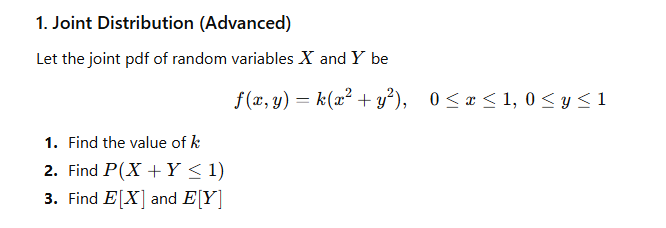 1. Joint Distribution (Advanced)
Let the joint pdf of random variables X and ¥ be
Jey) =k’ +4), 0