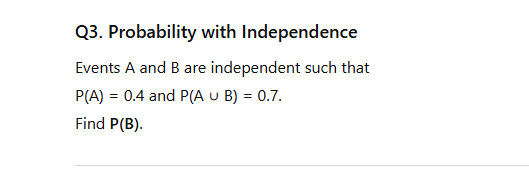
SOLVE AS IN CHEGG FIRST WRITE GIVEN INFORMATION ANDTHEN DERFINATIONSANDCONCEPTUSED AND THEN SOLVE STEPBY STEPIN DETAILWITHOUTMENTIONING STEPNUMBER AND NO BOLDLETTERSQ3. Probability with Independence
Events A and B are independent such that
P(A) = 0.4 and P(A UB) = 0.7.
Find P(B).
Question:
SOLVE AS IN CHEGG FIRST WRITE GIVEN INFORMATION ANDTHEN DERFINATIONSANDCONCEPTUSED AND THEN SOLVE STEPBY STEPIN DETAILWITHOUTMENTIONING STEPNUMBER AND NO BOLDLETTERSQ3. Probability with Independence
Events A and B are independent such that
P(A) = 0.4 and P(A UB) = 0.7.
Find P(B).
This is AI generated Response.
Asked by: nayan
Created at: 2026-02-02 18:42:19
Final Answer:
RenderedRaw Text
Did you like this answer?
# Given Information
Events A and B are independent
P(A) = .4
P(A ∪ B) = .7
Required: Find P(B)
# Definitions and Concepts Used
- If A and B are independent, then P(A ∩ B) = P(A) × P(B).
- The probability of the union of two events:
P(A ∪ B) = P(A) + P(B) − P(A ∩ B)
# Solution
Write the formula for the union:
P(A ∪ B) = P(A) + P(B) − P(A ∩ B)
Since A and B are independent:
P(A ∩ B) = P(A) × P(B)
Substitute the given values and the above relation into the union formula:
.7 = .4 + P(B) − [.4 × P(B)]
Express .4 × P(B) as .4P(B):
.7 = .4 + P(B) − .4P(B)
Combine like terms:
.7 = .4 + [P(B) − .4P(B)]
.7 = .4 + [1 − .4]P(B)
.7 = .4 + .6P(B)
Subtract .4 from both sides:
.7 − .4 = .6P(B)
.3 = .6P(B)
Divide both sides by .6:
P(B) = .3 / .6
P(B) = .5
So, the probability of event B is .5.
Question:
GIVE WELLSTRUCTURED SOLUTION
This is AI generated Response.
Asked by: nayan
Created at: 2026-02-02 18:44:00
Final Answer:
RenderedRaw Text
Did you like this answer?
# Given Information
- Events A and B are independent
- \( P(A) = 0.4 \)
- \( P(A \cup B) = 0.7 \)
- Required: Find \( P(B) \)
# Definitions and Concepts Used
- **Independence of Events**: For independent events A and B,
\[ P(A \cap B) = P(A) \times P(B) \]
- **Probability of Union**: The probability of the union of two events is given by
\[ P(A \cup B) = P(A) + P(B) - P(A \cap B) \]
# Solution
Start by applying the formula for the union of events A and B:
\[
P(A \cup B) = P(A) + P(B) - P(A \cap B)
\]
Given that A and B are independent, substitute for \( P(A \cap B) \):
\[
P(A \cup B) = P(A) + P(B) - (P(A) \times P(B))
\]
Now, substitute the known values into the equation:
\[
0.7 = 0.4 + P(B) - (0.4 \times P(B))
\]
Rewrite \( 0.4 \times P(B) \) as \( 0.4P(B) \):
\[
0.7 = 0.4 + P(B) - 0.4P(B)
\]
Combine the terms involving \( P(B) \):
\[
0.7 = 0.4 + (1 - 0.4)P(B)
\]
This simplifies to:
\[
0.7 = 0.4 + 0.6P(B)
\]
Next, isolate \( P(B) \) by subtracting \( 0.4 \) from both sides:
\[
0.7 - 0.4 = 0.6P(B)
\]
This leads to:
\[
0.3 = 0.6P(B)
\]
To find \( P(B) \), divide both sides by \( 0.6 \):
\[
P(B) = \frac{0.3}{0.6} = 0.5
\]
Thus, the probability of event B is \( P(B) = 0.5 \).
Question:
GENERATE ONEMOREUNIQUESOLUTIOON
This is AI generated Response.
Asked by: nayan
Created at: 2026-02-02 18:45:47
Final Answer:
RenderedRaw Text
Did you like this answer?
# Given Information
- Events A and B are independent.
- \( P(A) = 0.4 \)
- \( P(A \cup B) = 0.7 \)
- Required: Find \( P(B) \)
# Definitions and Concepts Used
- **Independence of Events**: For independent events A and B, the probability of their intersection is given by
\[ P(A \cap B) = P(A) \times P(B) \]
- **Probability of Union**: The probability of the union of two events is calculated as
\[ P(A \cup B) = P(A) + P(B) - P(A \cap B) \]
# Solution
Start with the probability of the union formula:
\[
P(A \cup B) = P(A) + P(B) - P(A \cap B)
\]
Given the independence of A and B, substitute \( P(A \cap B) \):
\[
P(A \cup B) = P(A) + P(B) - (P(A) \times P(B))
\]
Substitute the known values into the equation:
\[
0.7 = 0.4 + P(B) - (0.4 \times P(B))
\]
Rewrite \( 0.4 \times P(B) \) as \( 0.4P(B) \):
\[
0.7 = 0.4 + P(B) - 0.4P(B)
\]
Group the terms involving \( P(B) \):
\[
0.7 = 0.4 + (1 - 0.4)P(B)
\]
This results in:
\[
0.7 = 0.4 + 0.6P(B)
\]
Now, isolate \( P(B) \) by subtracting \( 0.4 \) from both sides:
\[
0.7 - 0.4 = 0.6P(B)
\]
This simplifies to:
\[
0.3 = 0.6P(B)
\]
To determine \( P(B) \), divide both sides by \( 0.6 \):
\[
P(B) = \frac{0.3}{0.6} = 0.5
\]
Therefore, the probability of event B is \( P(B) = 0.5 \).
Question:
GENERATE OENMORE UNIQUESOLUTION
This is AI generated Response.
Asked by: nayan
Created at: 2026-02-02 18:46:30
Final Answer:
RenderedRaw Text
Did you like this answer?
# Given Information
- Events A and B are independent.
- \( P(A) = 0.4 \)
- \( P(A \cup B) = 0.7 \)
- Required: Find \( P(B) \)
# Definitions and Concepts Used
- **Independence of Events**: For independent events A and B, the probability of their intersection is expressed as
\[ P(A \cap B) = P(A) \times P(B) \]
- **Probability of Union**: The probability of the union of two events is given by the formula
\[ P(A \cup B) = P(A) + P(B) - P(A \cap B) \]
# Solution
Begin with the formula for the probability of the union of events A and B:
\[
P(A \cup B) = P(A) + P(B) - P(A \cap B)
\]
Since A and B are independent, replace \( P(A \cap B) \) with its equivalent:
\[
P(A \cup B) = P(A) + P(B) - (P(A) \times P(B))
\]
Insert the known values into the equation:
\[
0.7 = 0.4 + P(B) - (0.4 \times P(B))
\]
Express \( 0.4 \times P(B) \) as \( 0.4P(B) \):
\[
0.7 = 0.4 + P(B) - 0.4P(B)
\]
Reorganize the terms involving \( P(B) \):
\[
0.7 = 0.4 + (1 - 0.4)P(B)
\]
This simplifies to:
\[
0.7 = 0.4 + 0.6P(B)
\]
Next, isolate \( P(B) \) by subtracting \( 0.4 \) from both sides:
\[
0.7 - 0.4 = 0.6P(B)
\]
This results in:
\[
0.3 = 0.6P(B)
\]
To find \( P(B) \), divide both sides by \( 0.6 \):
\[
P(B) = \frac{0.3}{0.6} = 0.5
\]
Thus, the probability of event B is \( P(B) = 0.5 \).
Question:
GENERATE OENMROEUNIQUE SOLUTION
This is AI generated Response.
Asked by: nayan
Created at: 2026-02-02 18:47:57
Final Answer:
RenderedRaw Text
Did you like this answer?
# Given Information
- Events A and B are independent.
- \( P(A) = 0.4 \)
- \( P(A \cup B) = 0.7 \)
- Required: Find \( P(B) \)
# Definitions and Concepts Used
- **Independence of Events**: For independent events A and B, the intersection probability is calculated as
\[ P(A \cap B) = P(A) \times P(B) \]
- **Probability of Union**: The union of two events A and B is given by the formula
\[ P(A \cup B) = P(A) + P(B) - P(A \cap B) \]
# Solution
Start by applying the union formula for events A and B:
\[
P(A \cup B) = P(A) + P(B) - P(A \cap B)
\]
Since A and B are independent, substitute \( P(A \cap B) \):
\[
P(A \cup B) = P(A) + P(B) - (P(A) \times P(B))
\]
Substitute the known values into the equation:
\[
0.7 = 0.4 + P(B) - (0.4 \times P(B))
\]
Rearranging \( 0.4 \times P(B) \) gives:
\[
0.7 = 0.4 + P(B) - 0.4P(B)
\]
Combine the terms involving \( P(B) \):
\[
0.7 = 0.4 + (1 - 0.4)P(B)
\]
This simplifies to:
\[
0.7 = 0.4 + 0.6P(B)
\]
Next, isolate \( P(B) \) by subtracting \( 0.4 \) from both sides:
\[
0.7 - 0.4 = 0.6P(B)
\]
This leads to:
\[
0.3 = 0.6P(B)
\]
To find \( P(B) \), divide both sides by \( 0.6 \):
\[
P(B) = \frac{0.3}{0.6} = 0.5
\]
Therefore, the probability of event B is \( P(B) = 0.5 \).
Question:
generate oenmroeuniqye andplagarismfreesolution
This is AI generated Response.
Asked by: nayan
Created at: 2026-02-02 18:49:54
Final Answer:
RenderedRaw Text
Did you like this answer?
# Given Information
- Events A and B are independent.
- \( P(A) = 0.4 \)
- \( P(A \cup B) = 0.7 \)
- Required: Find \( P(B) \)
# Definitions and Concepts Used
- **Independence of Events**: If A and B are independent, then
\[ P(A \cap B) = P(A) \times P(B) \]
- **Probability of Union**: The probability of the union of events A and B is defined as
\[ P(A \cup B) = P(A) + P(B) - P(A \cap B) \]
# Solution
Begin by applying the formula for the union of events:
\[
P(A \cup B) = P(A) + P(B) - P(A \cap B)
\]
Substituting the expression for \( P(A \cap B) \) based on independence:
\[
P(A \cup B) = P(A) + P(B) - (P(A) \times P(B))
\]
Insert the known values into this equation:
\[
0.7 = 0.4 + P(B) - (0.4 \times P(B))
\]
Rearranging \( 0.4 \times P(B) \):
\[
0.7 = 0.4 + P(B) - 0.4P(B)
\]
Combine terms that include \( P(B) \):
\[
0.7 = 0.4 + (1 - 0.4)P(B)
\]
This simplifies to:
\[
0.7 = 0.4 + 0.6P(B)
\]
To isolate \( P(B) \), subtract \( 0.4 \) from both sides:
\[
0.7 - 0.4 = 0.6P(B)
\]
This results in:
\[
0.3 = 0.6P(B)
\]
To find \( P(B) \), divide both sides by \( 0.6 \):
\[
P(B) = \frac{0.3}{0.6} = 0.5
\]
Thus, the probability of event B is \( P(B) = 0.5 \).
Question:
generate onemoresolutiuon uniqe and plagarismfree
This is AI generated Response.
Asked by: nayan
Created at: 2026-02-02 18:51:39
Final Answer:
RenderedRaw Text
Did you like this answer?
# Given Information
- Events A and B are independent.
- \( P(A) = 0.4 \)
- \( P(A \cup B) = 0.7 \)
- Required: Find \( P(B) \)
# Definitions and Concepts Used
- **Independence of Events**: For independent events A and B, the intersection probability can be calculated as
\[ P(A \cap B) = P(A) \times P(B) \]
- **Probability of Union**: The formula for the union of two events A and B is
\[ P(A \cup B) = P(A) + P(B) - P(A \cap B) \]
# Solution
Start with the union formula for events A and B:
\[
P(A \cup B) = P(A) + P(B) - P(A \cap B)
\]
Given that A and B are independent, substitute \( P(A \cap B) \):
\[
P(A \cup B) = P(A) + P(B) - (P(A) \times P(B))
\]
Now plug in the known values:
\[
0.7 = 0.4 + P(B) - (0.4 \times P(B))
\]
Rearranging gives:
\[
0.7 = 0.4 + P(B) - 0.4P(B)
\]
Combine the terms involving \( P(B) \):
\[
0.7 = 0.4 + (1 - 0.4)P(B)
\]
This simplifies to:
\[
0.7 = 0.4 + 0.6P(B)
\]
To isolate \( P(B) \), subtract \( 0.4 \) from both sides:
\[
0.7 - 0.4 = 0.6P(B)
\]
This results in:
\[
0.3 = 0.6P(B)
\]
Now, divide both sides by \( 0.6 \) to find \( P(B) \):
\[
P(B) = \frac{0.3}{0.6} = 0.5
\]
Thus, the probability of event B is \( P(B) = 0.5 \).
Question:
generate oenmoreuniqyue solution that definevariable anddefinationclearly
This is AI generated Response.
Asked by: nayan
Created at: 2026-02-02 18:53:11
Final Answer:
RenderedRaw Text
Did you like this answer?
# Given Information
- Events A and B are independent.
- \( P(A) = 0.4 \)
- \( P(A \cup B) = 0.7 \)
- Required: Find \( P(B) \)
# Definitions and Concepts Used
- **Event Independence**: Two events A and B are independent if the occurrence of one does not affect the other. Mathematically, this is represented as
\[ P(A \cap B) = P(A) \times P(B) \]
where \( P(A \cap B) \) is the probability that both events occur.
- **Probability of Union**: The probability that at least one of the events A or B occurs is given by the formula
\[ P(A \cup B) = P(A) + P(B) - P(A \cap B) \]
where \( P(A \cup B) \) is the probability that either A or B occurs.
# Solution
To find \( P(B) \), we start with the formula for the union of events A and B:
\[
P(A \cup B) = P(A) + P(B) - P(A \cap B)
\]
Given that A and B are independent, we can substitute \( P(A \cap B) \):
\[
P(A \cup B) = P(A) + P(B) - (P(A) \times P(B))
\]
Now substitute the known values:
\[
0.7 = 0.4 + P(B) - (0.4 \times P(B))
\]
Rearranging \( 0.4 \times P(B) \):
\[
0.7 = 0.4 + P(B) - 0.4P(B)
\]
Combine the terms that contain \( P(B) \):
\[
0.7 = 0.4 + (1 - 0.4)P(B)
\]
This simplifies to:
\[
0.7 = 0.4 + 0.6P(B)
\]
Next, isolate \( P(B) \) by subtracting \( 0.4 \) from both sides:
\[
0.7 - 0.4 = 0.6P(B)
\]
This results in:
\[
0.3 = 0.6P(B)
\]
To find \( P(B) \), divide both sides by \( 0.6 \):
\[
P(B) = \frac{0.3}{0.6} = 0.5
\]
Thus, the probability of event B is
\[
P(B) = 0.5
\]
Question:
generate onemroesunique solution
This is AI generated Response.
Asked by: nayan
Created at: 2026-02-02 19:27:04
Final Answer:
RenderedRaw Text
Did you like this answer?
# Given Information
- Events A and B are independent.
- \( P(A) = 0.4 \)
- \( P(A \cup B) = 0.7 \)
- Required: Find \( P(B) \)
# Definitions and Concepts Used
- **Independence of Events**: Events A and B are independent if the occurrence of one does not influence the occurrence of the other. This is mathematically expressed as:
\[ P(A \cap B) = P(A) \times P(B) \]
where \( P(A \cap B) \) is the probability that both events A and B occur simultaneously.
- **Probability of Union**: The probability that at least one of the events A or B occurs is given by the formula:
\[ P(A \cup B) = P(A) + P(B) - P(A \cap B) \]
where \( P(A \cup B) \) is the probability that either event A or event B occurs.
# Solution
Start with the union formula:
\[
P(A \cup B) = P(A) + P(B) - P(A \cap B)
\]
Since A and B are independent, we can substitute \( P(A \cap B) \):
\[
P(A \cup B) = P(A) + P(B) - (P(A) \times P(B))
\]
Substituting the known values into this equation gives:
\[
0.7 = 0.4 + P(B) - (0.4 \times P(B))
\]
Rearranging \( 0.4 \times P(B) \):
\[
0.7 = 0.4 + P(B) - 0.4P(B)
\]
Combine the terms involving \( P(B) \):
\[
0.7 = 0.4 + (1 - 0.4)P(B)
\]
This simplifies to:
\[
0.7 = 0.4 + 0.6P(B)
\]
To isolate \( P(B) \), subtract \( 0.4 \) from both sides:
\[
0.7 - 0.4 = 0.6P(B)
\]
This results in:
\[
0.3 = 0.6P(B)
\]
Now, divide both sides by \( 0.6 \) to find \( P(B) \):
\[
P(B) = \frac{0.3}{0.6} = 0.5
\]
Thus, the probability of event B is
\[
P(B) = 0.5
\]
Question:
generate inemoresolution but donot give too lengthy calculation
This is AI generated Response.
Asked by: nayan
Created at: 2026-02-02 19:28:17
Final Answer:
RenderedRaw Text
Did you like this answer?
# Given Information
- Events A and B are independent.
- \( P(A) = 0.4 \)
- \( P(A \cup B) = 0.7 \)
- Required: Find \( P(B) \)
# Definitions and Concepts Used
- **Independence of Events**: For independent events A and B,
\[ P(A \cap B) = P(A) \times P(B) \]
- **Probability of Union**: The probability of the union of events A and B is given by
\[ P(A \cup B) = P(A) + P(B) - P(A \cap B) \]
# Solution
Use the union formula:
\[
P(A \cup B) = P(A) + P(B) - P(A \cap B)
\]
Substituting the expression for \( P(A \cap B) \) based on independence:
\[
P(A \cup B) = P(A) + P(B) - (P(A) \times P(B))
\]
Now, substitute the known values:
\[
0.7 = 0.4 + P(B) - (0.4 \times P(B))
\]
Rearranging gives:
\[
0.7 = 0.4 + P(B) - 0.4P(B)
\]
Combine terms involving \( P(B) \):
\[
0.7 = 0.4 + 0.6P(B)
\]
To isolate \( P(B) \), subtract \( 0.4 \):
\[
0.3 = 0.6P(B)
\]
Dividing both sides by \( 0.6 \):
\[
P(B) = \frac{0.3}{0.6} = 0.5
\]
Thus, the probability of event B is
\[
P(B) = 0.5
\]
Question:
generate oienmroesolution plagarismfree and unique
This is AI generated Response.
Asked by: nayan
Created at: 2026-02-02 19:30:01
Final Answer:
RenderedRaw Text
Did you like this answer?
# Given Information
- Events A and B are independent.
- \( P(A) = 0.4 \)
- \( P(A \cup B) = 0.7 \)
- Required: Find \( P(B) \)
# Definitions and Concepts Used
- **Independence of Events**: Two events A and B are independent if the occurrence of one does not affect the other. This is mathematically defined by:
\[ P(A \cap B) = P(A) \times P(B) \]
- **Probability of Union**: The probability that at least one of the events A or B occurs is calculated using:
\[ P(A \cup B) = P(A) + P(B) - P(A \cap B) \]
# Solution
Start with the union formula for events A and B:
\[
P(A \cup B) = P(A) + P(B) - P(A \cap B)
\]
Given that A and B are independent, we can express \( P(A \cap B) \):
\[
P(A \cup B) = P(A) + P(B) - (P(A) \times P(B))
\]
Now, substituting the given values:
\[
0.7 = 0.4 + P(B) - (0.4 \times P(B))
\]
Rearranging gives:
\[
0.7 = 0.4 + P(B) - 0.4P(B)
\]
Combine the terms involving \( P(B) \):
\[
0.7 = 0.4 + (1 - 0.4)P(B)
\]
This simplifies to:
\[
0.7 = 0.4 + 0.6P(B)
\]
To isolate \( P(B) \), subtract \( 0.4 \):
\[
0.3 = 0.6P(B)
\]
Now, divide by \( 0.6 \):
\[
P(B) = \frac{0.3}{0.6} = 0.5
\]
Thus, the probability of event B is
\[
P(B) = 0.5
\]
Question:
generateonemoresolution that is unique and plagarism free
This is AI generated Response.
Asked by: nayan
Created at: 2026-02-02 19:51:01
Final Answer:
RenderedRaw Text
Did you like this answer?
# Given Information
- Events A and B are independent.
- \( P(A) = 0.4 \)
- \( P(A \cup B) = 0.7 \)
- Required: Find \( P(B) \)
# Definitions and Concepts Used
- **Independence of Events**: For independent events A and B, the probability of both occurring is calculated as:
\[ P(A \cap B) = P(A) \times P(B) \]
- **Probability of Union**: The probability that at least one of the events occurs is given by the formula:
\[ P(A \cup B) = P(A) + P(B) - P(A \cap B) \]
# Solution
Start by applying the union formula for events A and B:
\[
P(A \cup B) = P(A) + P(B) - P(A \cap B)
\]
Since A and B are independent, substitute \( P(A \cap B) \):
\[
P(A \cup B) = P(A) + P(B) - (P(A) \times P(B))
\]
Substituting the known values into the equation:
\[
0.7 = 0.4 + P(B) - (0.4 \times P(B))
\]
Rearranging the equation gives:
\[
0.7 = 0.4 + P(B) - 0.4P(B)
\]
Combine terms related to \( P(B) \):
\[
0.7 = 0.4 + (1 - 0.4)P(B)
\]
This simplifies to:
\[
0.7 = 0.4 + 0.6P(B)
\]
Next, isolate \( P(B) \) by subtracting \( 0.4 \) from both sides:
\[
0.3 = 0.6P(B)
\]
To find \( P(B) \), divide both sides by \( 0.6 \):
\[
P(B) = \frac{0.3}{0.6} = 0.5
\]
Thus, the probability of event B is
\[
P(B) = 0.5
\]
Question:
generate onemoreujnique solution
This is AI generated Response.
Asked by: nayan
Created at: 2026-02-02 19:51:37
Final Answer:
RenderedRaw Text
Did you like this answer?
# Given Information
- Events A and B are independent.
- \( P(A) = 0.4 \)
- \( P(A \cup B) = 0.7 \)
- Required: Find \( P(B) \)
# Definitions and Concepts Used
- **Independence of Events**: Events A and B are independent if the occurrence of one does not influence the occurrence of the other. This is mathematically represented as:
\[ P(A \cap B) = P(A) \times P(B) \]
- **Probability of Union**: The probability that at least one of the events A or B occurs is given by the formula:
\[ P(A \cup B) = P(A) + P(B) - P(A \cap B) \]
# Solution
Start with the union formula for events A and B:
\[
P(A \cup B) = P(A) + P(B) - P(A \cap B)
\]
Given the independence of A and B, substitute \( P(A \cap B) \):
\[
P(A \cup B) = P(A) + P(B) - (P(A) \times P(B))
\]
Now substitute the known values into the equation:
\[
0.7 = 0.4 + P(B) - (0.4 \times P(B))
\]
Rearranging gives:
\[
0.7 = 0.4 + P(B) - 0.4P(B)
\]
Combine the terms involving \( P(B) \):
\[
0.7 = 0.4 + (1 - 0.4)P(B)
\]
This simplifies to:
\[
0.7 = 0.4 + 0.6P(B)
\]
To isolate \( P(B) \), subtract \( 0.4 \) from both sides:
\[
0.3 = 0.6P(B)
\]
Now, divide by \( 0.6 \):
\[
P(B) = \frac{0.3}{0.6} = 0.5
\]
Thus, the probability of event B is
\[
P(B) = 0.5
\]
Question:
generate onemoreniquessolution
This is AI generated Response.
Asked by: nayan
Created at: 2026-02-02 19:52:52
Final Answer:
RenderedRaw Text
Did you like this answer?
# Given Information
- Events A and B are independent.
- \( P(A) = 0.4 \)
- \( P(A \cup B) = 0.7 \)
- Required: Find \( P(B) \)
# Definitions and Concepts Used
- **Independence of Events**: Two events A and B are independent if the occurrence of one does not affect the probability of the other. This is defined mathematically as:
\[ P(A \cap B) = P(A) \times P(B) \]
- **Probability of Union**: The probability that at least one of the events A or B occurs can be expressed using the formula:
\[ P(A \cup B) = P(A) + P(B) - P(A \cap B) \]
# Solution
Start by applying the union formula:
\[
P(A \cup B) = P(A) + P(B) - P(A \cap B)
\]
Since A and B are independent, we can replace \( P(A \cap B) \):
\[
P(A \cup B) = P(A) + P(B) - (P(A) \times P(B))
\]
Now substitute the known values into the equation:
\[
0.7 = 0.4 + P(B) - (0.4 \times P(B))
\]
Rearranging gives:
\[
0.7 = 0.4 + P(B) - 0.4P(B)
\]
Combine the terms related to \( P(B) \):
\[
0.7 = 0.4 + (1 - 0.4)P(B)
\]
This simplifies to:
\[
0.7 = 0.4 + 0.6P(B)
\]
Next, isolate \( P(B) \) by subtracting \( 0.4 \):
\[
0.3 = 0.6P(B)
\]
To find \( P(B) \), divide both sides by \( 0.6 \):
\[
P(B) = \frac{0.3}{0.6} = 0.5
\]
Thus, the probability of event B is
\[
P(B) = 0.5
\]
Question:
generate oenmporenique solution
This is AI generated Response.
Asked by: nayan
Created at: 2026-02-02 19:54:12
Final Answer:
RenderedRaw Text
Did you like this answer?
# Given Information
- Events A and B are independent.
- \( P(A) = 0.4 \)
- \( P(A \cup B) = 0.7 \)
- Required: Find \( P(B) \)
# Definitions and Concepts Used
- **Independence of Events**: Two events A and B are independent if the occurrence of one does not affect the probability of the other. This is mathematically defined as:
\[ P(A \cap B) = P(A) \times P(B) \]
- **Probability of Union**: The probability that at least one of the events A or B occurs is expressed by the formula:
\[ P(A \cup B) = P(A) + P(B) - P(A \cap B) \]
# Solution
Begin with the union formula:
\[
P(A \cup B) = P(A) + P(B) - P(A \cap B)
\]
Since A and B are independent, we substitute \( P(A \cap B) \):
\[
P(A \cup B) = P(A) + P(B) - (P(A) \times P(B))
\]
Now, substitute the known values:
\[
0.7 = 0.4 + P(B) - (0.4 \times P(B))
\]
Rearranging gives:
\[
0.7 = 0.4 + P(B) - 0.4P(B)
\]
Combine the terms involving \( P(B) \):
\[
0.7 = 0.4 + (1 - 0.4)P(B)
\]
This simplifies to:
\[
0.7 = 0.4 + 0.6P(B)
\]
Isolate \( P(B) \) by subtracting \( 0.4 \):
\[
0.3 = 0.6P(B)
\]
To determine \( P(B) \), divide both sides by \( 0.6 \):
\[
P(B) = \frac{0.3}{0.6} = 0.5
\]
Thus, the probability of event B is
\[
P(B) = 0.5
\]
Question:
generateonemoreunique andplagarismfre solution1.25 longer than this
This is AI generated Response.
Asked by: nayan
Created at: 2026-02-02 19:56:00
Final Answer:
RenderedRaw Text
Did you like this answer?
# Given Information
- Events A and B are independent.
- \( P(A) = 0.4 \)
- \( P(A \cup B) = 0.7 \)
- Required: Find \( P(B) \)
# Definitions and Concepts Used
- **Independence of Events**: Two events A and B are considered independent when the occurrence of one does not influence the occurrence of the other. Mathematically, this relationship is expressed as:
\[ P(A \cap B) = P(A) \times P(B) \]
Here, \( P(A \cap B) \) represents the probability that both events A and B occur simultaneously.
- **Probability of Union**: The probability that at least one of the events A or B occurs can be calculated using the formula:
\[ P(A \cup B) = P(A) + P(B) - P(A \cap B) \]
In this formula, \( P(A \cup B) \) denotes the probability that either event A occurs, event B occurs, or both events occur.
# Solution
To find \( P(B) \), we will begin with the union formula for events A and B:
\[
P(A \cup B) = P(A) + P(B) - P(A \cap B)
\]
Since A and B are independent, we substitute \( P(A \cap B) \) with its equivalent expression:
\[
P(A \cup B) = P(A) + P(B) - (P(A) \times P(B))
\]
Next, we insert the known values into this equation:
\[
0.7 = 0.4 + P(B) - (0.4 \times P(B))
\]
Rearranging the equation allows us to isolate terms more clearly:
\[
0.7 = 0.4 + P(B) - 0.4P(B)
\]
Next, we group the terms that involve \( P(B) \):
\[
0.7 = 0.4 + (1 - 0.4)P(B)
\]
This simplifies to:
\[
0.7 = 0.4 + 0.6P(B)
\]
Now, to isolate \( P(B) \), we first subtract \( 0.4 \) from both sides of the equation:
\[
0.7 - 0.4 = 0.6P(B)
\]
This calculation gives us:
\[
0.3 = 0.6P(B)
\]
To find \( P(B) \), we will divide both sides by \( 0.6 \):
\[
P(B) = \frac{0.3}{0.6} = 0.5
\]
Thus, we conclude that the probability of event B is
\[
P(B) = 0.5
\]
This result indicates that there is a 50% chance that event B will occur, given the independent nature of events A and B and the provided probabilities.
Question:
generate onemroeunique solutionnobold letters and different wording
This is AI generated Response.
Asked by: nayan
Created at: 2026-02-02 19:57:38
Final Answer:
RenderedRaw Text
Did you like this answer?
# Given Information
- Events A and B are independent.
- \( P(A) = 0.4 \)
- \( P(A \cup B) = 0.7 \)
- The task is to determine \( P(B) \).
# Definitions and Concepts Used
- **Independence of Events**: Two events A and B are independent when the occurrence of one does not affect the occurrence of the other. This can be mathematically expressed as:
\[ P(A \cap B) = P(A) \times P(B) \]
Here, \( P(A \cap B) \) represents the probability that both events happen simultaneously.
- **Probability of Union**: The probability that at least one of the events A or B occurs can be calculated using the formula:
\[ P(A \cup B) = P(A) + P(B) - P(A \cap B) \]
In this context, \( P(A \cup B) \) represents the probability of either event A occurring, event B occurring, or both occurring.
# Solution
To find \( P(B) \), we will start with the formula for the union of events:
\[
P(A \cup B) = P(A) + P(B) - P(A \cap B)
\]
Given that A and B are independent, we can rewrite the intersection probability:
\[
P(A \cup B) = P(A) + P(B) - (P(A) \times P(B))
\]
Substituting the known values into this equation provides:
\[
0.7 = 0.4 + P(B) - (0.4 \times P(B))
\]
Rearranging the equation helps to clarify the terms:
\[
0.7 = 0.4 + P(B) - 0.4P(B)
\]
Next, we combine the terms that involve \( P(B) \):
\[
0.7 = 0.4 + (1 - 0.4)P(B)
\]
This simplifies to:
\[
0.7 = 0.4 + 0.6P(B)
\]
To isolate \( P(B) \), we subtract \( 0.4 \) from both sides:
\[
0.7 - 0.4 = 0.6P(B)
\]
This leads to:
\[
0.3 = 0.6P(B)
\]
To solve for \( P(B) \), divide both sides by \( 0.6 \):
\[
P(B) = \frac{0.3}{0.6} = 0.5
\]
Thus, the probability of event B is
\[
P(B) = 0.5
\]
This outcome indicates that there is a 50% likelihood of event B occurring, considering the independence of events A and B along with the given probabilities.
Question:
generate oinemorewunique soilution
This is AI generated Response.
Asked by: nayan
Created at: 2026-02-02 19:59:33
Final Answer:
RenderedRaw Text
Did you like this answer?
# Given Information
- Events A and B are independent.
- \( P(A) = 0.4 \)
- \( P(A \cup B) = 0.7 \)
- Task: Find \( P(B) \).
# Definitions and Concepts Used
- **Independence of Events**: Events A and B are independent if the occurrence of one does not affect the probability of the other. This is mathematically represented as:
\[ P(A \cap B) = P(A) \times P(B) \]
- **Probability of Union**: The probability that either event A or event B (or both) occurs can be expressed as:
\[ P(A \cup B) = P(A) + P(B) - P(A \cap B) \]
Here, \( P(A \cup B) \) signifies the probability that at least one of the events occurs.
# Solution
To find \( P(B) \), we start with the union formula:
\[
P(A \cup B) = P(A) + P(B) - P(A \cap B)
\]
Since A and B are independent, we can substitute \( P(A \cap B) \):
\[
P(A \cup B) = P(A) + P(B) - (P(A) \times P(B))
\]
Now, inserting the known values into this equation yields:
\[
0.7 = 0.4 + P(B) - (0.4 \times P(B))
\]
Rearranging gives:
\[
0.7 = 0.4 + P(B) - 0.4P(B)
\]
Combine the terms involving \( P(B) \):
\[
0.7 = 0.4 + (1 - 0.4)P(B)
\]
This simplifies to:
\[
0.7 = 0.4 + 0.6P(B)
\]
To isolate \( P(B) \), subtract \( 0.4 \):
\[
0.3 = 0.6P(B)
\]
Now, divide both sides by \( 0.6 \):
\[
P(B) = \frac{0.3}{0.6} = 0.5
\]
Thus, the probability of event B is
\[
P(B) = 0.5
\]
This means there is a 50% chance that event B will occur, given the independence of events A and B and the probabilities provided.
Question:
generate one mroe unique solution
This is AI generated Response.
Asked by: nayan
Created at: 2026-02-02 20:31:27
Final Answer:
RenderedRaw Text
Did you like this answer?
# Given Information
- Events A and B are independent.
- \( P(A) = 0.4 \)
- \( P(A \cup B) = 0.7 \)
- Objective: Determine \( P(B) \).
# Definitions and Concepts Used
- **Independence of Events**: Two events A and B are independent if the occurrence of one does not influence the occurrence of the other. This relationship is expressed mathematically as:
\[ P(A \cap B) = P(A) \times P(B) \]
Here, \( P(A \cap B) \) denotes the probability that both events A and B occur together.
- **Probability of Union**: The probability that at least one of the events A or B occurs can be calculated using the formula:
\[ P(A \cup B) = P(A) + P(B) - P(A \cap B) \]
In this formula, \( P(A \cup B) \) represents the probability of either event A occurring, event B occurring, or both.
# Solution
To find \( P(B) \), we will begin with the union formula for events A and B:
\[
P(A \cup B) = P(A) + P(B) - P(A \cap B)
\]
Since A and B are independent, we can replace \( P(A \cap B) \) with:
\[
P(A \cup B) = P(A) + P(B) - (P(A) \times P(B))
\]
Inserting the known values into this equation gives:
\[
0.7 = 0.4 + P(B) - (0.4 \times P(B))
\]
Rearranging the terms allows for clearer isolation:
\[
0.7 = 0.4 + P(B) - 0.4P(B)
\]
Combine the terms that involve \( P(B) \):
\[
0.7 = 0.4 + (1 - 0.4)P(B)
\]
This simplifies to:
\[
0.7 = 0.4 + 0.6P(B)
\]
To isolate \( P(B) \), subtract \( 0.4 \) from both sides:
\[
0.3 = 0.6P(B)
\]
Now, divide both sides by \( 0.6 \):
\[
P(B) = \frac{0.3}{0.6} = 0.5
\]
Thus, the probability of event B is
\[
P(B) = 0.5
\]
This result indicates that there is a 50% chance that event B will occur, based on the independence of events A and B and the specified probabilities.
Question:
generate one mor euniqyue solurtion in different woding
This is AI generated Response.
Asked by: nayan
Created at: 2026-02-02 20:32:21
Final Answer:
RenderedRaw Text
Did you like this answer?
# Given Information
- Events A and B are independent.
- \( P(A) = 0.4 \)
- \( P(A \cup B) = 0.7 \)
- Task: Calculate \( P(B) \).
# Definitions and Concepts Used
- **Independence of Events**: Events A and B are independent if the occurrence of one does not influence the occurrence of the other. This can be mathematically represented as:
\[ P(A \cap B) = P(A) \times P(B) \]
Here, \( P(A \cap B) \) represents the probability that both events A and B happen at the same time.
- **Probability of Union**: The probability that at least one of the events A or B occurs is defined by the formula:
\[ P(A \cup B) = P(A) + P(B) - P(A \cap B) \]
In this context, \( P(A \cup B) \) signifies the likelihood of either event A occurring, event B occurring, or both events occurring.
# Solution
To find \( P(B) \), we initiate with the union formula for events A and B:
\[
P(A \cup B) = P(A) + P(B) - P(A \cap B)
\]
Since A and B are independent, we can substitute \( P(A \cap B) \) with:
\[
P(A \cup B) = P(A) + P(B) - (P(A) \times P(B))
\]
Substituting the known values into this equation results in:
\[
0.7 = 0.4 + P(B) - (0.4 \times P(B))
\]
Rearranging helps isolate the terms involving \( P(B) \):
\[
0.7 = 0.4 + P(B) - 0.4P(B)
\]
Next, we combine the terms that include \( P(B) \):
\[
0.7 = 0.4 + (1 - 0.4)P(B)
\]
This simplifies to:
\[
0.7 = 0.4 + 0.6P(B)
\]
To isolate \( P(B) \), we first subtract \( 0.4 \) from both sides:
\[
0.3 = 0.6P(B)
\]
Now, divide both sides by \( 0.6 \):
\[
P(B) = \frac{0.3}{0.6} = 0.5
\]
Thus, the probability of event B is
\[
P(B) = 0.5
\]
This indicates that there is a 50% chance of event B occurring, given the independence of events A and B along with the provided probabilities.
Question:
generate one more solution unique
This is AI generated Response.
Asked by: nayan
Created at: 2026-02-02 20:34:31
Final Answer:
RenderedRaw Text
Did you like this answer?
# Given Information
- Events A and B are independent.
- \( P(A) = 0.4 \)
- \( P(A \cup B) = 0.7 \)
- Objective: Determine \( P(B) \).
# Definitions and Concepts Used
- **Independence of Events**: Two events A and B are considered independent if the occurrence of one does not affect the probability of the other. This relationship is defined mathematically as:
\[ P(A \cap B) = P(A) \times P(B) \]
Here, \( P(A \cap B) \) represents the probability that both events A and B occur simultaneously.
- **Probability of Union**: The probability that at least one of the events A or B occurs can be calculated using the formula:
\[ P(A \cup B) = P(A) + P(B) - P(A \cap B) \]
In this formula, \( P(A \cup B) \) represents the probability of either event A, event B, or both occurring.
# Solution
To find \( P(B) \), we will start with the union formula for events A and B:
\[
P(A \cup B) = P(A) + P(B) - P(A \cap B)
\]
Since A and B are independent, we can rewrite \( P(A \cap B) \):
\[
P(A \cup B) = P(A) + P(B) - (P(A) \times P(B))
\]
Next, we substitute the known values into this equation:
\[
0.7 = 0.4 + P(B) - (0.4 \times P(B))
\]
Rearranging gives:
\[
0.7 = 0.4 + P(B) - 0.4P(B)
\]
Combine the terms that involve \( P(B) \):
\[
0.7 = 0.4 + (1 - 0.4)P(B)
\]
This simplifies to:
\[
0.7 = 0.4 + 0.6P(B)
\]
To isolate \( P(B) \), we first subtract \( 0.4 \):
\[
0.3 = 0.6P(B)
\]
Now, divide both sides by \( 0.6 \):
\[
P(B) = \frac{0.3}{0.6} = 0.5
\]
Thus, the probability of event B is
\[
P(B) = 0.5
\]
This indicates that there is a 50% chance that event B will occur, considering the independence of events A and B and the provided probabilities.
Question:
gemnerate one mroe solution
This is AI generated Response.
Asked by: nayan
Created at: 2026-02-02 20:35:38
Final Answer:
RenderedRaw Text
Did you like this answer?
# Given Information
- Events A and B are independent.
- \( P(A) = 0.4 \)
- \( P(A \cup B) = 0.7 \)
- Task: Find \( P(B) \).
# Definitions and Concepts Used
- **Independence of Events**: Two events A and B are independent if the occurrence of one does not affect the occurrence of the other. This is expressed mathematically as:
\[ P(A \cap B) = P(A) \times P(B) \]
Here, \( P(A \cap B) \) denotes the probability that both events A and B occur.
- **Probability of Union**: The probability that at least one of the events A or B occurs can be calculated using the formula:
\[ P(A \cup B) = P(A) + P(B) - P(A \cap B) \]
In this context, \( P(A \cup B) \) signifies the probability of either event A occurring, event B occurring, or both.
# Solution
To determine \( P(B) \), we start with the union formula for events A and B:
\[
P(A \cup B) = P(A) + P(B) - P(A \cap B)
\]
Since A and B are independent, we can substitute \( P(A \cap B) \):
\[
P(A \cup B) = P(A) + P(B) - (P(A) \times P(B))
\]
Substituting the known values into this equation yields:
\[
0.7 = 0.4 + P(B) - (0.4 \times P(B))
\]
Rearranging helps to isolate the terms:
\[
0.7 = 0.4 + P(B) - 0.4P(B)
\]
Next, we group the terms involving \( P(B) \):
\[
0.7 = 0.4 + (1 - 0.4)P(B)
\]
This simplifies to:
\[
0.7 = 0.4 + 0.6P(B)
\]
To isolate \( P(B) \), subtract \( 0.4 \) from both sides:
\[
0.3 = 0.6P(B)
\]
Now, dividing both sides by \( 0.6 \) gives:
\[
P(B) = \frac{0.3}{0.6} = 0.5
\]
Thus, the probability of event B is
\[
P(B) = 0.5
\]
This outcome indicates that there is a 50% chance of event B occurring, considering the independence of events A and B along with the provided probabilities.
Question:
one mroe soilution
This is AI generated Response.
Asked by: nayan
Created at: 2026-02-02 20:37:06
Final Answer:
RenderedRaw Text
Did you like this answer?
# Given Information
- Events A and B are independent.
- \( P(A) = 0.4 \)
- \( P(A \cup B) = 0.7 \)
- Objective: Determine \( P(B) \).
# Definitions and Concepts Used
- **Independence of Events**: Two events A and B are independent if the occurrence of one does not influence the occurrence of the other. This is mathematically represented as:
\[ P(A \cap B) = P(A) \times P(B) \]
Where \( P(A \cap B) \) denotes the probability that both events A and B occur at the same time.
- **Probability of Union**: The probability that at least one of the events A or B occurs is calculated using the formula:
\[ P(A \cup B) = P(A) + P(B) - P(A \cap B) \]
In this formula, \( P(A \cup B) \) signifies the likelihood of either event A or event B (or both) occurring.
# Solution
To determine \( P(B) \), we will start with the formula for the union of events A and B:
\[
P(A \cup B) = P(A) + P(B) - P(A \cap B)
\]
Given the independence of A and B, we substitute \( P(A \cap B) \):
\[
P(A \cup B) = P(A) + P(B) - (P(A) \times P(B))
\]
Now substituting the given values into this equation yields:
\[
0.7 = 0.4 + P(B) - (0.4 \times P(B))
\]
Rearranging helps isolate the terms involving \( P(B) \):
\[
0.7 = 0.4 + P(B) - 0.4P(B)
\]
Next, we combine the terms that involve \( P(B) \):
\[
0.7 = 0.4 + (1 - 0.4)P(B)
\]
This simplifies to:
\[
0.7 = 0.4 + 0.6P(B)
\]
To isolate \( P(B) \), we will subtract \( 0.4 \) from both sides:
\[
0.3 = 0.6P(B)
\]
Now, dividing both sides by \( 0.6 \) gives:
\[
P(B) = \frac{0.3}{0.6} = 0.5
\]
Thus, the probability of event B is
\[
P(B) = 0.5
\]
This indicates that there is a 50% chance that event B will occur, given the independence of events A and B and the specified probabilities.
Question:
gneerate onemore unique and more precise and structuired and descriptive of concept solution
This is AI generated Response.
Asked by: nayan
Created at: 2026-02-03 04:23:19
Final Answer:
RenderedRaw Text
Did you like this answer?
# Given Information
- Events A and B are independent.
- \( P(A) = 0.4 \)
- \( P(A \cup B) = 0.7 \)
- Goal: Calculate \( P(B) \).
# Definitions and Concepts Used
- **Independence of Events**: Events A and B are termed independent if the occurrence of one does not influence the occurrence of the other. This is quantitatively expressed as:
\[
P(A \cap B) = P(A) \times P(B)
\]
Here, \( P(A \cap B) \) indicates the probability that both events happen simultaneously.
- **Probability of Union**: The probability that at least one of the events A or B occurs is calculated using the formula:
\[
P(A \cup B) = P(A) + P(B) - P(A \cap B)
\]
In this expression, \( P(A \cup B) \) represents the likelihood of event A occurring, event B occurring, or both events occurring.
# Solution
To find \( P(B) \), we will begin with the union formula for events A and B:
\[
P(A \cup B) = P(A) + P(B) - P(A \cap B)
\]
Since A and B are independent, we can replace \( P(A \cap B) \):
\[
P(A \cup B) = P(A) + P(B) - (P(A) \times P(B))
\]
Next, substitute the known values into this equation:
\[
0.7 = 0.4 + P(B) - (0.4 \times P(B))
\]
Rearranging this equation allows us to group like terms:
\[
0.7 = 0.4 + P(B) - 0.4P(B)
\]
This can be simplified to:
\[
0.7 = 0.4 + (1 - 0.4)P(B)
\]
This further reduces to:
\[
0.7 = 0.4 + 0.6P(B)
\]
To isolate \( P(B) \), subtract \( 0.4 \) from both sides:
\[
0.7 - 0.4 = 0.6P(B)
\]
This results in:
\[
0.3 = 0.6P(B)
\]
Now, divide both sides by \( 0.6 \) to solve for \( P(B) \):
\[
P(B) = \frac{0.3}{0.6} = 0.5
\]
Thus, the probability of event B is
\[
P(B) = 0.5
\]
This indicates that there is a 50% probability that event B will occur, given the independence of events A and B and the stated probabilities. This analysis illustrates the fundamental principles of probability theory, particularly the concepts of independence and the calculation of the union of two events.
Question:
generate oenm ore solution
This is AI generated Response.
Asked by: nayan
Created at: 2026-02-03 04:25:20
Final Answer:
RenderedRaw Text
Did you like this answer?
# Given Information
- Events A and B are independent.
- \( P(A) = 0.4 \)
- \( P(A \cup B) = 0.7 \)
- Task: Determine \( P(B) \).
# Definitions and Concepts Used
- **Independence of Events**: Events A and B are independent if the outcome of one event does not affect the outcome of the other. This relationship can be expressed mathematically as:
\[
P(A \cap B) = P(A) \times P(B)
\]
Here, \( P(A \cap B) \) represents the probability that both events A and B occur simultaneously.
- **Probability of Union**: The probability that at least one of the events A or B occurs is calculated using the formula:
\[
P(A \cup B) = P(A) + P(B) - P(A \cap B)
\]
In this formula, \( P(A \cup B) \) signifies the likelihood of either event A, event B, or both events occurring.
# Solution
To find \( P(B) \), we start with the union formula for events A and B:
\[
P(A \cup B) = P(A) + P(B) - P(A \cap B)
\]
Since A and B are independent, we can express \( P(A \cap B) \) as:
\[
P(A \cup B) = P(A) + P(B) - (P(A) \times P(B))
\]
Now, substituting the known values into this equation yields:
\[
0.7 = 0.4 + P(B) - (0.4 \times P(B))
\]
Rearranging the equation helps in isolating the terms:
\[
0.7 = 0.4 + P(B) - 0.4P(B)
\]
Combine terms involving \( P(B) \):
\[
0.7 = 0.4 + (1 - 0.4)P(B)
\]
This simplifies to:
\[
0.7 = 0.4 + 0.6P(B)
\]
To isolate \( P(B) \), subtract \( 0.4 \) from both sides:
\[
0.3 = 0.6P(B)
\]
Now, divide both sides by \( 0.6 \):
\[
P(B) = \frac{0.3}{0.6} = 0.5
\]
Thus, the probability of event B is
\[
P(B) = 0.5
\]
This means there is a 50% chance that event B will occur, based on the independence of events A and B and the provided probabilities. This solution illustrates the application of basic probability principles, focusing on the concepts of independence and union of events.
Question:
one nmor eunique soluiton
This is AI generated Response.
Asked by: nayan
Created at: 2026-02-03 04:26:32
Final Answer:
RenderedRaw Text
Did you like this answer?
# Given Information
- Events A and B are independent.
- \( P(A) = 0.4 \)
- \( P(A \cup B) = 0.7 \)
- Goal: Calculate \( P(B) \).
# Definitions and Concepts Used
- **Independence of Events**: Two events A and B are considered independent when the occurrence of one does not influence the occurrence of the other. This can be mathematically expressed as:
\[
P(A \cap B) = P(A) \times P(B)
\]
Here, \( P(A \cap B) \) represents the probability that both events A and B occur simultaneously.
- **Probability of Union**: The probability that at least one of the events A or B occurs can be calculated using the formula:
\[
P(A \cup B) = P(A) + P(B) - P(A \cap B)
\]
In this expression, \( P(A \cup B) \) signifies the probability of either event A occurring, event B occurring, or both events occurring.
# Solution
To find \( P(B) \), we will begin with the union formula for events A and B:
\[
P(A \cup B) = P(A) + P(B) - P(A \cap B)
\]
Given that A and B are independent, we can substitute \( P(A \cap B) \):
\[
P(A \cup B) = P(A) + P(B) - (P(A) \times P(B))
\]
Next, we substitute the known values into this equation:
\[
0.7 = 0.4 + P(B) - (0.4 \times P(B))
\]
Rearranging the equation helps isolate terms:
\[
0.7 = 0.4 + P(B) - 0.4P(B)
\]
Now, combine the terms that involve \( P(B) \):
\[
0.7 = 0.4 + (1 - 0.4)P(B)
\]
This simplifies to:
\[
0.7 = 0.4 + 0.6P(B)
\]
To isolate \( P(B) \), we subtract \( 0.4 \):
\[
0.3 = 0.6P(B)
\]
Now, dividing both sides by \( 0.6 \) gives:
\[
P(B) = \frac{0.3}{0.6} = 0.5
\]
Thus, the probability of event B is
\[
P(B) = 0.5
\]
This means that there is a 50% chance that event B will occur, given the independence of events A and B along with the stated probabilities. This solution highlights the fundamental principles of probability, emphasizing the significance of independence and the calculation of the union of events.
Question:
generate one more 1.
35 longer solution
This is AI generated Response.
Asked by: nayan
Created at: 2026-02-03 04:38:43
Final Answer:
RenderedRaw Text
Did you like this answer?
# Given Information
- Events A and B are independent.
- \( P(A) = 0.4 \)
- \( P(A \cup B) = 0.7 \)
- Objective: Calculate \( P(B) \).
# Definitions and Concepts Used
- **Independence of Events**: Two events A and B are independent when the occurrence of one does not affect the occurrence of the other. This mathematical relationship can be defined as:
\[
P(A \cap B) = P(A) \times P(B)
\]
Here, \( P(A \cap B) \) represents the probability that both events A and B occur simultaneously.
- **Probability of Union**: The probability that at least one of the events A or B occurs is calculated using the formula:
\[
P(A \cup B) = P(A) + P(B) - P(A \cap B)
\]
In this expression, \( P(A \cup B) \) denotes the combined probability of event A occurring, event B occurring, or both events occurring.
# Solution
To determine \( P(B) \), we start with the union formula for events A and B:
\[
P(A \cup B) = P(A) + P(B) - P(A \cap B)
\]
Given the independence of A and B, we can express \( P(A \cap B) \) as:
\[
P(A \cup B) = P(A) + P(B) - (P(A) \times P(B))
\]
Next, we substitute the known values into this equation:
\[
0.7 = 0.4 + P(B) - (0.4 \times P(B))
\]
Rearranging the equation helps isolate the terms involving \( P(B) \):
\[
0.7 = 0.4 + P(B) - 0.4P(B)
\]
By grouping the terms related to \( P(B) \), we have:
\[
0.7 = 0.4 + (1 - 0.4)P(B)
\]
This simplifies to:
\[
0.7 = 0.4 + 0.6P(B)
\]
Next, to isolate \( P(B) \), we subtract \( 0.4 \) from both sides:
\[
0.3 = 0.6P(B)
\]
To find \( P(B) \), we divide both sides by \( 0.6 \):
\[
P(B) = \frac{0.3}{0.6} = 0.5
\]
Thus, the probability of event B is
\[
P(B) = 0.5
\]
This indicates that there is a 50% chance that event B will occur. This result is particularly significant as it reflects the independence of events A and B; hence, the occurrence of one does not impact the likelihood of the other. Understanding these probability concepts is crucial in various fields such as statistics, finance, and decision-making, where assessing the likelihood of multiple events is essential.
VIPSolutions focuses on clear, step‑by‑step explanations so you can learn quickly. Whether you need an AI‑generated walkthrough or a short hint to get unstuck, each solution is organized for fast reading and easy review later.
Search similar questions, compare approaches, and bookmark the best answers for revision. Our goal is simple: quick, reliable study help that feels natural—not noisy.
 VIPSolutions
 Q3. Probability with Independence
Events A and B are independent such that
P(A) = 0.4 and P(A UB) = 0.7.
Find P(B).