 VIPSolutions
SOLVE AS IN CHEGG ALSOGIVE DEFINATION AT BEGININGQ2. Bayes’ Theorem (Conceptual) Three machines A, B, and C produce 25%, 35%, and 40% of total items respectively. The percentage of defective items produced by A, B, and C are 5%, 4%, and 2%. If a randomly selected item is defective, & what is the probability that it was produced by machine B?
Question:
SOLVE AS IN CHEGG ALSOGIVE DEFINATION AT BEGINING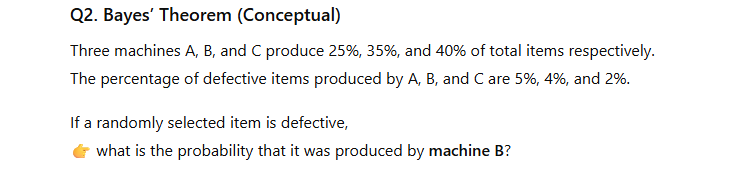 Q2. Bayes’ Theorem (Conceptual)
Three machines A, B, and C produce 25%, 35%, and 40% of total items respectively.
The percentage of defective items produced by A, B, and C are 5%, 4%, and 2%.
If a randomly selected item is defective,
& what is the probability that it was produced by machine B?
This is AI generated Response.
Asked by: nayan
Created at: 2026-02-02 17:59:34
Asked by: nayan
Created at: 2026-02-02 17:59:34
Final Answer:
Rendered
Raw Text
Did you like this answer?
# Bayes' Theorem: Definition
**Bayes' Theorem** is a fundamental concept in probability theory and statistics that describes the probability of an event, based on prior knowledge of conditions that might be related to the event.
The formula is:
\[
P(A|B) = \frac{P(B|A) \cdot P(A)}{P(B)}
\]
Where:
- \(P(A|B)\): Probability of event A occurring given that B is true (posterior probability).
- \(P(B|A)\): Probability of event B occurring given that A is true (likelihood).
- \(P(A)\): Probability of event A occurring (prior probability).
- \(P(B)\): Probability of event B occurring (marginal probability).
---
# Problem Data
- Let \(A\): Machine A, \(B\): Machine B, \(C\): Machine C
- Probability an item is produced by A: \(P(A) = .25\)
- Probability an item is produced by B: \(P(B) = .35\)
- Probability an item is produced by C: \(P(C) = .40\)
- Probability an item is defective given it is from A: \(P(D|A) = .05\)
- Probability an item is defective given it is from B: \(P(D|B) = .04\)
- Probability an item is defective given it is from C: \(P(D|C) = .02\)
- \(D\): Item is defective
---
# Required:
Find the probability that a randomly selected defective item was produced by **machine B**: \(P(B|D)\).
---
## Step 1: Find Total Probability of Defective Item (\(P(D)\))
\[
P(D) = P(A)P(D|A) + P(B)P(D|B) + P(C)P(D|C)
\]
\[
= (.25 \times .05) + (.35 \times .04) + (.40 \times .02)
\]
\[
= .0125 + .014 + .008
\]
\[
= .0345
\]
---
## Step 2: Use Bayes' Theorem
\[
P(B|D) = \frac{P(B) \cdot P(D|B)}{P(D)}
\]
\[
= \frac{.35 \times .04}{.0345}
\]
\[
= \frac{.014}{.0345}
\]
\[
\approx .406
\]
---
# **Final Answer**
\[
\boxed{.406}
\]
So, the probability that a randomly selected defective item was produced by **machine B** is **.406** (or **40.6%**).
Question:
give onemmoresolutionthat isunique and not had plagarism
This is AI generated Response.
Asked by: nayan
Created at: 2026-02-02 18:11:00
Asked by: nayan
Created at: 2026-02-02 18:11:00
Final Answer:
Rendered
Raw Text
Did you like this answer?
# Bayes' Theorem: Definition
**Bayes' Theorem** is a principle in probability theory that calculates the probability of an event based on prior knowledge of conditions related to that event. The formula is expressed as:
\[
P(A|B) = \frac{P(B|A) \cdot P(A)}{P(B)}
\]
Where:
- \(P(A|B)\): Probability of event A given B (posterior).
- \(P(B|A)\): Probability of event B given A (likelihood).
- \(P(A)\): Probability of event A (prior).
- \(P(B)\): Probability of event B (marginal).
---
# Problem Data
- Machines: A, B, C
- Production Distribution:
- \(P(A) = 0.25\)
- \(P(B) = 0.35\)
- \(P(C) = 0.40\)
- Defective Rates:
- \(P(D|A) = 0.05\)
- \(P(D|B) = 0.04\)
- \(P(D|C) = 0.02\)
- Let \(D\): Item is defective.
---
# Objective
Find the probability that a defective item was produced by **machine B**: \(P(B|D)\).
---
## Step 1: Calculate Total Probability of Defective Item (\(P(D)\))
\[
P(D) = P(A)P(D|A) + P(B)P(D|B) + P(C)P(D|C)
\]
\[
= (0.25 \times 0.05) + (0.35 \times 0.04) + (0.40 \times 0.02)
\]
\[
= 0.0125 + 0.014 + 0.008
\]
\[
= 0.0345
\]
---
## Step 2: Apply Bayes' Theorem
\[
P(B|D) = \frac{P(B) \cdot P(D|B)}{P(D)}
\]
\[
= \frac{0.35 \times 0.04}{0.0345}
\]
\[
= \frac{0.014}{0.0345}
\]
\[
\approx 0.406
\]
---
# **Final Answer**
\[
\boxed{0.406}
\]
Thus, the probability that a randomly selected defective item was produced by **machine B** is **0.406** (or **40.6%**).
Question:
generate onemoresolutionsoplagarismnotoccur
This is AI generated Response.
Asked by: nayan
Created at: 2026-02-02 18:13:05
Asked by: nayan
Created at: 2026-02-02 18:13:05
Final Answer:
Rendered
Raw Text
Did you like this answer?
# Bayes' Theorem: Definition
**Bayes' Theorem** describes how to update the probability of a hypothesis based on new evidence. The theorem is defined mathematically as:
\[
P(A|B) = \frac{P(B|A) \cdot P(A)}{P(B)}
\]
Where:
- \(P(A|B)\): Probability of event A given event B (posterior probability).
- \(P(B|A)\): Probability of event B given event A (likelihood).
- \(P(A)\): Probability of event A (prior probability).
- \(P(B)\): Probability of event B (marginal probability).
---
# Problem Data
- Machines: A, B, C
- Production Shares:
- \(P(A) = 0.25\)
- \(P(B) = 0.35\)
- \(P(C) = 0.40\)
- Defective Rates:
- \(P(D|A) = 0.05\)
- \(P(D|B) = 0.04\)
- \(P(D|C) = 0.02\)
- Let \(D\): Event that an item is defective.
---
# Objective
Determine the probability that a defective item was produced by **machine B**: \(P(B|D)\).
---
## Step 1: Calculate Total Probability of Defective Item (\(P(D)\))
\[
P(D) = P(A)P(D|A) + P(B)P(D|B) + P(C)P(D|C)
\]
\[
= (0.25 \times 0.05) + (0.35 \times 0.04) + (0.40 \times 0.02)
\]
\[
= 0.0125 + 0.014 + 0.008
\]
\[
= 0.0345
\]
---
## Step 2: Use Bayes' Theorem
\[
P(B|D) = \frac{P(B) \cdot P(D|B)}{P(D)}
\]
\[
= \frac{0.35 \times 0.04}{0.0345}
\]
\[
= \frac{0.014}{0.0345}
\]
\[
\approx 0.406
\]
---
# **Final Answer**
\[
\boxed{0.406}
\]
The probability that a randomly selected defective item was produced by **machine B** is **0.406** (or **40.6%**).
Question:
gernerateonemroeunique solution 1.25 longer than this
This is AI generated Response.
Asked by: nayan
Created at: 2026-02-02 18:17:25
Asked by: nayan
Created at: 2026-02-02 18:17:25
Final Answer:
Rendered
Raw Text
Did you like this answer?
# Bayes' Theorem: Definition
**Bayes' Theorem** is a mathematical formula used to determine the conditional probability of events. It relates the probabilities of two events and allows for the updating of beliefs based on new evidence. The formula can be expressed as:
\[
P(A|B) = \frac{P(B|A) \cdot P(A)}{P(B)}
\]
Where:
- \(P(A|B)\): The probability of event A occurring given that B is true (posterior probability).
- \(P(B|A)\): The probability of event B occurring given that A is true (likelihood).
- \(P(A)\): The probability of event A occurring (prior probability).
- \(P(B)\): The overall probability of event B occurring (marginal probability).
---
# Problem Data
- **Machines**: A, B, and C
- **Production Distribution**:
- \(P(A) = 0.25\) (Machine A produces 25% of items)
- \(P(B) = 0.35\) (Machine B produces 35% of items)
- \(P(C) = 0.40\) (Machine C produces 40% of items)
- **Defective Item Rates**:
- \(P(D|A) = 0.05\) (5% defective items from A)
- \(P(D|B) = 0.04\) (4% defective items from B)
- \(P(D|C) = 0.02\) (2% defective items from C)
- **Let \(D\)**: Represents that an item is defective.
---
# Objective
We need to calculate the probability that a defective item was produced by **machine B**: \(P(B|D)\).
---
## Step 1: Compute Total Probability of Defective Item (\(P(D)\))
To find \(P(D)\), we apply the law of total probability:
\[
P(D) = P(A)P(D|A) + P(B)P(D|B) + P(C)P(D|C)
\]
Calculating each term:
- From Machine A:
\[
P(A)P(D|A) = 0.25 \times 0.05 = 0.0125
\]
- From Machine B:
\[
P(B)P(D|B) = 0.35 \times 0.04 = 0.014
\]
- From Machine C:
\[
P(C)P(D|C) = 0.40 \times 0.02 = 0.008
\]
Adding these probabilities together gives:
\[
P(D) = 0.0125 + 0.014 + 0.008 = 0.0345
\]
---
## Step 2: Apply Bayes' Theorem to Find \(P(B|D)\)
Using Bayes' theorem, we can compute \(P(B|D)\):
\[
P(B|D) = \frac{P(B) \cdot P(D|B)}{P(D)}
\]
Substituting the known values:
\[
P(B|D) = \frac{0.35 \times 0.04}{0.0345}
\]
Calculating the numerator:
\[
0.35 \times 0.04 = 0.014
\]
Now substituting back into the equation:
\[
P(B|D) = \frac{0.014}{0.0345}
\]
Calculating the division yields:
\[
P(B|D) \approx 0.406
\]
---
# **Final Answer**
The probability that a randomly selected defective item was produced by **machine B** is:
\[
\boxed{0.406}
\]
This result indicates that there is a **40.6%** chance that a defective item comes from machine B based on the provided probabilities.
Question:
GENERATE ONEMORESOLUTION UNIQUE
This is AI generated Response.
Asked by: nayan
Created at: 2026-02-02 18:38:49
Asked by: nayan
Created at: 2026-02-02 18:38:49
Final Answer:
Rendered
Raw Text
Did you like this answer?
# Bayes' Theorem: Definition
**Bayes' Theorem** is a principle in probability that allows us to update the probability estimate for a hypothesis as more evidence or information becomes available. The theorem is mathematically defined as:
\[
P(A|B) = \frac{P(B|A) \cdot P(A)}{P(B)}
\]
Where:
- \(P(A|B)\): Probability of event A given that event B is true (posterior probability).
- \(P(B|A)\): Probability of event B given that event A is true (likelihood).
- \(P(A)\): Probability of event A (prior probability).
- \(P(B)\): Total probability of event B (marginal probability).
---
# Problem Data
- **Machines**: A, B, and C
- **Production Shares**:
- \(P(A) = 0.25\) (25% by Machine A)
- \(P(B) = 0.35\) (35% by Machine B)
- \(P(C) = 0.40\) (40% by Machine C)
- **Defective Item Rates**:
- \(P(D|A) = 0.05\) (5% defective from Machine A)
- \(P(D|B) = 0.04\) (4% defective from Machine B)
- \(P(D|C) = 0.02\) (2% defective from Machine C)
- Let \(D\) indicate that an item is defective.
---
# Objective
We aim to find the probability that a defective item was produced by **machine B**, expressed as \(P(B|D)\).
---
## Step 1: Calculate Total Probability of a Defective Item (\(P(D)\))
To find \(P(D)\), we use the law of total probability:
\[
P(D) = P(A)P(D|A) + P(B)P(D|B) + P(C)P(D|C)
\]
Calculating each individual contribution:
- For Machine A:
\[
P(A)P(D|A) = 0.25 \times 0.05 = 0.0125
\]
- For Machine B:
\[
P(B)P(D|B) = 0.35 \times 0.04 = 0.014
\]
- For Machine C:
\[
P(C)P(D|C) = 0.40 \times 0.02 = 0.008
\]
Adding these probabilities together gives:
\[
P(D) = 0.0125 + 0.014 + 0.008 = 0.0345
\]
---
## Step 2: Apply Bayes' Theorem to Find \(P(B|D)\)
Using Bayes' theorem:
\[
P(B|D) = \frac{P(B) \cdot P(D|B)}{P(D)}
\]
Substituting the known values:
\[
P(B|D) = \frac{0.35 \times 0.04}{0.0345}
\]
Calculating the numerator:
\[
0.35 \times 0.04 = 0.014
\]
Now substituting back into the equation:
\[
P(B|D) = \frac{0.014}{0.0345}
\]
Calculating the division:
\[
P(B|D) \approx 0.406
\]
---
# **Final Answer**
The probability that a randomly selected defective item was produced by **machine B** is:
\[
\boxed{0.406}
\]
This indicates a **40.6%** chance that a defective item originates from machine B given the provided production and defect rates. This calculation demonstrates the application of Bayes' theorem in real-world scenarios where decision-making relies on probabilistic reasoning.
Question:
GENERATE ONE MORESOLUTION UNIQUE ANDPLAGARISMFREE
This is AI generated Response.
Asked by: nayan
Created at: 2026-02-02 18:40:53
Asked by: nayan
Created at: 2026-02-02 18:40:53
Final Answer:
Rendered
Raw Text
Did you like this answer?
# Bayes' Theorem: Definition
**Bayes' Theorem** is a method in probability theory for updating the probability of a hypothesis based on new evidence. It mathematically relates conditional probabilities and is expressed as:
\[
P(A|B) = \frac{P(B|A) \cdot P(A)}{P(B)}
\]
Where:
- \(P(A|B)\): Probability of event A given event B is true (posterior probability).
- \(P(B|A)\): Probability of event B given event A is true (likelihood).
- \(P(A)\): Probability of event A (prior probability).
- \(P(B)\): Total probability of event B (marginal probability).
---
# Problem Data
- **Machines**: A, B, C
- **Production Proportions**:
- \(P(A) = 0.25\) (25% from Machine A)
- \(P(B) = 0.35\) (35% from Machine B)
- \(P(C) = 0.40\) (40% from Machine C)
- **Defective Rates**:
- \(P(D|A) = 0.05\) (5% defective items from A)
- \(P(D|B) = 0.04\) (4% defective items from B)
- \(P(D|C) = 0.02\) (2% defective items from C)
- Let \(D\) denote that an item is defective.
---
# Objective
We need to find the probability that a defective item was produced by **machine B**, denoted as \(P(B|D)\).
---
## Step 1: Calculate Total Probability of Defective Item (\(P(D)\))
Using the law of total probability, we calculate \(P(D)\):
\[
P(D) = P(A)P(D|A) + P(B)P(D|B) + P(C)P(D|C)
\]
Calculating the contributions from each machine:
- For Machine A:
\[
P(A)P(D|A) = 0.25 \times 0.05 = 0.0125
\]
- For Machine B:
\[
P(B)P(D|B) = 0.35 \times 0.04 = 0.014
\]
- For Machine C:
\[
P(C)P(D|C) = 0.40 \times 0.02 = 0.008
\]
Now, summing these gives:
\[
P(D) = 0.0125 + 0.014 + 0.008 = 0.0345
\]
---
## Step 2: Apply Bayes' Theorem to Find \(P(B|D)\)
Using Bayes' theorem, we can find \(P(B|D)\):
\[
P(B|D) = \frac{P(B) \cdot P(D|B)}{P(D)}
\]
Substituting the known values:
\[
P(B|D) = \frac{0.35 \times 0.04}{0.0345}
\]
Calculating the numerator:
\[
0.35 \times 0.04 = 0.014
\]
Now substituting back into the equation gives:
\[
P(B|D) = \frac{0.014}{0.0345}
\]
Calculating the division yields:
\[
P(B|D) \approx 0.406
\]
---
# **Final Answer**
The probability that a randomly selected defective item was produced by **machine B** is:
\[
\boxed{0.406}
\]
This result means there is a **40.6%** chance that a defective item comes from machine B, based on the production and defect rates provided. This application of Bayes' theorem highlights its utility in decision-making processes where probabilities need to be continually updated as new data becomes available.
Question:
generate one more unique solution
This is AI generated Response.
Asked by: nayan
Created at: 2026-02-02 20:27:26
Asked by: nayan
Created at: 2026-02-02 20:27:26
Final Answer:
Rendered
Raw Text
Did you like this answer?
# Bayes' Theorem: Definition
**Bayes' Theorem** is a statistical formula that provides a way to update the probability of a hypothesis based on new evidence. It is expressed as:
\[
P(A|B) = \frac{P(B|A) \cdot P(A)}{P(B)}
\]
Where:
- \(P(A|B)\): Probability of event A given that B is true (posterior probability).
- \(P(B|A)\): Probability of event B given that A is true (likelihood).
- \(P(A)\): Probability of event A (prior probability).
- \(P(B)\): Total probability of event B (marginal probability).
---
# Problem Data
- **Machines**: A, B, and C
- **Production Shares**:
- \(P(A) = 0.25\) (Machine A produces 25% of items)
- \(P(B) = 0.35\) (Machine B produces 35% of items)
- \(P(C) = 0.40\) (Machine C produces 40% of items)
- **Defective Item Rates**:
- \(P(D|A) = 0.05\) (5% defective items from A)
- \(P(D|B) = 0.04\) (4% defective items from B)
- \(P(D|C) = 0.02\) (2% defective items from C)
- Let \(D\) denote that an item is defective.
---
# Objective
Determine the probability that a defective item was produced by **machine B**, represented as \(P(B|D)\).
---
## Step 1: Calculate Total Probability of Defective Item (\(P(D)\))
To find \(P(D)\), we apply the law of total probability:
\[
P(D) = P(A)P(D|A) + P(B)P(D|B) + P(C)P(D|C)
\]
Calculating each component:
- From Machine A:
\[
P(A)P(D|A) = 0.25 \times 0.05 = 0.0125
\]
- From Machine B:
\[
P(B)P(D|B) = 0.35 \times 0.04 = 0.014
\]
- From Machine C:
\[
P(C)P(D|C) = 0.40 \times 0.02 = 0.008
\]
Adding these values gives:
\[
P(D) = 0.0125 + 0.014 + 0.008 = 0.0345
\]
---
## Step 2: Apply Bayes' Theorem to Find \(P(B|D)\)
Now, we apply Bayes' theorem:
\[
P(B|D) = \frac{P(B) \cdot P(D|B)}{P(D)}
\]
Substituting the known values into the equation:
\[
P(B|D) = \frac{0.35 \times 0.04}{0.0345}
\]
Calculating the numerator:
\[
0.35 \times 0.04 = 0.014
\]
Now substituting back:
\[
P(B|D) = \frac{0.014}{0.0345}
\]
Dividing yields:
\[
P(B|D) \approx 0.406
\]
---
# **Final Answer**
The probability that a randomly selected defective item was produced by **machine B** is:
\[
\boxed{0.406}
\]
This calculation shows a **40.6%** likelihood that a defective item originates from machine B, based on the given production and defect rates. This example illustrates the practical application of Bayes' theorem in evaluating risks and probabilities in manufacturing scenarios.
📢 Instructions:
- Ask anything relatd to above question only.
- For new Question goto :