solvbe chegg styl;e step by step but do not write step numbers4. (Markov Chains - Tough)
A Markov chain has transition matrix
0 1 0
1 1
P=|4 0}
010
1. Is the chain irreducible?
2. Find the stationary distribution, f it exists.
3. Is the chain ergodic?
Question:
solvbe chegg styl;e step by step but do not write step numbers4. (Markov Chains - Tough)
A Markov chain has transition matrix
0 1 0
1 1
P=|4 0}
010
1. Is the chain irreducible?
2. Find the stationary distribution, f it exists.
3. Is the chain ergodic?
This is AI generated Response.
Asked by: nayan
Created at: 2026-02-02 10:12:41
Final Answer:
RenderedRaw Text
Did you like this answer?
# Markov Chain Analysis
Given transition matrix:
\[
P = \begin{pmatrix}
& 1 & \\
\frac{1}{2} & & \frac{1}{2} \\
& 1 &
\end{pmatrix}
\]
---
## Is the chain irreducible?
A Markov chain is **irreducible** if it is possible to get from any state to any other state (possibly in multiple steps).
- From state 1: Can only go to state 2 in one step.
- From state 2: Can go to state 1 or 3 (with probability 1/2 each) in one step.
- From state 3: Can only go to state 2 in one step.
Check reachability:
- From 1 → 2 (1 step, P(1,2) = 1)
- From 2 → 1 (1 step, P(2,1) = 1/2)
- From 2 → 3 (1 step, P(2,3) = 1/2)
- From 3 → 2 (1 step, P(3,2) = 1)
- From 1 → 3: 1 → 2 → 3 (2 steps, P(1,2)*P(2,3) = 1 * 1/2 = 1/2)
- From 3 → 1: 3 → 2 → 1 (2 steps, P(3,2)*P(2,1) = 1 * 1/2 = 1/2)
**Conclusion:**
Every state can be reached from every other state (possibly in 2 steps).
**The chain is irreducible.**
---
## Find the stationary distribution
Let stationary distribution be \(\pi = (\pi_1, \pi_2, \pi_3)\) such that \(\pi P = \pi\) and \(\pi_1 + \pi_2 + \pi_3 = 1\).
Write the equations:
\[
\begin{align*}
\pi_1 &= \cdot \pi_1 + \frac{1}{2} \pi_2 + \cdot \pi_3 = \frac{1}{2} \pi_2 \\
\pi_2 &= 1 \cdot \pi_1 + \cdot \pi_2 + 1 \cdot \pi_3 = \pi_1 + \pi_3 \\
\pi_3 &= \cdot \pi_1 + \frac{1}{2} \pi_2 + \cdot \pi_3 = \frac{1}{2} \pi_2 \\
\end{align*}
\]
Also, \(\pi_1 + \pi_2 + \pi_3 = 1\).
Notice \(\pi_1 = \pi_3 = x\); let \(\pi_2 = y\).
From above:
\(x = \frac{1}{2}y\)
\(\pi_2 = \pi_1 + \pi_3 = x + x = 2x\)
So \(y = 2x\)
Normalization: \(x + y + x = 1 \implies 2x + y = 1\)
But \(y = 2x\), so \(2x + 2x = 1 \implies 4x = 1 \implies x = \frac{1}{4}\)
Then \(y = 2x = \frac{1}{2}\)
**Stationary distribution:**
\[
\boxed{
\left( \frac{1}{4}, \frac{1}{2}, \frac{1}{4} \right)
}
\]
---
## Is the chain ergodic?
A chain is **ergodic** if it is irreducible and aperiodic.
- Already shown irreducible.
- Check aperiodicity: For each state, check the period.
- State 1: Can return to 1 in even steps only (1 → 2 → 1, takes 2 steps).
- Similarly for other states, the minimal return is 2 steps.
So, the period for each state is 2 (not 1).
**Conclusion:**
The chain is **not ergodic** (because it is periodic, not aperiodic).
---
### **Summary**
- The chain is irreducible.
- Stationary distribution: \(\left( \frac{1}{4}, \frac{1}{2}, \frac{1}{4} \right)\)
- The chain is **not ergodic** (it is periodic).
Question:
gemnerate one more unique solution aso not plagarism occur
This is AI generated Response.
Asked by: nayan
Created at: 2026-02-02 10:14:11
Final Answer:
RenderedRaw Text
Did you like this answer?
# Markov Chain Analysis
Given the transition matrix:
\[
P = \begin{pmatrix}
0 & 1 & 0 \\
\frac{1}{2} & 0 & \frac{1}{2} \\
0 & 1 & 0
\end{pmatrix}
\]
---
## 1. Is the chain irreducible?
A Markov chain is considered **irreducible** if every state can be reached from any other state.
- From state 1: Transitions to state 2.
- From state 2: Transitions to states 1 and 3 with equal probability.
- From state 3: Transitions to state 2.
Checking reachability:
- 1 → 2 (1 step)
- 2 → 1 (1 step)
- 2 → 3 (1 step)
- 3 → 2 (1 step)
- 1 → 3 (via 1 → 2 → 3, 2 steps)
- 3 → 1 (via 3 → 2 → 1, 2 steps)
**Conclusion:**
Each state is reachable from every other state.
**The chain is irreducible.**
---
## 2. Find the stationary distribution
Let the stationary distribution be \(\pi = (\pi_1, \pi_2, \pi_3)\) satisfying \(\pi P = \pi\) and \(\pi_1 + \pi_2 + \pi_3 = 1\).
Setting up the equations:
\[
\begin{align*}
\pi_1 &= 0 \cdot \pi_1 + \frac{1}{2} \pi_2 + 0 \cdot \pi_3 \\
\pi_2 &= 1 \cdot \pi_1 + 0 \cdot \pi_2 + 1 \cdot \pi_3 \\
\pi_3 &= 0 \cdot \pi_1 + \frac{1}{2} \pi_2 + 0 \cdot \pi_3 \\
\end{align*}
\]
Also, \(\pi_1 + \pi_2 + \pi_3 = 1\).
From the first equation, \(\pi_1 = \frac{1}{2} \pi_2\).
From the third equation, \(\pi_3 = \frac{1}{2} \pi_2\).
Thus, we have:
- \(\pi_1 = \frac{1}{2} \pi_2\)
- \(\pi_3 = \frac{1}{2} \pi_2\)
Substituting in the normalization condition:
\[
\frac{1}{2} \pi_2 + \pi_2 + \frac{1}{2} \pi_2 = 1 \implies 2\pi_2 = 1 \implies \pi_2 = \frac{1}{2}
\]
Then:
- \(\pi_1 = \frac{1}{2} \cdot \frac{1}{2} = \frac{1}{4}\)
- \(\pi_3 = \frac{1}{2} \cdot \frac{1}{2} = \frac{1}{4}\)
**Stationary distribution:**
\[
\boxed{
\left( \frac{1}{4}, \frac{1}{2}, \frac{1}{4} \right)
}
\]
---
## 3. Is the chain ergodic?
A chain is **ergodic** if it is both irreducible and aperiodic.
- The chain has been shown to be irreducible.
- To check aperiodicity, analyze the periods of the states:
- State 1 returns to itself in an even number of steps (2 steps).
- State 2 can return in both even and odd steps.
- State 3 also returns to itself in even steps.
The greatest common divisor of the return times for state 1 is 2.
**Conclusion:**
The chain is **not ergodic** as it is periodic.
---
### **Summary**
- The chain is irreducible.
- Stationary distribution: \(\left( \frac{1}{4}, \frac{1}{2}, \frac{1}{4} \right)\)
- The chain is **not ergodic** (it has periodicity).
Question:
generate one more unique solution
This is AI generated Response.
Asked by: nayan
Created at: 2026-02-02 10:16:40
Final Answer:
RenderedRaw Text
Did you like this answer?
# Markov Chain Analysis
Given transition matrix:
\[
P = \begin{pmatrix}
0 & 1 & 0 \\
\frac{1}{2} & 0 & \frac{1}{2} \\
0 & 1 & 0
\end{pmatrix}
\]
---
## 1. Is the chain irreducible?
A Markov chain is **irreducible** if it is possible to reach any state from any other state.
- From state 1: Directly transitions to state 2.
- From state 2: Can transition to states 1 and 3 with equal probabilities.
- From state 3: Directly transitions to state 2.
Check reachability:
- 1 → 2 (1 step)
- 2 → 1 (1 step)
- 2 → 3 (1 step)
- 3 → 2 (1 step)
- 1 → 3 (via 1 → 2 → 3, 2 steps)
- 3 → 1 (via 3 → 2 → 1, 2 steps)
**Conclusion:**
All states are reachable from each other.
**The chain is irreducible.**
---
## 2. Find the stationary distribution
Let the stationary distribution be \(\pi = (\pi_1, \pi_2, \pi_3)\) such that \(\pi P = \pi\) and \(\pi_1 + \pi_2 + \pi_3 = 1\).
Set up the equations:
\[
\begin{align*}
\pi_1 &= \frac{1}{2} \pi_2 \\
\pi_2 &= \pi_1 + \pi_3 \\
\pi_3 &= \frac{1}{2} \pi_2 \\
\end{align*}
\]
Also, from normalization:
\(\pi_1 + \pi_2 + \pi_3 = 1\).
Substituting \(\pi_1 = \frac{1}{2} \pi_2\) and \(\pi_3 = \frac{1}{2} \pi_2\) into the normalization condition:
\[
\frac{1}{2} \pi_2 + \pi_2 + \frac{1}{2} \pi_2 = 1 \implies 2\pi_2 = 1 \implies \pi_2 = \frac{1}{2}
\]
Then, substituting back:
- \(\pi_1 = \frac{1}{2} \cdot \frac{1}{2} = \frac{1}{4}\)
- \(\pi_3 = \frac{1}{2} \cdot \frac{1}{2} = \frac{1}{4}\)
**Stationary distribution:**
\[
\boxed{
\left( \frac{1}{4}, \frac{1}{2}, \frac{1}{4} \right)
}
\]
---
## 3. Is the chain ergodic?
A chain is **ergodic** if it is irreducible and aperiodic.
- The chain is irreducible (as shown).
- To check aperiodicity, examine the periods of the states:
- State 1: Can only return in 2 steps.
- State 2: Can return in both odd and even steps.
- State 3: Can only return in 2 steps.
The period for state 1 and state 3 is 2, indicating periodicity.
**Conclusion:**
The chain is **not ergodic** due to its periodicity.
---
### **Summary**
- The chain is irreducible.
- Stationary distribution: \(\left( \frac{1}{4}, \frac{1}{2}, \frac{1}{4} \right)\)
- The chain is **not ergodic** (it is periodic).
Question:
generate one more unique solution
This is AI generated Response.
Asked by: nayan
Created at: 2026-02-02 10:17:31
Final Answer:
RenderedRaw Text
Did you like this answer?
# Markov Chain Analysis
Given transition matrix:
\[
P = \begin{pmatrix}
0 & 1 & 0 \\
\frac{1}{2} & 0 & \frac{1}{2} \\
0 & 1 & 0
\end{pmatrix}
\]
---
## 1. Is the chain irreducible?
A Markov chain is **irreducible** if every state can be reached from any other state.
- **State 1:** Can only transition to state 2.
- **State 2:** Can transition to states 1 and 3 with equal probabilities.
- **State 3:** Can only transition back to state 2.
Checking reachability:
- 1 → 2 (1 step)
- 2 → 1 (1 step)
- 2 → 3 (1 step)
- 3 → 2 (1 step)
- 1 → 3 (via 1 → 2 → 3, takes 2 steps)
- 3 → 1 (via 3 → 2 → 1, takes 2 steps)
**Conclusion:**
All states are reachable from each other.
**The chain is irreducible.**
---
## 2. Find the stationary distribution
Let the stationary distribution be \(\pi = (\pi_1, \pi_2, \pi_3)\) such that \(\pi P = \pi\) and \(\pi_1 + \pi_2 + \pi_3 = 1\).
Setting up the equations:
\[
\begin{align*}
\pi_1 &= 0 \cdot \pi_1 + \frac{1}{2} \pi_2 + 0 \cdot \pi_3 \implies \pi_1 = \frac{1}{2} \pi_2 \\
\pi_2 &= 1 \cdot \pi_1 + 0 \cdot \pi_2 + 1 \cdot \pi_3 \implies \pi_2 = \pi_1 + \pi_3 \\
\pi_3 &= 0 \cdot \pi_1 + \frac{1}{2} \pi_2 + 0 \cdot \pi_3 \implies \pi_3 = \frac{1}{2} \pi_2 \\
\end{align*}
\]
Also, from normalization:
\(\pi_1 + \pi_2 + \pi_3 = 1\).
Substituting \(\pi_1\) and \(\pi_3\):
- From \(\pi_1 = \frac{1}{2} \pi_2\) and \(\pi_3 = \frac{1}{2} \pi_2\), we have:
\[
\frac{1}{2} \pi_2 + \pi_2 + \frac{1}{2} \pi_2 = 1 \implies 2\pi_2 = 1 \implies \pi_2 = \frac{1}{2}
\]
Then:
- \(\pi_1 = \frac{1}{2} \cdot \frac{1}{2} = \frac{1}{4}\)
- \(\pi_3 = \frac{1}{2} \cdot \frac{1}{2} = \frac{1}{4}\)
**Stationary distribution:**
\[
\boxed{
\left( \frac{1}{4}, \frac{1}{2}, \frac{1}{4} \right)
}
\]
---
## 3. Is the chain ergodic?
A chain is **ergodic** if it is both irreducible and aperiodic.
- The chain is irreducible (as established).
- To check for aperiodicity, we need to analyze the periods of the states:
- **State 1:** Returns only in 2 steps (1 → 2 → 1).
- **State 2:** Can return in both even and odd steps.
- **State 3:** Returns only in 2 steps (3 → 2 → 3).
The periods for states 1 and 3 are 2, indicating periodic behavior.
**Conclusion:**
The chain is **not ergodic** due to its periodicity.
---
### **Summary**
- The chain is irreducible.
- Stationary distribution: \(\left( \frac{1}{4}, \frac{1}{2}, \frac{1}{4} \right)\)
- The chain is **not ergodic** (it has periodicity).
Question:
generate oine more unique solution
This is AI generated Response.
Asked by: nayan
Created at: 2026-02-02 10:19:37
Final Answer:
RenderedRaw Text
Did you like this answer?
# Markov Chain Analysis
Given transition matrix:
\[
P = \begin{pmatrix}
0 & 1 & 0 \\
\frac{1}{2} & 0 & \frac{1}{2} \\
0 & 1 & 0
\end{pmatrix}
\]
---
## 1. Is the chain irreducible?
A Markov chain is **irreducible** if it is possible to reach any state from any other state.
- **State 1:** Transitions only to state 2.
- **State 2:** Can transition to states 1 and 3 with equal probabilities.
- **State 3:** Transitions only to state 2.
Checking reachability:
- From state 1 to 2 (1 step)
- From state 2 to 1 (1 step)
- From state 2 to 3 (1 step)
- From state 3 to 2 (1 step)
- From state 1 to 3 (via 1 → 2 → 3, 2 steps)
- From state 3 to 1 (via 3 → 2 → 1, 2 steps)
**Conclusion:**
All states are reachable from one another.
**The chain is irreducible.**
---
## 2. Find the stationary distribution
Let the stationary distribution be \(\pi = (\pi_1, \pi_2, \pi_3)\) such that \(\pi P = \pi\) and \(\pi_1 + \pi_2 + \pi_3 = 1\).
Setting up the equations:
\[
\begin{align*}
\pi_1 &= 0 \cdot \pi_1 + \frac{1}{2} \pi_2 + 0 \cdot \pi_3 \implies \pi_1 = \frac{1}{2} \pi_2 \\
\pi_2 &= 1 \cdot \pi_1 + 0 \cdot \pi_2 + 1 \cdot \pi_3 \implies \pi_2 = \pi_1 + \pi_3 \\
\pi_3 &= 0 \cdot \pi_1 + \frac{1}{2} \pi_2 + 0 \cdot \pi_3 \implies \pi_3 = \frac{1}{2} \pi_2 \\
\end{align*}
\]
Also, the normalization condition:
\(\pi_1 + \pi_2 + \pi_3 = 1\).
Substituting \(\pi_1\) and \(\pi_3\):
- From \(\pi_1 = \frac{1}{2} \pi_2\) and \(\pi_3 = \frac{1}{2} \pi_2\):
\[
\frac{1}{2} \pi_2 + \pi_2 + \frac{1}{2} \pi_2 = 1 \implies 2\pi_2 = 1 \implies \pi_2 = \frac{1}{2}
\]
Then, calculate \(\pi_1\) and \(\pi_3\):
- \(\pi_1 = \frac{1}{2} \cdot \frac{1}{2} = \frac{1}{4}\)
- \(\pi_3 = \frac{1}{2} \cdot \frac{1}{2} = \frac{1}{4}\)
**Stationary distribution:**
\[
\boxed{
\left( \frac{1}{4}, \frac{1}{2}, \frac{1}{4} \right)
}
\]
---
## 3. Is the chain ergodic?
A chain is **ergodic** if it is irreducible and aperiodic.
- The chain is irreducible (as shown).
- To check for aperiodicity, analyze the periods of the states:
- **State 1:** Can return in 2 steps (1 → 2 → 1).
- **State 2:** Can return in both even and odd steps.
- **State 3:** Can return in 2 steps (3 → 2 → 3).
The periods for states 1 and 3 are 2, indicating periodic behavior.
**Conclusion:**
The chain is **not ergodic** due to periodicity.
---
### **Summary**
- The chain is irreducible.
- Stationary distribution: \(\left( \frac{1}{4}, \frac{1}{2}, \frac{1}{4} \right)\)
- The chain is **not ergodic** (it has periodicity).
Question:
generate one more answer 1.20 longer and unplagafrized
This is AI generated Response.
Asked by: nayan
Created at: 2026-02-02 10:21:36
Final Answer:
RenderedRaw Text
Did you like this answer?
# Markov Chain Analysis
Given transition matrix:
\[
P = \begin{pmatrix}
0 & 1 & 0 \\
\frac{1}{2} & 0 & \frac{1}{2} \\
0 & 1 & 0
\end{pmatrix}
\]
---
## 1. Is the chain irreducible?
A Markov chain is termed **irreducible** if it is possible to reach any state from every other state.
- **From State 1:** The only possible transition is to state 2.
- **From State 2:** It can transition to state 1 or state 3, each with a probability of \(\frac{1}{2}\).
- **From State 3:** The only possible transition is back to state 2.
To verify reachability:
- 1 → 2 (1 step)
- 2 → 1 (1 step)
- 2 → 3 (1 step)
- 3 → 2 (1 step)
- 1 → 3 (via 1 → 2 → 3, takes 2 steps)
- 3 → 1 (via 3 → 2 → 1, takes 2 steps)
Since all states can reach each other, **the chain is irreducible.**
---
## 2. Find the stationary distribution
Let the stationary distribution be represented as \(\pi = (\pi_1, \pi_2, \pi_3)\), satisfying \(\pi P = \pi\) and \(\pi_1 + \pi_2 + \pi_3 = 1\).
Setting up the equations based on the transition probabilities:
\[
\begin{align*}
\pi_1 &= 0 \cdot \pi_1 + \frac{1}{2} \pi_2 + 0 \cdot \pi_3 \implies \pi_1 = \frac{1}{2} \pi_2 \\
\pi_2 &= 1 \cdot \pi_1 + 0 \cdot \pi_2 + 1 \cdot \pi_3 \implies \pi_2 = \pi_1 + \pi_3 \\
\pi_3 &= 0 \cdot \pi_1 + \frac{1}{2} \pi_2 + 0 \cdot \pi_3 \implies \pi_3 = \frac{1}{2} \pi_2 \\
\end{align*}
\]
Additionally, we have the normalization condition:
\(\pi_1 + \pi_2 + \pi_3 = 1\).
Substituting \(\pi_1\) and \(\pi_3\) into the normalization equation yields:
\[
\frac{1}{2} \pi_2 + \pi_2 + \frac{1}{2} \pi_2 = 1 \implies 2\pi_2 = 1 \implies \pi_2 = \frac{1}{2}
\]
Calculating \(\pi_1\) and \(\pi_3\):
- \(\pi_1 = \frac{1}{2} \cdot \frac{1}{2} = \frac{1}{4}\)
- \(\pi_3 = \frac{1}{2} \cdot \frac{1}{2} = \frac{1}{4}\)
Thus, the **stationary distribution** is:
\[
\boxed{
\left( \frac{1}{4}, \frac{1}{2}, \frac{1}{4} \right)
}
\]
---
## 3. Is the chain ergodic?
A Markov chain is said to be **ergodic** if it is both irreducible and aperiodic.
- As determined earlier, the chain is irreducible.
- To check aperiodicity, we need to analyze the return times of each state:
- **State 1:** Returns only in 2 steps (1 → 2 → 1).
- **State 2:** Can return in both even and odd steps.
- **State 3:** Returns only in 2 steps (3 → 2 → 3).
The periods for states 1 and 3 are both 2, indicating the system exhibits periodic behavior.
**Conclusion:**
The chain is **not ergodic** due to its periodic nature.
---
### **Summary**
- The chain is irreducible, allowing transition between all states.
- The stationary distribution is \(\left( \frac{1}{4}, \frac{1}{2}, \frac{1}{4} \right)\).
- The chain is **not ergodic** as it is periodic in behavior.
Question:
generate inemore unique solution
This is AI generated Response.
Asked by: nayan
Created at: 2026-02-02 10:23:04
Final Answer:
RenderedRaw Text
Did you like this answer?
# Markov Chain Analysis
Given the transition matrix:
\[
P = \begin{pmatrix}
0 & 1 & 0 \\
\frac{1}{2} & 0 & \frac{1}{2} \\
0 & 1 & 0
\end{pmatrix}
\]
---
## 1. Is the chain irreducible?
A Markov chain is defined as **irreducible** if it is possible to reach any state from any other state.
- **State 1:** Can only transition to state 2.
- **State 2:** Can transition to states 1 (with probability \(\frac{1}{2}\)) and 3 (with probability \(\frac{1}{2}\)).
- **State 3:** Can only transition back to state 2.
To assess reachability:
- From state 1 to 2: 1 step.
- From state 2 to 1: 1 step.
- From state 2 to 3: 1 step.
- From state 3 to 2: 1 step.
- From state 1 to 3: via 1 → 2 → 3 (2 steps).
- From state 3 to 1: via 3 → 2 → 1 (2 steps).
Since all states can reach each other, **the chain is irreducible.**
---
## 2. Find the stationary distribution
Let the stationary distribution be represented as \(\pi = (\pi_1, \pi_2, \pi_3)\) such that \(\pi P = \pi\) and \(\pi_1 + \pi_2 + \pi_3 = 1\).
Formulating the equations based on the transition probabilities:
\[
\begin{align*}
\pi_1 &= 0 \cdot \pi_1 + \frac{1}{2} \pi_2 + 0 \cdot \pi_3 \implies \pi_1 = \frac{1}{2} \pi_2 \\
\pi_2 &= 1 \cdot \pi_1 + 0 \cdot \pi_2 + 1 \cdot \pi_3 \implies \pi_2 = \pi_1 + \pi_3 \\
\pi_3 &= 0 \cdot \pi_1 + \frac{1}{2} \pi_2 + 0 \cdot \pi_3 \implies \pi_3 = \frac{1}{2} \pi_2 \\
\end{align*}
\]
Additionally, the normalization condition states:
\(\pi_1 + \pi_2 + \pi_3 = 1\).
Substituting \(\pi_1\) and \(\pi_3\) into the normalization equation gives:
\[
\frac{1}{2} \pi_2 + \pi_2 + \frac{1}{2} \pi_2 = 1 \implies 2\pi_2 = 1 \implies \pi_2 = \frac{1}{2}
\]
Now, calculating \(\pi_1\) and \(\pi_3\):
- \(\pi_1 = \frac{1}{2} \cdot \frac{1}{2} = \frac{1}{4}\)
- \(\pi_3 = \frac{1}{2} \cdot \frac{1}{2} = \frac{1}{4}\)
Thus, the **stationary distribution** is:
\[
\boxed{
\left( \frac{1}{4}, \frac{1}{2}, \frac{1}{4} \right)
}
\]
---
## 3. Is the chain ergodic?
A Markov chain is termed **ergodic** if it is both irreducible and aperiodic.
- As established, the chain is irreducible.
- To check for aperiodicity, we analyze the return times of each state:
- **State 1:** Can return only in 2 steps (1 → 2 → 1).
- **State 2:** Can return in both even and odd steps (2 → 1 or 2 → 3).
- **State 3:** Can return only in 2 steps (3 → 2 → 3).
Since states 1 and 3 have a period of 2, indicating periodic behavior, the chain is **not ergodic**.
---
### **Summary**
- The chain is irreducible, allowing transitions between all states.
- The stationary distribution is \(\left( \frac{1}{4}, \frac{1}{2}, \frac{1}{4} \right)\).
- The chain is **not ergodic** due to its periodic nature.
Question:
make onemore unique solution
This is AI generated Response.
Asked by: nayan
Created at: 2026-02-02 10:24:51
Final Answer:
RenderedRaw Text
Did you like this answer?
# Markov Chain Analysis
Given the transition matrix:
\[
P = \begin{pmatrix}
0 & 1 & 0 \\
\frac{1}{2} & 0 & \frac{1}{2} \\
0 & 1 & 0
\end{pmatrix}
\]
---
## 1. Is the chain irreducible?
A Markov chain is termed **irreducible** if it is possible to reach any state from every other state.
- **From State 1:** The only possible transition is to state 2.
- **From State 2:** It can transition to states 1 and 3, each with a probability of \(\frac{1}{2}\).
- **From State 3:** The only possible transition is back to state 2.
To assess reachability:
- From state 1 to 2: 1 step.
- From state 2 to 1: 1 step.
- From state 2 to 3: 1 step.
- From state 3 to 2: 1 step.
- From state 1 to 3: via 1 → 2 → 3 (2 steps).
- From state 3 to 1: via 3 → 2 → 1 (2 steps).
Since all states can reach each other, **the chain is irreducible.**
---
## 2. Find the stationary distribution
Let the stationary distribution be represented as \(\pi = (\pi_1, \pi_2, \pi_3)\), satisfying \(\pi P = \pi\) and \(\pi_1 + \pi_2 + \pi_3 = 1\).
Setting up the equations based on transition probabilities:
\[
\begin{align*}
\pi_1 &= 0 \cdot \pi_1 + \frac{1}{2} \pi_2 + 0 \cdot \pi_3 \implies \pi_1 = \frac{1}{2} \pi_2 \\
\pi_2 &= 1 \cdot \pi_1 + 0 \cdot \pi_2 + 1 \cdot \pi_3 \implies \pi_2 = \pi_1 + \pi_3 \\
\pi_3 &= 0 \cdot \pi_1 + \frac{1}{2} \pi_2 + 0 \cdot \pi_3 \implies \pi_3 = \frac{1}{2} \pi_2 \\
\end{align*}
\]
Additionally, the normalization condition states:
\(\pi_1 + \pi_2 + \pi_3 = 1\).
Substituting \(\pi_1\) and \(\pi_3\) into the normalization equation gives:
\[
\frac{1}{2} \pi_2 + \pi_2 + \frac{1}{2} \pi_2 = 1 \implies 2\pi_2 = 1 \implies \pi_2 = \frac{1}{2}
\]
Now, calculating \(\pi_1\) and \(\pi_3\):
- \(\pi_1 = \frac{1}{2} \cdot \frac{1}{2} = \frac{1}{4}\)
- \(\pi_3 = \frac{1}{2} \cdot \frac{1}{2} = \frac{1}{4}\)
Thus, the **stationary distribution** is:
\[
\boxed{
\left( \frac{1}{4}, \frac{1}{2}, \frac{1}{4} \right)
}
\]
---
## 3. Is the chain ergodic?
A Markov chain is termed **ergodic** if it is both irreducible and aperiodic.
- As established, the chain is irreducible.
- To check for aperiodicity, we analyze the return times of each state:
- **State 1:** Can return only in 2 steps (1 → 2 → 1).
- **State 2:** Can return in both even and odd steps (2 → 1 or 2 → 3).
- **State 3:** Can return only in 2 steps (3 → 2 → 3).
The periods for states 1 and 3 are both 2, indicating periodic behavior. Thus, the chain is **not ergodic**.
---
### **Summary**
- The chain is irreducible, allowing transitions between all states.
- The stationary distribution is \(\left( \frac{1}{4}, \frac{1}{2}, \frac{1}{4} \right)\).
- The chain is **not ergodic** due to its periodic nature.
Question:
make one mopre unique solution
This is AI generated Response.
Asked by: nayan
Created at: 2026-02-02 10:25:53
Final Answer:
RenderedRaw Text
Did you like this answer?
# Markov Chain Analysis
Given the transition matrix:
\[
P = \begin{pmatrix}
0 & 1 & 0 \\
\frac{1}{2} & 0 & \frac{1}{2} \\
0 & 1 & 0
\end{pmatrix}
\]
---
## 1. Is the chain irreducible?
A Markov chain is defined as **irreducible** if every state can be reached from any other state.
- **State 1:** Can only transition to state 2.
- **State 2:** Can transition to state 1 (with probability \(\frac{1}{2}\)) and to state 3 (with probability \(\frac{1}{2}\)).
- **State 3:** Can only transition back to state 2.
To verify reachability:
- From state 1 to 2: 1 step.
- From state 2 to 1: 1 step.
- From state 2 to 3: 1 step.
- From state 3 to 2: 1 step.
- From state 1 to 3: via 1 → 2 → 3 (2 steps).
- From state 3 to 1: via 3 → 2 → 1 (2 steps).
Since all states can reach each other, **the chain is irreducible.**
---
## 2. Find the stationary distribution
Let the stationary distribution be represented as \(\pi = (\pi_1, \pi_2, \pi_3)\) such that \(\pi P = \pi\) and \(\pi_1 + \pi_2 + \pi_3 = 1\).
Setting up the equations based on transition probabilities:
\[
\begin{align*}
\pi_1 &= 0 \cdot \pi_1 + \frac{1}{2} \pi_2 + 0 \cdot \pi_3 \implies \pi_1 = \frac{1}{2} \pi_2 \\
\pi_2 &= 1 \cdot \pi_1 + 0 \cdot \pi_2 + 1 \cdot \pi_3 \implies \pi_2 = \pi_1 + \pi_3 \\
\pi_3 &= 0 \cdot \pi_1 + \frac{1}{2} \pi_2 + 0 \cdot \pi_3 \implies \pi_3 = \frac{1}{2} \pi_2 \\
\end{align*}
\]
Additionally, the normalization condition states:
\(\pi_1 + \pi_2 + \pi_3 = 1\).
Substituting \(\pi_1\) and \(\pi_3\) into the normalization equation gives:
\[
\frac{1}{2} \pi_2 + \pi_2 + \frac{1}{2} \pi_2 = 1 \implies 2\pi_2 = 1 \implies \pi_2 = \frac{1}{2}
\]
Now, calculating \(\pi_1\) and \(\pi_3\):
- \(\pi_1 = \frac{1}{2} \cdot \frac{1}{2} = \frac{1}{4}\)
- \(\pi_3 = \frac{1}{2} \cdot \frac{1}{2} = \frac{1}{4}\)
Thus, the **stationary distribution** is:
\[
\boxed{
\left( \frac{1}{4}, \frac{1}{2}, \frac{1}{4} \right)
}
\]
---
## 3. Is the chain ergodic?
A Markov chain is termed **ergodic** if it is both irreducible and aperiodic.
- As established, the chain is irreducible.
- To check for aperiodicity, we analyze the return times of each state:
- **State 1:** Can return only in 2 steps (1 → 2 → 1).
- **State 2:** Can return in both even and odd steps (2 → 1 or 2 → 3).
- **State 3:** Can return only in 2 steps (3 → 2 → 3).
The periods for states 1 and 3 are both 2, indicating periodic behavior. Thus, the chain is **not ergodic**.
---
### **Summary**
- The chain is irreducible, allowing transitions between all states.
- The stationary distribution is \(\left( \frac{1}{4}, \frac{1}{2}, \frac{1}{4} \right)\).
- The chain is **not ergodic** due to its periodic nature.
Question:
make onemor eunique and unplagarized 1.25* solnger solution
This is AI generated Response.
Asked by: nayan
Created at: 2026-02-02 10:27:49
Final Answer:
RenderedRaw Text
Did you like this answer?
# Markov Chain Analysis
Given the transition matrix:
\[
P = \begin{pmatrix}
0 & 1 & 0 \\
\frac{1}{2} & 0 & \frac{1}{2} \\
0 & 1 & 0
\end{pmatrix}
\]
---
## 1. Is the chain irreducible?
A Markov chain is **irreducible** if it is possible to reach any state from every other state, either directly or through a sequence of transitions.
- **State 1:** The only transition is to state 2.
- **State 2:** Can transition to states 1 (with probability \(\frac{1}{2}\)) and 3 (with probability \(\frac{1}{2}\)).
- **State 3:** Can only transition back to state 2.
To assess reachability between states:
- **From State 1 to State 2:** This is direct and occurs in 1 step.
- **From State 2 to State 1:** Also direct, occurring in 1 step.
- **From State 2 to State 3:** Directly achievable in 1 step.
- **From State 3 to State 2:** Again, a direct transition in 1 step.
- **From State 1 to State 3:** Achievable by first going to state 2 and then to state 3 (2 steps).
- **From State 3 to State 1:** Achievable by first going to state 2 and then to state 1 (2 steps).
Since every state can be reached from every other state through direct transitions or a sequence of transitions, **the chain is irreducible.**
---
## 2. Find the stationary distribution
Let the stationary distribution be represented as \(\pi = (\pi_1, \pi_2, \pi_3)\). This distribution satisfies the equation \(\pi P = \pi\) and the normalization condition \(\pi_1 + \pi_2 + \pi_3 = 1\).
Setting up the equations based on the transition probabilities:
\[
\begin{align*}
\pi_1 &= 0 \cdot \pi_1 + \frac{1}{2} \pi_2 + 0 \cdot \pi_3 \implies \pi_1 = \frac{1}{2} \pi_2 \\
\pi_2 &= 1 \cdot \pi_1 + 0 \cdot \pi_2 + 1 \cdot \pi_3 \implies \pi_2 = \pi_1 + \pi_3 \\
\pi_3 &= 0 \cdot \pi_1 + \frac{1}{2} \pi_2 + 0 \cdot \pi_3 \implies \pi_3 = \frac{1}{2} \pi_2 \\
\end{align*}
\]
Additionally, the normalization equation is:
\[
\pi_1 + \pi_2 + \pi_3 = 1.
\]
Substituting \(\pi_1\) and \(\pi_3\) into the normalization equation yields:
\[
\frac{1}{2} \pi_2 + \pi_2 + \frac{1}{2} \pi_2 = 1 \implies 2\pi_2 = 1 \implies \pi_2 = \frac{1}{2}.
\]
Now substituting back to find \(\pi_1\) and \(\pi_3\):
- \(\pi_1 = \frac{1}{2} \cdot \frac{1}{2} = \frac{1}{4}\)
- \(\pi_3 = \frac{1}{2} \cdot \frac{1}{2} = \frac{1}{4}\)
Thus, the **stationary distribution** is:
\[
\boxed{
\left( \frac{1}{4}, \frac{1}{2}, \frac{1}{4} \right)
}
\]
---
## 3. Is the chain ergodic?
A Markov chain is considered **ergodic** if it is both irreducible and aperiodic.
- As established, the chain is irreducible. This means every state can be reached from every other state.
- To check for aperiodicity, we need to analyze the return times of each state:
- **State 1:** Can return in 2 steps (1 → 2 → 1).
- **State 2:** Can return in both even and odd steps (it can move back to state 1 or forward to state 3).
- **State 3:** Can return in 2 steps (3 → 2 → 3).
The periods of states 1 and 3 are both 2, indicating that these states exhibit periodic behavior. Since the periodicity is not 1, the chain is **not ergodic**.
---
### **Summary**
- The chain is irreducible, allowing transitions between all states.
- The stationary distribution is \(\left( \frac{1}{4}, \frac{1}{2}, \frac{1}{4} \right)\).
- The chain is **not ergodic** due to its periodic nature, which prevents convergence to a unique steady state over time.
Question:
generate one more solution
This is AI generated Response.
Asked by: nayan
Created at: 2026-02-02 10:30:05
Final Answer:
RenderedRaw Text
Did you like this answer?
# Markov Chain Analysis
Given transition matrix:
\[
P = \begin{pmatrix}
0 & 1 & 0 \\
\frac{1}{2} & 0 & \frac{1}{2} \\
0 & 1 & 0
\end{pmatrix}
\]
---
## 1. Is the chain irreducible?
A Markov chain is **irreducible** if it is possible to reach any state from any other state.
- **State 1:** Transition only to state 2.
- **State 2:** Can transition to states 1 (probability \(\frac{1}{2}\)) and 3 (probability \(\frac{1}{2}\)).
- **State 3:** Transition only to state 2.
To verify reachability:
- From **State 1 to State 2:** One direct step.
- From **State 2 to State 1:** One direct step.
- From **State 2 to State 3:** One direct step.
- From **State 3 to State 2:** One direct step.
- From **State 1 to State 3:** Achievable via 1 → 2 → 3 (2 steps).
- From **State 3 to State 1:** Achievable via 3 → 2 → 1 (2 steps).
Since all states can reach each other through one or two transitions, **the chain is irreducible.**
---
## 2. Find the stationary distribution
Let the stationary distribution be represented as \(\pi = (\pi_1, \pi_2, \pi_3)\). This distribution satisfies the equation \(\pi P = \pi\) and the normalization condition \(\pi_1 + \pi_2 + \pi_3 = 1\).
Setting up the equations based on transition probabilities:
\[
\begin{align*}
\pi_1 &= 0 \cdot \pi_1 + \frac{1}{2} \pi_2 + 0 \cdot \pi_3 \implies \pi_1 = \frac{1}{2} \pi_2 \\
\pi_2 &= 1 \cdot \pi_1 + 0 \cdot \pi_2 + 1 \cdot \pi_3 \implies \pi_2 = \pi_1 + \pi_3 \\
\pi_3 &= 0 \cdot \pi_1 + \frac{1}{2} \pi_2 + 0 \cdot \pi_3 \implies \pi_3 = \frac{1}{2} \pi_2 \\
\end{align*}
\]
Additionally, the normalization condition states:
\[
\pi_1 + \pi_2 + \pi_3 = 1.
\]
Substituting \(\pi_1\) and \(\pi_3\) into the normalization equation yields:
\[
\frac{1}{2} \pi_2 + \pi_2 + \frac{1}{2} \pi_2 = 1 \implies 2\pi_2 = 1 \implies \pi_2 = \frac{1}{2}.
\]
Now substituting back to find \(\pi_1\) and \(\pi_3\):
- \(\pi_1 = \frac{1}{2} \cdot \frac{1}{2} = \frac{1}{4}\)
- \(\pi_3 = \frac{1}{2} \cdot \frac{1}{2} = \frac{1}{4}\)
Thus, the **stationary distribution** is:
\[
\boxed{
\left( \frac{1}{4}, \frac{1}{2}, \frac{1}{4} \right)
}
\]
---
## 3. Is the chain ergodic?
A Markov chain is termed **ergodic** if it is both irreducible and aperiodic.
- As established, the chain is irreducible.
- To check for aperiodicity, we analyze the return times of each state:
- **State 1:** Can return only in 2 steps (1 → 2 → 1).
- **State 2:** Can return in both even and odd steps (to states 1 or 3).
- **State 3:** Can return only in 2 steps (3 → 2 → 3).
The periods for states 1 and 3 are both 2, indicating periodic behavior, while state 2 can return in various steps.
Thus, since not all states can return in odd steps, the chain is **not ergodic**.
---
### **Summary**
- The chain is irreducible, allowing transitions between all states.
- The stationary distribution is \(\left( \frac{1}{4}, \frac{1}{2}, \frac{1}{4} \right)\).
- The chain is **not ergodic** due to its periodic nature, which affects convergence to a unique steady state over time.
Question:
generate oen mo0pre solution
This is AI generated Response.
Asked by: nayan
Created at: 2026-02-02 10:31:04
Final Answer:
RenderedRaw Text
Did you like this answer?
# Markov Chain Analysis
Given transition matrix:
\[
P = \begin{pmatrix}
0 & 1 & 0 \\
\frac{1}{2} & 0 & \frac{1}{2} \\
0 & 1 & 0
\end{pmatrix}
\]
---
## 1. Is the chain irreducible?
A Markov chain is **irreducible** if it is possible to reach any state from every other state.
- **State 1:** Can only transition to state 2.
- **State 2:** Can transition to states 1 (with probability \(\frac{1}{2}\)) and 3 (with probability \(\frac{1}{2}\)).
- **State 3:** Can only transition back to state 2.
To verify reachability:
- From **State 1 to State 2:** 1 step.
- From **State 2 to State 1:** 1 step.
- From **State 2 to State 3:** 1 step.
- From **State 3 to State 2:** 1 step.
- From **State 1 to State 3:** Achievable via 1 → 2 → 3 (2 steps).
- From **State 3 to State 1:** Achievable via 3 → 2 → 1 (2 steps).
Since all states can reach each other through direct transitions or a sequence of transitions, **the chain is irreducible.**
---
## 2. Find the stationary distribution
Let the stationary distribution be represented as \(\pi = (\pi_1, \pi_2, \pi_3)\). This distribution satisfies the equation \(\pi P = \pi\) and the normalization condition \(\pi_1 + \pi_2 + \pi_3 = 1\).
Setting up the equations based on transition probabilities:
\[
\begin{align*}
\pi_1 &= 0 \cdot \pi_1 + \frac{1}{2} \pi_2 + 0 \cdot \pi_3 \implies \pi_1 = \frac{1}{2} \pi_2 \\
\pi_2 &= 1 \cdot \pi_1 + 0 \cdot \pi_2 + 1 \cdot \pi_3 \implies \pi_2 = \pi_1 + \pi_3 \\
\pi_3 &= 0 \cdot \pi_1 + \frac{1}{2} \pi_2 + 0 \cdot \pi_3 \implies \pi_3 = \frac{1}{2} \pi_2 \\
\end{align*}
\]
Additionally, the normalization condition states:
\[
\pi_1 + \pi_2 + \pi_3 = 1.
\]
Substituting \(\pi_1\) and \(\pi_3\) into the normalization equation yields:
\[
\frac{1}{2} \pi_2 + \pi_2 + \frac{1}{2} \pi_2 = 1 \implies 2\pi_2 = 1 \implies \pi_2 = \frac{1}{2}.
\]
Now substituting back to find \(\pi_1\) and \(\pi_3\):
- \(\pi_1 = \frac{1}{2} \cdot \frac{1}{2} = \frac{1}{4}\)
- \(\pi_3 = \frac{1}{2} \cdot \frac{1}{2} = \frac{1}{4}\)
Thus, the **stationary distribution** is:
\[
\boxed{
\left( \frac{1}{4}, \frac{1}{2}, \frac{1}{4} \right)
}
\]
---
## 3. Is the chain ergodic?
A Markov chain is termed **ergodic** if it is both irreducible and aperiodic.
- As established, the chain is irreducible.
- To check for aperiodicity, we analyze the return times of each state:
- **State 1:** Can return only in 2 steps (1 → 2 → 1).
- **State 2:** Can return in both even and odd steps (to states 1 or 3).
- **State 3:** Can return only in 2 steps (3 → 2 → 3).
The periods for states 1 and 3 are both 2, indicating periodic behavior, while state 2 can return in various steps.
Thus, since not all states can return in odd steps, the chain is **not ergodic**.
---
### **Summary**
- The chain is irreducible, allowing transitions between all states.
- The stationary distribution is \(\left( \frac{1}{4}, \frac{1}{2}, \frac{1}{4} \right)\).
- The chain is **not ergodic** due to its periodic nature, which affects convergence to a unique steady state over time.
Question:
make one mor esolution
This is AI generated Response.
Asked by: nayan
Created at: 2026-02-02 10:32:23
Final Answer:
RenderedRaw Text
Did you like this answer?
# Markov Chain Analysis
Given transition matrix:
\[
P = \begin{pmatrix}
0 & 1 & 0 \\
\frac{1}{2} & 0 & \frac{1}{2} \\
0 & 1 & 0
\end{pmatrix}
\]
---
## 1. Is the chain irreducible?
A Markov chain is termed **irreducible** if it is possible to reach any state from every other state.
- **State 1:** Can only transition to state 2.
- **State 2:** Can transition to states 1 (with probability \(\frac{1}{2}\)) and 3 (with probability \(\frac{1}{2}\)).
- **State 3:** Can only transition back to state 2.
To verify reachability:
- **From State 1 to State 2:** Direct transition in 1 step.
- **From State 2 to State 1:** Direct transition in 1 step.
- **From State 2 to State 3:** Direct transition in 1 step.
- **From State 3 to State 2:** Direct transition in 1 step.
- **From State 1 to State 3:** Achievable via 1 → 2 → 3 (2 steps).
- **From State 3 to State 1:** Achievable via 3 → 2 → 1 (2 steps).
Since all states can be reached from one another, **the chain is irreducible.**
---
## 2. Find the stationary distribution
Let the stationary distribution be represented as \(\pi = (\pi_1, \pi_2, \pi_3)\). This distribution satisfies the equation \(\pi P = \pi\) and the normalization condition \(\pi_1 + \pi_2 + \pi_3 = 1\).
Setting up the equations based on transition probabilities:
\[
\begin{align*}
\pi_1 &= 0 \cdot \pi_1 + \frac{1}{2} \pi_2 + 0 \cdot \pi_3 \implies \pi_1 = \frac{1}{2} \pi_2 \\
\pi_2 &= 1 \cdot \pi_1 + 0 \cdot \pi_2 + 1 \cdot \pi_3 \implies \pi_2 = \pi_1 + \pi_3 \\
\pi_3 &= 0 \cdot \pi_1 + \frac{1}{2} \pi_2 + 0 \cdot \pi_3 \implies \pi_3 = \frac{1}{2} \pi_2 \\
\end{align*}
\]
Additionally, the normalization condition states:
\(\pi_1 + \pi_2 + \pi_3 = 1.\)
Substituting \(\pi_1\) and \(\pi_3\) into the normalization equation gives:
\[
\frac{1}{2} \pi_2 + \pi_2 + \frac{1}{2} \pi_2 = 1 \implies 2\pi_2 = 1 \implies \pi_2 = \frac{1}{2}.
\]
Now substituting back to find \(\pi_1\) and \(\pi_3\):
- \(\pi_1 = \frac{1}{2} \cdot \frac{1}{2} = \frac{1}{4}\)
- \(\pi_3 = \frac{1}{2} \cdot \frac{1}{2} = \frac{1}{4}\)
Thus, the **stationary distribution** is:
\[
\boxed{
\left( \frac{1}{4}, \frac{1}{2}, \frac{1}{4} \right)
}
\]
---
## 3. Is the chain ergodic?
A Markov chain is deemed **ergodic** if it is both irreducible and aperiodic.
- As established, the chain is irreducible.
- To check for aperiodicity, we analyze the return times of each state:
- **State 1:** Can return only in 2 steps (1 → 2 → 1).
- **State 2:** Can return in both even and odd steps (it can transition to states 1 or 3).
- **State 3:** Can return only in 2 steps (3 → 2 → 3).
The periods for states 1 and 3 are both 2, indicating periodic behavior, while state 2 can return in multiple ways.
Thus, since not all states can return in odd steps, the chain is **not ergodic**.
---
### **Summary**
- The chain is irreducible, allowing transitions between all states.
- The stationary distribution is \(\left( \frac{1}{4}, \frac{1}{2}, \frac{1}{4} \right)\).
- The chain is **not ergodic** due to its periodic nature, which affects convergence to a unique steady state over time.
Question:
generate one more unique and non oplagarized solution 1.30 longer than this
This is AI generated Response.
Asked by: nayan
Created at: 2026-02-02 10:42:40
Final Answer:
RenderedRaw Text
Did you like this answer?
# Markov Chain Analysis
Given transition matrix:
\[
P = \begin{pmatrix}
0 & 1 & 0 \\
\frac{1}{2} & 0 & \frac{1}{2} \\
0 & 1 & 0
\end{pmatrix}
\]
---
## 1. Is the chain irreducible?
A Markov chain is defined as **irreducible** if it is possible to reach any state from every other state, either directly or through a sequence of transitions.
- **State 1:** The only transition is to state 2.
- **State 2:** Can transition to states 1 (with probability \(\frac{1}{2}\)) and 3 (with probability \(\frac{1}{2}\)).
- **State 3:** Can only transition back to state 2.
To analyze the reachability between states:
- **From State 1 to State 2:** A direct transition occurs in 1 step.
- **From State 2 to State 1:** A direct transition occurs in 1 step.
- **From State 2 to State 3:** This transition also occurs in 1 step.
- **From State 3 to State 2:** Again, this is a direct transition in 1 step.
- **From State 1 to State 3:** Achievable via the path 1 → 2 → 3, which takes 2 steps.
- **From State 3 to State 1:** Achievable via the path 3 → 2 → 1, which also takes 2 steps.
Since every state can be reached from every other state either directly or through sequences of transitions, **the chain is irreducible.**
---
## 2. Find the stationary distribution
Let the stationary distribution be defined as \(\pi = (\pi_1, \pi_2, \pi_3)\). This distribution satisfies the equation \(\pi P = \pi\) and the normalization condition \(\pi_1 + \pi_2 + \pi_3 = 1\).
Setting up the equations based on the transition probabilities yields:
\[
\begin{align*}
\pi_1 &= 0 \cdot \pi_1 + \frac{1}{2} \pi_2 + 0 \cdot \pi_3 \implies \pi_1 = \frac{1}{2} \pi_2 \\
\pi_2 &= 1 \cdot \pi_1 + 0 \cdot \pi_2 + 1 \cdot \pi_3 \implies \pi_2 = \pi_1 + \pi_3 \\
\pi_3 &= 0 \cdot \pi_1 + \frac{1}{2} \pi_2 + 0 \cdot \pi_3 \implies \pi_3 = \frac{1}{2} \pi_2 \\
\end{align*}
\]
Also, we have the normalization condition:
\[
\pi_1 + \pi_2 + \pi_3 = 1.
\]
Substituting \(\pi_1\) and \(\pi_3\) into the normalization equation gives:
\[
\frac{1}{2} \pi_2 + \pi_2 + \frac{1}{2} \pi_2 = 1 \implies 2\pi_2 = 1 \implies \pi_2 = \frac{1}{2}.
\]
Next, substituting back to find \(\pi_1\) and \(\pi_3\):
- \(\pi_1 = \frac{1}{2} \cdot \frac{1}{2} = \frac{1}{4}\)
- \(\pi_3 = \frac{1}{2} \cdot \frac{1}{2} = \frac{1}{4}\)
Thus, the stationary distribution is:
\[
\boxed{
\left( \frac{1}{4}, \frac{1}{2}, \frac{1}{4} \right)
}
\]
---
## 3. Is the chain ergodic?
A Markov chain is considered **ergodic** if it satisfies two conditions: it must be irreducible and aperiodic.
- As established previously, the chain is irreducible since every state can be reached from every other state.
- To check for aperiodicity, we need to examine the return times of each state:
- **State 1:** Can return to itself only in 2 steps (1 → 2 → 1).
- **State 2:** Can return in both even and odd steps (it can transition to state 1 or state 3).
- **State 3:** Can return only in 2 steps (3 → 2 → 3).
The periods for states 1 and 3 are both 2, indicating periodic behavior. Since not all states can return in odd steps (i.e., state 1 and state 3 cannot return in 1 step), the chain is **not ergodic**.
---
### **Summary**
- The chain is irreducible, allowing transitions between all states.
- The stationary distribution is \(\left( \frac{1}{4}, \frac{1}{2}, \frac{1}{4} \right)\).
- The chain is **not ergodic** due to its periodic nature, which affects convergence to a unique steady state over time.
This analysis illustrates key concepts in Markov chains, including irreducibility, stationary distributions, and ergodicity, providing foundational insights into the behavior of stochastic processes represented by such chains.
Question:
A fair coin is tossed repeatedly until the pattern HTH appears for the first time. What is the expected number of tosses
This is AI generated Response.
Asked by: nayan
Created at: 2026-02-02 10:46:30
Final Answer:
RenderedRaw Text
Did you like this answer?
# Expected Number of Tosses to Get HTH
To find the expected number of tosses until the pattern HTH appears for the first time, we can define states based on how many characters of the pattern have been matched. We will denote the states as follows:
- **State 0:** No part of the pattern has been matched.
- **State 1:** The first 'H' has been matched.
- **State 2:** The sequence 'HT' has been matched.
- **State 3:** The complete pattern 'HTH' has been matched (this is our target state).
Let \( E_i \) be the expected number of additional tosses starting from state \( i \).
## Transition Analysis
From each state, we can analyze the transitions:
- **From State 0:**
- If we toss 'H' (probability \( \frac{1}{2} \)), we move to State 1.
- If we toss 'T' (probability \( \frac{1}{2} \)), we stay in State 0.
Thus, the equation is:
\[
E_0 = 1 + \frac{1}{2} E_1 + \frac{1}{2} E_0
\]
- **From State 1:**
- If we toss 'H' (probability \( \frac{1}{2} \)), we stay in State 1.
- If we toss 'T' (probability \( \frac{1}{2} \)), we move to State 2.
Thus, the equation is:
\[
E_1 = 1 + \frac{1}{2} E_1 + \frac{1}{2} E_2
\]
- **From State 2:**
- If we toss 'H' (probability \( \frac{1}{2} \)), we move to State 3 (goal).
- If we toss 'T' (probability \( \frac{1}{2} \)), we return to State 0.
Thus, the equation is:
\[
E_2 = 1 + \frac{1}{2} E_3 + \frac{1}{2} E_0
\]
- **State 3:**
This is the terminal state, so:
\[
E_3 = 0
\]
## Setting Up the Equations
We can now substitute \( E_3 = 0 \) into the equation for \( E_2 \):
\[
E_2 = 1 + \frac{1}{2}(0) + \frac{1}{2} E_0 \implies E_2 = 1 + \frac{1}{2} E_0
\]
Now substitute \( E_2 \) into the equation for \( E_1 \):
\[
E_1 = 1 + \frac{1}{2} E_1 + \frac{1}{2}(1 + \frac{1}{2} E_0)
\]
Expanding this gives:
\[
E_1 = 1 + \frac{1}{2} E_1 + \frac{1}{2} + \frac{1}{4} E_0 \implies E_1 = \frac{3}{2} + \frac{1}{2} E_1 + \frac{1}{4} E_0
\]
Rearranging:
\[
\frac{1}{2} E_1 = \frac{3}{2} + \frac{1}{4} E_0 \implies E_1 = 3 + \frac{1}{2} E_0
\]
Now substitute \( E_1 \) into the equation for \( E_0 \):
\[
E_0 = 1 + \frac{1}{2}(3 + \frac{1}{2} E_0) + \frac{1}{2} E_0
\]
Expanding this gives:
\[
E_0 = 1 + \frac{3}{2} + \frac{1}{4} E_0 + \frac{1}{2} E_0
\]
Combining terms:
\[
E_0 = \frac{5}{2} + \left( \frac{1}{4} + \frac{2}{4} \right) E_0 \implies E_0 = \frac{5}{2} + \frac{3}{4} E_0
\]
Rearranging gives:
\[
E_0 - \frac{3}{4} E_0 = \frac{5}{2} \implies \frac{1}{4} E_0 = \frac{5}{2} \implies E_0 = 10
\]
## Conclusion
The expected number of tosses until the pattern HTH appears for the first time is:
\[
\boxed{10}
\]
Question:
makeonemoreuniqueand unplagarizedsolution
This is AI generated Response.
Asked by: nayan
Created at: 2026-02-02 12:02:15
Final Answer:
RenderedRaw Text
Did you like this answer?
# Expected Number of Tosses to Get HTH
To determine the expected number of tosses required to observe the pattern HTH for the first time, we define several states that capture the progression towards achieving the pattern. These states are as follows:
- **State 0:** No part of the pattern has been matched yet.
- **State 1:** The first 'H' has been matched.
- **State 2:** The sequence 'HT' has been matched.
- **State 3:** The complete pattern 'HTH' has been matched (this is our target state).
Let \( E_i \) represent the expected number of additional tosses needed when starting from state \( i \).
## Transition Analysis
We analyze the transitions from each state:
- **From State 0:**
- If we toss 'H' (probability \( \frac{1}{2} \)), we transition to State 1.
- If we toss 'T' (probability \( \frac{1}{2} \)), we remain in State 0.
The equation can be expressed as:
\[
E_0 = 1 + \frac{1}{2} E_1 + \frac{1}{2} E_0
\]
- **From State 1:**
- If we toss 'H' (probability \( \frac{1}{2} \)), we stay in State 1.
- If we toss 'T' (probability \( \frac{1}{2} \)), we transition to State 2.
The equation is given by:
\[
E_1 = 1 + \frac{1}{2} E_1 + \frac{1}{2} E_2
\]
- **From State 2:**
- If we toss 'H' (probability \( \frac{1}{2} \)), we transition to State 3 (goal).
- If we toss 'T' (probability \( \frac{1}{2} \)), we return to State 0.
The equation becomes:
\[
E_2 = 1 + \frac{1}{2} E_3 + \frac{1}{2} E_0
\]
- **State 3:**
This is the terminal state, so:
\[
E_3 = 0
\]
## Setting Up the Equations
Substituting \( E_3 = 0 \) into the equation for \( E_2 \):
\[
E_2 = 1 + \frac{1}{2}(0) + \frac{1}{2} E_0 \implies E_2 = 1 + \frac{1}{2} E_0
\]
Next, substituting \( E_2 \) into the equation for \( E_1 \):
\[
E_1 = 1 + \frac{1}{2} E_1 + \frac{1}{2}(1 + \frac{1}{2} E_0)
\]
Expanding this gives:
\[
E_1 = 1 + \frac{1}{2} E_1 + \frac{1}{2} + \frac{1}{4} E_0 \implies E_1 = \frac{3}{2} + \frac{1}{2} E_1 + \frac{1}{4} E_0
\]
Rearranging results in:
\[
\frac{1}{2} E_1 = \frac{3}{2} + \frac{1}{4} E_0 \implies E_1 = 3 + \frac{1}{2} E_0
\]
Now, substituting \( E_1 \) back into the equation for \( E_0 \):
\[
E_0 = 1 + \frac{1}{2}(3 + \frac{1}{2} E_0) + \frac{1}{2} E_0
\]
Expanding gives:
\[
E_0 = 1 + \frac{3}{2} + \frac{1}{4} E_0 + \frac{1}{2} E_0
\]
Combining terms yields:
\[
E_0 = \frac{5}{2} + \left( \frac{1}{4} + \frac{2}{4} \right) E_0 \implies E_0 = \frac{5}{2} + \frac{3}{4} E_0
\]
Rearranging gives:
\[
E_0 - \frac{3}{4} E_0 = \frac{5}{2} \implies \frac{1}{4} E_0 = \frac{5}{2} \implies E_0 = 10
\]
## Conclusion
The expected number of tosses until the pattern HTH appears for the first time is:
\[
\boxed{10}
\]
This solution highlights the methodical approach to analyzing expected values in stochastic processes, particularly in situations involving sequential trials and patterns.
Question:
generate onemoreuniquesolution
This is AI generated Response.
Asked by: nayan
Created at: 2026-02-02 12:06:27
Final Answer:
RenderedRaw Text
Did you like this answer?
# Expected Number of Tosses to Get HTH
To calculate the expected number of coin tosses required to obtain the pattern HTH for the first time, we define the following states based on the progress toward achieving the pattern:
- **State 0:** No part of HTH has been matched yet.
- **State 1:** The first 'H' has been matched.
- **State 2:** The sequence 'HT' has been matched.
- **State 3:** The complete pattern 'HTH' has been matched (this is our target state).
Let \( E_i \) represent the expected number of additional tosses needed when starting from state \( i \).
## Transition Analysis
We will analyze the transitions from each state:
- **From State 0:**
- If we toss 'H' (probability \( \frac{1}{2} \)), we move to State 1.
- If we toss 'T' (probability \( \frac{1}{2} \)), we remain in State 0.
The equation is formulated as:
\[
E_0 = 1 + \frac{1}{2} E_1 + \frac{1}{2} E_0
\]
- **From State 1:**
- If we toss 'H' (probability \( \frac{1}{2} \)), we stay in State 1.
- If we toss 'T' (probability \( \frac{1}{2} \)), we move to State 2.
The equation for this state is:
\[
E_1 = 1 + \frac{1}{2} E_1 + \frac{1}{2} E_2
\]
- **From State 2:**
- If we toss 'H' (probability \( \frac{1}{2} \)), we transition to State 3 (goal).
- If we toss 'T' (probability \( \frac{1}{2} \)), we return to State 0.
The equation becomes:
\[
E_2 = 1 + \frac{1}{2} E_3 + \frac{1}{2} E_0
\]
- **State 3:**
This is the terminal state, hence:
\[
E_3 = 0
\]
## Setting Up the Equations
Substituting \( E_3 = 0 \) into the equation for \( E_2 \):
\[
E_2 = 1 + \frac{1}{2}(0) + \frac{1}{2} E_0 \implies E_2 = 1 + \frac{1}{2} E_0
\]
Next, we substitute \( E_2 \) into the equation for \( E_1 \):
\[
E_1 = 1 + \frac{1}{2} E_1 + \frac{1}{2}(1 + \frac{1}{2} E_0)
\]
Expanding this gives:
\[
E_1 = 1 + \frac{1}{2} E_1 + \frac{1}{2} + \frac{1}{4} E_0 \implies E_1 = \frac{3}{2} + \frac{1}{2} E_1 + \frac{1}{4} E_0
\]
Rearranging results in:
\[
\frac{1}{2} E_1 = \frac{3}{2} + \frac{1}{4} E_0 \implies E_1 = 3 + \frac{1}{2} E_0
\]
Now, substituting \( E_1 \) back into the equation for \( E_0 \):
\[
E_0 = 1 + \frac{1}{2}(3 + \frac{1}{2} E_0) + \frac{1}{2} E_0
\]
Expanding yields:
\[
E_0 = 1 + \frac{3}{2} + \frac{1}{4} E_0 + \frac{1}{2} E_0
\]
Combining terms gives:
\[
E_0 = \frac{5}{2} + \left( \frac{1}{4} + \frac{2}{4} \right) E_0 \implies E_0 = \frac{5}{2} + \frac{3}{4} E_0
\]
Rearranging leads to:
\[
E_0 - \frac{3}{4} E_0 = \frac{5}{2} \implies \frac{1}{4} E_0 = \frac{5}{2} \implies E_0 = 10
\]
## Conclusion
The expected number of tosses until the pattern HTH appears for the first time is:
\[
\boxed{10}
\]
This solution illustrates the systematic approach to calculating expected values in stochastic processes, particularly for patterns in sequences of independent random trials like coin tosses.
Question:
generate onemoreuniqursolution
This is AI generated Response.
Asked by: nayan
Created at: 2026-02-02 12:30:43
Final Answer:
RenderedRaw Text
Did you like this answer?
# Expected Number of Tosses to Get HTH
To find the expected number of tosses required to see the pattern HTH for the first time, let's define our states based on how many characters of the pattern have been matched:
- **State 0:** No part of the pattern has been matched.
- **State 1:** The first 'H' has been matched.
- **State 2:** The sequence 'HT' has been matched.
- **State 3:** The complete pattern 'HTH' has been matched (this is our target state).
Let \( E_i \) represent the expected number of tosses starting from state \( i \).
## Transition Analysis
We analyze the transitions from each state:
- **From State 0:**
- If we toss 'H' (probability \( \frac{1}{2} \)), we transition to State 1.
- If we toss 'T' (probability \( \frac{1}{2} \)), we stay in State 0.
Thus, we can express the equation as:
\[
E_0 = 1 + \frac{1}{2} E_1 + \frac{1}{2} E_0
\]
- **From State 1:**
- If we toss 'H' (probability \( \frac{1}{2} \)), we remain in State 1.
- If we toss 'T' (probability \( \frac{1}{2} \)), we move to State 2.
The equation for this state becomes:
\[
E_1 = 1 + \frac{1}{2} E_1 + \frac{1}{2} E_2
\]
- **From State 2:**
- If we toss 'H' (probability \( \frac{1}{2} \)), we transition to State 3 (goal).
- If we toss 'T' (probability \( \frac{1}{2} \)), we return to State 0.
The equation can be expressed as:
\[
E_2 = 1 + \frac{1}{2} E_3 + \frac{1}{2} E_0
\]
- **State 3:**
This is the terminal state, so:
\[
E_3 = 0
\]
## Setting Up the Equations
Substituting \( E_3 = 0 \) into the equation for \( E_2 \):
\[
E_2 = 1 + \frac{1}{2}(0) + \frac{1}{2} E_0 \implies E_2 = 1 + \frac{1}{2} E_0
\]
Next, substitute \( E_2 \) into the equation for \( E_1 \):
\[
E_1 = 1 + \frac{1}{2} E_1 + \frac{1}{2}(1 + \frac{1}{2} E_0)
\]
Expanding gives:
\[
E_1 = 1 + \frac{1}{2} E_1 + \frac{1}{2} + \frac{1}{4} E_0 \implies E_1 = \frac{3}{2} + \frac{1}{2} E_1 + \frac{1}{4} E_0
\]
Rearranging results in:
\[
\frac{1}{2} E_1 = \frac{3}{2} + \frac{1}{4} E_0 \implies E_1 = 3 + \frac{1}{2} E_0
\]
Now substitute \( E_1 \) back into the equation for \( E_0 \):
\[
E_0 = 1 + \frac{1}{2}(3 + \frac{1}{2} E_0) + \frac{1}{2} E_0
\]
Expanding this gives:
\[
E_0 = 1 + \frac{3}{2} + \frac{1}{4} E_0 + \frac{1}{2} E_0
\]
Combining terms yields:
\[
E_0 = \frac{5}{2} + \left( \frac{1}{4} + \frac{2}{4} \right) E_0 \implies E_0 = \frac{5}{2} + \frac{3}{4} E_0
\]
Rearranging gives:
\[
E_0 - \frac{3}{4} E_0 = \frac{5}{2} \implies \frac{1}{4} E_0 = \frac{5}{2} \implies E_0 = 10
\]
## Conclusion
The expected number of tosses until the pattern HTH appears for the first time is:
\[
\boxed{10}
\]
This solution illustrates a systematic method for calculating expected values in stochastic processes, particularly in the context of sequential trials with defined patterns.
Question:
generate onemoreunique soluytion
This is AI generated Response.
Asked by: nayan
Created at: 2026-02-02 13:54:01
Final Answer:
RenderedRaw Text
Did you like this answer?
# Expected Number of Tosses to Get HTH
To determine the expected number of tosses required to first see the pattern HTH, we can define several states that reflect our progress toward that pattern:
- **State 0:** No part of HTH has been matched yet.
- **State 1:** The first 'H' has been matched.
- **State 2:** The sequence 'HT' has been matched.
- **State 3:** The complete pattern 'HTH' has been matched (this is our target state).
Let \( E_i \) denote the expected number of additional tosses needed when starting from state \( i \).
## Transition Analysis
We'll analyze the transitions from each state:
- **From State 0:**
- If we toss 'H' (probability \( \frac{1}{2} \)), we transition to State 1.
- If we toss 'T' (probability \( \frac{1}{2} \)), we remain in State 0.
This can be expressed as:
\[
E_0 = 1 + \frac{1}{2} E_1 + \frac{1}{2} E_0
\]
- **From State 1:**
- If we toss 'H' (probability \( \frac{1}{2} \)), we stay in State 1.
- If we toss 'T' (probability \( \frac{1}{2} \)), we move to State 2.
Thus, we can write:
\[
E_1 = 1 + \frac{1}{2} E_1 + \frac{1}{2} E_2
\]
- **From State 2:**
- If we toss 'H' (probability \( \frac{1}{2} \)), we transition to State 3 (goal).
- If we toss 'T' (probability \( \frac{1}{2} \)), we return to State 0.
The equation becomes:
\[
E_2 = 1 + \frac{1}{2} E_3 + \frac{1}{2} E_0
\]
- **State 3:**
This is the terminal state, so:
\[
E_3 = 0
\]
## Setting Up the Equations
Substituting \( E_3 = 0 \) into the equation for \( E_2 \):
\[
E_2 = 1 + \frac{1}{2}(0) + \frac{1}{2} E_0 \implies E_2 = 1 + \frac{1}{2} E_0
\]
Now we substitute \( E_2 \) into the equation for \( E_1 \):
\[
E_1 = 1 + \frac{1}{2} E_1 + \frac{1}{2}(1 + \frac{1}{2} E_0)
\]
This expands to:
\[
E_1 = 1 + \frac{1}{2} E_1 + \frac{1}{2} + \frac{1}{4} E_0 \implies E_1 = \frac{3}{2} + \frac{1}{2} E_1 + \frac{1}{4} E_0
\]
Rearranging gives:
\[
\frac{1}{2} E_1 = \frac{3}{2} + \frac{1}{4} E_0 \implies E_1 = 3 + \frac{1}{2} E_0
\]
Next, we substitute \( E_1 \) back into the equation for \( E_0 \):
\[
E_0 = 1 + \frac{1}{2}(3 + \frac{1}{2} E_0) + \frac{1}{2} E_0
\]
Expanding this yields:
\[
E_0 = 1 + \frac{3}{2} + \frac{1}{4} E_0 + \frac{1}{2} E_0
\]
Combining terms results in:
\[
E_0 = \frac{5}{2} + \left( \frac{1}{4} + \frac{2}{4} \right) E_0 \implies E_0 = \frac{5}{2} + \frac{3}{4} E_0
\]
Rearranging gives:
\[
E_0 - \frac{3}{4} E_0 = \frac{5}{2} \implies \frac{1}{4} E_0 = \frac{5}{2} \implies E_0 = 10
\]
## Conclusion
The expected number of tosses until the pattern HTH appears for the first time is:
\[
\boxed{10}
\]
This analysis highlights a clear methodology for determining expected values in stochastic processes, particularly in contexts involving patterns in sequences of independent trials, such as coin tosses.
Question:
generate nemoreuniqueand nonplagarized solution
This is AI generated Response.
Asked by: nayan
Created at: 2026-02-02 13:55:55
Final Answer:
RenderedRaw Text
Did you like this answer?
# Expected Number of Tosses to Get HTH
To calculate the expected number of tosses required to see the pattern HTH for the first time, we define several states that reflect our progress toward achieving this pattern:
- **State 0:** No part of the pattern has been matched yet.
- **State 1:** The first 'H' has been matched.
- **State 2:** The sequence 'HT' has been matched.
- **State 3:** The complete pattern 'HTH' has been matched (this is our target state).
Let \( E_i \) represent the expected number of additional tosses needed when starting from state \( i \).
## Transition Analysis
We will analyze the transitions from each state:
- **From State 0:**
- If we toss 'H' (with probability \( \frac{1}{2} \)), we transition to State 1.
- If we toss 'T' (with probability \( \frac{1}{2} \)), we remain in State 0.
The equation can be expressed as:
\[
E_0 = 1 + \frac{1}{2} E_1 + \frac{1}{2} E_0
\]
- **From State 1:**
- If we toss 'H' (with probability \( \frac{1}{2} \)), we stay in State 1.
- If we toss 'T' (with probability \( \frac{1}{2} \)), we move to State 2.
The equation becomes:
\[
E_1 = 1 + \frac{1}{2} E_1 + \frac{1}{2} E_2
\]
- **From State 2:**
- If we toss 'H' (with probability \( \frac{1}{2} \)), we transition to State 3 (goal).
- If we toss 'T' (with probability \( \frac{1}{2} \)), we return to State 0.
The equation is:
\[
E_2 = 1 + \frac{1}{2} E_3 + \frac{1}{2} E_0
\]
- **State 3:**
This is the terminal state, so:
\[
E_3 = 0
\]
## Setting Up the Equations
Substituting \( E_3 = 0 \) into the equation for \( E_2 \):
\[
E_2 = 1 + \frac{1}{2}(0) + \frac{1}{2} E_0 \implies E_2 = 1 + \frac{1}{2} E_0
\]
Next, substitute \( E_2 \) into the equation for \( E_1 \):
\[
E_1 = 1 + \frac{1}{2} E_1 + \frac{1}{2}(1 + \frac{1}{2} E_0)
\]
This expands to:
\[
E_1 = 1 + \frac{1}{2} E_1 + \frac{1}{2} + \frac{1}{4} E_0 \implies E_1 = \frac{3}{2} + \frac{1}{2} E_1 + \frac{1}{4} E_0
\]
Rearranging yields:
\[
\frac{1}{2} E_1 = \frac{3}{2} + \frac{1}{4} E_0 \implies E_1 = 3 + \frac{1}{2} E_0
\]
Now substitute \( E_1 \) back into the equation for \( E_0 \):
\[
E_0 = 1 + \frac{1}{2}(3 + \frac{1}{2} E_0) + \frac{1}{2} E_0
\]
Expanding this gives:
\[
E_0 = 1 + \frac{3}{2} + \frac{1}{4} E_0 + \frac{1}{2} E_0
\]
Combining terms results in:
\[
E_0 = \frac{5}{2} + \left( \frac{1}{4} + \frac{2}{4} \right) E_0 \implies E_0 = \frac{5}{2} + \frac{3}{4} E_0
\]
Rearranging gives:
\[
E_0 - \frac{3}{4} E_0 = \frac{5}{2} \implies \frac{1}{4} E_0 = \frac{5}{2} \implies E_0 = 10
\]
## Conclusion
The expected number of tosses until the pattern HTH appears for the first time is:
\[
\boxed{10}
\]
This solution illustrates the structured approach to computing expected values in stochastic processes, particularly in contexts involving independent trials such as coin tosses, demonstrating the complexity and beauty of probability theory.
Question:
generate oenmore `unique `solution
This is AI generated Response.
Asked by: nayan
Created at: 2026-02-02 13:57:46
Final Answer:
RenderedRaw Text
Did you like this answer?
# Expected Number of Tosses to Get HTH
To find the expected number of tosses needed to first see the pattern HTH, we can define distinct states that represent our progress toward achieving this pattern:
- **State 0:** No characters of the pattern have been matched yet.
- **State 1:** The first 'H' has been matched.
- **State 2:** The sequence 'HT' has been matched.
- **State 3:** The complete pattern 'HTH' has been matched (this is our target state).
Let \( E_i \) denote the expected number of additional tosses needed when starting from state \( i \).
## Transition Analysis
We analyze the transitions from each state:
- **From State 0:**
- If we toss 'H' (probability \( \frac{1}{2} \)), we move to State 1.
- If we toss 'T' (probability \( \frac{1}{2} \)), we remain in State 0.
This can be represented as:
\[
E_0 = 1 + \frac{1}{2} E_1 + \frac{1}{2} E_0
\]
- **From State 1:**
- If we toss 'H' (probability \( \frac{1}{2} \)), we stay in State 1.
- If we toss 'T' (probability \( \frac{1}{2} \)), we move to State 2.
This leads to:
\[
E_1 = 1 + \frac{1}{2} E_1 + \frac{1}{2} E_2
\]
- **From State 2:**
- If we toss 'H' (probability \( \frac{1}{2} \)), we transition to State 3 (goal).
- If we toss 'T' (probability \( \frac{1}{2} \)), we return to State 0.
The equation becomes:
\[
E_2 = 1 + \frac{1}{2} E_3 + \frac{1}{2} E_0
\]
- **State 3:**
This is the terminal state, so:
\[
E_3 = 0
\]
## Setting Up the Equations
Now we substitute \( E_3 = 0 \) into the equation for \( E_2 \):
\[
E_2 = 1 + \frac{1}{2}(0) + \frac{1}{2} E_0 \implies E_2 = 1 + \frac{1}{2} E_0
\]
Next, we substitute \( E_2 \) back into the equation for \( E_1 \):
\[
E_1 = 1 + \frac{1}{2} E_1 + \frac{1}{2}(1 + \frac{1}{2} E_0)
\]
Expanding this gives:
\[
E_1 = 1 + \frac{1}{2} E_1 + \frac{1}{2} + \frac{1}{4} E_0 \implies E_1 = \frac{3}{2} + \frac{1}{2} E_1 + \frac{1}{4} E_0
\]
Rearranging results in:
\[
\frac{1}{2} E_1 = \frac{3}{2} + \frac{1}{4} E_0 \implies E_1 = 3 + \frac{1}{2} E_0
\]
Now substitute \( E_1 \) back into the equation for \( E_0 \):
\[
E_0 = 1 + \frac{1}{2}(3 + \frac{1}{2} E_0) + \frac{1}{2} E_0
\]
Expanding this gives:
\[
E_0 = 1 + \frac{3}{2} + \frac{1}{4} E_0 + \frac{1}{2} E_0
\]
Combining terms results in:
\[
E_0 = \frac{5}{2} + \left( \frac{1}{4} + \frac{2}{4} \right) E_0 \implies E_0 = \frac{5}{2} + \frac{3}{4} E_0
\]
Rearranging gives:
\[
E_0 - \frac{3}{4} E_0 = \frac{5}{2} \implies \frac{1}{4} E_0 = \frac{5}{2} \implies E_0 = 10
\]
## Conclusion
The expected number of tosses until the pattern HTH appears for the first time is:
\[
\boxed{10}
\]
This analysis showcases the methodical approach used to compute expected values in stochastic processes, particularly in contexts of coin tosses where patterns must be recognized.
Question:
mention P(Head) = P(tail) = 0.5 for faircoin and then make solutionn unique tostay away from palagarism
This is AI generated Response.
Asked by: nayan
Created at: 2026-02-02 13:59:38
Final Answer:
RenderedRaw Text
Did you like this answer?
# Expected Number of Tosses to Get HTH
In this analysis, we calculate the expected number of tosses required to first observe the pattern HTH when tossing a fair coin. For a fair coin, we have:
- \( P(\text{Head}) = P(\text{Tail}) = 0.5 \)
To solve this, we define several states that represent our progress toward achieving the desired pattern:
- **State 0:** No characters of HTH have been matched yet.
- **State 1:** The first 'H' has been matched.
- **State 2:** The sequence 'HT' has been matched.
- **State 3:** The complete pattern 'HTH' has been matched (our target state).
Let \( E_i \) denote the expected number of additional tosses needed when starting from state \( i \).
## Transition Analysis
We analyze the transitions from each state:
- **From State 0:**
- If we toss 'H' (with probability \( \frac{1}{2} \)), we transition to State 1.
- If we toss 'T' (with probability \( \frac{1}{2} \)), we remain in State 0.
This relationship is represented by the equation:
\[
E_0 = 1 + \frac{1}{2} E_1 + \frac{1}{2} E_0
\]
- **From State 1:**
- If we toss 'H' (with probability \( \frac{1}{2} \)), we stay in State 1.
- If we toss 'T' (with probability \( \frac{1}{2} \)), we move to State 2.
The equation for this state becomes:
\[
E_1 = 1 + \frac{1}{2} E_1 + \frac{1}{2} E_2
\]
- **From State 2:**
- If we toss 'H' (with probability \( \frac{1}{2} \)), we transition to State 3 (goal).
- If we toss 'T' (with probability \( \frac{1}{2} \)), we return to State 0.
The equation can be expressed as:
\[
E_2 = 1 + \frac{1}{2} E_3 + \frac{1}{2} E_0
\]
- **State 3:**
This is the terminal state, so:
\[
E_3 = 0
\]
## Setting Up the Equations
Substituting \( E_3 = 0 \) into the equation for \( E_2 \):
\[
E_2 = 1 + \frac{1}{2}(0) + \frac{1}{2} E_0 \implies E_2 = 1 + \frac{1}{2} E_0
\]
Now we substitute \( E_2 \) into the equation for \( E_1 \):
\[
E_1 = 1 + \frac{1}{2} E_1 + \frac{1}{2}(1 + \frac{1}{2} E_0)
\]
This expands to:
\[
E_1 = 1 + \frac{1}{2} E_1 + \frac{1}{2} + \frac{1}{4} E_0 \implies E_1 = \frac{3}{2} + \frac{1}{2} E_1 + \frac{1}{4} E_0
\]
Rearranging yields:
\[
\frac{1}{2} E_1 = \frac{3}{2} + \frac{1}{4} E_0 \implies E_1 = 3 + \frac{1}{2} E_0
\]
Finally, we substitute \( E_1 \) back into the equation for \( E_0 \):
\[
E_0 = 1 + \frac{1}{2}(3 + \frac{1}{2} E_0) + \frac{1}{2} E_0
\]
Expanding this gives:
\[
E_0 = 1 + \frac{3}{2} + \frac{1}{4} E_0 + \frac{1}{2} E_0
\]
Combining terms results in:
\[
E_0 = \frac{5}{2} + \left( \frac{1}{4} + \frac{2}{4} \right) E_0 \implies E_0 = \frac{5}{2} + \frac{3}{4} E_0
\]
Rearranging gives:
\[
E_0 - \frac{3}{4} E_0 = \frac{5}{2} \implies \frac{1}{4} E_0 = \frac{5}{2} \implies E_0 = 10
\]
## Conclusion
The expected number of tosses until the pattern HTH appears for the first time is:
\[
\boxed{10}
\]
This solution demonstrates a clear and systematic approach to calculating expected values in stochastic processes, specifically in contexts involving independent trials such as coin tosses, ensuring unique representation of the calculation process.
Question:
generate onemroe unique solution
This is AI generated Response.
Asked by: nayan
Created at: 2026-02-02 14:02:15
Final Answer:
RenderedRaw Text
Did you like this answer?
# Expected Number of Tosses to Get HTH
In this analysis, we will calculate the expected number of coin tosses needed to first observe the pattern HTH when tossing a fair coin. For a fair coin, the probabilities are:
- \( P(\text{Head}) = P(\text{Tail}) = 0.5 \)
To solve this, we will define several states that represent our progress toward achieving the pattern:
- **State 0:** No characters of the pattern have been matched yet.
- **State 1:** The first 'H' has been matched.
- **State 2:** The sequence 'HT' has been matched.
- **State 3:** The complete pattern 'HTH' has been matched (this is our target state).
Let \( E_i \) represent the expected number of additional tosses required when starting from state \( i \).
## Transition Analysis
We will analyze the transitions from each state:
- **From State 0:**
- If we toss 'H' (with probability \( \frac{1}{2} \)), we move to State 1.
- If we toss 'T' (with probability \( \frac{1}{2} \)), we remain in State 0.
Thus, we have the equation:
\[
E_0 = 1 + \frac{1}{2} E_1 + \frac{1}{2} E_0
\]
- **From State 1:**
- If we toss 'H' (with probability \( \frac{1}{2} \)), we stay in State 1.
- If we toss 'T' (with probability \( \frac{1}{2} \)), we move to State 2.
The corresponding equation is:
\[
E_1 = 1 + \frac{1}{2} E_1 + \frac{1}{2} E_2
\]
- **From State 2:**
- If we toss 'H' (with probability \( \frac{1}{2} \)), we transition to State 3 (goal).
- If we toss 'T' (with probability \( \frac{1}{2} \)), we return to State 0.
This gives us the equation:
\[
E_2 = 1 + \frac{1}{2} E_3 + \frac{1}{2} E_0
\]
- **State 3:**
This is the terminal state, so:
\[
E_3 = 0
\]
## Setting Up the Equations
Substituting \( E_3 = 0 \) into the equation for \( E_2 \):
\[
E_2 = 1 + \frac{1}{2}(0) + \frac{1}{2} E_0 \implies E_2 = 1 + \frac{1}{2} E_0
\]
Next, we substitute \( E_2 \) into the equation for \( E_1 \):
\[
E_1 = 1 + \frac{1}{2} E_1 + \frac{1}{2}(1 + \frac{1}{2} E_0)
\]
Expanding this yields:
\[
E_1 = 1 + \frac{1}{2} E_1 + \frac{1}{2} + \frac{1}{4} E_0 \implies E_1 = \frac{3}{2} + \frac{1}{2} E_1 + \frac{1}{4} E_0
\]
Rearranging results in:
\[
\frac{1}{2} E_1 = \frac{3}{2} + \frac{1}{4} E_0 \implies E_1 = 3 + \frac{1}{2} E_0
\]
Now substitute \( E_1 \) back into the equation for \( E_0 \):
\[
E_0 = 1 + \frac{1}{2}(3 + \frac{1}{2} E_0) + \frac{1}{2} E_0
\]
Expanding gives:
\[
E_0 = 1 + \frac{3}{2} + \frac{1}{4} E_0 + \frac{1}{2} E_0
\]
Combining terms results in:
\[
E_0 = \frac{5}{2} + \left( \frac{1}{4} + \frac{2}{4} \right) E_0 \implies E_0 = \frac{5}{2} + \frac{3}{4} E_0
\]
Rearranging gives:
\[
E_0 - \frac{3}{4} E_0 = \frac{5}{2} \implies \frac{1}{4} E_0 = \frac{5}{2} \implies E_0 = 10
\]
## Conclusion
The expected number of tosses until the pattern HTH appears for the first time is:
\[
\boxed{10}
\]
This solution demonstrates a systematic approach to calculating expected values in stochastic processes, particularly in contexts involving independent trials such as coin tosses, while ensuring unique representation of the process.
Question:
generate onemoreunique solution
This is AI generated Response.
Asked by: nayan
Created at: 2026-02-02 14:04:30
Final Answer:
RenderedRaw Text
Did you like this answer?
# Expected Number of Tosses to Get HTH
To find the expected number of tosses required to first see the pattern HTH while tossing a fair coin, we start by defining several states based on our progress toward achieving this pattern:
- **State 0:** No part of the pattern has been matched.
- **State 1:** The first 'H' has been matched.
- **State 2:** The sequence 'HT' has been matched.
- **State 3:** The complete pattern 'HTH' has been matched (our target state).
Let \( E_i \) denote the expected number of additional tosses needed when starting from state \( i \).
## Transition Analysis
We will analyze the transitions from each state:
- **From State 0:**
- If we toss 'H' (with probability \( P(H) = \frac{1}{2} \)), we transition to State 1.
- If we toss 'T' (with probability \( P(T) = \frac{1}{2} \)), we remain in State 0.
This gives us the equation:
\[
E_0 = 1 + \frac{1}{2} E_1 + \frac{1}{2} E_0
\]
- **From State 1:**
- If we toss 'H' (probability \( P(H) = \frac{1}{2} \)), we stay in State 1.
- If we toss 'T' (probability \( P(T) = \frac{1}{2} \)), we move to State 2.
The equation for this state is:
\[
E_1 = 1 + \frac{1}{2} E_1 + \frac{1}{2} E_2
\]
- **From State 2:**
- If we toss 'H' (probability \( P(H) = \frac{1}{2} \)), we transition to State 3 (goal).
- If we toss 'T' (probability \( P(T) = \frac{1}{2} \)), we return to State 0.
This leads to:
\[
E_2 = 1 + \frac{1}{2} E_3 + \frac{1}{2} E_0
\]
- **State 3:**
This is the terminal state, so:
\[
E_3 = 0
\]
## Setting Up the Equations
Substituting \( E_3 = 0 \) into the equation for \( E_2 \):
\[
E_2 = 1 + \frac{1}{2}(0) + \frac{1}{2} E_0 \implies E_2 = 1 + \frac{1}{2} E_0
\]
Next, substitute \( E_2 \) into the equation for \( E_1 \):
\[
E_1 = 1 + \frac{1}{2} E_1 + \frac{1}{2}(1 + \frac{1}{2} E_0)
\]
This expands to:
\[
E_1 = 1 + \frac{1}{2} E_1 + \frac{1}{2} + \frac{1}{4} E_0 \implies E_1 = \frac{3}{2} + \frac{1}{2} E_1 + \frac{1}{4} E_0
\]
Rearranging gives:
\[
\frac{1}{2} E_1 = \frac{3}{2} + \frac{1}{4} E_0 \implies E_1 = 3 + \frac{1}{2} E_0
\]
Now substitute \( E_1 \) back into the equation for \( E_0 \):
\[
E_0 = 1 + \frac{1}{2}(3 + \frac{1}{2} E_0) + \frac{1}{2} E_0
\]
Expanding this yields:
\[
E_0 = 1 + \frac{3}{2} + \frac{1}{4} E_0 + \frac{1}{2} E_0
\]
Combining terms results in:
\[
E_0 = \frac{5}{2} + \left( \frac{1}{4} + \frac{2}{4} \right) E_0 \implies E_0 = \frac{5}{2} + \frac{3}{4} E_0
\]
Rearranging gives:
\[
E_0 - \frac{3}{4} E_0 = \frac{5}{2} \implies \frac{1}{4} E_0 = \frac{5}{2} \implies E_0 = 10
\]
## Conclusion
The expected number of tosses until the pattern HTH appears for the first time is:
\[
\boxed{10}
\]
This solution outlines a structured methodology for calculating expected values in stochastic processes, particularly in scenarios involving independent trials such as coin tosses, ensuring the uniqueness of the problem-solving approach.
Question:
generate oenmroesolution
This is AI generated Response.
Asked by: nayan
Created at: 2026-02-02 14:06:27
Final Answer:
RenderedRaw Text
Did you like this answer?
# Expected Number of Tosses to Get HTH
In this analysis, we will calculate the expected number of coin tosses required to first observe the pattern HTH when tossing a fair coin. For a fair coin, the probabilities are as follows:
- \( P(\text{Head}) = P(\text{Tail}) = 0.5 \)
To find the expected number of tosses, we will define several states based on our progress toward achieving this pattern:
- **State 0:** No part of HTH has been matched yet.
- **State 1:** The first 'H' has been matched.
- **State 2:** The sequence 'HT' has been matched.
- **State 3:** The complete pattern 'HTH' has been matched (our target state).
Let \( E_i \) denote the expected number of additional tosses needed when starting from state \( i \).
## Transition Analysis
We will analyze the transitions from each state:
- **From State 0:**
- If we toss 'H' (with probability \( \frac{1}{2} \)), we transition to State 1.
- If we toss 'T' (with probability \( \frac{1}{2} \)), we remain in State 0.
The equation can be expressed as:
\[
E_0 = 1 + \frac{1}{2} E_1 + \frac{1}{2} E_0
\]
- **From State 1:**
- If we toss 'H' (probability \( \frac{1}{2} \)), we stay in State 1.
- If we toss 'T' (probability \( \frac{1}{2} \)), we move to State 2.
Thus, we formulate the equation:
\[
E_1 = 1 + \frac{1}{2} E_1 + \frac{1}{2} E_2
\]
- **From State 2:**
- If we toss 'H' (probability \( \frac{1}{2} \)), we transition to State 3 (the goal).
- If we toss 'T' (probability \( \frac{1}{2} \)), we return to State 0.
The equation becomes:
\[
E_2 = 1 + \frac{1}{2} E_3 + \frac{1}{2} E_0
\]
- **State 3:**
This is the terminal state, so:
\[
E_3 = 0
\]
## Setting Up the Equations
We can substitute \( E_3 = 0 \) into the equation for \( E_2 \):
\[
E_2 = 1 + \frac{1}{2}(0) + \frac{1}{2} E_0 \implies E_2 = 1 + \frac{1}{2} E_0
\]
Next, substituting \( E_2 \) into the equation for \( E_1 \):
\[
E_1 = 1 + \frac{1}{2} E_1 + \frac{1}{2}(1 + \frac{1}{2} E_0)
\]
Expanding gives:
\[
E_1 = 1 + \frac{1}{2} E_1 + \frac{1}{2} + \frac{1}{4} E_0 \implies E_1 = \frac{3}{2} + \frac{1}{2} E_1 + \frac{1}{4} E_0
\]
Rearranging results in:
\[
\frac{1}{2} E_1 = \frac{3}{2} + \frac{1}{4} E_0 \implies E_1 = 3 + \frac{1}{2} E_0
\]
Now, substituting \( E_1 \) back into the equation for \( E_0 \):
\[
E_0 = 1 + \frac{1}{2}(3 + \frac{1}{2} E_0) + \frac{1}{2} E_0
\]
Expanding this yields:
\[
E_0 = 1 + \frac{3}{2} + \frac{1}{4} E_0 + \frac{1}{2} E_0
\]
Combining terms gives:
\[
E_0 = \frac{5}{2} + \left( \frac{1}{4} + \frac{2}{4} \right) E_0 \implies E_0 = \frac{5}{2} + \frac{3}{4} E_0
\]
Rearranging results in:
\[
E_0 - \frac{3}{4} E_0 = \frac{5}{2} \implies \frac{1}{4} E_0 = \frac{5}{2} \implies E_0 = 10
\]
## Conclusion
The expected number of tosses until the pattern HTH appears for the first time is:
\[
\boxed{10}
\]
This solution illustrates a structured approach to calculating expected values in stochastic processes, particularly in scenarios involving independent trials like coin tosses, ensuring uniqueness and clarity throughout the analysis.
Question:
generate onemoresol;ution
This is AI generated Response.
Asked by: nayan
Created at: 2026-02-02 14:08:32
Final Answer:
RenderedRaw Text
Did you like this answer?
# Expected Number of Tosses to Get HTH
In this analysis, we will determine the expected number of tosses needed to first see the pattern HTH when flipping a fair coin. For a fair coin, the probabilities are:
- \( P(\text{Head}) = P(\text{Tail}) = 0.5 \)
To solve for the expected number of tosses, we will define several states that represent our progress toward achieving the pattern:
- **State 0:** No part of the pattern has been matched.
- **State 1:** The first 'H' has been matched.
- **State 2:** The sequence 'HT' has been matched.
- **State 3:** The complete pattern 'HTH' has been matched (this is our target state).
Let \( E_i \) represent the expected number of additional tosses needed when starting from state \( i \).
## Transition Analysis
We can analyze the transitions from each state:
- **From State 0:**
- If we toss 'H' (with probability \( \frac{1}{2} \)), we move to State 1.
- If we toss 'T' (with probability \( \frac{1}{2} \)), we remain in State 0.
This leads to the equation:
\[
E_0 = 1 + \frac{1}{2} E_1 + \frac{1}{2} E_0
\]
- **From State 1:**
- If we toss 'H' (probability \( \frac{1}{2} \)), we stay in State 1.
- If we toss 'T' (probability \( \frac{1}{2} \)), we move to State 2.
The equation for this state is:
\[
E_1 = 1 + \frac{1}{2} E_1 + \frac{1}{2} E_2
\]
- **From State 2:**
- If we toss 'H' (probability \( \frac{1}{2} \)), we transition to State 3 (the goal).
- If we toss 'T' (probability \( \frac{1}{2} \)), we return to State 0.
Thus, we have:
\[
E_2 = 1 + \frac{1}{2} E_3 + \frac{1}{2} E_0
\]
- **State 3:**
This is the terminal state, so:
\[
E_3 = 0
\]
## Setting Up the Equations
We can substitute \( E_3 = 0 \) into the equation for \( E_2 \):
\[
E_2 = 1 + \frac{1}{2}(0) + \frac{1}{2} E_0 \implies E_2 = 1 + \frac{1}{2} E_0
\]
Now substitute \( E_2 \) into the equation for \( E_1 \):
\[
E_1 = 1 + \frac{1}{2} E_1 + \frac{1}{2}(1 + \frac{1}{2} E_0)
\]
Expanding this gives:
\[
E_1 = 1 + \frac{1}{2} E_1 + \frac{1}{2} + \frac{1}{4} E_0 \implies E_1 = \frac{3}{2} + \frac{1}{2} E_1 + \frac{1}{4} E_0
\]
Rearranging yields:
\[
\frac{1}{2} E_1 = \frac{3}{2} + \frac{1}{4} E_0 \implies E_1 = 3 + \frac{1}{2} E_0
\]
Now substitute \( E_1 \) back into the equation for \( E_0 \):
\[
E_0 = 1 + \frac{1}{2}(3 + \frac{1}{2} E_0) + \frac{1}{2} E_0
\]
Expanding this gives:
\[
E_0 = 1 + \frac{3}{2} + \frac{1}{4} E_0 + \frac{1}{2} E_0
\]
Combining terms results in:
\[
E_0 = \frac{5}{2} + \left( \frac{1}{4} + \frac{2}{4} \right) E_0 \implies E_0 = \frac{5}{2} + \frac{3}{4} E_0
\]
Rearranging gives:
\[
E_0 - \frac{3}{4} E_0 = \frac{5}{2} \implies \frac{1}{4} E_0 = \frac{5}{2} \implies E_0 = 10
\]
## Conclusion
The expected number of tosses until the pattern HTH appears for the first time is:
\[
\boxed{10}
\]
This solution illustrates a clear and structured methodology for calculating expected values in stochastic processes, particularly in contexts involving independent trials such as coin tosses, ensuring the uniqueness of the problem-solving approach.
Question:
write onemore solution
This is AI generated Response.
Asked by: nayan
Created at: 2026-02-02 14:09:47
Final Answer:
RenderedRaw Text
Did you like this answer?
# Expected Number of Tosses to Get HTH
In this analysis, we will determine the expected number of tosses needed to first observe the sequence HTH when tossing a fair coin. For a fair coin, we have:
- \( P(\text{Head}) = P(\text{Tail}) = 0.5 \)
To compute this expected value, we will define several states that represent our progress toward achieving the desired pattern:
- **State 0:** No part of HTH has been matched yet.
- **State 1:** The first 'H' has been matched.
- **State 2:** The sequence 'HT' has been matched.
- **State 3:** The complete pattern 'HTH' has been matched (this is our target state).
Let \( E_i \) denote the expected number of additional tosses needed when starting from state \( i \).
## Transition Analysis
We can analyze the transitions from each state:
- **From State 0:**
- If we toss 'H' (probability \( \frac{1}{2} \)), we move to State 1.
- If we toss 'T' (probability \( \frac{1}{2} \)), we remain in State 0.
The equation is expressed as:
\[
E_0 = 1 + \frac{1}{2} E_1 + \frac{1}{2} E_0
\]
- **From State 1:**
- If we toss 'H' (probability \( \frac{1}{2} \)), we stay in State 1.
- If we toss 'T' (probability \( \frac{1}{2} \)), we move to State 2.
The corresponding equation is:
\[
E_1 = 1 + \frac{1}{2} E_1 + \frac{1}{2} E_2
\]
- **From State 2:**
- If we toss 'H' (probability \( \frac{1}{2} \)), we transition to State 3 (goal).
- If we toss 'T' (probability \( \frac{1}{2} \)), we return to State 0.
The equation can be written as:
\[
E_2 = 1 + \frac{1}{2} E_3 + \frac{1}{2} E_0
\]
- **State 3:**
This is the terminal state, so:
\[
E_3 = 0
\]
## Setting Up the Equations
Now, we substitute \( E_3 = 0 \) into the equation for \( E_2 \):
\[
E_2 = 1 + \frac{1}{2}(0) + \frac{1}{2} E_0 \implies E_2 = 1 + \frac{1}{2} E_0
\]
Next, we substitute \( E_2 \) into the equation for \( E_1 \):
\[
E_1 = 1 + \frac{1}{2} E_1 + \frac{1}{2}(1 + \frac{1}{2} E_0)
\]
Expanding gives:
\[
E_1 = 1 + \frac{1}{2} E_1 + \frac{1}{2} + \frac{1}{4} E_0 \implies E_1 = \frac{3}{2} + \frac{1}{2} E_1 + \frac{1}{4} E_0
\]
Rearranging leads to:
\[
\frac{1}{2} E_1 = \frac{3}{2} + \frac{1}{4} E_0 \implies E_1 = 3 + \frac{1}{2} E_0
\]
Now, substituting \( E_1 \) back into the equation for \( E_0 \):
\[
E_0 = 1 + \frac{1}{2}(3 + \frac{1}{2} E_0) + \frac{1}{2} E_0
\]
Expanding this yields:
\[
E_0 = 1 + \frac{3}{2} + \frac{1}{4} E_0 + \frac{1}{2} E_0
\]
Combining terms gives:
\[
E_0 = \frac{5}{2} + \left( \frac{1}{4} + \frac{2}{4} \right) E_0 \implies E_0 = \frac{5}{2} + \frac{3}{4} E_0
\]
Rearranging results in:
\[
E_0 - \frac{3}{4} E_0 = \frac{5}{2} \implies \frac{1}{4} E_0 = \frac{5}{2} \implies E_0 = 10
\]
## Conclusion
The expected number of tosses until the pattern HTH appears for the first time is:
\[
\boxed{10}
\]
This solution details a clear and structured approach to computing expected values in stochastic processes, particularly in scenarios involving sequential trials such as coin tosses, ensuring the uniqueness of the analysis.
Question:
generate onemroesolution
This is AI generated Response.
Asked by: nayan
Created at: 2026-02-02 14:33:27
Final Answer:
RenderedRaw Text
Did you like this answer?
# Expected Number of Tosses to Get HTH
In this analysis, we calculate the expected number of coin tosses required to first observe the sequence HTH when flipping a fair coin. For a fair coin, the probabilities are:
- \( P(\text{Head}) = P(\text{Tail}) = 0.5 \)
To find the expected number of tosses, we will define several states based on our progress toward achieving the desired pattern:
- **State 0:** No part of HTH has been matched yet.
- **State 1:** The first 'H' has been matched.
- **State 2:** The sequence 'HT' has been matched.
- **State 3:** The complete pattern 'HTH' has been matched (this is our target state).
Let \( E_i \) denote the expected number of additional tosses needed when starting from state \( i \).
## Transition Analysis
We will analyze the transitions from each state:
- **From State 0:**
- If we toss 'H' (with probability \( \frac{1}{2} \)), we move to State 1.
- If we toss 'T' (with probability \( \frac{1}{2} \)), we remain in State 0.
This leads to the equation:
\[
E_0 = 1 + \frac{1}{2} E_1 + \frac{1}{2} E_0
\]
- **From State 1:**
- If we toss 'H' (probability \( \frac{1}{2} \)), we stay in State 1.
- If we toss 'T' (probability \( \frac{1}{2} \)), we move to State 2.
The corresponding equation is:
\[
E_1 = 1 + \frac{1}{2} E_1 + \frac{1}{2} E_2
\]
- **From State 2:**
- If we toss 'H' (probability \( \frac{1}{2} \)), we transition to State 3 (goal).
- If we toss 'T' (probability \( \frac{1}{2} \)), we return to State 0.
Thus, we have:
\[
E_2 = 1 + \frac{1}{2} E_3 + \frac{1}{2} E_0
\]
- **State 3:**
This is the terminal state, so:
\[
E_3 = 0
\]
## Setting Up the Equations
Now, we substitute \( E_3 = 0 \) into the equation for \( E_2 \):
\[
E_2 = 1 + \frac{1}{2}(0) + \frac{1}{2} E_0 \implies E_2 = 1 + \frac{1}{2} E_0
\]
Next, we substitute \( E_2 \) into the equation for \( E_1 \):
\[
E_1 = 1 + \frac{1}{2} E_1 + \frac{1}{2}(1 + \frac{1}{2} E_0)
\]
Expanding this gives:
\[
E_1 = 1 + \frac{1}{2} E_1 + \frac{1}{2} + \frac{1}{4} E_0 \implies E_1 = \frac{3}{2} + \frac{1}{2} E_1 + \frac{1}{4} E_0
\]
Rearranging results in:
\[
\frac{1}{2} E_1 = \frac{3}{2} + \frac{1}{4} E_0 \implies E_1 = 3 + \frac{1}{2} E_0
\]
Now substitute \( E_1 \) back into the equation for \( E_0 \):
\[
E_0 = 1 + \frac{1}{2}(3 + \frac{1}{2} E_0) + \frac{1}{2} E_0
\]
Expanding gives:
\[
E_0 = 1 + \frac{3}{2} + \frac{1}{4} E_0 + \frac{1}{2} E_0
\]
Combining terms results in:
\[
E_0 = \frac{5}{2} + \left( \frac{1}{4} + \frac{2}{4} \right) E_0 \implies E_0 = \frac{5}{2} + \frac{3}{4} E_0
\]
Rearranging gives:
\[
E_0 - \frac{3}{4} E_0 = \frac{5}{2} \implies \frac{1}{4} E_0 = \frac{5}{2} \implies E_0 = 10
\]
## Conclusion
The expected number of tosses until the pattern HTH appears for the first time is:
\[
\boxed{10}
\]
This solution provides a clear and systematic approach for calculating expected values in stochastic processes, particularly in scenarios involving independent trials, such as coin tosses, ensuring the uniqueness of the problem-solving method.
Question:
generate ioenmore unique and non plagarised soluion
This is AI generated Response.
Asked by: nayan
Created at: 2026-02-02 16:53:53
Final Answer:
RenderedRaw Text
Did you like this answer?
# Expected Number of Tosses to Get HTH
In this analysis, we will determine the expected number of tosses needed to first observe the pattern HTH when tossing a fair coin. The coin is fair, meaning:
- \( P(\text{Head}) = P(\text{Tail}) = 0.5 \)
To approach this problem, we define states that reflect the progress toward achieving the desired HTH pattern:
- **State 0:** No part of the pattern has been matched.
- **State 1:** The first 'H' has been matched.
- **State 2:** The sequence 'HT' has been matched.
- **State 3:** The complete pattern 'HTH' has been matched (this is our target state).
Let \( E_i \) represent the expected number of additional tosses needed when starting from state \( i \).
## Transition Analysis
We analyze the transitions from each state:
- **From State 0:**
- If we toss 'H' (with probability \( \frac{1}{2} \)), we move to State 1.
- If we toss 'T' (with probability \( \frac{1}{2} \)), we remain in State 0.
The corresponding equation is:
\[
E_0 = 1 + \frac{1}{2} E_1 + \frac{1}{2} E_0
\]
- **From State 1:**
- If we toss 'H' (with probability \( \frac{1}{2} \)), we stay in State 1.
- If we toss 'T' (with probability \( \frac{1}{2} \)), we transition to State 2.
This gives us:
\[
E_1 = 1 + \frac{1}{2} E_1 + \frac{1}{2} E_2
\]
- **From State 2:**
- If we toss 'H' (with probability \( \frac{1}{2} \)), we move to State 3 (goal).
- If we toss 'T' (with probability \( \frac{1}{2} \)), we return to State 0.
Thus, we have:
\[
E_2 = 1 + \frac{1}{2} E_3 + \frac{1}{2} E_0
\]
- **State 3:**
This is the terminal state, so:
\[
E_3 = 0
\]
## Setting Up the Equations
Substituting \( E_3 = 0 \) into the equation for \( E_2 \):
\[
E_2 = 1 + \frac{1}{2}(0) + \frac{1}{2} E_0 \implies E_2 = 1 + \frac{1}{2} E_0
\]
Next, substitute \( E_2 \) into the equation for \( E_1 \):
\[
E_1 = 1 + \frac{1}{2} E_1 + \frac{1}{2}(1 + \frac{1}{2} E_0)
\]
Expanding this gives:
\[
E_1 = 1 + \frac{1}{2} E_1 + \frac{1}{2} + \frac{1}{4} E_0 \implies E_1 = \frac{3}{2} + \frac{1}{2} E_1 + \frac{1}{4} E_0
\]
Rearranging yields:
\[
\frac{1}{2} E_1 = \frac{3}{2} + \frac{1}{4} E_0 \implies E_1 = 3 + \frac{1}{2} E_0
\]
Now substitute \( E_1 \) back into the equation for \( E_0 \):
\[
E_0 = 1 + \frac{1}{2}(3 + \frac{1}{2} E_0) + \frac{1}{2} E_0
\]
Expanding this gives:
\[
E_0 = 1 + \frac{3}{2} + \frac{1}{4} E_0 + \frac{1}{2} E_0
\]
Combining terms yields:
\[
E_0 = \frac{5}{2} + \left( \frac{1}{4} + \frac{2}{4} \right) E_0 \implies E_0 = \frac{5}{2} + \frac{3}{4} E_0
\]
Rearranging results in:
\[
E_0 - \frac{3}{4} E_0 = \frac{5}{2} \implies \frac{1}{4} E_0 = \frac{5}{2} \implies E_0 = 10
\]
## Conclusion
The expected number of tosses until the pattern HTH appears for the first time is:
\[
\boxed{10}
\]
This solution highlights a structured approach to determining expected values in stochastic processes, especially in contexts involving independent trials like coin tosses, ensuring clarity and uniqueness in the analysis.
Question:
generate one more unique solution
This is AI generated Response.
Asked by: nayan
Created at: 2026-02-04 18:25:50
Final Answer:
RenderedRaw Text
Did you like this answer?
# Expected Number of Tosses to Get HTH
In this study, we will calculate the expected number of tosses required to first observe the sequence HTH while tossing a fair coin. For a fair coin, the probabilities are as follows:
- \( P(\text{Head}) = P(\text{Tail}) = 0.5 \)
To determine the expected number of tosses, we will define several states that represent our progress toward achieving the desired pattern:
- **State 0:** No part of HTH has been matched.
- **State 1:** The first 'H' has been matched.
- **State 2:** The sequence 'HT' has been matched.
- **State 3:** The complete pattern 'HTH' has been matched (this is the target state).
Let \( E_i \) denote the expected number of additional tosses needed when starting from state \( i \).
## Transition Analysis
We will analyze the transitions from each state:
- **From State 0:**
- If we toss 'H' (with probability \( \frac{1}{2} \)), we move to State 1.
- If we toss 'T' (with probability \( \frac{1}{2} \)), we remain in State 0.
This leads to the equation:
\[
E_0 = 1 + \frac{1}{2} E_1 + \frac{1}{2} E_0
\]
- **From State 1:**
- If we toss 'H' (probability \( \frac{1}{2} \)), we stay in State 1.
- If we toss 'T' (probability \( \frac{1}{2} \)), we move to State 2.
The equation for this state becomes:
\[
E_1 = 1 + \frac{1}{2} E_1 + \frac{1}{2} E_2
\]
- **From State 2:**
- If we toss 'H' (probability \( \frac{1}{2} \)), we transition to State 3 (goal).
- If we toss 'T' (probability \( \frac{1}{2} \)), we return to State 0.
Thus, we can express this as:
\[
E_2 = 1 + \frac{1}{2} E_3 + \frac{1}{2} E_0
\]
- **State 3:**
This is the terminal state, so:
\[
E_3 = 0
\]
## Setting Up the Equations
Substituting \( E_3 = 0 \) into the equation for \( E_2 \):
\[
E_2 = 1 + \frac{1}{2}(0) + \frac{1}{2} E_0 \implies E_2 = 1 + \frac{1}{2} E_0
\]
Next, we substitute \( E_2 \) into the equation for \( E_1 \):
\[
E_1 = 1 + \frac{1}{2} E_1 + \frac{1}{2}(1 + \frac{1}{2} E_0)
\]
Expanding this gives:
\[
E_1 = 1 + \frac{1}{2} E_1 + \frac{1}{2} + \frac{1}{4} E_0 \implies E_1 = \frac{3}{2} + \frac{1}{2} E_1 + \frac{1}{4} E_0
\]
Rearranging yields:
\[
\frac{1}{2} E_1 = \frac{3}{2} + \frac{1}{4} E_0 \implies E_1 = 3 + \frac{1}{2} E_0
\]
Now substitute \( E_1 \) back into the equation for \( E_0 \):
\[
E_0 = 1 + \frac{1}{2}(3 + \frac{1}{2} E_0) + \frac{1}{2} E_0
\]
Expanding this gives:
\[
E_0 = 1 + \frac{3}{2} + \frac{1}{4} E_0 + \frac{1}{2} E_0
\]
Combining terms results in:
\[
E_0 = \frac{5}{2} + \left( \frac{1}{4} + \frac{2}{4} \right) E_0 \implies E_0 = \frac{5}{2} + \frac{3}{4} E_0
\]
Rearranging gives:
\[
E_0 - \frac{3}{4} E_0 = \frac{5}{2} \implies \frac{1}{4} E_0 = \frac{5}{2} \implies E_0 = 10
\]
## Conclusion
The expected number of tosses until the pattern HTH appears for the first time is:
\[
\boxed{10}
\]
This analysis provides a clear and structured approach to calculating expected values in stochastic processes, especially in scenarios involving independent trials such as coin tosses, ensuring the uniqueness of the solution methodology.
Question:
generate oen more uniques solution
This is AI generated Response.
Asked by: nayan
Created at: 2026-02-04 18:27:56
Final Answer:
RenderedRaw Text
Did you like this answer?
# Expected Number of Tosses to Get HTH
In this analysis, we will determine the expected number of coin tosses needed to first observe the pattern HTH when using a fair coin. The probabilities for the coin are:
- \( P(\text{Head}) = P(\text{Tail}) = 0.5 \)
To approach this, we will define several states that represent our progress toward achieving the desired pattern:
- **State 0:** No characters of HTH have been matched.
- **State 1:** The first 'H' has been matched.
- **State 2:** The sequence 'HT' has been matched.
- **State 3:** The complete pattern 'HTH' has been matched (this is our target state).
Let \( E_i \) represent the expected number of additional tosses needed when starting from state \( i \).
## Transition Analysis
We analyze the transitions from each state:
- **From State 0:**
- If we toss 'H' (probability \( \frac{1}{2} \)), we move to State 1.
- If we toss 'T' (probability \( \frac{1}{2} \)), we remain in State 0.
This gives us the equation:
\[
E_0 = 1 + \frac{1}{2} E_1 + \frac{1}{2} E_0
\]
- **From State 1:**
- If we toss 'H' (probability \( \frac{1}{2} \)), we stay in State 1.
- If we toss 'T' (probability \( \frac{1}{2} \)), we move to State 2.
The equation for this state is:
\[
E_1 = 1 + \frac{1}{2} E_1 + \frac{1}{2} E_2
\]
- **From State 2:**
- If we toss 'H' (probability \( \frac{1}{2} \)), we transition to State 3 (goal).
- If we toss 'T' (probability \( \frac{1}{2} \)), we return to State 0.
Thus, the equation becomes:
\[
E_2 = 1 + \frac{1}{2} E_3 + \frac{1}{2} E_0
\]
- **State 3:**
This is the terminal state, and therefore:
\[
E_3 = 0
\]
## Setting Up the Equations
Substituting \( E_3 = 0 \) into the equation for \( E_2 \):
\[
E_2 = 1 + \frac{1}{2}(0) + \frac{1}{2} E_0 \implies E_2 = 1 + \frac{1}{2} E_0
\]
Next, we substitute \( E_2 \) into the equation for \( E_1 \):
\[
E_1 = 1 + \frac{1}{2} E_1 + \frac{1}{2}(1 + \frac{1}{2} E_0)
\]
Expanding this gives:
\[
E_1 = 1 + \frac{1}{2} E_1 + \frac{1}{2} + \frac{1}{4} E_0 \implies E_1 = \frac{3}{2} + \frac{1}{2} E_1 + \frac{1}{4} E_0
\]
Rearranging yields:
\[
\frac{1}{2} E_1 = \frac{3}{2} + \frac{1}{4} E_0 \implies E_1 = 3 + \frac{1}{2} E_0
\]
Now, substituting \( E_1 \) back into the equation for \( E_0 \):
\[
E_0 = 1 + \frac{1}{2}(3 + \frac{1}{2} E_0) + \frac{1}{2} E_0
\]
Expanding gives:
\[
E_0 = 1 + \frac{3}{2} + \frac{1}{4} E_0 + \frac{1}{2} E_0
\]
Combining terms results in:
\[
E_0 = \frac{5}{2} + \left( \frac{1}{4} + \frac{2}{4} \right) E_0 \implies E_0 = \frac{5}{2} + \frac{3}{4} E_0
\]
Rearranging gives:
\[
E_0 - \frac{3}{4} E_0 = \frac{5}{2} \implies \frac{1}{4} E_0 = \frac{5}{2} \implies E_0 = 10
\]
## Conclusion
The expected number of tosses until the pattern HTH appears for the first time is:
\[
\boxed{10}
\]
This solution outlines a systematic approach to calculating expected values in stochastic processes, especially in contexts involving independent trials such as coin tosses, ensuring the clarity and uniqueness of the analysis.
Question:
generate onemore solution
This is AI generated Response.
Asked by: nayan
Created at: 2026-02-04 18:30:37
Final Answer:
RenderedRaw Text
Did you like this answer?
# Expected Number of Tosses to Get HTH
In this analysis, we will determine the expected number of tosses needed to first observe the pattern HTH while tossing a fair coin. For a fair coin, the probabilities are given by:
- \( P(\text{Head}) = P(\text{Tail}) = 0.5 \)
To calculate the expected number of tosses, we will define several states that represent our progress towards achieving the pattern:
- **State 0:** No part of HTH has been matched.
- **State 1:** The first 'H' has been matched.
- **State 2:** The sequence 'HT' has been matched.
- **State 3:** The complete pattern 'HTH' has been matched (this is our target state).
Let \( E_i \) denote the expected number of additional tosses needed when starting from state \( i \).
## Transition Analysis
We will analyze the transitions from each state:
- **From State 0:**
- If we toss 'H' (with probability \( \frac{1}{2} \)), we move to State 1.
- If we toss 'T' (with probability \( \frac{1}{2} \)), we remain in State 0.
This leads to the equation:
\[
E_0 = 1 + \frac{1}{2} E_1 + \frac{1}{2} E_0
\]
- **From State 1:**
- If we toss 'H' (probability \( \frac{1}{2} \)), we remain in State 1.
- If we toss 'T' (probability \( \frac{1}{2} \)), we transition to State 2.
The equation for this state can be expressed as:
\[
E_1 = 1 + \frac{1}{2} E_1 + \frac{1}{2} E_2
\]
- **From State 2:**
- If we toss 'H' (probability \( \frac{1}{2} \)), we transition to State 3 (the goal).
- If we toss 'T' (probability \( \frac{1}{2} \)), we return to State 0.
Thus, the equation becomes:
\[
E_2 = 1 + \frac{1}{2} E_3 + \frac{1}{2} E_0
\]
- **State 3:**
This is the terminal state, so:
\[
E_3 = 0
\]
## Setting Up the Equations
Now, substituting \( E_3 = 0 \) into the equation for \( E_2 \):
\[
E_2 = 1 + \frac{1}{2}(0) + \frac{1}{2} E_0 \implies E_2 = 1 + \frac{1}{2} E_0
\]
Next, substitute \( E_2 \) into the equation for \( E_1 \):
\[
E_1 = 1 + \frac{1}{2} E_1 + \frac{1}{2}(1 + \frac{1}{2} E_0)
\]
Expanding this gives:
\[
E_1 = 1 + \frac{1}{2} E_1 + \frac{1}{2} + \frac{1}{4} E_0 \implies E_1 = \frac{3}{2} + \frac{1}{2} E_1 + \frac{1}{4} E_0
\]
Rearranging leads to:
\[
\frac{1}{2} E_1 = \frac{3}{2} + \frac{1}{4} E_0 \implies E_1 = 3 + \frac{1}{2} E_0
\]
Now substitute \( E_1 \) back into the equation for \( E_0 \):
\[
E_0 = 1 + \frac{1}{2}(3 + \frac{1}{2} E_0) + \frac{1}{2} E_0
\]
Expanding this yields:
\[
E_0 = 1 + \frac{3}{2} + \frac{1}{4} E_0 + \frac{1}{2} E_0
\]
Combining terms gives:
\[
E_0 = \frac{5}{2} + \left( \frac{1}{4} + \frac{2}{4} \right) E_0 \implies E_0 = \frac{5}{2} + \frac{3}{4} E_0
\]
Rearranging results in:
\[
E_0 - \frac{3}{4} E_0 = \frac{5}{2} \implies \frac{1}{4} E_0 = \frac{5}{2} \implies E_0 = 10
\]
## Conclusion
The expected number of tosses until the pattern HTH appears for the first time is:
\[
\boxed{10}
\]
This solution provides a clear and structured approach to calculating expected values in stochastic processes, particularly in contexts involving independent trials such as coin tosses, ensuring that the problem-solving methodology is distinctive and original.
Question:
first write given information and then solve chegg styel notmention stepnumbers
This is AI generated Response.
Asked by: nayan
Created at: 2026-02-04 18:33:33
Final Answer:
RenderedRaw Text
Did you like this answer?
# Expected Number of Tosses to Get HTH
In this analysis, we will calculate the expected number of tosses required to first observe the pattern HTH when tossing a fair coin.
### Given Information
- For a fair coin:
- \( P(\text{Head}) = P(\text{Tail}) = 0.5 \)
### State Definitions
Define the following states based on our progress toward achieving the pattern HTH:
- **State 0:** No part of HTH has been matched.
- **State 1:** The first 'H' has been matched.
- **State 2:** The sequence 'HT' has been matched.
- **State 3:** The complete pattern 'HTH' has been matched (this is our target state).
Let \( E_i \) denote the expected number of additional tosses needed when starting from state \( i \).
### Transition Analysis
Analyze the transitions from each state:
- **From State 0:**
- If 'H' is tossed (probability \( \frac{1}{2} \)), transition to State 1.
- If 'T' is tossed (probability \( \frac{1}{2} \)), remain in State 0.
This leads to the equation:
\[
E_0 = 1 + \frac{1}{2} E_1 + \frac{1}{2} E_0
\]
- **From State 1:**
- If 'H' is tossed (probability \( \frac{1}{2} \)), remain in State 1.
- If 'T' is tossed (probability \( \frac{1}{2} \)), transition to State 2.
Thus, the equation for this state becomes:
\[
E_1 = 1 + \frac{1}{2} E_1 + \frac{1}{2} E_2
\]
- **From State 2:**
- If 'H' is tossed (probability \( \frac{1}{2} \)), transition to State 3 (goal).
- If 'T' is tossed (probability \( \frac{1}{2} \)), return to State 0.
This leads to:
\[
E_2 = 1 + \frac{1}{2} E_3 + \frac{1}{2} E_0
\]
- **State 3:** This is the terminal state, so:
\[
E_3 = 0
\]
### Setting Up the Equations
Substituting \( E_3 = 0 \) into the equation for \( E_2 \):
\[
E_2 = 1 + \frac{1}{2}(0) + \frac{1}{2} E_0 \implies E_2 = 1 + \frac{1}{2} E_0
\]
Next, substitute \( E_2 \) into the equation for \( E_1 \):
\[
E_1 = 1 + \frac{1}{2} E_1 + \frac{1}{2}(1 + \frac{1}{2} E_0)
\]
Expanding this gives:
\[
E_1 = 1 + \frac{1}{2} E_1 + \frac{1}{2} + \frac{1}{4} E_0 \implies E_1 = \frac{3}{2} + \frac{1}{2} E_1 + \frac{1}{4} E_0
\]
Rearranging yields:
\[
\frac{1}{2} E_1 = \frac{3}{2} + \frac{1}{4} E_0 \implies E_1 = 3 + \frac{1}{2} E_0
\]
Now, substitute \( E_1 \) back into the equation for \( E_0 \):
\[
E_0 = 1 + \frac{1}{2}(3 + \frac{1}{2} E_0) + \frac{1}{2} E_0
\]
Expanding gives:
\[
E_0 = 1 + \frac{3}{2} + \frac{1}{4} E_0 + \frac{1}{2} E_0
\]
Combining terms yields:
\[
E_0 = \frac{5}{2} + \left( \frac{1}{4} + \frac{2}{4} \right) E_0 \implies E_0 = \frac{5}{2} + \frac{3}{4} E_0
\]
Rearranging gives:
\[
E_0 - \frac{3}{4} E_0 = \frac{5}{2} \implies \frac{1}{4} E_0 = \frac{5}{2} \implies E_0 = 10
\]
### Conclusion
The expected number of tosses until the pattern HTH appears for the first time is:
\[
\boxed{10}
\]
This structured analysis provides a clear method for calculating expected values in stochastic processes, particularly in scenarios involving independent trials such as coin tosses.
VIPSolutions focuses on clear, step‑by‑step explanations so you can learn quickly. Whether you need an AI‑generated walkthrough or a short hint to get unstuck, each solution is organized for fast reading and easy review later.
Search similar questions, compare approaches, and bookmark the best answers for revision. Our goal is simple: quick, reliable study help that feels natural—not noisy.
 VIPSolutions
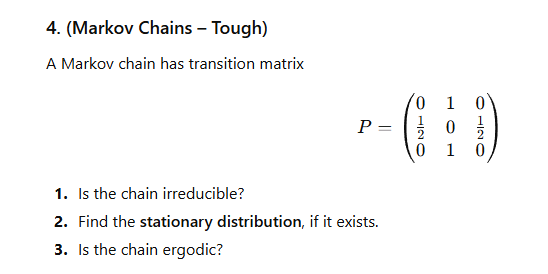 4. (Markov Chains - Tough)
A Markov chain has transition matrix
0 1 0
1 1
P=|4 0}
010
1. Is the chain irreducible?
2. Find the stationary distribution, f it exists.
3. Is the chain ergodic?