Gate Mock Test, Gate Practice Test question, Answer carefully with all clear steps and accuracy with given answer:
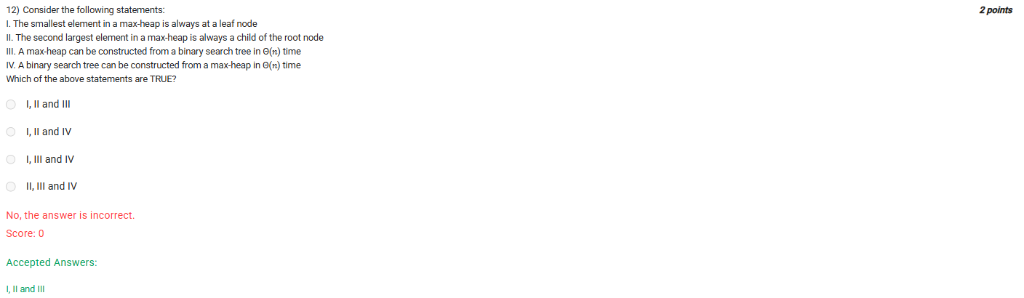
Consider the following statements:
I. The smallest element in a max-heap is always at a leaf node
II. The second largest element in a max-heap is always a child of the root node
III. A max-heap can be constructed from a binary search tree in Θ(?) time
IV. A binary search tree can be constructed from a max-heap in Θ(?) time
Which of the above statements are TRUE?
I, II and III
I, II and IV
I, III and IV
II, III and IV
No, the answer is incorrect.
Score: 0
Accepted Answers:
I, II and III112) Consider the following statements: 2 points
The smallest lementina max bps ahways at ale ode
11The sacond largest coment na max heaps ways a chi ofthe oct nod
1. Amaxhaap can be constructed from a binary seach ce i Gf) me.
1 Abin sec ree can bs constructed rom a maxhesp in 60) me.
ich of he bore sstements are TRUE?
Litand in
Land
Liana
andy.
No, the answer is incorrect.
score: 0
‘Accepted Answers:
Liana
Question:
Gate Mock Test, Gate Practice Test question, Answer carefully with all clear steps and accuracy with given answer:
Consider the following statements:
I. The smallest element in a max-heap is always at a leaf node
II. The second largest element in a max-heap is always a child of the root node
III. A max-heap can be constructed from a binary search tree in Θ(?) time
IV. A binary search tree can be constructed from a max-heap in Θ(?) time
Which of the above statements are TRUE?
I, II and III
I, II and IV
I, III and IV
II, III and IV
No, the answer is incorrect.
Score: 0
Accepted Answers:
I, II and III112) Consider the following statements: 2 points
The smallest lementina max bps ahways at ale ode
11The sacond largest coment na max heaps ways a chi ofthe oct nod
1. Amaxhaap can be constructed from a binary seach ce i Gf) me.
1 Abin sec ree can bs constructed rom a maxhesp in 60) me.
ich of he bore sstements are TRUE?
Litand in
Land
Liana
andy.
No, the answer is incorrect.
score: 0
‘Accepted Answers:
Liana
This is AI generated Response.
Asked by: Vishal
Created at: 2025-11-19 10:48:51
Final Answer:
RenderedRaw Text
Did you like this answer?
Let's analyze each statement carefully:
### Statement I:
**"The smallest element in a max-heap is always at a leaf node**
- ****: In max-heap, the is the maximum element. The smallest element must be at a leaf node because:
- Non-leaf nodes have children larger or equal to themselves (by heap property).
- The smallest element tends to be among the leaves, as they are at the bottom and have fewer constraints.
### Statement II:
**"The second largest element in a max-heap is always a child of the root node."**
- **True**: Since the root is the maximum element, its children are the next candidates for the second largest element. The second largest element must be among the root's children because:
- Heap property guarantees children are less than or equal to the parent.
- The second largest element cannot be elsewhere in the heap without violating the heap property.
### Statement III:
**"A max-heap can be constructed from a binary search tree in Θ(n) time."**
- **True**: Constructing a max-heap from a binary search tree (BST):
- First, perform an inorder traversal of the BST to get sorted elements (O(n))
- Then, build a heap from these elements in O(n) using the heapify process.
- The combined process can be optimized to O(n).
### Statement IV:
**"A binary search tree can be constructed from a max-heap in Θ(n) time."**
- **False**: Constructing a BST from a heap is not straightforward:
- The heap does not preserve the in-order sequence needed for a BST.
- Building a BST from an arbitrary array (heap elements) generally takes O(n log n) time unless the data is sorted.
- Since the heap does not necessarily store elements in in-order, constructing a BST cannot be guaranteed in Θ(n).
---
### **Conclusion:**
- Statements **I, II, and III** are **true**.
- Statements **IV** is **false**.
**Correct answer:**
> **I, II, and III**
VIPSolutions focuses on clear, step‑by‑step explanations so you can learn quickly. Whether you need an AI‑generated walkthrough or a short hint to get unstuck, each solution is organized for fast reading and easy review later.
Search similar questions, compare approaches, and bookmark the best answers for revision. Our goal is simple: quick, reliable study help that feels natural—not noisy.
 VIPSolutions
 112) Consider the following statements: 2 points
The smallest lementina max bps ahways at ale ode
11The sacond largest coment na max heaps ways a chi ofthe oct nod
1. Amaxhaap can be constructed from a binary seach ce i Gf) me.
1 Abin sec ree can bs constructed rom a maxhesp in 60) me.
ich of he bore sstements are TRUE?
Litand in
Land
Liana
andy.
No, the answer is incorrect.
score: 0
‘Accepted Answers:
Liana