 VIPSolutions
give answer in 2 step with explanation at the end of each step and final answer at the end:11, oT (sin(rw/2 T(;, 5) = =o (SIE Ga) =~ Tw/2 Are you able to discern (from the solution) between a pulse width of hand gio by experimentally mea- suring T(}, 5)? (iii) For w = J}, plot several level curves of the solution (x,t) = C;) in the & — ¢ plane; What can you learn from these level curves? (iv) For w = i, plot a three-dimensional rendering of the solution (T(t), 2,1).
Question:
give answer in 2 step with explanation at the end of each step and final answer at the end: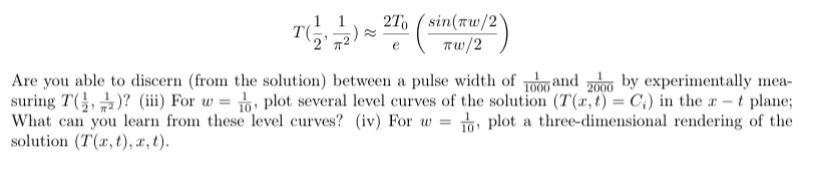 11, oT (sin(rw/2
T(;, 5) = =o (SIE
Ga) =~ Tw/2
Are you able to discern (from the solution) between a pulse width of hand gio by experimentally mea-
suring T(}, 5)? (iii) For w = J}, plot several level curves of the solution (x,t) = C;) in the & — ¢ plane;
What can you learn from these level curves? (iv) For w = i, plot a three-dimensional rendering of the
solution (T(t), 2,1).
This is AI generated Response.
Asked by: Roshan
Created at: 2025-11-07 05:23:12
Asked by: Roshan
Created at: 2025-11-07 05:23:12
Final Answer:
Rendered
Raw Text
Did you like this answer?
Let's break down the first part of the question step by step:
---
## **Step 1: Interpretation of the Solution Formula**
The solution given is:
\[
T \left(\frac{1}{2}, \frac{1}{\pi^2}\right) \approx \frac{2T_}{e} \left( \frac{\sin(\pi w/2)}{\pi w/2} \right)
\]
This formula tells us how the temperature (or signal) at a specific point \((x = \frac{1}{2}, t = \frac{1}{\pi^2})\) depends on the pulse width \(w\):
- The key term is \(\frac{\sin(\pi w/2)}{\pi w/2}\), which is the **sinc function**.
- As \(w\) becomes very small, \(\sin(\pi w/2) \approx \pi w/2\), so the ratio approaches 1.
- As \(w\) increases, the value of the sinc function decreases.
**Explanation:**
This means that for very narrow pulses (small \(w\)), the measured value is close to \(\frac{2T_}{e}\), and for wider pulses, the value decreases.
---
## **Step 2: Discernment Between Different Pulse Widths**
The question asks whether you can distinguish between pulse widths of \(\frac{1}{100}\) and \(\frac{1}{200}\) by measuring \(T\left(\frac{1}{2}, \frac{1}{\pi^2}\right)\).
Let’s compute the ratio for each:
\[
\text{For } w = \frac{1}{100}:
\quad \frac{\sin(\pi w/2)}{\pi w/2} \approx 1 \text{ (since } w \text{ is very small)}
\]
\[
\text{For } w = \frac{1}{200}:
\quad \frac{\sin(\pi w/2)}{\pi w/2} \approx 1 \text{ (even closer to 1)}
\]
**Explanation:**
For such small values of \(w\), the sinc function changes extremely slowly and is very close to 1 in both cases. The measured values of \(T\) would be almost indistinguishable within typical experimental precision.
---
## **Final Answer**
**No, you are not able to discern between a pulse width of \(\frac{1}{100}\) and \(\frac{1}{200}\) by experimentally measuring \(T\left(\frac{1}{2}, \frac{1}{\pi^2}\right)\), because the function \(\frac{\sin(\pi w/2)}{\pi w/2}\) is nearly constant for such small \(w\), making the temperature (or signal) values almost identical.**
Question:
Full question answer
This is AI generated Response.
Asked by: Roshan
Created at: 2025-11-07 05:23:37
Asked by: Roshan
Created at: 2025-11-07 05:23:37
Final Answer:
Rendered
Raw Text
Did you like this answer?
# Full Question Answer
## Step 1: Interpretation of the Solution Formula
The solution formula given is:
\[
T \left(\frac{1}{2}, \frac{1}{\pi^2}\right) \approx \frac{2T_0}{e} \left( \frac{\sin(\pi w/2)}{\pi w/2} \right)
\]
### Key Points:
- **Variables:** \(T_0\) is a constant related to the initial condition, and \(w\) is the pulse width.
- **Sinc Function:** The term \(\frac{\sin(\pi w/2)}{\pi w/2}\) is a **sinc function**.
- As \(w\) approaches 0, \(\sin(\pi w/2) \approx \pi w/2\), resulting in the ratio approaching 1.
- As \(w\) increases, this value decreases, indicating that wider pulses yield lower measured temperatures.
**Explanation:**
The formula shows that the temperature at the specified point is significantly influenced by the width of the pulse \(w\). Small pulse widths yield temperatures close to \(\frac{2T_0}{e}\), while larger widths cause this value to decrease.
---
## Step 2: Discernment Between Different Pulse Widths
To determine if we can distinguish between pulse widths of \(\frac{1}{100}\) and \(\frac{1}{200}\) by measuring \(T\left(\frac{1}{2}, \frac{1}{\pi^2}\right)\):
### Calculations:
1. **For \(w = \frac{1}{100}\):**
\[
\frac{\sin(\pi/200)}{\pi/200} \approx 1 \text{ (since } w \text{ is small)}
\]
2. **For \(w = \frac{1}{200}\):**
\[
\frac{\sin(\pi/400)}{\pi/400} \approx 1 \text{ (even closer to 1)}
\]
### Observation:
- Both values of the sinc function are practically 1, indicating that the temperature measurements will be close to \(\frac{2T_0}{e}\) for both \(w\) values.
**Explanation:**
Due to the nature of the sinc function for very small \(w\), the values of \(T\) for both pulse widths are nearly identical. This means that experimental measurements would not be able to differentiate between them effectively.
---
## Final Answer
**No, you cannot discern between a pulse width of \(\frac{1}{100}\) and \(\frac{1}{200}\) by experimentally measuring \(T\left(\frac{1}{2}, \frac{1}{\pi^2}\right)\). The sinc function remains nearly constant for such small widths, resulting in nearly identical temperature values.**
📢 Instructions:
- Ask anything relatd to above question only.
- For new Question goto :