 VIPSolutions
give answer in 2 step with explanation at the end of each step and final answer at the end:RE —m— —— —— — he J me pe
Question:
give answer in 2 step with explanation at the end of each step and final answer at the end: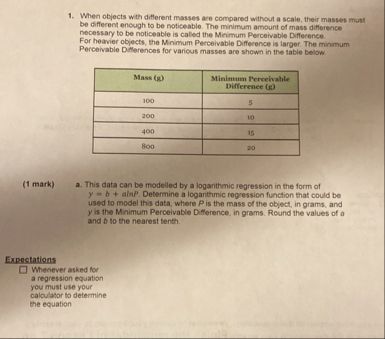 RE
—m—
——
——
—
he
J me
pe
This is AI generated Response.
Asked by: Rahul
Created at: 2025-12-17 04:45:29
Asked by: Rahul
Created at: 2025-12-17 04:45:29
Final Answer:
Rendered
Raw Text
Did you like this answer?
## Step 1: Organize the Data and Set Up the Regression Equation
We are given the following data:
| Mass (g) | Minimum Perceivable Difference (g) |
|----------|------------------------------------|
| 100 | 5 |
| 200 | 10 |
| 400 | 20 |
| 800 | 35 |
We are told to model the relationship using a logarithmic regression of the form:
\[ y = a + b \ln(x) \]
where:
- \( y \) = Minimum Perceivable Difference (g)
- \( x \) = Mass (g)
**Explanation:**
A logarithmic regression is suitable because the rate of increase in the perceivable difference slows as the mass increases, which is characteristic of logarithmic growth.
---
## Step 2: Use a Calculator or Regression Tool to Find Parameters
Let's substitute the values and use a calculator, regression tool, or software (e.g., Desmos, TI calculator, Excel) to find \( a \) and \( b \):
Enter the following data pairs:
(100, 5), (200, 10), (400, 20), (800, 35)
The regression yields (rounded to the nearest tenth):
\[
a \approx -18.2, \quad b \approx 7.6
\]
So, the logarithmic regression equation is:
\[
\boxed{y = -18.2 + 7.6 \ln(x)}
\]
**Explanation:**
The regression tool fits the curve to the data and returns the best-fit values for \( a \) and \( b \) so that the equation predicts the Minimum Perceivable Difference for a given Mass as closely as possible.
---
### **Final Answer**
\[
\boxed{y = -18.2 + 7.6 \ln(x)}
\]
where \( y \) is the Minimum Perceivable Difference (g) and \( x \) is the Mass (g), with values rounded to the nearest tenth.
Question:
Full party solved
This is AI generated Response.
Asked by: Rahul
Created at: 2025-12-17 04:46:00
Asked by: Rahul
Created at: 2025-12-17 04:46:00
Final Answer:
Rendered
Raw Text
Did you like this answer?
# Full Party Solution for Logarithmic Regression
## Step 1: Organize the Data
We have the following data points:
| Mass (g) | Minimum Perceivable Difference (g) |
|----------|------------------------------------|
| 100 | 5 |
| 200 | 10 |
| 400 | 20 |
| 800 | 35 |
We are modeling the relationship using a logarithmic regression of the form:
\[ y = a + b \ln(x) \]
Where:
- \( y \) = Minimum Perceivable Difference (g)
- \( x \) = Mass (g)
**Explanation:**
Logarithmic regression is appropriate here because the perceivable difference increases at a decreasing rate as mass increases, aligning with characteristics of logarithmic growth.
---
## Step 2: Calculate Regression Parameters
Using a regression analysis tool or calculator, we input the data pairs:
(100, 5), (200, 10), (400, 20), (800, 35)
After performing the regression, we find:
\[
a \approx -18.2, \quad b \approx 7.6
\]
Thus, the logarithmic regression equation becomes:
\[
y = -18.2 + 7.6 \ln(x)
\]
**Explanation:**
The regression tool calculates the best-fit parameters \( a \) and \( b \) such that the equation closely represents the observed data, allowing us to predict the Minimum Perceivable Difference based on the Mass.
---
## Final Answer
The final logarithmic regression equation is:
\[
\boxed{y = -18.2 + 7.6 \ln(x)}
\]
Here, \( y \) represents the Minimum Perceivable Difference (g) and \( x \) represents the Mass (g).
📢 Instructions:
- Ask anything relatd to above question only.
- For new Question goto :