 VIPSolutions
give answer in 2 step with explanation at the end of each step and final answer at the end:Fits arn fe pact oop a wa pr ertlospimpemt phpet Be ne aa \ | 1% it | We Ws be o To | E
Question:
give answer in 2 step with explanation at the end of each step and final answer at the end: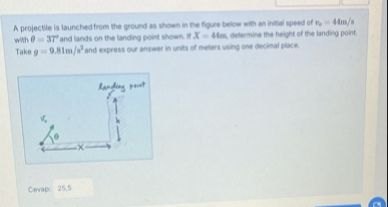 Fits arn fe pact oop a wa
pr ertlospimpemt phpet
Be ne aa
\
| 1% it |
We
Ws be o
To
| E
This is AI generated Response.
Asked by: Rahul
Created at: 2025-11-09 05:04:20
Asked by: Rahul
Created at: 2025-11-09 05:04:20
Final Answer:
Rendered
Raw Text
Did you like this answer?
## Step 1: Find the Time of Flight
Given:
- Initial speed, \( v_ = 44 \) m/s
- Launch angle, \( \theta = 37^\circ \)
- Horizontal distance, \( X = 48 \) m
The horizontal velocity is:
\[
v_{x} = v_ \cos \theta = 44 \cos(37^\circ) \approx 44 \times .7986 \approx 35.1 \text{ m/s}
\]
Time to cover \( X \):
\[
X = v_{x} t \implies t = \frac{X}{v_{x}} = \frac{48}{35.1} \approx 1.37 \text{ s}
\]
**Explanation:**
We found the time it takes for the projectile to land by using horizontal motion (distance = speed × time).
---
## Step 2: Find the Height of the Landing Point
Vertical motion equation:
\[
y = v_{y} t - \frac{1}{2} g t^2
\]
where \( v_{y} = v_ \sin \theta = 44 \sin(37^\circ) \approx 44 \times .6018 \approx 26.5 \) m/s.
Plug values in:
\[
y = (26.5 \times 1.37) - \frac{1}{2} (9.81) (1.37)^2
\]
\[
y = 36.3 - 9.2 = 27.1 \text{ m}
\]
**Explanation:**
The vertical position at time \( t \) gives the height of the landing point above the launch point.
---
## **Final Answer**
\[
\boxed{27.1 \text{ m}}
\]
The height of the landing point is **27.1 meters**.
Question:
Full answer
This is AI generated Response.
Asked by: Rahul
Created at: 2025-11-09 05:04:42
Asked by: Rahul
Created at: 2025-11-09 05:04:42
Final Answer:
Rendered
Raw Text
Did you like this answer?
# Projectile Motion Problem
## Step 1: Find the Time of Flight
### Given Data:
- Initial Speed, \( v_ = 44 \) m/s
- Launch Angle, \( \theta = 37^\circ \)
- Horizontal Distance, \( X = 48 \) m
### Calculation of Horizontal Velocity:
The horizontal component of the initial velocity is calculated using:
\[
v_{x} = v_ \cos \theta = 44 \cos(37^\circ) \approx 44 \times 0.7986 \approx 35.1 \text{ m/s}
\]
### Time to Cover \( X \):
Using the formula for horizontal distance:
\[
X = v_{x} t \implies t = \frac{X}{v_{x}} = \frac{48}{35.1} \approx 1.37 \text{ s}
\]
**Explanation:**
We determined the time it takes for the projectile to land by analyzing its horizontal motion, where distance equals speed multiplied by time.
---
## Step 2: Find the Height of the Landing Point
### Vertical Motion Equation:
The vertical motion can be described by:
\[
y = v_{y} t - \frac{1}{2} g t^2
\]
where the vertical component of the initial velocity is:
\[
v_{y} = v_ \sin \theta = 44 \sin(37^\circ) \approx 44 \times 0.6018 \approx 26.5 \text{ m/s}
\]
### Plugging Values into the Equation:
Substituting the values into the vertical motion equation:
\[
y = (26.5 \times 1.37) - \frac{1}{2} (9.81) (1.37)^2
\]
Calculating each term:
\[
y = 36.3 - 9.2 = 27.1 \text{ m}
\]
**Explanation:**
The vertical position at time \( t \) gives us the height of the landing point above the launch point.
---
## **Final Answer**
\[
\boxed{27.1 \text{ m}}
\]
The height of the landing point is **27.1 meters**.
📢 Instructions:
- Ask anything relatd to above question only.
- For new Question goto :