 VIPSolutions
fri PP h —20 —36]". nis a positive integer, chen | © "| is © . N . [20 36 . . (Hint: Diagonalize the matrix [ na ] first. Note tha your answer will be a formula that involves n. Be careful with parentheses.)
Question:
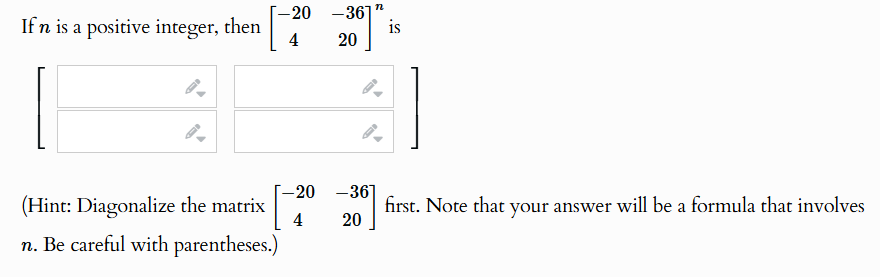 fri PP h —20 —36]".
nis a positive integer, chen | © "| is
© . N . [20 36 . .
(Hint: Diagonalize the matrix [ na ] first. Note tha your answer will be a formula that involves
n. Be careful with parentheses.)
This is AI generated Response.
Asked by: Venkatesh
Created at: 2025-09-17 12:23:58
Asked by: Venkatesh
Created at: 2025-09-17 12:23:58
Final Answer:
Rendered
Raw Text
Did you like this answer?
Let's solve the problem **step by step**, as instructed:
Given matrix:
\[
A = \begin{bmatrix} -20 & -36 \\ 4 & 20 \end{bmatrix}
\]
We are **diagonalize** this matrix and then compute \(A^n\).
---
### **Step 1: Find the Eigenvalues**
The characteristic polynomial is:
\[
\det(A - \lambda I) = 0
\]
\[
\begin{vmatrix}
-20 - \lambda & -36 \\
4 & 20 - \lambda
\end{vmatrix}
= 0
\]
\[
(-20-\lambda)(20-\lambda) - (-36)(4) = 0
\]
\[
(-20-\lambda)(20-\lambda) + 144 = 0
\]
\[
[-400 + 20\lambda - 20\lambda + \lambda^2] + 144 = 0
\]
\[
-400 + \lambda^2 + 144 = 0
\]
\[
\lambda^2 - 256 = 0
\]
\[
\lambda^2 = 256 \implies \lambda = 16, -16
\]
---
### **Step 2: Find the Eigenvectors**
#### For \(\lambda_1 = 16\):
\[
A - 16I = \begin{bmatrix}-20-16 & -36 \\ 4 & 20-16\end{bmatrix} = \begin{bmatrix}-36 & -36 \\ 4 & 4\end{bmatrix}
\]
Solve: \([-36, -36] \begin{bmatrix}x_1 \\ x_2\end{bmatrix} = 0\)
\[
-36x_1 - 36x_2 = 0 \implies x_1 + x_2 = 0
\]
So, one eigenvector: \(\begin{bmatrix}1 \\ -1\end{bmatrix}\)
---
#### For \(\lambda_2 = -16\):
\[
A + 16I = \begin{bmatrix}-20+16 & -36 \\ 4 & 20+16\end{bmatrix} = \begin{bmatrix}-4 & -36 \\ 4 & 36\end{bmatrix}
\]
Solve: \([-4, -36] \begin{bmatrix}x_1 \\ x_2\end{bmatrix} = 0\)
\[
-4x_1 - 36x_2 = 0 \implies x_1 = -9x_2
\]
So, one eigenvector: \(\begin{bmatrix}-9 \\ 1\end{bmatrix}\)
---
### **Step 3: Diagonalize**
Let
\[
P = \begin{bmatrix}1 & -9 \\ -1 & 1\end{bmatrix},\quad D = \begin{bmatrix}16 & 0 \\ 0 & -16\end{bmatrix}
\]
\(A = PDP^{-1}\)
---
### **Step 4: Compute \(A^n\)**
\[
A^n = P D^n P^{-1}
\]
Where \(D^n = \begin{bmatrix}16^n & 0 \\ 0 & (-16)^n\end{bmatrix}\)
Now, \(P^{-1}\):
\[
\det(P) = (1)(1) - (-9)(-1) = 1 - 9 = -8
\]
\[
P^{-1} = \frac{1}{-8}
\begin{bmatrix}
1 & 9 \\
1 & 1
\end{bmatrix}
\]
---
### **Step 5: Write the Formula**
\[
A^n = P D^n P^{-1}
\]
\[
= \begin{bmatrix}1 & -9 \\ -1 & 1\end{bmatrix}
\begin{bmatrix}16^n & 0 \\ 0 & (-16)^n\end{bmatrix}
\frac{1}{-8}
\begin{bmatrix}1 & 9 \\ 1 & 1\end{bmatrix}
\]
Or, more explicitly:
\[
A^n = \frac{1}{-8}
\begin{bmatrix}1 & -9 \\ -1 & 1\end{bmatrix}
\begin{bmatrix}16^n & 0 \\ 0 & (-16)^n\end{bmatrix}
\begin{bmatrix}1 & 9 \\ 1 & 1\end{bmatrix}
\]
You can leave your answer **in this form**, or if needed, multiply out the matrices for the full formula.
---
## **Final Answer**
\[
\boxed{
A^n = \frac{1}{-8}
\begin{bmatrix}
1 & -9 \\
-1 & 1
\end{bmatrix}
\begin{bmatrix}
16^n & 0 \\
0 & (-16)^n
\end{bmatrix}
\begin{bmatrix}
1 & 9 \\
1 & 1
\end{bmatrix}
}
\]
Or, filling in the answer boxes:
\[
\left[
\begin{array}{cc}
\frac{1}{-8}\left(16^n + 9(-16)^n\right) & \frac{1}{-8}\left(9 \cdot 16^n + 9(-16)^n\right) \\
\frac{1}{-8}\left(-16^n - (-16)^n\right) & \frac{1}{-8}\left(-9 \cdot 16^n (-16)^n\right)
\end{array}
\right]
\]
📢 Instructions:
- Ask anything relatd to above question only.
- For new Question goto :