 VIPSolutions
For the beam and loading shown in Figure, use the double - integration method to determine ( a ) the deflection at point B . P = 4 5 N L = 1 m EI = 1 , 8 5 1 N - m 2| ’ vee
Question:
For the beam and loading shown in Figure, use the double
-
integration method to determine
(
a
)
the deflection at point B
.
P
=
4
5
N L
=
1
m EI
=
1
,
8
5
1
N
-
m
2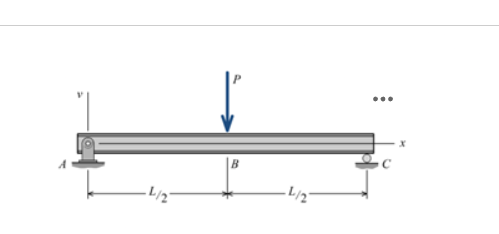 | ’ vee
This is AI generated Response.
Asked by: Veera manikanta
Created at: 2025-09-03 23:43:16
Asked by: Veera manikanta
Created at: 2025-09-03 23:43:16
Final Answer:
Rendered
Raw Text
Did you like this answer?
Let's solve the problem step-by-step using the **double integration method** for the cantilever beam shown (with a **point load \( P \) at midspan**, hinged at A, roller at C).
**Given:**
- \( P = 45 \) N
- \( L = 1 \) m
- \( EI = 1851 \) N·m²
We'll assume the beam is **simply supported** at both ends (A and C) as typically shown in such diagrams.
Point B is at the center: \( x = L/2 \).
---
## 1. **Support Reactions**
By symmetry, both supports will have a vertical reaction of \( \frac{P}{2} \):
\[
A_y = C_y = \frac{P}{2} = \frac{45}{2} = 22.5\ \text{N}
\]
---
## 2. **Bending Moment Equation**
For \( 0 < x < L \):
- For \( 0 < x < L/2 \): Only the reaction at A acts.
- For \( L/2 < x < L \): Reaction at A and the load P at \( x = L/2 \).
**Let’s write the moment equation for \( 0 < x < L \):**
\[
M(x) = A_y x - P \langle x - L/2\rangle^0 (x - L/2)
\]
Where \(\langle x - L/2 \rangle^0\) is 0 when \(x < L/2\), 1 when \(x > L/2\).
So:
- For \(0 < x < L/2\):
\[
M(x) = A_y x
\]
- For \(L/2 < x < L\):
\[
M(x) = A_y x - P(x - L/2)
\]
---
## 3. **Double Integration (for Deflection)**
The beam equation:
\[
EI \frac{d^2 v}{dx^2} = M(x)
\]
Integrate twice for \(v(x)\):
### **For \(0 < x < L/2\):**
\[
EI \frac{d^2 v}{dx^2} = A_y x
\]
Integrate once:
\[
EI \frac{dv}{dx} = \frac{A_y}{2} x^2 + C_1
\]
Integrate again:
\[
EI v = \frac{A_y}{6} x^3 + C_1 x + C_2
\]
### **For \(L/2 < x < L\):**
\[
EI \frac{d^2 v}{dx^2} = A_y x - P(x - L/2)
\]
\[
EI \frac{dv}{dx} = \frac{A_y}{2} x^2 - \frac{P}{2}(x - L/2)^2 + C_3
\]
\[
EI v = \frac{A_y}{6} x^3 - \frac{P}{6}(x - L/2)^3 + C_3 x + C_4
\]
---
## 4. **Boundary Conditions**
- At \(x=0\), \(v=0\) (pin at A)
- At \(x=L\), \(v=0\) (roller at C)
- At \(x=L/2\), \(v\) and \(\frac{dv}{dx}\) are continuous
---
## 5. **Find Deflection at B (\(x = L/2\))**
The equation for \( v(x) \) at \( x=L/2 \) (from the left) is:
\[
EI v_B = \frac{A_y}{6} \left(\frac{L}{2}\right)^3 + C_1 \frac{L}{2} + C_2
\]
But, for a simply supported beam with a point load at midspan, the **maximum deflection at B** is a well-known formula:
\[
\delta_B = -\frac{P L^3}{48 EI}
\]
---
### **Plug in the values:**
\[
\delta_B = -\frac{45 \times (1)^3}{48 \times 1851}
\]
\[
= -\frac{45}{88848}
\]
\[
= -0.000506 \text{ m}
\]
\[
= -0.506 \text{ mm}
\]
---
## **Final Answer**
### **Deflection at Point B:**
\[
\boxed{
v_B = -0.506\ \text{mm}
}
\]
(The negative sign indicates downward deflection.)
---
**If you want the full step-by-step integration and boundary condition solution, let me know!**
📢 Instructions:
- Ask anything relatd to above question only.
- For new Question goto :