 VIPSolutions
FIRST WRITE GIVENINFORMATION THENWHAT HAVE TO FIND AND THEN DEFINATION ORCONCEPT USED AND THEN STEP BY STEPSOLUTION WITHOUT MENTIONING STEP NUMBER AND AT LAST WRITE FINALANSWERS ONLY AS SUMMARY . ALSO MAKE SOLUTION WELL STRUCTUREDLet Xy,..., X,, ~ Uniform(0, 1). 2) Find the PDF of the maximum X(). b) Find E[X (x). © Find P(X(n) — X(1) < 0.5).
Question:
FIRST WRITE GIVENINFORMATION THENWHAT HAVE TO FIND AND THEN DEFINATION ORCONCEPT USED AND THEN STEP BY STEPSOLUTION WITHOUT MENTIONING STEP NUMBER AND AT LAST WRITE FINALANSWERS ONLY AS SUMMARY . ALSO MAKE SOLUTION WELL STRUCTURED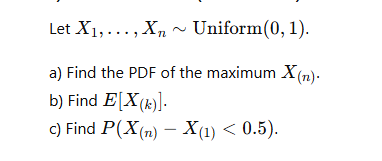 Let Xy,..., X,, ~ Uniform(0, 1).
2) Find the PDF of the maximum X().
b) Find E[X (x).
© Find P(X(n) — X(1) < 0.5).
This is AI generated Response.
Asked by: nayan
Created at: 2026-02-14 06:55:38
Asked by: nayan
Created at: 2026-02-14 06:55:38
Final Answer:
Rendered
Raw Text
Did you like this answer?
# Given Information
- Random variables \( X_1, X_2, ..., X_n \) are i.i.d. and follow the uniform distribution:
\[
X_i \sim \text{Uniform}(, 1)
\]
# What Have to Find
a) PDF of the maximum: \( X_{(n)} = \max\{X_1, X_2, ..., X_n\} \)
b) Expected value of the \( k \)-th order statistic: \( E[X_{(k)}] \)
c) Probability \( P(X_{(n)} - X_{(1)} < .5) \), where \( X_{(1)} = \min\{X_1, ..., X_n\} \)
# Definition or Concept Used
- **Order statistics:** For i.i.d. random variables, the \( k \)-th order statistic is the \( k \)-th smallest value.
- **PDF of order statistics:** For \( X_i \sim \text{Uniform}(,1) \), the PDF of the \( k \)-th order statistic is:
\[
f_{X_{(k)}}(x) = \frac{n!}{(k-1)!(n-k)!}x^{k-1}(1-x)^{n-k}, \quad < x < 1
\]
- **CDF of maximum:** \( F_{X_{(n)}}(x) = [F_X(x)]^n \)
- **PDF of maximum:** Derivative of the CDF.
- **Probability calculation:** Use integration of joint PDF or CDF properties.
# Solution
**a) PDF of the maximum \( X_{(n)} \):**
The CDF of the maximum is:
\[
F_{X_{(n)}}(x) = P(X_{(n)} \leq x) = P(X_1 \leq x, ..., X_n \leq x) = [F_X(x)]^n = x^n, \quad < x < 1
\]
The PDF is:
\[
f_{X_{(n)}}(x) = \frac{d}{dx}F_{X_{(n)}}(x) = n x^{n-1}, \quad < x < 1
\]
---
**b) \( E[X_{(k)}] \):**
The PDF of the \( k \)-th order statistic is:
\[
f_{X_{(k)}}(x) = \frac{n!}{(k-1)!(n-k)!} x^{k-1}(1-x)^{n-k}, \quad < x < 1
\]
The expected value is:
\[
E[X_{(k)}] = \int_^1 x f_{X_{(k)}}(x) dx
\]
\[
= \frac{n!}{(k-1)!(n-k)!} \int_^1 x \cdot x^{k-1} (1-x)^{n-k} dx
\]
\[
= \frac{n!}{(k-1)!(n-k)!} \int_^1 x^k (1-x)^{n-k} dx
\]
\[
= \frac{n!}{(k-1)!(n-k)!} \cdot \text{B}(k+1, n-k+1)
\]
where \(\text{B}(a, b)\) is the Beta function: \(\text{B}(a, b) = \frac{\Gamma(a)\Gamma(b)}{\Gamma(a+b)}\). For integers, \(\Gamma(m) = (m-1)!\).
Thus,
\[
E[X_{(k)}] = \frac{k}{n+1}
\]
---
**c) \( P(X_{(n)} - X_{(1)} < .5) \):**
Let \( X_{(n)} = y \), \( X_{(1)} = x \), \( < x < y < 1 \).
We require \( y - x < .5 \implies x > y - .5 \) and \( y < x + .5 \).
Joint PDF:
\[
f_{X_{(1)}, X_{(n)}}(x, y) = n(n-1)(y-x)^{n-2}, \quad < x < y < 1
\]
Probability:
\[
P(X_{(n)} - X_{(1)} < .5) = \int_^1 \int_{x}^{\min(x+.5,\,1)} n(n-1)(y-x)^{n-2} dy\, dx
\]
Change order for easier computation:
\[
= \int_^1 \int_{\max(, y-.5)}^{y} n(n-1)(y-x)^{n-2} dx\, dy
\]
\[
= \int_^1 n(n-1) \left[ \int_{\max(, y-.5)}^{y} (y-x)^{n-2} dx \right] dy
\]
Let \( u = y - x \), \( du = -dx \), bounds: \( x = y \to u= \), \( x = \max(, y-.5) \to u = y-\max(, y-.5) = \min(y, .5) \):
So,
\[
= \int_^1 n(n-1) \int_{}^{\min(y, .5)} u^{n-2} du\, dy
\]
\[
= \int_^{.5} n(n-1) \int_{}^{y} u^{n-2} du\, dy + \int_{.5}^{1} n(n-1) \int_{}^{.5} u^{n-2} du\, dy
\]
Evaluating the inner integrals:
\[
\int_{}^{a} u^{n-2} du = \frac{a^{n-1}}{n-1}
\]
So,
\[
= \int_^{.5} n y^{n-1} dy + \int_{.5}^{1} n [.5]^{n-1} dy
\]
\[
= n \left[ \frac{y^n}{n} \right]_^{.5} + n [.5]^{n-1} (1 - .5)
\]
\[
= (.5)^n + .5 n (.5)^{n-1}
\]
\[
= (.5)^n (1 + n)
\]
---
# Summary
- **PDF of the maximum:** \( f_{X_{(n)}}(x) = n x^{n-1}, \quad < x < 1 \)
- **Expected value of the \(k\)-th order statistic:** \( E[X_{(k)}] = \frac{k}{n+1} \)
- **Probability:** \( P(X_{(n)} - X_{(1)} < .5) = (1 + n) \cdot (.5)^n \)
📢 Instructions:
- Ask anything relatd to above question only.
- For new Question goto :