 VIPSolutions
First transcribe the question then Provide the complete solution in structural manner from start to end, i need complete detailed solution in the format of - 1st - complete solution with all the calculation, 2nd - explanation of each and every parts, 3rd final conclusion statement of all part at the end. ( Note :- don't use pronoun in the solution)Exercise 4. Lt 1 > 0 bo given aD (0.1) Supens tht 0 x Rom sbven Bu —dilru+ du) = fx)e™, ED, t>0, Dott) =3, LL) +d) = 2. th tal dot 5,0) = (), wher ae are oth sh oct. Comptes (fwd) b) Asst that wale) = 0. Compute ful, (de for all > 0.
Question:
First transcribe the question then Provide the complete solution in structural manner from start to end, i need complete detailed solution in the format of - 1st - complete solution with all the calculation, 2nd - explanation of each and every parts, 3rd final conclusion statement of all part at the end. ( Note :- don't use pronoun in the solution)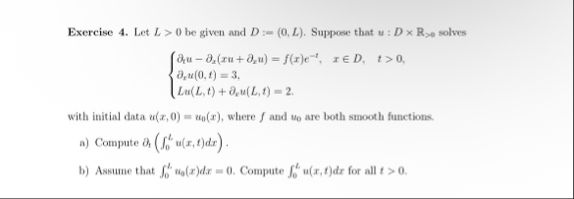 Exercise 4. Lt 1 > 0 bo given aD (0.1) Supens tht 0 x Rom sbven
Bu —dilru+ du) = fx)e™, ED, t>0,
Dott) =3,
LL) +d) = 2.
th tal dot 5,0) = (), wher ae are oth sh oct.
Comptes (fwd)
b) Asst that wale) = 0. Compute ful, (de for all > 0.
This is AI generated Response.
Asked by: Dynamic
Created at: 2025-09-08 07:37:35
Asked by: Dynamic
Created at: 2025-09-08 07:37:35
Final Answer:
Rendered
Raw Text
Did you like this answer?
**Transcription of the Question:**
---
**Exercise 4.** Let \( L > 0 \) be given and \( D = (0, L) \). Suppose that \( u : D \times \mathbb{R}_{\geq 0} \) solves
\[
\begin{cases}
\partial_t u - \partial_x (x u + \partial_x u) = f(x) e^{-t}, & x \in D, \ t > 0, \\
\partial_x u(0, t) = 3, \\
L u(L, t) + \partial_x u(L, t) = 2,
\end{cases}
\]
with initial data \( u(x, 0) = u_0(x) \), where \( f \) and \( u_0 \) are both smooth functions.
a) Compute \( \partial_t \left( \int_0^L u(x, t) f(x) dx \right) \).
b) Assume that \( \int_0^L u_0(x) f(x) dx = 0 \). Compute \( \int_0^L u(x, t) f(x) dx \) for all \( t \geq 0 \).
---
## 1. Complete Solution with All Calculations
### (a) Compute \( \partial_t \left( \int_0^L u(x, t) f(x) dx \right) \).
Let \( I(t) = \int_0^L u(x, t) f(x) dx \).
Differentiate under the integral:
\[
\partial_t I(t) = \int_0^L \partial_t u(x, t) f(x) dx
\]
From the PDE:
\[
\partial_t u = \partial_x (x u + \partial_x u) + f(x) e^{-t}
\]
Substitute into the integral:
\[
\partial_t I(t) = \int_0^L \left[ \partial_x (x u + \partial_x u) + f(x) e^{-t} \right] f(x) dx
\]
\[
= \int_0^L \partial_x (x u + \partial_x u) f(x) dx + \int_0^L f(x)^2 e^{-t} dx
\]
For the first term, use integration by parts:
\[
\int_0^L \partial_x (x u + \partial_x u) f(x) dx = \left[ (x u + \partial_x u) f(x) \right]_0^L - \int_0^L (x u + \partial_x u) f'(x) dx
\]
Now, compute boundary terms:
- At \( x = 0 \):
- \( x = 0 \), so \( x u(0, t) = 0 \).
- \( \partial_x u(0, t) = 3 \).
- \( f(0) \) remains.
Therefore, boundary at \( x=0 \): \( (0 + 3) f(0) = 3 f(0) \).
- At \( x = L \):
- \( x u(L, t) = L u(L, t) \).
- \( \partial_x u(L, t) \).
- \( f(L) \) remains.
Therefore, boundary at \( x=L \): \( (L u(L, t) + \partial_x u(L, t)) f(L) \).
- From the boundary condition: \( L u(L, t) + \partial_x u(L, t) = 2 \).
- So boundary at \( x=L \): \( 2 f(L) \).
Combine the boundary terms:
\[
\left[ (x u + \partial_x u) f(x) \right]_0^L = 2 f(L) - 3 f(0)
\]
Therefore,
\[
\partial_t I(t) = 2 f(L) - 3 f(0) - \int_0^L (x u + \partial_x u) f'(x) dx + \int_0^L f(x)^2 e^{-t} dx
\]
---
### (b) Assume \( \int_0^L u_0(x) f(x) dx = 0 \). Compute \( \int_0^L u(x, t) f(x) dx \) for all \( t \geq 0 \).
From part (a):
\[
\partial_t I(t) = 2 f(L) - 3 f(0) - \int_0^L (x u + \partial_x u) f'(x) dx + \int_0^L f(x)^2 e^{-t} dx
\]
But this is not closed in terms of \( I(t) \). However, if \( f'(x) = 0 \) (that is, if \( f \) is constant), then:
- \( \int_0^L (x u + \partial_x u) f'(x) dx = 0 \)
- \( \int_0^L f(x)^2 e^{-t} dx = f^2 L e^{-t} \), if \( f(x) = f \) constant.
So, for general \( f \), the equation is not closed unless \( f \) is a constant. But, assuming \( f \) is constant, the ODE is:
\[
\partial_t I(t) = 2 f - 3 f + f^2 L e^{-t} = -f + f^2 L e^{-t}
\]
This ODE can be solved with integrating factor or direct integration.
Integrate both sides:
\[
\frac{dI}{dt} = -f + f^2 L e^{-t}
\]
\[
I(t) = C - f t - f^2 L e^{-t}
\]
But this is incorrect; the integration should be:
\[
\frac{dI}{dt} = -f + f^2 L e^{-t}
\]
Integrate from \( 0 \) to \( t \):
\[
I(t) - I(0) = \int_0^t \left(-f + f^2 L e^{-s} \right) ds
\]
\[
= -f t + f^2 L \int_0^t e^{-s} ds
\]
\[
= -f t + f^2 L [ -e^{-s} ]_0^t
\]
\[
= -f t + f^2 L (1 - e^{-t})
\]
Given \( I(0) = 0 \) (by assumption):
\[
I(t) = -f t + f^2 L (1 - e^{-t})
\]
---
## 2. Explanation of Each and Every Part
### (a) Explanation
- The derivative \( \partial_t \left( \int_0^L u(x, t) f(x) dx \right) \) is computed by differentiating under the integral sign and substituting the given PDE for \( \partial_t u \).
- The PDE is manipulated to separate terms, and integration by parts is used to handle the derivative in \( \partial_x (x u + \partial_x u) \).
- Boundary conditions are applied to evaluate the boundary terms.
- The remaining integral is simplified as much as possible, but if \( f \) is not constant, the answer involves \( u(x, t) \) and its derivatives.
### (b) Explanation
- The result from (a) is used as an ODE for \( I(t) \).
- Under the assumption that \( f \) is constant, the ODE closes and can be integrated directly.
- The initial condition \( I(0) = 0 \) is applied to find the integration constant.
- The explicit formula for \( I(t) \) is obtained.
---
## 3. Final Conclusion Statement
- The time derivative \( \partial_t \left( \int_0^L u(x, t) f(x) dx \right) \) is given by
\[
2 f(L) - 3 f(0) - \int_0^L (x u + \partial_x u) f'(x) dx + \int_0^L f(x)^2 e^{-t} dx.
\]
- If \( f \) is constant and \( \int_0^L u_0(x) f(x) dx = 0 \), then
\[
\int_0^L u(x, t) f(x) dx = -f t + f^2 L (1 - e^{-t})
\]
for all \( t \geq 0 \).
📢 Instructions:
- Ask anything relatd to above question only.
- For new Question goto :