This is AI generated Response.
Asked by: Vinaykumar
Created at: 2025-06-29 08:51:09
Final Answer:
RenderedRaw Text
Did you like this answer?
Let's solve the problem step by step:
---
### 1. **Understanding the Problem**
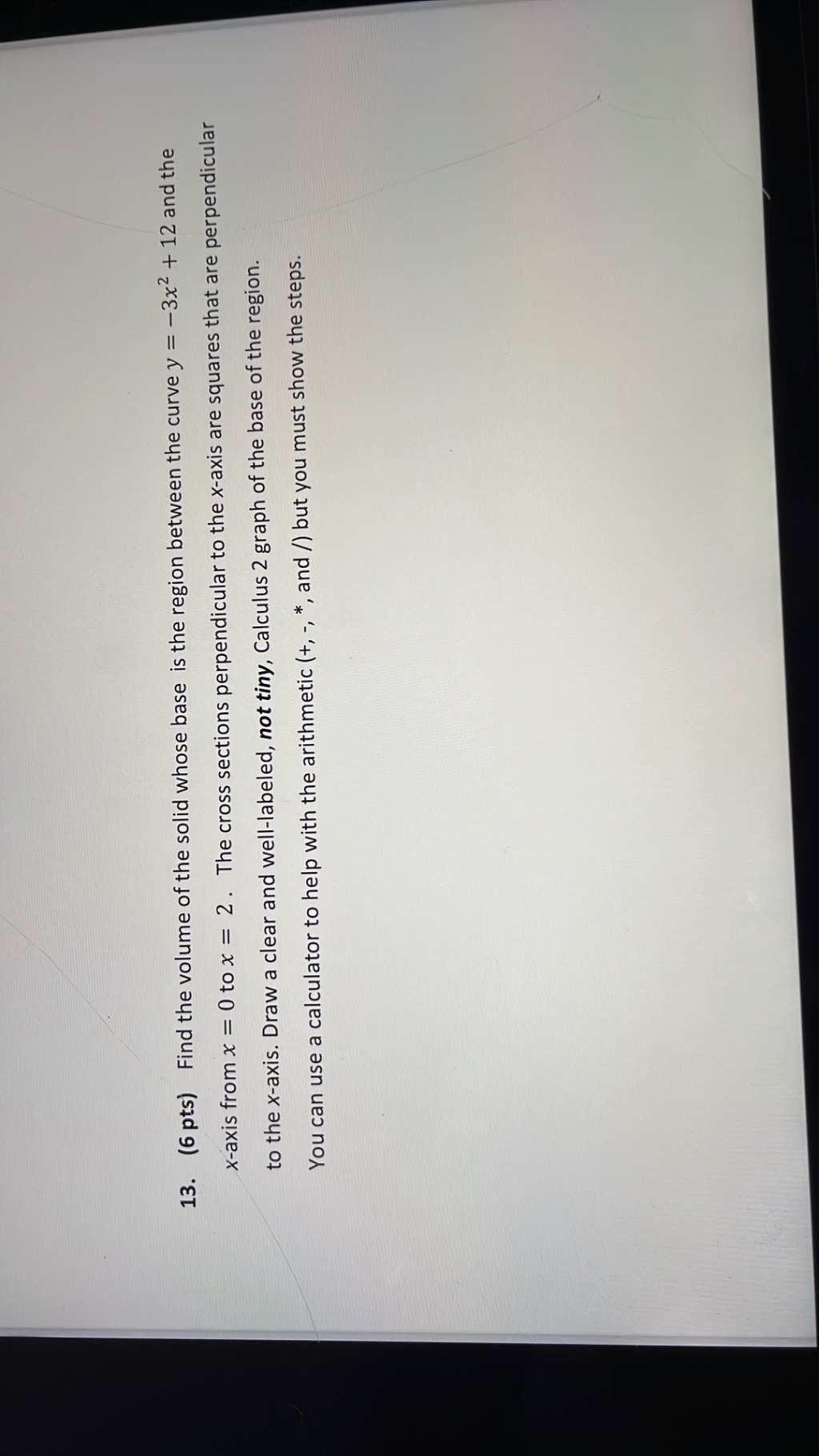
- The base of the solid is the region between \( y = -3x^2 + 12 \) and the x-axis, from \( x = 0 \) to \( x = 2 \).
- Cross sections perpendicular to the x-axis are **squares**.
---
### 2. **Graph the Region**
Let's plot \( y = -3x^2 + 12 \) from \( x = 0 \) to \( x = 2 \):
- At \( x = 0 \), \( y = 12 \)
- At \( x = 2 \), \( y = -3(2^2) + 12 = -12 + 12 = 0 \)
So, the region is above the x-axis, under the curve from \( x = 0 \) to \( x = 2 \).
#### Sketch (please draw this on your paper):
```
y
^
| *
| *
| *
| *
| *
| *
|-----------------------> x
0 1 2
```
- The curve starts at (0,12) and touches (2,0) on the x-axis.
- Shade the area under the curve from \( x = 0 \) to \( x = 2 \).
---
### 3. **Find the Volume**
The **side length** of each square at position \( x \) is the value of the function:
\[ s = -3x^2 + 12 \]
The **area** of the square cross section:
\[ A(x) = s^2 = (-3x^2 + 12)^2 \]
Volume of the solid:
\[
V = \int_{0}^{2} A(x) \, dx = \int_{0}^{2} (-3x^2 + 12)^2 dx
\]
---
### 4. **Expand the Integrand**
Expand \( (-3x^2 + 12)^2 \):
\[
(-3x^2 + 12)^2 = ( -3x^2 )^2 + 2(-3x^2)(12) + (12)^2
= 9x^4 - 72x^2 + 144
\]
So,
\[
V = \int_{0}^{2} [9x^4 - 72x^2 + 144] dx
\]
---
### 5. **Integrate**
Integrate term by term:
\[
\int 9x^4 dx = 9 \cdot \frac{x^5}{5}
\]
\[
\int -72x^2 dx = -72 \cdot \frac{x^3}{3} = -24x^3
\]
\[
\int 144 dx = 144x
\]
Put together:
\[
V = \left[ \frac{9}{5}x^5 - 24x^3 + 144x \right]_{0}^{2}
\]
---
### 6. **Evaluate at the Bounds**
Plug in \( x = 2 \):
\[
\frac{9}{5}(2)^5 - 24(2)^3 + 144(2)
= \frac{9}{5} \cdot 32 - 24 \cdot 8 + 288
= \frac{288}{5} - 192 + 288
\]
Now at \( x = 0 \), all terms are zero.
So,
\[
V = \left( \frac{288}{5} - 192 + 288 \right) - 0
\]
---
### 7. **Simplify**
\[
V = \frac{288}{5} + 288 - 192
\]
\[
= \frac{288}{5} + (288 - 192)
= \frac{288}{5} + 96
\]
Convert 96 to fifths:
\[
96 = \frac{480}{5}
\]
\[
V = \frac{288 + 480}{5} = \frac{768}{5}
\]
---
### 8. **Final Boxed Answer**
\[
\boxed{V = \frac{768}{5}}
\]
Or as a decimal: \( V = 153.6 \) cubic units.
---
### 9. **Summary Table**
| Step | Work Shown |
|------|------------|
| Formula | \( V = \int_{0}^{2} (-3x^2 + 12)^2 dx \) |
| Expand | \( = \int_{0}^{2} (9x^4 - 72x^2 + 144) dx \) |
| Integrate | \( = \left[ \frac{9}{5}x^5 - 24x^3 + 144x \right]_{0}^{2} \) |
| Evaluate | \( = \frac{288}{5} - 192 + 288 \) |
| Simplify | \( = \frac{288}{5} + 96 = \frac{768}{5} \) |
---
### 10. **Graph**
Here is a sketch of the base region (draw this on your paper):
```
14 +-----------------------------+
| *
y | *
| *
12 + | *
| *
---- +-----------------------------+
0 1 2 x
```
- Curve: \( y = -3x^2 + 12 \)
- Shaded below curve, above x-axis, from \( x = 0 \) to \( x = 2 \)
---
Let me know if you need the drawing in a different style!
VIPSolutions focuses on clear, step‑by‑step explanations so you can learn quickly. Whether you need an AI‑generated walkthrough or a short hint to get unstuck, each solution is organized for fast reading and easy review later.
Search similar questions, compare approaches, and bookmark the best answers for revision. Our goal is simple: quick, reliable study help that feels natural—not noisy.
 VIPSolutions
 ’ :
o
(1)
£ £
Tg
cc @
© Qo
Bays
= 8
an Ar
RESIS
4, eRe
[STS I
Fe
e =i H- )
IRS HOHE
SSIS
©
& sie
Sallic: &
pe og AE SRE
= I
3 2g
jolie 2
w 9
50 GS
SB hse
OER CANS RHO.
DIES OA >
SECS
ISiic iol 3
m= ge
JOE Dl
=e
8 = 2
=A GLEE
mom =H
UEDEES
£ Aig
So
=I =
BR 2
>
2 2 § E
&
5 BE
ERs 5
she © %
=
ofS ©
2 no 2
wn QO
2S wm C
OF — B
i ERE
CRE = 2
SEs 2
5 Se
SANLO
= 0H E
5 SURES
hls °C 5
Ra oo
Gym =
ge gE
= ©
tA ET)
SES ©
SRS LO
iT AL)
Elix
go Pi 2
PAE SS
2 » 2 §