 VIPSolutions
Find the APR, or stated rate, in each of the following cases. Note: Use 365 days in a year. Do not round intermediate calculations and enter your answers as a percent rounded to 2 decimal places, e.g., 32.16. Stated Rate Number of Times Effective Rate (APR) Compounded (EAR) 1% mony Ff Assessment Tool = Weekly | t0e]% | efor | sex]
Question:
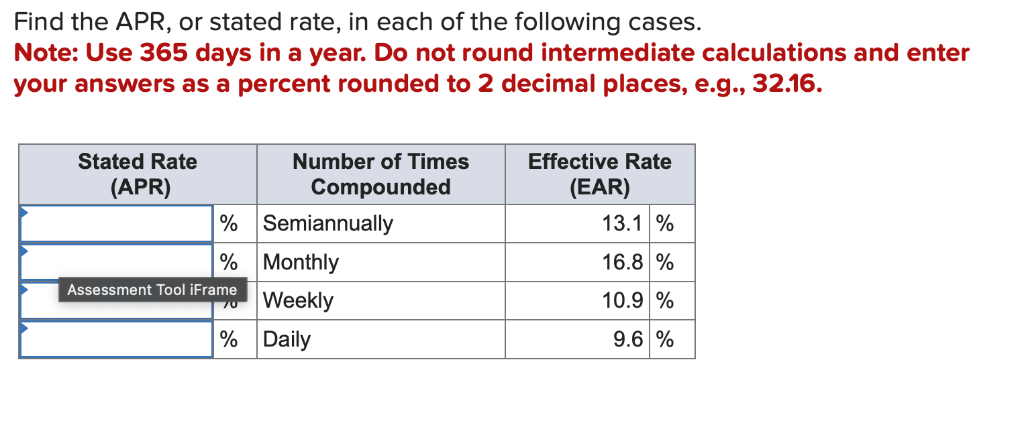 Find the APR, or stated rate, in each of the following cases.
Note: Use 365 days in a year. Do not round intermediate calculations and enter
your answers as a percent rounded to 2 decimal places, e.g., 32.16.
Stated Rate Number of Times Effective Rate
(APR) Compounded (EAR)
1% mony
Ff Assessment Tool = Weekly | t0e]% |
efor | sex]
This is AI generated Response.
Asked by: Vinay
Created at: 2025-12-12 17:52:42
Asked by: Vinay
Created at: 2025-12-12 17:52:42
Thought Process:
Rendered
Raw Text
**Calculating APR from EAR**
Okay, so when I’m looking into compounding periods, I should use 52 weeks for weekly compounding and 365 days for daily compounding. It seems the instruction is specific to daily comp.
For monthly, semiannually, and weekly, I’m using m=2, 12, 52, and 365. I want to compute the APR given the EAR, using the formulas provided. I’ll work through the math step by step for each compounding frequency. Let’s compute that semiannually for an EAR of 0.131!**Approximating square roots and logarithms**
I’m using Newton's method to approximate sqrt(1.131), starting with an initial guess of 1.064. It seems slightly high, so I refine it to 1.0635, which gives me a more accurate result.
Then, for computing the monthly APR with m=12 and EAR of 0.168, I need to find the 12th root of (1 + e). I can use the natural log to approximate it, applying the logarithmic expansion to get a precise value.
This should help in determining the APR correctly!**Calculating logarithms and approximate returns**
So, I estimated ln(1.168) to be around 0.1553. From there, I computed the 12th root of 1.168 using the exponential function, leading to an APR of approximately 15.63% after all my rounding.
Next, for the weekly EAR of 10.9%, I noted that e equals 0.109. I’m working through the natural log approximation and calculating it step by step for accuracy. Finally, I’ll exponentiate that and properly adjust for the weekly compounding over 52 weeks. It’s a careful process, but I'm getting there!**Refining APR calculations**
I computed about 1.0019916, subtracting 1 gives me approximately 0.0019916. Multiplying that by 52 results in around 10.356%, which is less than the EAR of 10.9%. This seems valid since APR is generally less than EAR when compounding is greater than 1.
I considered whether to use 52 weeks or 365 days divided by 7 for weekly compounding, which led me to adjust my calculations slightly. After ensuring accuracy, the APR rounds to about 10.36%. Now, onto daily compounding for an EAR of 9.6%!**Summarizing APR calculations**
Here’s where I’ve landed with my calculations:
1. For semiannual compounding, the APR is approximately 12.70%.
2. Monthly compounding gives an APR of about 15.63%.
3. Weekly compounding results in an APR of about 10.36%.
4. For daily compounding, I found the APR to be around 9.17%.
I’ve double-checked my approximations and they appear consistent with the EAR values. I should clarify that while I maintained accuracy without rounding intermediate steps, the results are rounded to two decimal places. Each value relates correctly to its respective compounding method!
Final Answer:
Rendered
Raw Text
Did you like this answer?
Use the relation between EAR and APR for m compounding periods per year:
EAR = (1 + APR/m)^m − 1 ⇒ APR = m[(1 + EAR)^(1/m) − 1]
- Semiannually (m = 2), EAR = 13.1%:
APR = 2[(1.131)^(1/2) − 1] ≈ 12.70%
- Monthly (m = 12), EAR = 16.8%:
APR = 12[(1.168)^(1/12) − 1] ≈ 15.63%
- Weekly (m = 52), EAR = 10.9%:
APR = 52[(1.109)^(1/52) − 1] ≈ 10.36%
- Daily (m = 365), EAR = 9.6%:
APR = 365[(1.096)^(1/365) − 1] ≈ 9.17%
Answers (APR, percent to two decimals): 12.70%, 15.63%, 10.36%, 9.17%.
📢 Instructions:
- Ask anything relatd to above question only.
- For new Question goto :