Give step-by-step solution with explanation and final answer:
Individual Problems
1
5
-
5
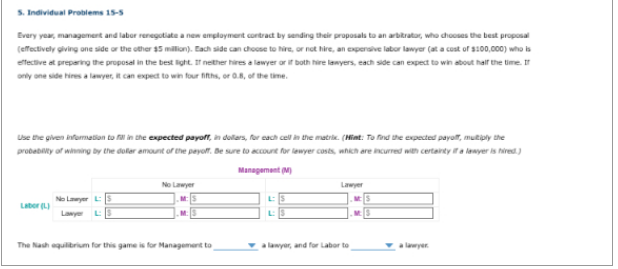
Every year, management and labor renegotiate a new employment contract by sending their proposals to an arbitrator, who chooses the best proposal
(
effectively giving one side or the other $
5
million
)
.
Each side can chocse to hire, or not hire, an experolve labor lawyer
(
at a cost of $
1
0
0
,
0
0
0
)
who is effective at preparing the proposal in the best light. If nether hires a lawyer or if both hire lawyers, each side can expect to win about half the time. If only one side hires a lawyer, it can expect to win four fiths, or
0
.
8
,
of the time. Use the given information to fill in the expected payorf, in dollars, for each cell in the matrik.
(
Hiat
.
To find the expected payolf, multiply the probabilly of whining by the dollar amount of the payolf. Be sure to account for lawyer costs, which are incurred with certainty if a lawyer is hired.
)
The Nash equilibrium for this game is for Management to
_
_
_
_
_
_
(
hire or not hire
)
a lawyer and for labor to
_
_
_
_
_
_
(
hire or not hire
)
a lawyer
)
.5. Inaitun proviems 15-5
EP —
Chatty gon eco 5 le. co et cr at 0 50080)
ov st or i dn oi M1 0.4,
hee pm mse. cpt pre ch t,t Be td prt et
tet mn br er vt ¢ el. 5 1 nr ee le 0 en ry 4 rt)
JR
Et] om com | o— Co—)
BP en £7 o— UY — 1 —
hh ct or apne 2 te nd irs slr
Question:
Give step-by-step solution with explanation and final answer:
Individual Problems
1
5
-
5
Every year, management and labor renegotiate a new employment contract by sending their proposals to an arbitrator, who chooses the best proposal
(
effectively giving one side or the other $
5
million
)
.
Each side can chocse to hire, or not hire, an experolve labor lawyer
(
at a cost of $
1
0
0
,
0
0
0
)
who is effective at preparing the proposal in the best light. If nether hires a lawyer or if both hire lawyers, each side can expect to win about half the time. If only one side hires a lawyer, it can expect to win four fiths, or
0
.
8
,
of the time. Use the given information to fill in the expected payorf, in dollars, for each cell in the matrik.
(
Hiat
.
To find the expected payolf, multiply the probabilly of whining by the dollar amount of the payolf. Be sure to account for lawyer costs, which are incurred with certainty if a lawyer is hired.
)
The Nash equilibrium for this game is for Management to
_
_
_
_
_
_
(
hire or not hire
)
a lawyer and for labor to
_
_
_
_
_
_
(
hire or not hire
)
a lawyer
)
.5. Inaitun proviems 15-5
EP —
Chatty gon eco 5 le. co et cr at 0 50080)
ov st or i dn oi M1 0.4,
hee pm mse. cpt pre ch t,t Be td prt et
tet mn br er vt ¢ el. 5 1 nr ee le 0 en ry 4 rt)
JR
Et] om com | o— Co—)
BP en £7 o— UY — 1 —
hh ct or apne 2 te nd irs slr
This is AI generated Response.
Asked by: Vikram Kumar
Created at: 2025-10-15 23:56:21
Final Answer:
RenderedRaw Text
Did you like this answer?
Let's break down the problem into clear steps and **fill in the payoff matrix**. We'll also explain the Nash equilibrium at the end.
---
## **Step 1: Understand the Payoff Structure**
- **Prize:** $5,000,000 (winner takes all)
- **Lawyer cost:** $100,000 (incurred if hired)
- **Probabilities:**
- **Neither hires:** Each wins .5
- **Both hire:** Each wins .5 (but both pay $100,000)
- **Only one hires:** That side wins .8, the other wins .2
---
## **Step 2: Calculate Expected Payoffs for Each Case**
Let’s fill the matrix **from Labor's perspective first, then Management's**.
| | Management: No Lawyer | Management: Lawyer |
|-------------------|------------------------------|-----------------------------|
| **Labor: No Lawyer** | L: .5($5M) = $2,500,000 | L: .2($5M) = $1,000,000 |
| **Labor: Lawyer** | L: .8($5M) - $100,000 = $3,900,000 | L: .5($5M) - $100,000 = $2,400,000 |
**Now for Management:**
- If neither hires: M: .5($5M) = $2,500,000
- If only M hires: M: .8($5M) - $100,000 = $3,900,000
- If only L hires: M: .2($5M) = $1,000,000
- If both hire: M: .5($5M) - $100,000 = $2,400,000
---
## **Step 3: Fill in the Matrix**
| | Management: No Lawyer | Management: Lawyer |
|-------------------|------------------------------|-------------------------------|
| **Labor: No Lawyer** | L: $2,500,000<br>M: $2,500,000 | L: $1,000,000<br>M: $3,900,000 |
| **Labor: Lawyer** | L: $3,900,000<br>M: $1,000,000 | L: $2,400,000<br>M: $2,400,000 |
---
## **Step 4: Find Nash Equilibrium**
- If one side hires, the other side is better off hiring too (to avoid a big disadvantage).
- If both hire, deviation (not hiring) drops their expected payoff.
- If neither hires, deviation (hiring) increases their payoff.
**So, both will hire lawyers.**
---
## **Step 5: Final Answers**
#### **Payoff Matrix:**
| | Management: No Lawyer | Management: Lawyer |
|-------------------|------------------------------|-------------------------------|
| **Labor: No Lawyer** | L: $2,500,000<br>M: $2,500,000 | L: $1,000,000<br>M: $3,900,000 |
| **Labor: Lawyer** | L: $3,900,000<br>M: $1,000,000 | L: $2,400,000<br>M: $2,400,000 |
#### **Nash Equilibrium:**
- Management: **hire** a lawyer
- Labor: **hire** a lawyer
---
**Summary:**
> The Nash equilibrium for this game is for Management to **hire** a lawyer, and for Labor to **hire** a lawyer.
Question:
explantion each step
This is AI generated Response.
Asked by: Vikram Kumar
Created at: 2025-10-15 23:57:45
Final Answer:
RenderedRaw Text
Did you like this answer?
Certainly! Let's explain each step in detail for clarity.
---
## **Step 1: Understand the Payoff Structure**
In any negotiation or game theory scenario, understanding the potential outcomes and structures is crucial. Here, we identify:
- **Prize:** The total monetary value at stake is $5,000,000, which only one party can win.
- **Lawyer Cost:** If either side chooses to hire a lawyer, they incur a cost of $100,000.
- **Probabilities:** The likelihood of winning varies based on whether one or both parties hire lawyers. This directly affects the expected outcomes.
---
## **Step 2: Calculate Expected Payoffs for Each Case**
Expected payoffs are calculated based on the probability of winning multiplied by the potential payoff, while also accounting for any costs incurred.
- **Neither hires lawyers:** Each has a 50% chance of winning, resulting in:
\[
\text{Payoff} = 0.5 \times \$5,000,000 = \$2,500,000
\]
- **Both hire lawyers:** Each still has a 50% chance, but both incur the lawyer cost:
\[
\text{Payoff} = 0.5 \times \$5,000,000 - \$100,000 = \$2,400,000
\]
- **Only one side hires a lawyer:** The hiring side has an 80% chance of winning:
- For the hiring side:
\[
\text{Payoff} = 0.8 \times \$5,000,000 - \$100,000 = \$3,900,000
\]
- For the non-hiring side:
\[
\text{Payoff} = 0.2 \times \$5,000,000 = \$1,000,000
\]
---
## **Step 3: Fill in the Matrix**
The payoff matrix is structured to represent all possible combinations of choices made by Management and Labor. Each cell shows the expected payoffs for both sides based on their choices of hiring or not hiring a lawyer.
| | Management: No Lawyer | Management: Lawyer |
|-------------------|------------------------------|-------------------------------|
| **Labor: No Lawyer** | L: $2,500,000<br>M: $2,500,000 | L: $1,000,000<br>M: $3,900,000 |
| **Labor: Lawyer** | L: $3,900,000<br>M: $1,000,000 | L: $2,400,000<br>M: $2,400,000 |
- Each cell indicates the expected payoffs for Labor (L) and Management (M).
---
## **Step 4: Find Nash Equilibrium**
The Nash equilibrium occurs when neither party can improve their outcome by changing their strategy unilaterally.
- **Both sides hiring lawyers:** If one side chooses not to hire while the other does, the non-hiring side has a significantly lower expected payoff. Therefore, the incentive is to hire a lawyer to avoid a disadvantage.
- **Both sides not hiring:** If both don't hire, either side has an incentive to hire, as it increases their chances of winning.
In this scenario, the best strategy for both parties is to hire lawyers, leading to the Nash equilibrium.
---
## **Step 5: Final Answers**
This step summarizes the findings from the previous calculations and the Nash equilibrium identification.
### **Payoff Matrix:**
The final payoff matrix captures the expected outcomes based on the choices of both parties.
### **Nash Equilibrium:**
The conclusion highlights the optimal strategies for both Management and Labor in this negotiation scenario.
**Management:** **Hire** a lawyer
**Labor:** **Hire** a lawyer
---
This structured breakdown clarifies the reasoning behind each step and the final conclusions drawn from the game theory analysis.
VIPSolutions focuses on clear, step‑by‑step explanations so you can learn quickly. Whether you need an AI‑generated walkthrough or a short hint to get unstuck, each solution is organized for fast reading and easy review later.
Search similar questions, compare approaches, and bookmark the best answers for revision. Our goal is simple: quick, reliable study help that feels natural—not noisy.
 VIPSolutions
 5. Inaitun proviems 15-5
EP —
Chatty gon eco 5 le. co et cr at 0 50080)
ov st or i dn oi M1 0.4,
hee pm mse. cpt pre ch t,t Be td prt et
tet mn br er vt ¢ el. 5 1 nr ee le 0 en ry 4 rt)
JR
Et] om com | o— Co—)
BP en £7 o— UY — 1 —
hh ct or apne 2 te nd irs slr