 VIPSolutions
Problem 2 [20 points] The state of stress at a point in a body is given by 0, = 8 MPa, 7,, = 4 MPa, 7,, = 0, 0,,, = 6 MPa, 7, = 0. and g,, = 0. y : Ip : A ras ; 457 gmt gie— ™ / ° z a) Find the traction (stress) vector on the inclined surface ABCD shown above. [10 points] b) Find the normal component of the traction vector, g,, on the surface ABCD. [10 points]
Question:
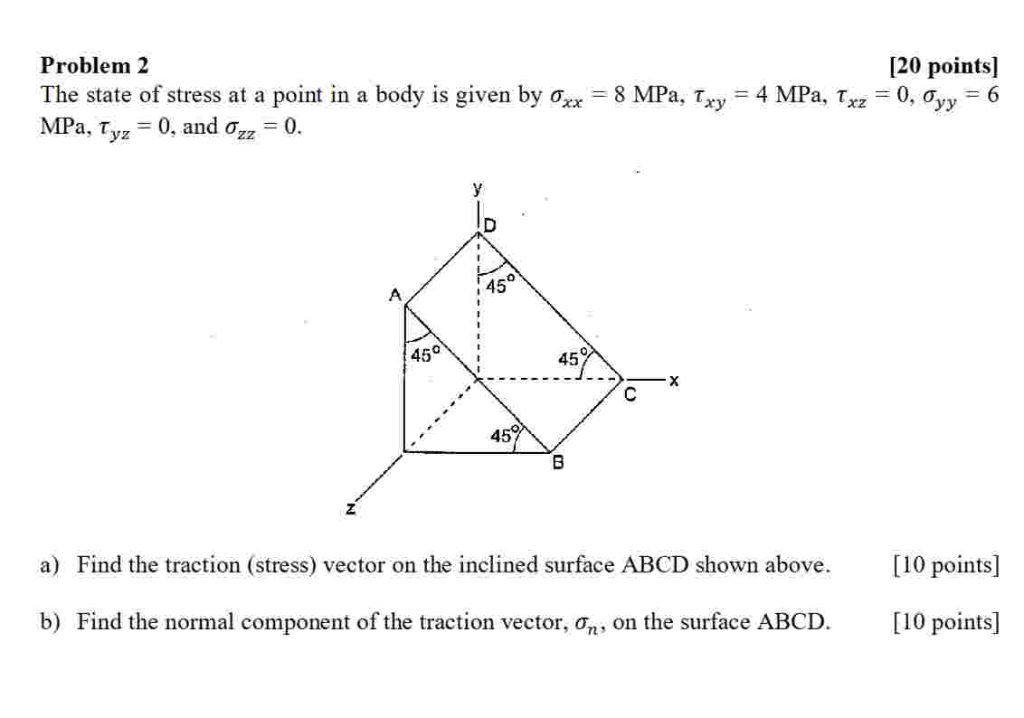 Problem 2 [20 points]
The state of stress at a point in a body is given by 0, = 8 MPa, 7,, = 4 MPa, 7,, = 0, 0,,, = 6
MPa, 7, = 0. and g,, = 0.
y :
Ip :
A ras
; 457
gmt gie—
™
/ °
z
a) Find the traction (stress) vector on the inclined surface ABCD shown above. [10 points]
b) Find the normal component of the traction vector, g,, on the surface ABCD. [10 points]
This is AI generated Response.
Asked by: gorle prasanth
Created at: 2025-09-20 01:45:50
Asked by: gorle prasanth
Created at: 2025-09-20 01:45:50
Final Answer:
Rendered
Raw Text
Did you like this answer?
Let's break down the solution step by step:
---
## **Given Data**
- \(\sigma_{xx} = 8\, \text{MPa}\)
- \(\sigma_{yy} = 6\, \text{MPa}\)
- \(\sigma_{zz} = 0\)
- \(\tau_{xy} = 4\, \text{MPa}\)
- \(\tau_{xz} = 0\)
- \(\tau_{yz} = 0\)
---
## **Step 1: Stress Tensor**
The stress tensor in matrix form is:
\[
\boldsymbol{\sigma} =
\begin{bmatrix}
8 & 4 & 0 \\
4 & 6 & 0 \\
0 & 0 & 0
\end{bmatrix}
\]
---
## **Step 2: Find the Unit Normal to Surface ABCD**
From the diagram, the surface ABCD is diagonal to the \(x, y, z\) axes. Note the surface normal points equally along \(-x, -y, -z\) (since all angles are \(45^\circ\)), so:
\[
\vec{n} = -\frac{1}{\sqrt{3}} \hat{x} - \frac{1}{\sqrt{3}} \hat{y} - \frac{1}{\sqrt{3}} \hat{z}
\]
---
## **Step 3: Traction Vector Formula**
The traction vector \(\vec{t}\) on a surface with normal \(\vec{n}\) is:
\[
\vec{t} = \boldsymbol{\sigma} \cdot \vec{n}
\]
\[
t_i = \sigma_{ij} n_j
\]
---
### **a) Traction Vector on ABCD**
Let's compute \(\vec{t}\):
\[
\vec{t} =
\begin{bmatrix}
8 & 4 & 0 \\
4 & 6 & 0 \\
0 & 0 & 0
\end{bmatrix}
\begin{bmatrix}
-\frac{1}{\sqrt{3}} \\
-\frac{1}{\sqrt{3}} \\
-\frac{1}{\sqrt{3}}
\end{bmatrix}
\]
Calculate each component:
#### **x-component:**
\[
t_x = 8\left(-\frac{1}{\sqrt{3}}\right) + 4\left(-\frac{1}{\sqrt{3}}\right) + 0 = -\frac{8}{\sqrt{3}} - \frac{4}{\sqrt{3}} = -\frac{12}{\sqrt{3}}
\]
#### **y-component:**
\[
t_y = 4\left(-\frac{1}{\sqrt{3}}\right) + 6\left(-\frac{1}{\sqrt{3}}\right) + 0 = -\frac{4}{\sqrt{3}} - \frac{6}{\sqrt{3}} = -\frac{10}{\sqrt{3}}
\]
#### **z-component:**
\[
t_z = 0 + 0 + 0 = 0
\]
So:
\[
\boxed{
\vec{t} =
\begin{bmatrix}
-\frac{12}{\sqrt{3}} \\
-\frac{10}{\sqrt{3}} \\
0
\end{bmatrix}
\text{ MPa}
}
\]
Or numerically (\(\sqrt{3} \approx 1.732\)):
\[
\vec{t} \approx
\begin{bmatrix}
-6.93 \\
-5.77 \\
0
\end{bmatrix}
\text{ MPa}
\]
---
### **b) Normal Component of Traction (\(\sigma_n\))**
The normal component is:
\[
\sigma_n = \vec{t} \cdot \vec{n}
\]
\[
\sigma_n = \left(-\frac{12}{\sqrt{3}}\right)\left(-\frac{1}{\sqrt{3}}\right) + \left(-\frac{10}{\sqrt{3}}\right)\left(-\frac{1}{\sqrt{3}}\right) + 0
\]
\[
= \frac{12}{3} + \frac{10}{3} = \frac{22}{3} = 7.33 \text{ MPa}
\]
---
## **Final Answers**
### **(a) Traction vector on ABCD:**
\[
\boxed{
\vec{t} \approx
\begin{bmatrix}
-6.93 \\
-5.77 \\
0
\end{bmatrix}
\text{ MPa}
}
\]
---
### **(b) Normal component \(\sigma_n\):**
\[
\boxed{
\sigma_n \approx 7.33\ \text{MPa}
}
\]
Question:
explanation missing each header
This is AI generated Response.
Asked by: gorle prasanth
Created at: 2025-09-20 01:46:43
Asked by: gorle prasanth
Created at: 2025-09-20 01:46:43
Final Answer:
Rendered
Raw Text
Did you like this answer?
# Problem 2: Stress Analysis
The problem requires finding the traction vector on an inclined surface and the normal component of that traction vector based on the given state of stress.
## Given Data
- Normal Stresses:
- \(\sigma_{xx} = 8\, \text{MPa}\)
- \(\sigma_{yy} = 6\, \text{MPa}\)
- \(\sigma_{zz} = 0\)
- Shear Stresses:
- \(\tau_{xy} = 4\, \text{MPa}\)
- \(\tau_{xz} = 0\)
- \(\tau_{yz} = 0\)
## Step 1: Stress Tensor
The stress tensor \(\boldsymbol{\sigma}\) is represented in matrix form as follows:
\[
\boldsymbol{\sigma} =
\begin{bmatrix}
8 & 4 & 0 \\
4 & 6 & 0 \\
0 & 0 & 0
\end{bmatrix}
\]
## Step 2: Find the Unit Normal to Surface ABCD
The surface ABCD is oriented diagonally with respect to the coordinate axes. The unit normal vector \(\vec{n}\) is given by:
\[
\vec{n} = -\frac{1}{\sqrt{3}} \hat{x} - \frac{1}{\sqrt{3}} \hat{y} - \frac{1}{\sqrt{3}} \hat{z}
\]
## Step 3: Traction Vector Formula
The traction vector \(\vec{t}\) on a surface with normal vector \(\vec{n}\) is calculated using:
\[
\vec{t} = \boldsymbol{\sigma} \cdot \vec{n}
\]
## a) Traction Vector on ABCD
Now we compute the traction vector \(\vec{t}\):
\[
\vec{t} =
\begin{bmatrix}
8 & 4 & 0 \\
4 & 6 & 0 \\
0 & 0 & 0
\end{bmatrix}
\begin{bmatrix}
-\frac{1}{\sqrt{3}} \\
-\frac{1}{\sqrt{3}} \\
-\frac{1}{\sqrt{3}}
\end{bmatrix}
\]
### Component Calculations
- **x-component**:
\[
t_x = 8\left(-\frac{1}{\sqrt{3}}\right) + 4\left(-\frac{1}{\sqrt{3}}\right) + 0 = -\frac{12}{\sqrt{3}}
\]
- **y-component**:
\[
t_y = 4\left(-\frac{1}{\sqrt{3}}\right) + 6\left(-\frac{1}{\sqrt{3}}\right) + 0 = -\frac{10}{\sqrt{3}}
\]
- **z-component**:
\[
t_z = 0 + 0 + 0 = 0
\]
Thus, the traction vector is:
\[
\boxed{
\vec{t} =
\begin{bmatrix}
-\frac{12}{\sqrt{3}} \\
-\frac{10}{\sqrt{3}} \\
0
\end{bmatrix}
\text{ MPa}
}
\]
### Numerical Approximation
Using \(\sqrt{3} \approx 1.732\):
\[
\vec{t} \approx
\begin{bmatrix}
-6.93 \\
-5.77 \\
0
\end{bmatrix}
\text{ MPa}
\]
## b) Normal Component of Traction (\(\sigma_n\))
The normal component of the traction vector is given by:
\[
\sigma_n = \vec{t} \cdot \vec{n}
\]
Calculating \(\sigma_n\):
\[
\sigma_n = \left(-\frac{12}{\sqrt{3}}\right)\left(-\frac{1}{\sqrt{3}}\right) + \left(-\frac{10}{\sqrt{3}}\right)\left(-\frac{1}{\sqrt{3}}\right) + 0
\]
\[
= \frac{12}{3} + \frac{10}{3} = \frac{22}{3} = 7.33 \text{ MPa}
\]
## Final Answers
### a) Traction vector on ABCD:
\[
\boxed{
\vec{t} \approx
\begin{bmatrix}
-6.93 \\
-5.77 \\
0
\end{bmatrix}
\text{ MPa}
}
\]
### b) Normal component \(\sigma_n\):
\[
\boxed{
\sigma_n \approx 7.33\ \text{MPa}
}
\]
📢 Instructions:
- Ask anything relatd to above question only.
- For new Question goto :