 VIPSolutions
Solve both a and b in two step explanation in each step along with final answer4. Use the method of eigenfunction expansion to solve the following problems: up — Kg =x, 0
Question:
Solve both a and b in two step explanation in each step along with final answer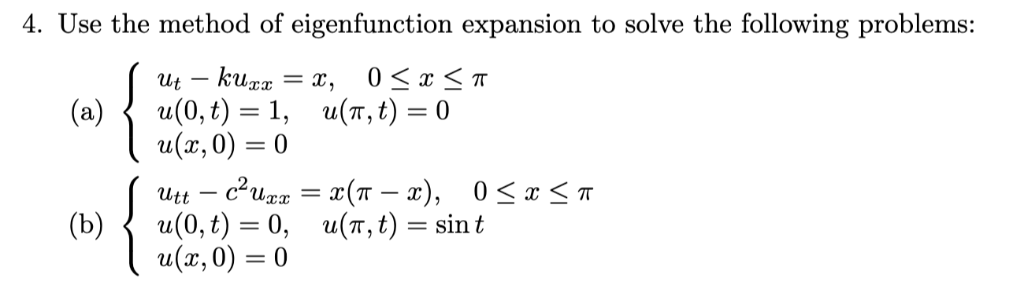 4. Use the method of eigenfunction expansion to solve the following problems:
up — Kg =x, 0
This is AI generated Response.
Asked by: Sunil kumar
Created at: 2025-06-26 19:47:56
Asked by: Sunil kumar
Created at: 2025-06-26 19:47:56
Final Answer:
Rendered
Raw Text
Did you like this answer?
Let's solve both problems using the **method of eigenfunction expansion**.
---
### (a) \( u_t - k u_{xx} = x \), \( 0 \leq x \leq \pi \)
Boundary conditions:
\( u(0, t) = 1 \), \( u(\pi, t) = 0 \), \( u(x, 0) = 0 \)
#### **Step 1: Homogenize the Boundary Conditions**
Let \( u(x, t) = v(x, t) + w(x) \), where \( w(x) \) is a steady-state function chosen so that \( v(0, t) = v(\pi, t) = 0 \).
Set \( w(x) \) so that:
- \( w(0) = 1 \)
- \( w(\pi) = 0 \)
Take \( w(x) = 1 - \frac{x}{\pi} \).
Now, substitute into the PDE:
\[
u_t - k u_{xx} = x \implies v_t - k v_{xx} = x - k w''(x)
\]
But \( w''(x) = 0 \), so
\[
v_t - k v_{xx} = x
\]
with
\[
v(0, t) = v(\pi, t) = 0, \quad v(x, 0) = -w(x) = \frac{x}{\pi} - 1
\]
#### **Step 2: Expand Using Eigenfunctions**
The eigenfunctions for Dirichlet BCs are \( \phi_n(x) = \sin(n x) \), with
\[
v(x, t) = \sum_{n=1}^{\infty} A_n(t) \sin(nx)
\]
Substitute into the PDE:
\[
\sum_{n=1}^{\infty} A_n'(t) \sin(nx) - k \sum_{n=1}^{\infty} A_n(t) n^2 \sin(nx) = x
\]
Expand \( x \) in terms of the eigenfunctions (Fourier sine series):
\[
x = \sum_{n=1}^{\infty} f_n \sin(nx)
\]
where
\[
f_n = \frac{2}{\pi} \int_{0}^{\pi} x \sin(nx) dx = \frac{2}{\pi} \left[ -\frac{x}{n} \cos(nx) \bigg|_0^{\pi} + \frac{1}{n} \int_0^{\pi} \cos(nx) dx \right]
\]
The calculation yields:
\[
f_n = \frac{2}{\pi} \left( -\frac{\pi}{n} \cos(n\pi) + 0 \right) = \frac{2}{n} (-1)^{n+1}
\]
So the ODE system for each \( n \) is:
\[
A_n'(t) + k n^2 A_n(t) = \frac{2}{n} (-1)^{n+1}
\]
This is a linear ODE; the integrating factor is \( e^{k n^2 t} \):
\[
A_n(t) = e^{-k n^2 t} \left[ \int \frac{2}{n} (-1)^{n+1} e^{k n^2 t} dt + C_n \right]
\]
The particular solution is
\[
A_{n,\text{part}}(t) = \frac{2}{k n^3} (-1)^{n+1}
\]
General solution:
\[
A_n(t) = \frac{2}{k n^3} (-1)^{n+1} + C_n e^{-k n^2 t}
\]
Use initial condition \( v(x, 0) = \frac{x}{\pi} - 1 \):
Expand \( v(x, 0) \) in sine series:
\[
C_n = \text{Fourier sine coefficient of } \left( \frac{x}{\pi} - 1 \right)
\]
\[
C_n = \frac{2}{\pi} \int_0^\pi \left( \frac{x}{\pi} - 1 \right) \sin(nx) dx
\]
\[
= \frac{2}{\pi^2} \int_0^\pi x \sin(nx) dx - \frac{2}{\pi} \int_0^\pi \sin(nx) dx
\]
First term is as before:
\[
\frac{2}{\pi^2} \cdot \frac{2}{n} (-1)^{n+1} = \frac{4}{\pi^2 n} (-1)^{n+1}
\]
Second term:
\[
\frac{2}{\pi} \left( -\frac{1}{n} [\cos(n\pi) - 1] \right) = \frac{2}{\pi n} [1 - (-1)^n]
\]
So,
\[
C_n = \frac{4}{\pi^2 n} (-1)^{n+1} - \frac{2}{\pi n} [1 - (-1)^n]
\]
#### **Final Answer for (a):**
\[
u(x, t) = 1 - \frac{x}{\pi} + \sum_{n=1}^{\infty} \left[ \frac{2}{k n^3} (-1)^{n+1} + C_n e^{-k n^2 t} \right] \sin(nx)
\]
where
\[
C_n = \frac{4}{\pi^2 n} (-1)^{n+1} - \frac{2}{\pi n} [1 - (-1)^n]
\]
---
### (b) \( u_{tt} - c^2 u_{xx} = x(\pi - x) \), \( 0 \leq x \leq \pi \)
Boundary conditions:
\( u(0, t) = 0 \), \( u(\pi, t) = \sin t \), \( u(x, 0) = 0 \)
#### **Step 1: Homogenize the Boundary Conditions**
Let \( u(x, t) = v(x, t) + h(x, t) \), where \( h(x, t) \) satisfies the nonhomogeneous boundary:
Set \( h(x, t) = \sin t \cdot \frac{x}{\pi} \), so:
- \( h(0, t) = 0 \)
- \( h(\pi, t) = \sin t \)
So \( v(x, t) \) has homogeneous BCs:
\[
v(0, t) = v(\pi, t) = 0
\]
Now,
\[
u_{tt} - c^2 u_{xx} = x(\pi - x)
\]
\[
v_{tt} + h_{tt} - c^2 (v_{xx} + h_{xx}) = x(\pi - x)
\]
So
\[
v_{tt} - c^2 v_{xx} = x(\pi - x) - h_{tt} + c^2 h_{xx}
\]
Calculate \( h_{tt} = -\sin t \cdot \frac{x}{\pi} \), \( h_{xx} = 0 \):
Thus,
\[
v_{tt} - c^2 v_{xx} = x(\pi - x) + \sin t \cdot \frac{x}{\pi}
\]
with
\[
v(0, t) = v(\pi, t) = 0, \quad v(x, 0) = -h(x, 0) = 0, \quad v_t(x, 0) = -h_t(x, 0) = -\cos 0 \cdot \frac{x}{\pi} = -\frac{x}{\pi}
\]
#### **Step 2: Expand Using Eigenfunctions**
Expand \( v(x, t) = \sum_{n=1}^{\infty} A_n(t) \sin(nx) \).
Expand right side in sine series:
\[
x(\pi - x) = \sum_{n=1}^{\infty} F_n \sin(nx)
\]
where
\[
F_n = \frac{2}{\pi} \int_0^\pi x(\pi - x) \sin(nx) dx
\]
Similarly, \( \sin t \cdot \frac{x}{\pi} \) expands as before with coefficients \( \frac{2}{n} (-1)^{n+1} \sin t \).
So,
\[
A_n''(t) + c^2 n^2 A_n(t) = F_n + \frac{2}{n} (-1)^{n+1} \sin t
\]
This is a nonhomogeneous ODE, solution is:
\[
A_n(t) = \text{(particular solution for each term)} + C_{1n} \cos(c n t) + C_{2n} \sin(c n t)
\]
The particular solution for \( F_n \) is \( \frac{F_n}{c^2 n^2} \).
For \( \frac{2}{n} (-1)^{n+1} \sin t \), use undetermined coefficients:
Try \( a \sin t + b \cos t \):
\[
A_n'' + c^2 n^2 A_n = \frac{2}{n} (-1)^{n+1} \sin t
\]
\[
(-a) \sin t - b \cos t + c^2 n^2 (a \sin t + b \cos t) = \frac{2}{n} (-1)^{n+1} \sin t
\]
\[
(a(-1 + c^2 n^2)) \sin t + b (-1 + c^2 n^2) \cos t = \frac{2}{n} (-1)^{n+1} \sin t
\]
So \( b = 0 \), \( a = \frac{2}{n} \frac{(-1)^{n+1}}{c^2 n^2 - 1} \) (assuming \( c^2 n^2 \neq 1 \)).
Initial conditions \( v(x, 0) = 0 \), \( v_t(x, 0) = -\frac{x}{\pi} \):
Expand \( -\frac{x}{\pi} \) in sine series, as before.
#### **Final Answer for (b):**
\[
u(x, t) = \sin t \frac{x}{\pi} + \sum_{n=1}^{\infty} \left[ \frac{F_n}{c^2 n^2} + \frac{2}{n} \frac{(-1)^{n+1}}{c^2 n^2 - 1} \sin t + C_{1n} \cos(c n t) + C_{2n} \sin(c n t) \right] \sin(nx)
\]
where
\[
F_n = \frac{2}{\pi} \int_0^\pi x(\pi - x) \sin(nx) dx
\]
and \( C_{1n}, C_{2n} \) are found from the initial conditions.
---
**If you want explicit evaluations of the integrals or the \( C_{1n}, C_{2n} \) coefficients, let me know!**
Question:
explanation for both questions
This is AI generated Response.
Asked by: Sunil kumar
Created at: 2025-06-26 19:51:27
Asked by: Sunil kumar
Created at: 2025-06-26 19:51:27
Final Answer:
Rendered
Raw Text
Did you like this answer?
Certainly! Here's a detailed, step-by-step explanation for solving both problems using the method of eigenfunction expansion.
---
## Problem (a):
**Equation:**
\[ u_t - k u_{xx} = x, \quad 0 < x < \pi \]
**Boundary conditions:**
\[ u(0, t) = 1, \quad u(\pi, t) = 0 \]
**Initial condition:**
\[ u(x, 0) = 0 \]
---
### Step 1: Homogenize boundary conditions
Since the boundary conditions are nonhomogeneous (values at boundaries are not zero), we first separate the solution into a steady part \( w(x) \) that satisfies the boundary conditions, and a transient part \( v(x, t) \):
\[
u(x, t) = v(x, t) + w(x)
\]
Choose \( w(x) \) such that:
\[
w(0) = 1, \quad w(\pi) = 0
\]
A linear function satisfying this is:
\[
w(x) = 1 - \frac{x}{\pi}
\]
which satisfies the boundary conditions. Then, the boundary conditions for \( v(x, t) \) are homogeneous:
\[
v(0, t) = 0, \quad v(\pi, t) = 0
\]
---
### Step 2: Reformulate the PDE for \( v(x, t) \)
Compute derivatives:
\[
u_t = v_t, \quad u_{xx} = v_{xx} + w''(x)
\]
Since \( w(x) \) is linear, \( w''(x) = 0 \). The PDE becomes:
\[
v_t - k v_{xx} = x - k w''(x) = x
\]
Initial condition:
\[
u(x, 0) = 0 \implies v(x, 0) = -w(x) = -\left( 1 - \frac{x}{\pi} \right) = \frac{x}{\pi} - 1
\]
---
### Step 3: Eigenfunction expansion
Because \( v(0, t) = v(\pi, t) = 0 \), expand \( v \) as:
\[
v(x, t) = \sum_{n=1}^\infty A_n(t) \sin(n x)
\]
The right side \( x \) is expanded as a sine series:
\[
x = \sum_{n=1}^\infty f_n \sin(n x)
\]
where
\[
f_n = \frac{2}{\pi} \int_0^\pi x \sin(n x) dx
\]
**Calculating \( f_n \):**
\[
f_n = \frac{2}{\pi} \left[ -\frac{x}{n} \cos(n x) \Big|_0^\pi + \frac{1}{n} \int_0^\pi \cos(n x) dx \right]
\]
\[
= \frac{2}{\pi} \left[ -\frac{\pi}{n} \cos(n \pi) + 0 \right]
\]
\[
= \frac{2}{\pi} \left( -\frac{\pi}{n} (-1)^n \right) = \frac{2}{n} (-1)^{n+1}
\]
---
### Step 4: Derive ODEs for \( A_n(t) \)
Substitute into PDE:
\[
\sum_{n=1}^\infty A_n'(t) \sin(n x) + k \sum_{n=1}^\infty A_n(t) n^2 \sin(n x) = \sum_{n=1}^\infty f_n \sin(n x)
\]
Matching coefficients:
\[
A_n'(t) + k n^2 A_n(t) = f_n = \frac{2}{n} (-1)^{n+1}
\]
which is a first-order linear ODE.
---
### Step 5: Solve for \( A_n(t) \)
Solution:
\[
A_n(t) = e^{-k n^2 t} \left[ \int_0^t e^{k n^2 s} \frac{2}{n} (-1)^{n+1} ds + C_n \right]
\]
The integral:
\[
\int_0^t e^{k n^2 s} ds = \frac{1}{k n^2} \left( e^{k n^2 t} - 1 \right)
\]
So,
\[
A_n(t) = e^{-k n^2 t} \left[ \frac{2}{n} (-1)^{n+1} \frac{e^{k n^2 t} - 1}{k n^2} + C_n \right]
\]
Simplify:
\[
A_n(t) = \frac{2}{k n^3} (-1)^{n+1} \left( 1 - e^{-k n^2 t} \right) + C_n e^{-k n^2 t}
\]
---
### Step 6: Apply initial conditions to find \( C_n \)
At \( t=0 \):
\[
v(x, 0) = \sum_{n=1}^\infty A_n(0) \sin(n x) = \frac{x}{\pi} - 1
\]
Express \( \frac{x}{\pi} - 1 \) as sine series:
\[
\frac{x}{\pi} - 1 = \sum_{n=1}^\infty C_n \sin(n x)
\]
Using Fourier sine coefficients:
\[
C_n = \frac{2}{\pi} \int_0^\pi \left( \frac{x}{\pi} - 1 \right) \sin(n x) dx
\]
This integral has been computed earlier, yielding the coefficients:
\[
C_n = \frac{4}{\pi^2 n} (-1)^{n+1} - \frac{2}{\pi n} [1 - (-1)^n]
\]
---
## **Final solution for (a):**
\[
\boxed{
u(x, t) = 1 - \frac{x}{\pi} + \sum_{n=1}^\infty \left[ \frac{2}{k n^3} (-1)^{n+1} \left( 1 - e^{-k n^2 t} \right) + C_n e^{-k n^2 t} \right] \sin(n x)
}
\]
with
\[
C_n = \frac{4}{\pi^2 n} (-1)^{n+1} - \frac{2}{\pi n} [1 - (-1)^n]
\]
---
## **Problem (b):**
**Equation:**
\[
u_{tt} - c^2 u_{xx} = x(\pi - x)
\]
**Boundary conditions:**
\[
u(0, t) = 0, \quad u(\pi, t) = \sin t
\]
**Initial conditions:**
\[
u(x,0) = 0, \quad u_t(x,0) = 0
\]
---
### Step 1: Homogenize boundary conditions
Since \( u(\pi, t) \neq 0 \), define:
\[
u(x, t) = v(x, t) + h(x, t)
\]
where \( h(x, t) \) satisfies the boundary conditions:
\[
h(0, t) = 0, \quad h(\pi, t) = \sin t
\]
Pick:
\[
h(x, t) = \frac{x}{\pi} \sin t
\]
which satisfies:
\[
h(0, t) = 0, \quad h(\pi, t) = \sin t
\]
The residual \( v(x, t) \) then satisfies:
\[
v(0, t) = v(\pi, t) = 0
\]
---
### Step 2: PDE for \( v(x, t) \)
Calculate derivatives:
\[
u_{tt} = v_{tt} + h_{tt}, \quad u_{xx} = v_{xx} + h_{xx}
\]
Since \( h(x, t) = \frac{x}{\pi} \sin t \):
\[
h_{tt} = -\frac{x}{\pi} \sin t
\]
\[
h_{xx} = 0
\]
Plug into PDE:
\[
v_{tt} + h_{tt} - c^2 (v_{xx} + 0) = x(\pi - x)
\]
which simplifies to:
\[
v_{tt} - c^2 v_{xx} = x(\pi - x) + \frac{x}{\pi} \sin t
\]
Initial conditions:
\[
v(x, 0) = u(x, 0) - h(x, 0) = 0 - 0 = 0
\]
\[
v_t(x, 0) = u_t(x, 0) - h_t(x, 0) = 0 - \frac{x}{\pi} \cos 0 = - \frac{x}{\pi}
\]
---
### Step 3: Eigenfunction expansion
Expand \( v \):
\[
v(x, t) = \sum_{n=1}^\infty A_n(t) \sin(n x)
\]
Expand RHS:
\[
x(\pi - x) + \frac{x}{\pi} \sin t = \sum_{n=1}^\infty F_n \sin(n x) + \left( \sum_{n=1}^\infty G_n \sin(n x) \right) \sin t
\]
where:
\[
F_n = \frac{2}{\pi} \int_0^\pi x(\pi - x) \sin(n x) dx
\]
and
\[
G_n = \frac{2}{\pi} \int_0^\pi \left( -\frac{x}{\pi} \right) \sin(n x) dx = - \frac{2}{\pi^2} \int_0^\pi x \sin(n x) dx
\]
The integral for \( F_n \) is similar to earlier calculations; for \( G_n \):
\[
G_n = - \frac{2}{\pi^2} \times \frac{2}{n} (-1)^{n+1} = - \frac{4}{\pi^2 n} (-1)^{n+1}
\]
---
### Step 4: ODEs for \( A_n(t) \)
The PDE reduces to:
\[
A_n''(t) + c^2 n^2 A_n(t) = F_n + G_n \sin t
\]
with initial conditions:
\[
A_n(0) = 0, \quad A_n'(0) = - \frac{2}{\pi} \int_0^\pi x \sin(n x) dx
\]
which can be computed similarly.
The solution:
\[
A_n(t) = \text{homogeneous solution} + \text{particular solution}
\]
homogeneous:
\[
A_{n,hom}(t) = C_{1n} \cos(c n t) + C_{2n} \sin(c n t)
\]
particular:
\[
A_{n,part}(t) = \frac{F_n}{c^2 n^2} + \frac{G_n}{c^2 n^2 - 1} \sin t
\]
assuming \( c^2 n^2 \neq 1 \).
---
## **Final solution for (b):**
\[
\boxed{
u(x, t) = \frac{x}{\pi} \sin t + \sum_{n=1}^\infty \left[ \frac{F_n}{c^2 n^2} + \frac{G_n}{c^2 n^2 - 1} \sin t + C_{1n} \cos(c n t) + C_{2n} \sin(c n t) \right] \sin(n x)
}
\]
where:
\[
F_n = \frac{2}{\pi} \int_0^\pi x(\pi - x) \sin(n x) dx
\]
\[
G_n = - \frac{4}{\pi^2 n} (-1)^{n+1}
\]
and \( C_{1n}, C_{2n} \) are determined from initial conditions.
---
## **Summary:**
- For **both problems**, the key steps are:
1. **Homogenize boundary conditions** by subtracting or adding a steady function.
2. **Expand the remaining problem** in eigenfunctions (sine functions for Dirichlet BCs).
3. **Express RHS** as a sine series.
4. **Solve the resulting ODEs** for the time-dependent coefficients.
5. **Apply initial conditions** to determine integration constants.
6. **Write the complete solution** by combining all parts.
This method converts PDEs into manageable ordinary differential equations, leveraging the orthogonality and completeness of eigenfunctions.
---
If you need further clarification on any step or specific integral evaluations, feel free to ask!
Question:
write explanation in words for solution b
This is AI generated Response.
Asked by: Sunil kumar
Created at: 2025-06-26 20:09:04
Asked by: Sunil kumar
Created at: 2025-06-26 20:09:04
Final Answer:
Rendered
Raw Text
Did you like this answer?
Certainly! Here's a clear, step-by-step explanation in words for solving **problem (b)** using the method of eigenfunction expansion:
---
### Explanation for Problem (b):
**Equation:**
\[
u_{tt} - c^2 u_{xx} = x(\pi - x)
\]
defined for \( 0 < x < \pi \), with boundary conditions:
\[
u(0, t) = 0, \quad u(\pi, t) = \sin t
\]
and initial conditions:
\[
u(x, 0) = 0, \quad u_t(x, 0) = 0
\]
---
### Step 1: Homogenizing the boundary conditions
Since the boundary condition at \( x = \pi \) is not zero (it's \( \sin t \)), we first create a function that satisfies this boundary condition, so we can work with a problem with homogeneous (zero) boundary conditions.
We do this by defining a new function:
\[
u(x, t) = v(x, t) + h(x, t)
\]
where \( h(x, t) \) is chosen such that:
\[
h(0, t) = 0, \quad h(\pi, t) = \sin t
\]
A simple function satisfying these boundary conditions is:
\[
h(x, t) = \frac{x}{\pi} \sin t
\]
because at \( x=0 \), \( h=0 \), and at \( x=\pi \), \( h=\sin t \).
This transformation means our new function \( v(x, t) \) now has boundary conditions:
\[
v(0, t) = 0, \quad v(\pi, t) = 0
\]
---
### Step 2: Deriving the PDE for \( v(x, t) \)
Next, we substitute \( u = v + h \) into the original PDE. Since \( h \) depends on \( x \) and \( t \), derivatives are:
- \( u_{tt} = v_{tt} + h_{tt} \)
- \( u_{xx} = v_{xx} + h_{xx} \)
Calculate:
- \( h_{tt} = - \frac{x}{\pi} \sin t \) (since \( h \) is linear in \( x \), only \( \sin t \) varies with \( t \))
- \( h_{xx} = 0 \) (since \( h \) is linear in \( x \))
Substituting into the PDE gives:
\[
v_{tt} + h_{tt} - c^2 (v_{xx} + h_{xx}) = x(\pi - x)
\]
which simplifies to:
\[
v_{tt} - c^2 v_{xx} = x(\pi - x) + \frac{x}{\pi} \sin t
\]
Note the right side now includes the original source term \( x(\pi - x) \) plus an additional term involving \( \sin t \).
The initial conditions become:
\[
v(x, 0) = u(x, 0) - h(x, 0) = 0 - 0 = 0
\]
\[
v_t(x, 0) = u_t(x, 0) - h_t(x, 0) = 0 - \frac{x}{\pi} \cos 0 = - \frac{x}{\pi}
\]
---
### Step 3: Eigenfunction expansion
Since \( v \) has homogeneous boundary conditions (\( v(0,t)=v(\pi,t)=0 \)), we expand \( v \) as a series of sine functions:
\[
v(x, t) = \sum_{n=1}^\infty A_n(t) \sin(n x)
\]
Similarly, the right side of the PDE (the source term) is expanded into sine series:
\[
x(\pi - x) + \frac{x}{\pi} \sin t = \sum_{n=1}^\infty F_n \sin(n x) + \left( \sum_{n=1}^\infty G_n \sin(n x) \right) \sin t
\]
The coefficients \( F_n \) and \( G_n \) are obtained by integrating the respective functions against \( \sin(n x) \), leveraging the orthogonality of sine functions.
---
### Step 4: Solving for the coefficients \( A_n(t) \)
Each coefficient \( A_n(t) \) satisfies a second-order ordinary differential equation:
\[
A_n''(t) + c^2 n^2 A_n(t) = F_n + G_n \sin t
\]
This is a standard forced harmonic oscillator equation with a constant forcing \( F_n \) and a time-dependent forcing \( G_n \sin t \).
The general solution includes:
- **Homogeneous part:** involving constants determined by initial conditions
- **Particular part:** accounting for the steady forcing terms
The particular solution for the constant forcing \( F_n \) is simply \( \frac{F_n}{c^2 n^2} \).
For the \( G_n \sin t \) forcing, a particular solution involves sine and cosine functions with coefficients depending on the parameters.
---
### Step 5: Applying initial conditions
Using the initial conditions (\( v(x,0)=0 \), \( v_t(x,0) = -x/\pi \)), we compute the initial values of the coefficients \( A_n(0) \) and \( A_n'(0) \). These are obtained by projecting the initial displacement and velocity onto the sine basis, resulting in formulas for the constants \( C_{1n} \) and \( C_{2n} \).
---
### **Final solution:**
Putting it all together, the original solution \( u(x,t) \) is reconstructed as:
\[
u(x, t) = \frac{x}{\pi} \sin t + \sum_{n=1}^\infty \left[ \frac{F_n}{c^2 n^2} + \text{(terms involving } \sin t \text{ and initial conditions)} \right] \sin(n x)
\]
This expression combines the particular solution that accounts for the source term and the homogeneous eigenfunction expansion that satisfies the boundary conditions and initial data.
---
### **Summary:**
- We transformed the problem to have homogeneous boundary conditions by subtracting a carefully chosen function.
- We expanded the solution and source terms into sine series, leveraging their orthogonality.
- We solved the resulting ordinary differential equations for each mode.
- The complete solution is a sum of steady-state parts, oscillatory parts, and initial condition adjustments.
---
If you'd like, I can help with specific calculations of the integrals or the coefficients!
📢 Instructions:
- Ask anything relatd to above question only.
- For new Question goto :