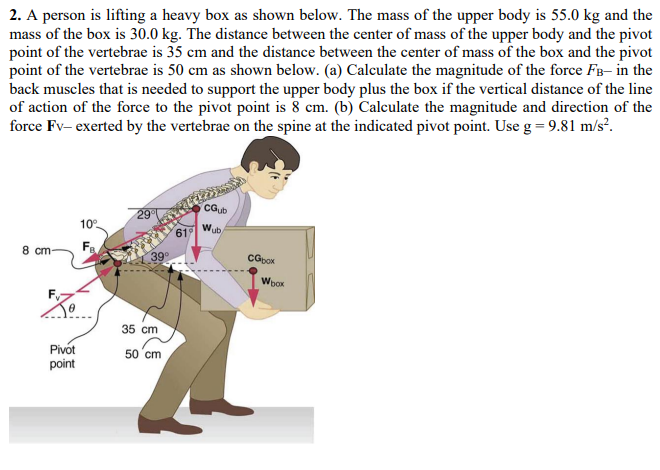
Explain theroy for each part2. A person is lifting a heavy box as shown below. The mass of the upper body is 55.0 kg and the
‘mass of the box is 30.0 kg. The distance between the center of mass of the upper body and the pivot
point of the vertebrae is 35 cm and the distance between the center of mass of the box and the pivot
point of the vertebrae is 50 cm as shown below. (a) Calculate the magnitude of the force Fis— in the
‘back muscles that is needed to support the upper body plus the box if the vertical distance of the line
of action of the force to the pivot point is 8 cm. (b) Calculate the magnitude and direction of the
force Fv— exerted by the vertebrae on the spine at the indicated pivot point. Use g = 9.81 m/s.
peg
Py
yf
10°. >
567 4
8 on— Fo BSES a
Fy: 4
ps Se
35 cm
Prt
point 50 cm
Question:
Explain theroy for each part2. A person is lifting a heavy box as shown below. The mass of the upper body is 55.0 kg and the
‘mass of the box is 30.0 kg. The distance between the center of mass of the upper body and the pivot
point of the vertebrae is 35 cm and the distance between the center of mass of the box and the pivot
point of the vertebrae is 50 cm as shown below. (a) Calculate the magnitude of the force Fis— in the
‘back muscles that is needed to support the upper body plus the box if the vertical distance of the line
of action of the force to the pivot point is 8 cm. (b) Calculate the magnitude and direction of the
force Fv— exerted by the vertebrae on the spine at the indicated pivot point. Use g = 9.81 m/s.
peg
Py
yf
10°. >
567 4
8 on— Fo BSES a
Fy: 4
ps Se
35 cm
Prt
point 50 cm
This is AI generated Response.
Asked by: Sahab Sharan
Created at: 2025-10-22 07:12:04
Final Answer:
RenderedRaw Text
Did you like this answer?
# Explanation of the for Each Part
## (a) Magnitude of the Force \( F_B \) in the Back Muscles
**Theory:**
- The force \( F_B \) in the back muscles must support the weight of both the body and the box.
- This a static equilibrium problem, where the of forces and the sum of momentstorques) be zero.
- The main idea is to calculate the moment due to the weights of the upper body and the box, and then determine the muscular force \( F_B \) required at the pivot point to counteract these moments.
- The vertical distances (perpendicular distances from the pivot to the line of action of forces) are crucial in calculating moments.
**Calculation:**
- Use the principle of moments about the pivot point:
\[
\sum \tau = \Rightarrow F_B \times \text{vertical distance} = \text{sum of moments due to weights}
\]
- The weights act vertically downward at their respective centers of mass.
- The moments are calculated as:
\[
\text{Moment} = \text{force} \times \text{distance from pivot}
\]
## (b) Magnitude and Direction of the Force \( F_v \) on the Spine
**Theory:**
- The force \( F_v \) is the vertical component of the force exerted by the vertebrae on the spine due to the load.
- It acts along the spine, at an angle \( \theta \) to the vertical.
- The force can be found by analyzing the equilibrium of forces in the vertical and horizontal directions, considering the components of \( F_v \) and the muscular forces.
- The direction (angle \( \theta \)) indicates how the vertebrae are supporting the load at an inclined angle.
**Calculation:**
- Resolve the total load into components along and perpendicular to the spine.
- Use trigonometric relations to find \( F_v \):
\[
F_v = \frac{\text{total load}}{\cos \theta}
\]
- The total load includes the weight of the upper body, the box, and the muscular support.
---
## Additional Notes:
- The distances (35 cm, 50 cm, 8 cm) and angles (29°, 39°, 61°, 10°) are used to resolve forces and moments accurately.
- Gravity \( g = 9.81\, \text{m/s}^2 \) converts mass to weight (force).
---
This theoretical framework helps in understanding how the forces are distributed in the body during lifting and how to calculate the muscular and vertebral forces involved.
VIPSolutions focuses on clear, step‑by‑step explanations so you can learn quickly. Whether you need an AI‑generated walkthrough or a short hint to get unstuck, each solution is organized for fast reading and easy review later.
Search similar questions, compare approaches, and bookmark the best answers for revision. Our goal is simple: quick, reliable study help that feels natural—not noisy.
 VIPSolutions
 2. A person is lifting a heavy box as shown below. The mass of the upper body is 55.0 kg and the
‘mass of the box is 30.0 kg. The distance between the center of mass of the upper body and the pivot
point of the vertebrae is 35 cm and the distance between the center of mass of the box and the pivot
point of the vertebrae is 50 cm as shown below. (a) Calculate the magnitude of the force Fis— in the
‘back muscles that is needed to support the upper body plus the box if the vertical distance of the line
of action of the force to the pivot point is 8 cm. (b) Calculate the magnitude and direction of the
force Fv— exerted by the vertebrae on the spine at the indicated pivot point. Use g = 9.81 m/s.
peg
Py
yf
10°. >
567 4
8 on— Fo BSES a
Fy: 4
ps Se
35 cm
Prt
point 50 cm