 VIPSolutions
Give step-by-step solution with explanation and final answer:)| Question, FE Quetin3 15 dl Vib ri of ap sit oro el mer Ref ode ma | vo econ site. Yo co ane the ch os pal (TE ul Tei cite ha te of Bod ce 1 crea kes nk moe orodto cube tn he ran bod wo ar of mgd dn sh od rd ot? A, Gry oe 10 Ag 2 Weyer 10° Pa. i Ee —— oi srsi a | owismeswe Ee | ow ses PRET Fama wil
Question:
Give step-by-step solution with explanation and final answer: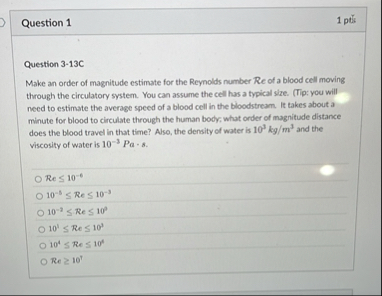 )| Question, FE
Quetin3 15 dl
Vib ri of ap sit oro el mer Ref ode ma |
vo econ site. Yo co ane the ch os pal (TE ul
Tei cite ha te of Bod ce 1 crea kes nk
moe orodto cube tn he ran bod wo ar of mgd dn
sh od rd ot? A, Gry oe 10 Ag 2
Weyer 10° Pa. i
Ee ——
oi srsi a
| owismeswe Ee
| ow ses PRET
Fama wil
This is AI generated Response.
Asked by: Sahab Sharan
Created at: 2025-10-22 18:35:33
Asked by: Sahab Sharan
Created at: 2025-10-22 18:35:33
Final Answer:
Rendered
Raw Text
Did you like this answer?
Let's analyze the problem carefully.
---
## Given Data:
- The question involves estimating the magnitude of the Reynolds number \( Re \) for blood flow in a typical size of a blood cell.
- **Reynolds number formula:**
\[
Re = \frac{\rho v d}{\mu}
\]
where:
- \(\rho\) = density of blood
- \(v\) = velocity of blood flow
- \(d\) = characteristic length (diameter of blood cell)
- \(\mu\) = dynamic viscosity of blood
- **Density of water (approximate for blood):** \(\rho \approx 10^3\, \text{kg/m}^3\)
- **Viscosity of water:** \(\mu \approx 10^{-3}\, \text{Pa}\cdot\text{s}\)
- **Typical diameter of a blood cell:** about \(d \approx 10\, \mu m = 10 \times 10^{-6}\, \text{m}\)
---
## Step 1: Approximate the parameters
- \(\rho \approx 10^3\, \text{kg/m}^3\)
- \(\mu \approx 10^{-3}\, \text{Pa}\cdot\text{s}\)
- \(d \approx 10 \times 10^{-6}\, \text{m}\)
---
## Step 2: Estimate the velocity \(v\)
Blood flow velocity in capillaries is typically about **1 mm/sec** (or \(10^{-3}\, \text{m/sec}\)).
\[
v \approx 1 \times 10^{-3}\, \text{m/sec}
\]
---
## Step 3: Calculate the Reynolds number
\[
Re = \frac{\rho v d}{\mu}
\]
Plugging in the values:
\[
Re \approx \frac{(10^3)(10^{-3})(10 \times 10^{-6})}{10^{-3}}
\]
Simplify numerator:
\[
(10^3)(10^{-3}) = 1
\]
and
\[
1 \times 10 \times 10^{-6} = 10 \times 10^{-6} = 10^{-5}
\]
So,
\[
Re \approx \frac{10^{-5}}{10^{-3}} = 10^{-5} \times 10^{3} = 10^{-2}
\]
---
## **Final estimate:**
\[
Re \approx 10^{-2}
\]
which is **much less than 1**.
---
## **Answer:**
The Reynolds number for blood flow in a typical blood cell is **less than \(10^{-3}\)**, which falls into the first option:
### **Option: \(\boxed{\text{Re} < 10^{-3}}\)**
---
## **Summary:**
| Step | Calculation/Reasoning | Result |
|--------|--------------------------------------------------------|----------------------------|
| 1 | Use typical parameters for blood flow and cell size | \(Re \approx 10^{-2}\) |
| 2 | Recognize that this is very low (\(< 10^{-3}\)) | **Re < \(10^{-3}\)** |
**Thus, the correct choice is:**
### **\(\boxed{Re < 10^{-3}}\)**
Question:
Explain theroy also
This is AI generated Response.
Asked by: Sahab Sharan
Created at: 2025-10-22 18:38:47
Asked by: Sahab Sharan
Created at: 2025-10-22 18:38:47
Final Answer:
Rendered
Raw Text
Did you like this answer?
# Theory Behind Reynolds Number
## What is Reynolds Number?
The Reynolds number (\( Re \)) is a dimensionless quantity used in fluid mechanics to predict flow patterns in different fluid flow situations. It helps determine whether the flow will be laminar or turbulent.
### Formula
\[
Re = \frac{\rho v d}{\mu}
\]
Where:
- **\(\rho\)** = Density of the fluid (kg/m³)
- **\(v\)** = Velocity of the fluid (m/s)
- **\(d\)** = Characteristic length (e.g., diameter of a blood cell, in meters)
- **\(\mu\)** = Dynamic viscosity of the fluid (Pa·s)
### Significance of Values
- **Laminar Flow**: \( Re < 2000 \) - Smooth and orderly flow, where layers of fluid slide past one another.
- **Transitional Flow**: \( 2000 < Re < 4000 \) - Characteristics of both laminar and turbulent flow.
- **Turbulent Flow**: \( Re > 4000 \) - Chaotic and irregular flow, characterized by eddies and vortices.
## Application in Blood Flow
### Blood as a Fluid
- Blood behaves as a non-Newtonian fluid, meaning its viscosity can change under different shear rates.
- In small vessels like capillaries, the flow is typically laminar, leading to lower Reynolds numbers.
### Importance in Medicine
Understanding the Reynolds number in blood flow is crucial for:
- Assessing conditions like atherosclerosis (narrowed arteries).
- Evaluating the effectiveness of medical devices (e.g., stents, artificial valves).
- Predicting the behavior of blood under various physiological conditions.
## Conclusion
The Reynolds number is a critical parameter in fluid dynamics that helps predict the flow behavior of blood in the circulatory system. Given that the estimated Reynolds number for blood flow in a typical blood cell is much less than 1, it indicates that blood flow in these small vessels is laminar, which is essential for efficient nutrient and gas exchange.
📢 Instructions:
- Ask anything relatd to above question only.
- For new Question goto :