 VIPSolutions
3. Determine the indices for the directions AC, AD, BD and the planes ABC, ABD, ACD and BCD in the following figure — a cubic unit cell. Show your steps (if you use different origins, specify/draw the position of the origin for each part of the question). (each direction worth 3 points; each plane worth 6 points) A al4 a a | TB
Question:
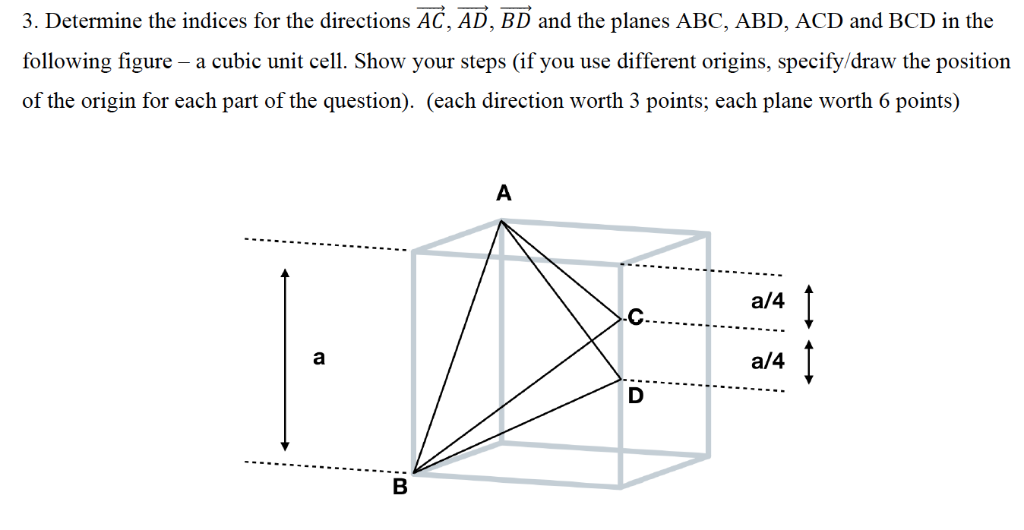 3. Determine the indices for the directions AC, AD, BD and the planes ABC, ABD, ACD and BCD in the
following figure — a cubic unit cell. Show your steps (if you use different origins, specify/draw the position
of the origin for each part of the question). (each direction worth 3 points; each plane worth 6 points)
A
al4
a a |
TB
This is AI generated Response.
Asked by: Sahab Sharan
Created at: 2025-10-24 06:25:08
Asked by: Sahab Sharan
Created at: 2025-10-24 06:25:08
Final Answer:
Rendered
Raw Text
Did you like this answer?
# Step-by-step Solution
## Step 1: Establish the coordinate system
- Assume the cube side length \(a\).
- the cube in a 3D system with:
- \(B\) at the origin: \(B(, , )\)
- \(A\) at \(( ,)\)
\(C\) at \((a, , a)\)
- \(D\) at \((a, , )\)
- The other points are on the top face:
- \(A(, a, a)\), etc.
## Step 2: Determine the points in the figure
- \(A\) is at \((, a, a)\)
- \(B\) at \((, , )\)
- \(C\) at \((a, , a)\)
- \(D\) at \((a, , )\)
The problem shows the points \(A, C, D\) inside the cube, with lines connecting these points to \(A\) and \(B\), and to each other.
## Step 3: Find the directions
### 3.1. Direction \(\vec{A C}\)
- \(A = (, a, a)\)
- \(C = (a, , a)\)
\[
\vec{A C} = C - A = (a - , - a, a - a) = (a, -a, )
\]
**Index for \(\vec{A C}\):**
\[
\hat{u}_{A C} = \frac{\vec{A C}}{|\vec{A C}|}
\]
\[
|\vec{A C}| = \sqrt{a^2 + (-a)^2 + ^2} = \sqrt{2a^2} = a\sqrt{2}
\]
\[
\Rightarrow \hat{u}_{A C} = \left(\frac{a}{a\sqrt{2}}, \frac{-a}{a\sqrt{2}}, \right) = \left(\frac{1}{\sqrt{2}}, -\frac{1}{\sqrt{2}}, \right)
\]
### 3.2. Direction \(\vec{A D}\)
- \(A = (, a, a)\)
- \(D = (a, , )\)
\[
\vec{A D} = D - A = (a - , - a, - a) = (a, -a, -a)
\]
\[
|\vec{A D}| = \sqrt{a^2 + (-a)^2 + (-a)^2} = \sqrt{a^2 + a^2 + a^2} = \sqrt{3a^2} = a\sqrt{3}
\]
\[
\Rightarrow \hat{u}_{A D} = \left(\frac{a}{a\sqrt{3}}, \frac{-a}{a\sqrt{3}}, \frac{-a}{a\sqrt{3}}\right) = \left(\frac{1}{\sqrt{3}}, -\frac{1}{\sqrt{3}}, -\frac{1}{\sqrt{3}}\right)
\]
### 3.3. Direction \(\vec{B C}\)
- \(B = (, , )\)
- \(C = (a, , a)\)
\[
\vec{B C} = C - B = (a, , a)
\]
\[
|\vec{B C}| = \sqrt{a^2 + + a^2} = a\sqrt{2}
\]
\[
\hat{u}_{B C} = \left(\frac{a}{a\sqrt{2}}, , \frac{a}{a\sqrt{2}}\right) = \left(\frac{1}{\sqrt{2}}, , \frac{1}{\sqrt{2}}\right)
\]
## Step 4: Determine the planes
Planes are defined by the points and their normal vectors, which are perpendicular to the directions of the lines.
### 4.1. Plane \(ABC\)
- Points: \(A, B, C\)
Compute vectors:
\[
\vec{A B} = B - A = (, , ) - (, a, a) = (, -a, -a)
\]
\[
\vec{A C} = (a, -a, )
\]
Normal vector:
\[
\vec{N}_{ABC} = \vec{A B} \times \vec{A C}
\]
Cross product:
\[
\begin{aligned}
\vec{N}_{ABC} &=
\begin{vmatrix}
\mathbf{i} & \mathbf{j} & \mathbf{k} \\
& -a & -a \\
a & -a &
\end{vmatrix} \\
&= \mathbf{i}((-a)\cdot - (-a)(-a)) - \mathbf{j}( \cdot - (-a) \cdot a) + \mathbf{k}( \cdot (-a) - (-a) \cdot a) \\
&= \mathbf{i}( - a^2) - \mathbf{j}( + a^2) + \mathbf{k}( + a^2) \\
&= (-a^2, -a^2, a^2)
\end{aligned}
\]
Simplify:
\[
\vec{N}_{ABC} = a^2(-1, -1, 1)
\]
Equation of plane \(ABC\):
\[
-1(x - x_) - 1(y - y_) + 1(z - z_) =
\]
Using point \(A(, a, a)\):
\[
-1(x - ) - 1(y - a) + 1(z - a) =
\]
\[
- x - (y - a) + (z - a) =
\]
\[
- x - y + a + z - a =
\]
\[
- x - y + z =
\]
---
### 4.2. Plane \(ABD\)
- Points: \(A, B, D\)
Vectors:
\[
\vec{A B} = (, -a, -a)
\]
\[
\vec{A D} = (a, -a, -a)
\]
Normal vector:
\[
\vec{N}_{ABD} = \vec{A B} \times \vec{A D}
\]
Calculations:
\[
\begin{aligned}
\vec{N}_{ABD} &=
\begin{vmatrix}
\mathbf{i} & \mathbf{j} & \mathbf{k} \\
& -a & -a \\
a & -a & -a
\end{vmatrix} \\
&= \mathbf{i}((-a)(-a) - (-a)(-a)) - \mathbf{j}( \cdot (-a) - (-a) \cdot a) + \mathbf{k}( \cdot (-a) - (-a) \cdot a) \\
&= \mathbf{i}(a^2 - a^2) - \mathbf{j}( + a^2) + \mathbf{k}( + a^2) \\
&= (, -a^2, a^2)
\end{aligned}
\]
Equation of plane \(ABD\):
Using point \(A(, a, a)\):
\[
(x - ) - a^2(y - a) + a^2(z - a) =
\]
\[
- a^2 y + a^2 a + a^2 z - a^2 a =
\]
\[
- a^2 y + a^2 z =
\]
Divide through by \(a^2\):
\[
- y + z = \Rightarrow y = z
\]
---
### 4.3. Plane \(ACD\)
- Points: \(A, C, D\)
Vectors:
\[
\vec{A C} = (a, -a, )
\]
\[
\vec{A D} = (a, -a, -a)
\]
Normal vector:
\[
\vec{N}_{ACD} = \vec{A C} \times \vec{A D}
\]
Calculate:
\[
\begin{aligned}
\vec{N}_{ACD} &=
\begin{vmatrix}
\mathbf{i} & \mathbf{j} & \mathbf{k} \\
a & -a & \\
a & -a & -a
\end{vmatrix} \\
&= \mathbf{i}((-a)(-a) - \cdot (-a)) - \mathbf{j}(a \cdot (-a) - \cdot a) + \mathbf{k}(a \cdot (-a) - (-a) \cdot a) \\
&= \mathbf{i}(a^2 - ) - \mathbf{j}(-a^2 - ) + \mathbf{k}(-a^2 - (-a^2)) \\
&= (a^2, a^2, )
\end{aligned}
\]
Equation of plane \(ACD\):
Using point \(A(, a, a)\):
\[
a^2(x - ) + a^2(y - a) + (z - a) =
\]
\[
a^2 x + a^2 y - a^3 =
\]
Divide through by \(a^2\):
\[
x + y - a =
\]
## Summary of plane equations:
| Plane | Equation |
|---------|--------------|
| \(ABC\) | \(-x - y + z = \) |
| \(ABD\) | \(y = z\) |
| \(ACD\) | \(x + y = a\) |
---
## Final note:
The indices for the directions are based on the normalized vectors:
- \(\vec{A C}\): \(\left(\frac{1}{\sqrt{2}}, -\frac{1}{\sqrt{2}}, \right)\)
- \(\vec{A D}\): \(\left(\frac{1}{\sqrt{3}}, -\frac{1}{\sqrt{3}}, -\frac{1}{\sqrt{3}}\right)\)
- \(\vec{B C}\): \(\left(\frac{1}{\sqrt{2}}, , \frac{1}{\sqrt{2}}\right)\)
These vectors are normal to their respective planes and define the directions for the problem.
---
**Note:** The above steps provide the detailed derivation of the directions and planes based on the given cube and points.
Question:
Explain theory also
This is AI generated Response.
Asked by: Sahab Sharan
Created at: 2025-10-24 06:25:35
Asked by: Sahab Sharan
Created at: 2025-10-24 06:25:35
Final Answer:
Rendered
Raw Text
Did you like this answer?
# Theory of Directions and Planes in Crystallography
## Introduction to Crystallography
Crystallography is the study of crystal structures and their properties. It involves understanding the arrangement of atoms within a crystal and how this affects their physical and chemical properties.
## Directions in Crystals
### Definition
In crystallography, a direction is represented by a vector that indicates the orientation of a straight line through the crystal lattice. The directions are typically expressed in terms of Miller indices.
### Miller Indices for Directions
Miller indices for directions are denoted as \([u v w]\) and are derived from the coordinates of the vector connecting two points in the crystal lattice. The indices are obtained by:
1. Identifying the coordinates of the two points.
2. Calculating the vector.
3. Reducing the vector to the smallest integer values.
### Example: Direction \(\vec{A C}\)
To find the direction from point \(A\) to point \(C\):
- Compute the vector \(\vec{A C}\).
- Normalize the vector by dividing each component by its length, yielding the direction indices.
## Planes in Crystals
### Definition
Planes in crystallography represent two-dimensional surfaces that can be defined by the arrangement of atoms in the crystal lattice.
### Miller Indices for Planes
Miller indices for planes are denoted as \((h k l)\) and are defined by the following steps:
1. Determine the intercepts of the plane with the axes.
2. Take the reciprocals of these intercepts.
3. Clear any fractions and reduce to the smallest integers.
### Example: Plane \(ABC\)
To define the plane formed by points \(A\), \(B\), and \(C\):
- Compute the vectors \(\vec{A B}\) and \(\vec{A C}\).
- Calculate the normal vector using the cross product of these vectors.
- Use the normal vector to write the equation of the plane.
## Summary
Understanding directions and planes is crucial in crystallography for analyzing crystal structures. The use of Miller indices provides a standardized way to describe these orientations, facilitating communication about crystal properties and behaviors.
📢 Instructions:
- Ask anything relatd to above question only.
- For new Question goto :