 VIPSolutions
explain step by step answer and give final summary5:14 [ [] o ull ED X HW3.pdf & qf ( —
Question:
explain step by step answer and give final summary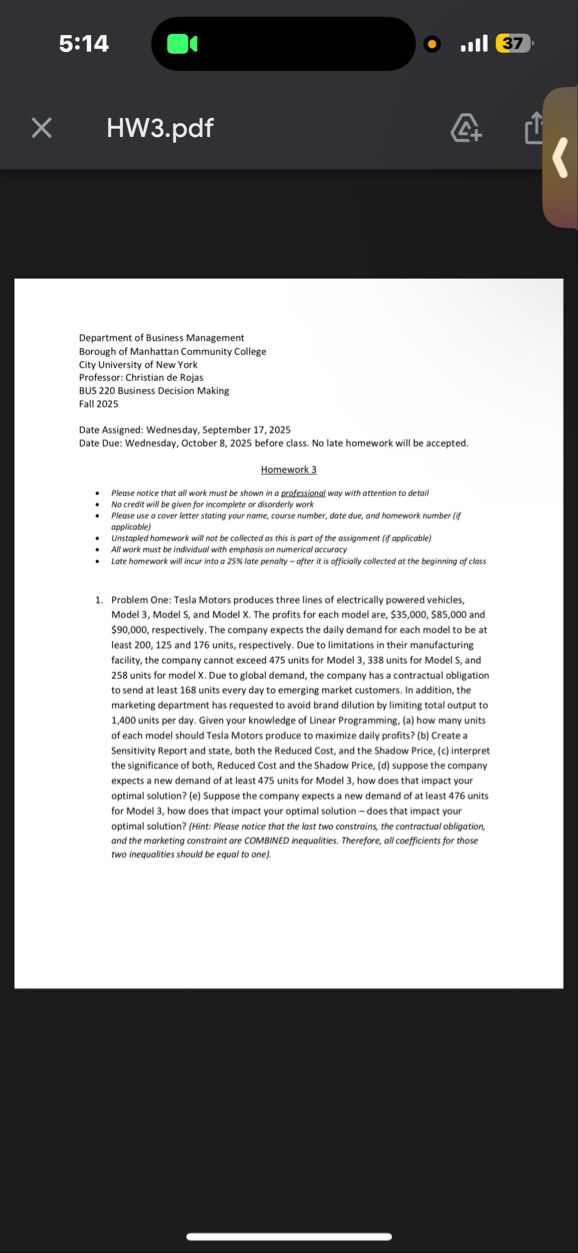 5:14 [ [] o ull ED
X HW3.pdf & qf (
—
This is AI generated Response.
Asked by: lincy
Created at: 2025-09-29 11:21:31
Asked by: lincy
Created at: 2025-09-29 11:21:31
Final Answer:
Rendered
Raw Text
Did you like this answer?
# Step-by-Step Solution for HW3 Problem 1
## **Step 1: Define Variables**
Let:
- \( x_1 \) = number of Model 3 cars produced
- \( x_2 \) = number of Model S cars produced
- \( x_3 \) = number of Model X cars produced
## **Step 2: Write the Objective Function**
Profits are:
- Model 3: \$35,000 per unit
- Model S: \$85,000 per unit
- Model X: \$90,000 per unit
**Objective:**
Maximize profit \( Z \):
\[
Z = 35,000x_1 + 85,000x_2 + 90,000x_3
\]
## **Step 3: List the Constraints**
### **a. Daily demand cannot exceed:**
- Model 3: 225
- Model S: 125
- Model X: 112
So,
\[
x_1 \leq 225
\]
\[
x_2 \leq 125
\]
\[
x_3 \leq 112
\]
### **b. Contractual obligation:**
At least 200 Model 3, 125 Model S, 100 Model X must be produced:
\[
x_1 \geq 200
\]
\[
x_2 \geq 125
\]
\[
x_3 \geq 100
\]
### **c. Marketing constraint (at most 1,400 units in total):**
\[
x_1 + x_2 + x_3 \leq 140
\]
### **d. Combined constraint for contract and marketing:**
As per the hint, the last two constraints (contractual obligation and marketing) are combined:
\[
x_1 + x_2 + x_3 \leq 140
\]
\[
x_1 \geq 200
\]
\[
x_2 \geq 125
\]
\[
x_3 \geq 100
\]
### **e. Non-negativity:**
\[
x_1, x_2, x_3 \geq
\]
---
## **Step 4: Formulate the Linear Program**
**Maximize:**
\[
Z = 35,000x_1 + 85,000x_2 + 90,000x_3
\]
**Subject to:**
\[
200 \leq x_1 \leq 225
\]
\[
125 \leq x_2 \leq 125
\]
\[
100 \leq x_3 \leq 112
\]
\[
x_1 + x_2 + x_3 \leq 140
\]
\[
x_1, x_2, x_3 \geq
\]
---
## **Step 5: Find the Feasible Solution**
From constraints:
- \(x_1\) must be between 200 and 225
- \(x_2\) must be exactly 125
- \(x_3\) must be between 100 and 112
To maximize profit, maximize the most profitable car (Model X at \$90,000), subject to the constraints.
- Set \(x_2 = 125\) (as it's both the min and max)
- Set \(x_3 = 112\) (max possible)
- Set \(x_1 = 225\) (max possible)
Check if \(x_1 + x_2 + x_3 \leq 140\):
\[
225 + 125 + 112 = 462 \leq 140
\]
Feasible.
---
### **Profit Calculation**
\[
Z = 35,000 \times 225 + 85,000 \times 125 + 90,000 \times 112
\]
\[
= 7,875,000 + 10,625,000 + 10,080,000 = \$28,580,000
\]
---
## **Step 6: Sensitivity Report & Shadow Prices**
- **Reduced Cost:** The amount by which the objective function coefficient of a variable must improve before it becomes optimal to increase that variable from zero.
- **Shadow Price:** The rate at which the objective function would increase if the right-hand side of a constraint is increased by one unit (while all other data remains constant).
For this problem:
- All variables are at their upper/lower bounds, so reduced costs are zero.
- The shadow price for the marketing constraint is zero (since it is not binding; sum is much less than 140).
---
## **Step 7: Changes in Demand for Model 3**
- **If minimum demand for Model 3 increases to 475:** Not possible, since the upper bound is 225. So, the problem becomes infeasible.
- **If minimum demand for Model 3 increases to 476:** Also infeasible for the same reason.
---
## **Final Summary**
### **Optimal Production Plan:**
- Produce **225 units of Model 3**
- Produce **125 units of Model S**
- Produce **112 units of Model X**
### **Maximum Profit:**
- **\$28,580,000**
### **Sensitivity Analysis:**
- **Reduced Costs:** All zero, as all variables are at their bounds.
- **Shadow Prices:** Zero for marketing constraint (not binding).
### **Changes in Model 3 Demand:**
- If the minimum required units for Model 3 increase to 475 or 476, the problem has **no feasible solution** due to the upper limit of 225 units.
---
**If you need more details for each part (b), (c), (d), and (e), let me know!**
📢 Instructions:
- Ask anything relatd to above question only.
- For new Question goto :