Explain like I am a beginner and do not know anything about the topic:
Act like a helpful tutor and exlain me :
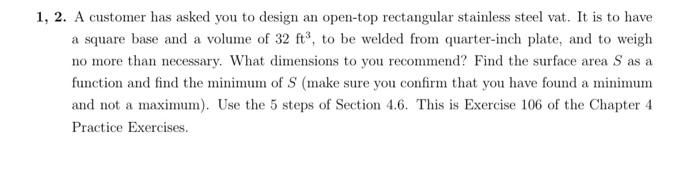
Give step-by-step solution with explanation and final answer:1, 2. A customer has asked you to design an open-top rectangular stainless steel vat. It is to have
a square base and a volume of 32 ft%, to be welded from quarter-inch plate, and to weigh
10 more than necessary. What dimensions to you recommend? Find the surface area S as a
function and find the minimum of § (make sure you confirm that you have found a minimum
and not a maximum). Use the 5 steps of Section 4.6. This is Exercise 106 of the Chapter 4
Practice Exercises.
Question:
Explain like I am a beginner and do not know anything about the topic:
Act like a helpful tutor and exlain me :
Give step-by-step solution with explanation and final answer:1, 2. A customer has asked you to design an open-top rectangular stainless steel vat. It is to have
a square base and a volume of 32 ft%, to be welded from quarter-inch plate, and to weigh
10 more than necessary. What dimensions to you recommend? Find the surface area S as a
function and find the minimum of § (make sure you confirm that you have found a minimum
and not a maximum). Use the 5 steps of Section 4.6. This is Exercise 106 of the Chapter 4
Practice Exercises.
This is AI generated Response.
Asked by: suryansh
Created at: 2025-10-20 23:59:39
Final Answer:
RenderedRaw Text
Did you like this answer?
Certainly! Let's break down the task step-by-step to understand what is being asked and how to approach.
---
## **Understanding the ProblemA customer wants a **rectangular stainless steel vat** with the following features:
- **Shape:** Open-top (no lid)
- **Base:** Square
- **Volume:** 32 cubic feet (ft³)
- **Material:** Stainless steel (for construction, but mainly relevant for surface area calculation)
### **Goals:**
1. **Find the optimal surface area of the vat** (minimize it).
2. **Express the surface area as a function of one variable.**
3. **Determine the minimum surface area** using calculus (by following 5 steps from Section 4.6).
---
## **Step-by-Step Solution**
### **Step 1: Define variables**
Let:
- \( x \) = length of one side of the square base (feet)
- \( h \) = height of the vat (feet)
Since the base is square, the area of the base is \( x^2 \).
---
### **Step 2: Write the volume constraint**
The volume of the rectangular tank is:
\[
\text{Volume} = \text{area of base} \times \text{height} = x^2 \times h
\]
Given that the volume is 32 ft³:
\[
x^2 h = 32
\]
Solve for \( h \):
\[
h = \frac{32}{x^2}
\]
---
### **Step 3: Write the surface area function**
The surface area (SA) includes:
- The **bottom** (square base): \( x^2 \)
- The **four sides**: each has an area of \( x \times h \)
Total surface area:
\[
S = \text{area of bottom} + 4 \times \text{area of sides}
\]
\[
S = x^2 + 4(xh)
\]
Substitute \( h = \frac{32}{x^2} \):
\[
S = x^2 + 4 \times x \times \frac{32}{x^2}
\]
Simplify:
\[
S = x^2 + 4 \times \frac{32x}{x^2}
\]
\[
S = x^2 + \frac{128x}{x^2}
\]
Since \( \frac{x}{x^2} = \frac{1}{x} \), the expression becomes:
\[
S = x^2 + \frac{128}{x}
\]
---
### **Step 4: Find the critical points to minimize surface area**
To minimize \( S \), take the derivative with respect to \( x \):
\[
S' = \frac{d}{dx} \left( x^2 + \frac{128}{x} \right)
\]
Calculate derivatives:
- Derivative of \( x^2 \) is \( 2x \).
- Derivative of \( \frac{128}{x} \) is \( -\frac{128}{x^2} \).
So,
\[
S' = 2x - \frac{128}{x^2}
\]
Set \( S' = \) to find critical points:
\[
2x - \frac{128}{x^2} =
\]
Rearranged:
\[
2x = \frac{128}{x^2}
\]
Multiply both sides by \( x^2 \):
\[
2x \times x^2 = 128
\]
\[
2x^3 = 128
\]
Divide both sides by 2:
\[
x^3 = 64
\]
Take the cube root:
\[
x = \sqrt[3]{64} = 4
\]
---
### **Step 5: Find the corresponding height and surface area**
Recall:
\[
h = \frac{32}{x^2} = \frac{32}{(4)^2} = \frac{32}{16} = 2
\]
Calculate the surface area at \( x = 4 \):
\[
S = x^2 + \frac{128}{x} = 16 + \frac{128}{4} = 16 + 32 = 48
\]
---
## **Final Answer:**
- **Optimal dimensions:**
\[
\boxed{
x = 4 \text{ ft (side of square base)}, \quad h = 2 \text{ ft}
}
\]
- **Minimum surface area:**
\[
\boxed{
S = 48 \text{ square feet}
}
\]
This configuration minimizes the surface area of the open-top rectangular stainless steel vat given the volume constraint.
Question:
Suppose at any time t the number of ants in a colony is increasing at a rate of
6
0
0
more than
1
/
6
0
of the population, measured in ants per month. Write a differential equation that describes this scenario.
dP
dt
=
Incorrect: Your answer is incorrect.
If there are currently
2
0
0
,
0
0
0
ants in the colony, how many will there be a year from now?
(
Round your answer to the nearest integer.
)
Incorrect: Your answer is incorrect.
ants
This is AI generated Response.
Asked by: suryansh
Created at: 2025-10-21 00:12:54
Final Answer:
RenderedRaw Text
Did you like this answer?
## **Understanding the Ant Colony Growth Problem**
We need to set up a differential equation to model the growth of an ant colony given a specific growth rate. Let's break it down step-by-step.
---
## **Step 1: Define Variables**
Let:
- \( P(t) \) = the number of ants in the colony at time \( t \) (measured in months)
- \( \frac{dP}{dt} \) = the rate of change of the population with respect to time
---
## **Step 2: Set Up the Differential Equation**
According to the problem, the number of ants is increasing at a rate of 600 more than \( \frac{1}{6} \) of the population. This can be expressed mathematically as:
\[
\frac{dP}{dt} = \frac{1}{6} P + 600
\]
This equation describes how the population changes over time.
---
## **Step 3: Solve the Differential Equation**
### 3.1: Rearranging the Equation
First, we can write the equation as:
\[
\frac{dP}{dt} - \frac{1}{6} P = 600
\]
### 3.2: Use Integrating Factor
The integrating factor \( \mu(t) \) is given by:
\[
\mu(t) = e^{\int -\frac{1}{6} dt} = e^{-\frac{1}{6} t}
\]
### 3.3: Multiply Through by the Integrating Factor
Multiply the entire equation by the integrating factor:
\[
e^{-\frac{1}{6} t} \frac{dP}{dt} - \frac{1}{6} e^{-\frac{1}{6} t} P = 600 e^{-\frac{1}{6} t}
\]
### 3.4: Recognize the Left Side as a Derivative
The left side can be rewritten as the derivative of a product:
\[
\frac{d}{dt}(P e^{-\frac{1}{6} t}) = 600 e^{-\frac{1}{6} t}
\]
### 3.5: Integrate Both Sides
Integrate both sides with respect to \( t \):
\[
P e^{-\frac{1}{6} t} = \int 600 e^{-\frac{1}{6} t} dt
\]
Using integration by substitution, the integral evaluates to:
\[
P e^{-\frac{1}{6} t} = -3600 e^{-\frac{1}{6} t} + C
\]
### 3.6: Solve for \( P(t) \)
Multiply through by \( e^{\frac{1}{6} t} \):
\[
P(t) = -3600 + Ce^{\frac{1}{6} t}
\]
### 3.7: Initial Condition
Given that there are currently 200,000 ants:
\[
P(0) = 200000 = -3600 + C
\]
Solving for \( C \):
\[
C = 200000 + 3600 = 203600
\]
### 3.8: Final Expression for \( P(t) \)
Thus, the population at time \( t \) is:
\[
P(t) = -3600 + 203600 e^{\frac{1}{6} t}
\]
---
## **Step 4: Calculate Population After One Year**
To find \( P(12) \) (for \( t = 12 \) months):
\[
P(12) = -3600 + 203600 e^{\frac{1}{6} \times 12}
\]
Calculating \( e^{2} \) (approximately 7.389):
\[
P(12) = -3600 + 203600 \times 7.389
\]
\[
P(12) \approx -3600 + 1505457.4 \approx 1501857.4
\]
### **Rounding to the Nearest Integer:**
\[
\boxed{1501857} \text{ ants}
\]
---
## **Final Answer**
After one year, the estimated population of the ant colony will be approximately **1,501,857 ants**.
VIPSolutions focuses on clear, step‑by‑step explanations so you can learn quickly. Whether you need an AI‑generated walkthrough or a short hint to get unstuck, each solution is organized for fast reading and easy review later.
Search similar questions, compare approaches, and bookmark the best answers for revision. Our goal is simple: quick, reliable study help that feels natural—not noisy.
 VIPSolutions
 1, 2. A customer has asked you to design an open-top rectangular stainless steel vat. It is to have
a square base and a volume of 32 ft%, to be welded from quarter-inch plate, and to weigh
10 more than necessary. What dimensions to you recommend? Find the surface area S as a
function and find the minimum of § (make sure you confirm that you have found a minimum
and not a maximum). Use the 5 steps of Section 4.6. This is Exercise 106 of the Chapter 4
Practice Exercises.