 VIPSolutions
Evaluate the source rock characteristics ( type ( 1 , 2 , 3 and 4 ) from the plotted geochemical results of the studied shales and coals. Use Van Krevelen diagram Give step-by-step explanation600.00000 -» 50000000 woe, % * & 40000000 |, * . . F 30000000 | + 3 ‘eo . 20000000 . AT 10000000 000000 © o © N © © N FF FFF FO fF & & & FF § SECS 5 of § © © Ff
Question:
Evaluate the source rock characteristics
(
type
(
1
,
2
,
3
and
4
)
from the plotted geochemical results of the studied shales and coals.
Use Van Krevelen
diagram
Give step-by-step explanation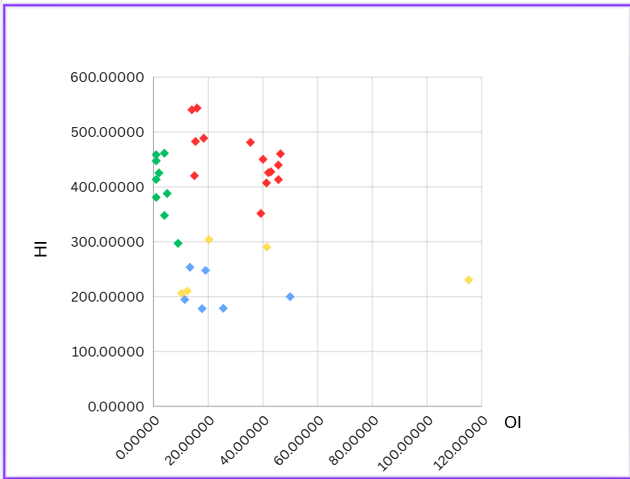 600.00000
-»
50000000 woe,
%
* &
40000000 |, *
. .
F 30000000 | + 3
‘eo
.
20000000 .
AT
10000000
000000
© o © N © © N
FF FFF FO
fF & & &
FF § SECS
5 of § © © Ff
This is AI generated Response.
Asked by: coochbehar
Created at: 2025-07-29 22:06:57
Asked by: coochbehar
Created at: 2025-07-29 22:06:57
Final Answer:
Rendered
Raw Text
Did you like this answer?
Let's evaluate the **source rock types** (Type I, II, III, IV) using the **Van Krevelen diagram** based on the provided plot of HI (Hydrogen Index) vs. OI (Oxygen Index).
---
## **Step-by-Step Explanation**
### **1. Understanding the Van Krevelen Diagram**
- **HI** (Hydrogen Index, y-axis): Indicates the hydrogen richness, usually in mg HC/g TOC.
- **OI** (Oxygen Index, x-axis): Indicates the oxygen content, usually in mg CO₂/g TOC.
**Source Rock Types:**
- **Type I:** Oil-prone (algal, lacustrine); HI > 700, OI < 50
- **Type II:** Oil & gas-prone (marine planktonic); HI ~ 300–700, OI < 50
- **Type III:** Gas-prone (terrestrial, woody); HI ~ 50–250, OI > 50
- **Type IV:** Inert, non-source (highly oxidized, reworked material); HI < 50, OI variable
---
### **2. Interpreting the Plot**
#### **Color Clusters (as per your plot):**
- **Green cluster:** HI ~ 300–500, OI < 20
- **Red cluster:** HI ~ 400–500, OI ~ 20–50
- **Yellow cluster:** HI ~ 200–300, OI ~ 20–120
- **Blue cluster:** HI ~ 150–200, OI ~ 20–60
---
### **3. Assigning Source Rock Types**
#### **A. Type I (Oil-Prone)**
- **Criteria:** HI > 700, OI < 50
- **Observation:** No samples with HI > 700, so **no clear Type I**. The highest HI is ~500.
#### **B. Type II (Oil & Gas-Prone)**
- **Criteria:** HI 300–700, OI < 50
- **Green and Red clusters** (HI: 300–500, OI: <50) fit here.
- **Interpretation:** **Green and Red clusters** are **Type II** source rocks.
#### **C. Type III (Gas-Prone)**
- **Criteria:** HI 50–250, OI > 50
- **Some Yellow and Blue clusters** (HI: 150–250, OI: 50–120) fit here.
- **Interpretation:** **Yellow and Blue clusters** are mostly **Type III** source rocks.
#### **D. Type IV (Inert)**
- **Criteria:** HI < 50, OI variable
- **Observation:** No points with HI < 50, so **no clear Type IV**.
---
### **4. Detailed Assignments from Your Plot**
| Color | HI Range | OI Range | Rock Type | Interpretation |
|--------|----------|----------|-----------|-------------------------------|
| Green | 300–500 | 0–20 | II | Good oil/gas-prone |
| Red | 400–500 | 20–50 | II | Good oil/gas-prone |
| Yellow | 200–300 | 20–120 | III | Mostly gas-prone |
| Blue | 150–200 | 20–60 | III | Gas-prone |
---
## **Summary Table**
| **Cluster** | **HI** | **OI** | **Type** | **Potential** |
|-------------|-------------|-------------|-------------|----------------------------|
| Green | 300–500 | <20 | Type II | Oil & gas-prone |
| Red | 400–500 | 20–50 | Type II | Oil & gas-prone |
| Yellow | 200–300 | 20–120 | Type III | Gas-prone |
| Blue | 150–200 | 20–60 | Type III | Gas-prone |
---
## **Conclusion**
- **Your shales and coals are mostly Type II and Type III source rocks.**
- **Type II (Oil & gas-prone):** Green and Red clusters (HI 300–500, OI < 50)
- **Type III (Gas-prone):** Yellow and Blue clusters (HI 150–300, OI 20–120)
- **No evidence for Type I (very oil-prone) or Type IV (inert) in your data.**
**This means the rocks have moderate to good oil and gas potential, with some being predominantly gas-prone.**
---
**If you have questions about specific data points, let me know!**
📢 Instructions:
- Ask anything relatd to above question only.
- For new Question goto :