 VIPSolutions
eo le titre etre 0 — = CC a — = | Sle IES rst ge er =
Question:
 eo le titre etre
0 —
=
CC a —
=
|
Sle IES
rst ge er
=
This is AI generated Response.
Asked by: Sahab Sharan
Created at: 2025-09-17 18:47:04
Asked by: Sahab Sharan
Created at: 2025-09-17 18:47:04
Final Answer:
Rendered
Raw Text
Did you like this answer?
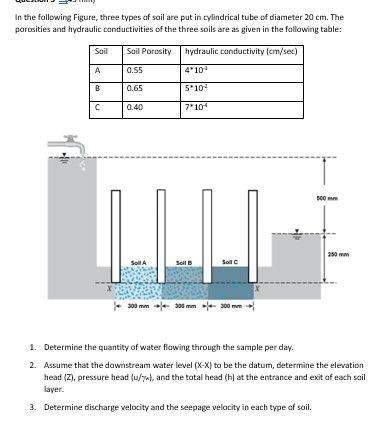
Let's solve the problem step by step, based on the provided image and data:
### **Given Data**
#### **Soil Properties Table**
| Soil Soil Porosity | Hydraulic conductivity (cm/sec) |
|------|---------------|----------------------------------|
| A | 0.55 | 4 × 10⁻⁴ |
| B | 0.65 | 5 × 10⁻⁴ |
| C | 0.40 | 7 × 10⁻⁴ |
#### **Other Data from Figure**
- Diameter of tube = 20 cm ⇒ Radius = 10 cm
- Length of each soil section = 300 mm = 30 cm
- Total length = 3 × 30 cm = 90 cm
- Water levels:
- Upstream head \( h_1 = 500 \) mm \( = 50 \) cm
- Downstream head \( h_2 = 290 \) mm \( = 29 \) cm
---
## **1. Quantity of Water Flowing Through the Sample per Day**
### **Step 1: Darcy's Law for Series Flow**
For layers in series:
\[
Q = \frac{K_{eq} \cdot A \cdot \Delta h}{L_{total}}
\]
Where:
- \( K_{eq} \) = equivalent hydraulic conductivity
- \( A \) = cross-sectional area
- \( \Delta h \) = total head drop = \( h_1 - h_2 \)
- \( L_{total} \) = total length
But for series, use:
\[
\frac{L_{total}}{K_{eq}} = \frac{L_A}{K_A} + \frac{L_B}{K_B} + \frac{L_C}{K_C}
\]
### **Step 2: Calculate Area**
\[
A = \pi r^2 = \pi (10)^2 = 314.16 \text{ cm}^2
\]
### **Step 3: Layer Lengths and \( K \) Values**
- \( L_A = L_B = L_C = 30 \) cm
- \( K_A = 4 \times 10^{-4} \) cm/sec
- \( K_B = 5 \times 10^{-4} \) cm/sec
- \( K_C = 7 \times 10^{-4} \) cm/sec
### **Step 4: Equivalent Hydraulic Conductivity**
\[
\frac{L_{total}}{K_{eq}} = \frac{L_A}{K_A} + \frac{L_B}{K_B} + \frac{L_C}{K_C}
\]
\[
\frac{90}{K_{eq}} = \frac{30}{4 \times 10^{-4}} + \frac{30}{5 \times 10^{-4}} + \frac{30}{7 \times 10^{-4}}
\]
Calculate each term:
- \( \frac{30}{4 \times 10^{-4}} = 75,000 \)
- \( \frac{30}{5 \times 10^{-4}} = 60,000 \)
- \( \frac{30}{7 \times 10^{-4}} \approx 42,857 \)
Sum:
\[
\frac{90}{K_{eq}} = 75,000 + 60,000 + 42,857 = 177,857
\]
\[
K_{eq} = \frac{90}{177,857} \approx 5.06 \times 10^{-4} \text{ cm/sec}
\]
### **Step 5: Calculate \( Q \) (per second)**
\[
\Delta h = h_1 - h_2 = 50 - 29 = 21 \text{ cm}
\]
\[
Q = \frac{K_{eq} \cdot A \cdot \Delta h}{L_{total}}
\]
\[
Q = \frac{5.06 \times 10^{-4} \times 314.16 \times 21}{90}
\]
\[
= \frac{5.06 \times 10^{-4} \times 6597.36}{90}
\]
\[
= \frac{3.34}{90}
\]
\[
= 0.0371 \text{ cm}^3/\text{sec}
\]
### **Step 6: Convert to per day**
- 1 day = 86400 sec
\[
Q_{day} = 0.0371 \times 86400 \approx 3207 \text{ cm}^3/\text{day}
\]
---
## **2. Elevation Head (\( Z \)), Pressure Head (\( u/\gamma_w \)), and Total Head (\( h \)) at Each Layer Interface**
- Assume datum at downstream water level (bottom right).
- Tube is horizontal, so elevation from datum is the vertical distance above downstream base.
**At each interface:**
- **Entrance (leftmost):**
- Elevation (\( Z \)) = 0 (datum at base of downstream)
- Pressure head = water column above = \( 50 \) cm
- Total head = \( 50 \) cm
- **After Soil A (end of A, start of B):**
- Distance from left = 30 cm
- Elevation = 0 (since datum is at the same base)
- Head loss through A: \( \Delta h_A = Q \frac{L_A}{K_A A} \)
- But since A, B, C are in series, head drops linearly.
The head drop across each layer:
\[
\Delta h = 21 \text{ cm}
\]
The proportion for each layer:
- \( \Delta h_A = \Delta h \cdot \frac{L_A / K_A}{\sum (L_i / K_i)} \)
- \( \Delta h_B = \Delta h \cdot \frac{L_B / K_B}{\sum (L_i / K_i)} \)
- \( \Delta h_C = \Delta h \cdot \frac{L_C / K_C}{\sum (L_i / K_i)} \)
Let’s compute:
Total = 177,857
- \( \Delta h_A = 21 \cdot \frac{75,000}{177,857} = 8.85 \) cm
- \( \Delta h_B = 21 \cdot \frac{60,000}{177,857} = 7.09 \) cm
- \( \Delta h_C = 21 \cdot \frac{42,857}{177,857} = 5.06 \) cm
So:
- At start (left): **Total head = 50 cm**
- After A: \( 50 - 8.85 = 41.15 \) cm
- After B: \( 41.15 - 7.09 = 34.06 \) cm
- After C: \( 34.06 - 5.06 = 29 \) cm
---
## **3. Discharge Velocity (\( v \)) and Seepage Velocity (\( v_s \))**
**Discharge velocity**:
\[
v = \frac{Q}{A}
\]
\[
v = \frac{0.0371}{314.16} = 1.18 \times 10^{-4} \text{ cm/sec}
\]
**Seepage velocity for each soil**:
\[
v_s = \frac{v}{\text{porosity}}
\]
- Soil A: \( v_{sA} = \frac{1.18 \times 10^{-4}}{0.55} = 2.15 \times 10^{-4} \) cm/sec
- Soil B: \( v_{sB} = \frac{1.18 \times 10^{-4}}{0.65} = 1.82 \times 10^{-4} \) cm/sec
- Soil C: \( v_{sC} = \frac{1.18 \times 10^{-4}}{0.40} = 2.95 \times 10^{-4} \) cm/sec
---
## **Summary Table**
| Location | Total Head (cm) |
|------------------|----------------|
| Upstream/Entrance| 50 |
| After Soil A | 41.15 |
| After Soil B | 34.06 |
| After Soil C | 29 |
| Soil | Porosity | Seepage Velocity (\( v_s \), cm/sec) |
|--------|----------|--------------------------------------|
| A | 0.55 | \( 2.15 \times 10^{-4} \) |
| B | 0.65 | \( 1.82 \times 10^{-4} \) |
| C | 0.40 | \( 2.95 \times 10^{-4} \) |
---
## **Final Answers**
1. **Quantity of water flowing per day:**
\( \boxed{3207 \ \text{cm}^3/\text{day}} \)
2. **Heads at each interface:**
- Upstream: \( 50 \) cm
- After A: \( 41.15 \) cm
- After B: \( 34.06 \) cm
- Downstream: \( 29 \) cm
3. **Discharge velocity:** \( 1.18 \times 10^{-4} \) cm/sec
**Seepage velocities:**
- Soil A: \( 2.15 \times 10^{-4} \) cm/sec
- Soil B: \( 1.82 \times 10^{-4} \) cm/sec
- Soil C: \( 2.95 \times 10^{-4} \) cm/sec
If you need the calculations in SI units or further explanations, please let me know!
📢 Instructions:
- Ask anything relatd to above question only.
- For new Question goto :