 VIPSolutions
Give step-by-step solution with explanation and final answer:1.77 Use the mesh current method to 1nd the mesh currents mn figure rl. //. Let Ky = 10Q,R, =5Q, V,=2V, V,=1V,[[=2 A. D Ry va MEE
Question:
Give step-by-step solution with explanation and final answer: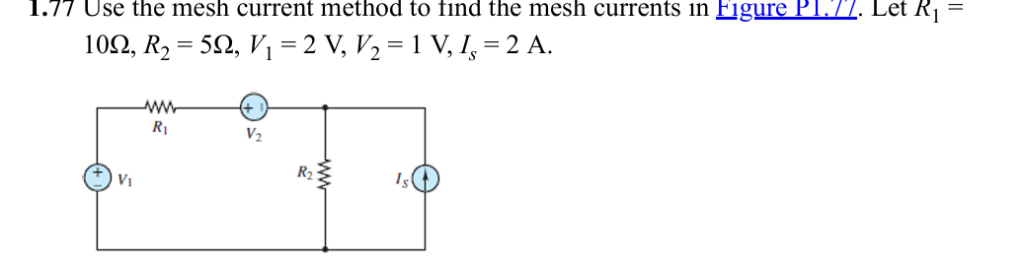 1.77 Use the mesh current method to 1nd the mesh currents mn figure rl. //. Let Ky =
10Q,R, =5Q, V,=2V, V,=1V,[[=2 A.
D
Ry va
MEE
This is AI generated Response.
Asked by: M Raju
Created at: 2025-09-08 20:27:42
Asked by: M Raju
Created at: 2025-09-08 20:27:42
Final Answer:
Rendered
Raw Text
Did you like this answer?
Let's solve the problem **step by step using the mesh current method**.
## **Given:**
- \( R_1 = 10 \Omega \)
- \( R_2 = 5 \Omega \)
- \( V_1 = 2~V \)
- \( V_2 = 1~V \)
- \( I_s = 2~A \)
Let's label the mesh currents:
- \( I_1 \) for the left mesh (clockwise)
- \( I_2 \) for the right mesh (clockwise)
### **Step 1: Assign mesh currents**
- **Left Mesh:** \( I_1 \) (flows through \( V_1 \), \( R_1 \), \( V_2 \), \( R_2 \))
- **Right Mesh:** \( I_2 \) (flows through \( R_2 \) and the current source \( I_s \))
### **Step 2: Mesh equations**
#### **Mesh 1 (Left Loop):**
Starting from the bottom left corner and moving clockwise:
- Pass \( V_1 \) (from - to +): \( -V_1 \)
- Pass \( R_1 \): \( +R_1 I_1 \)
- Pass \( V_2 \) (from + to -): \( +V_2 \)
- Pass \( R_2 \): \( +R_2 (I_1 - I_2) \) (since both mesh currents pass through \( R_2 \), in opposite directions)
**Equation:**
\[
-V_1 + R_1 I_1 + V_2 + R_2 (I_1 - I_2) = 0
\]
#### **Mesh 2 (Right Loop):**
There is a current source \( I_s \) in this mesh:
- The mesh current \( I_2 \) is **set by the current source**:
\[
I_2 = I_s = 2~A
\]
### **Step 3: Substitute values and solve**
From Mesh 2:
\[
I_2 = 2~A
\]
From Mesh 1:
\[
-2 + 10 I_1 + 1 + 5(I_1 - I_2) = 0
\]
\[
-1 + 10 I_1 + 5 I_1 - 5 I_2 = 0
\]
\[
-1 + 15 I_1 - 5 I_2 = 0
\]
\[
15 I_1 - 5 I_2 = 1
\]
Substitute \( I_2 = 2 \):
\[
15 I_1 - 5 \times 2 = 1
\]
\[
15 I_1 - 10 = 1
\]
\[
15 I_1 = 11
\]
\[
I_1 = \frac{11}{15} = 0.733~A
\]
---
## **Final Answers (with explanation):**
- **Mesh current \( I_1 \):** \(\boxed{0.733~A}\) (clockwise in the left mesh)
- **Mesh current \( I_2 \):** \(\boxed{2~A}\) (clockwise in the right mesh, set by the current source)
---
If you need current through a particular element or a check, let me know!
Question:
Each Step give me 50 Words Explaines only Theory
This is AI generated Response.
Asked by: M Raju
Created at: 2025-09-08 20:32:43
Asked by: M Raju
Created at: 2025-09-08 20:32:43
Final Answer:
Rendered
Raw Text
Did you like this answer?
Certainly! Here's a concise explanation of each step with about 50 words focusing on the theory:
**Step 1: Assign Mesh Currents**
Assigning mesh currents simplifies circuit analysis by reducing multiple unknowns into a few variables. Each mesh current circulates around a loop, and shared elements help relate currents, making it easier to write KVL equations.
**Step 2: Write Mesh Equations (KVL)**
Kirchhoff's Voltage Law states the sum of voltage drops around a closed loop equals zero. Applying KVL to each mesh relates the mesh currents through resistances and sources, forming equations solvable for unknown currents.
**Step 3: Incorporate Current Sources**
Current sources directly set the current in their branch, simplifying the analysis. The mesh current through a branch with a current source equals the source value, reducing the number of equations needed and providing constraints for solving other mesh currents.
**Step 4: Solve the Equations**
Substitute known values into the equations and solve algebraically for each mesh current. This process uses the relationships derived from KVL and the constraints from current sources, yielding the unknown currents in the circuit.
**Final Step: Interpret Results**
The calculated mesh currents reveal the current distribution in the circuit. They can be used to find branch currents and voltages across elements, completing the analysis and helping understand circuit behavior under given conditions.
📢 Instructions:
- Ask anything relatd to above question only.
- For new Question goto :