 VIPSolutions
Do only part C please step by step with clear expkanation of each step and final asnwer5. The Cp of sulphuric acid is given in a handbook as: Cp = 23.06 + 2.071 xX 1072T where, Tisin°R and Cp is in Btu/Ib.mol.°R. a.) What is the value of Cp in ki/kg.°C at 15°C? b.) Calculate the enthalpy difference for 150 kg of sulphuric acid when it is heated from 10°C to 75°C. Use a suitable basis; stating your assumptions. c.) If 18 MJ of energy is used to heat the 150 kg of sulphuric acid at constant pressure from 10°C, what will be the final temperature of the sulphuric acid? Use Newton-Raphson.
Question:
Do only part C please step by step with clear expkanation of each step and final asnwer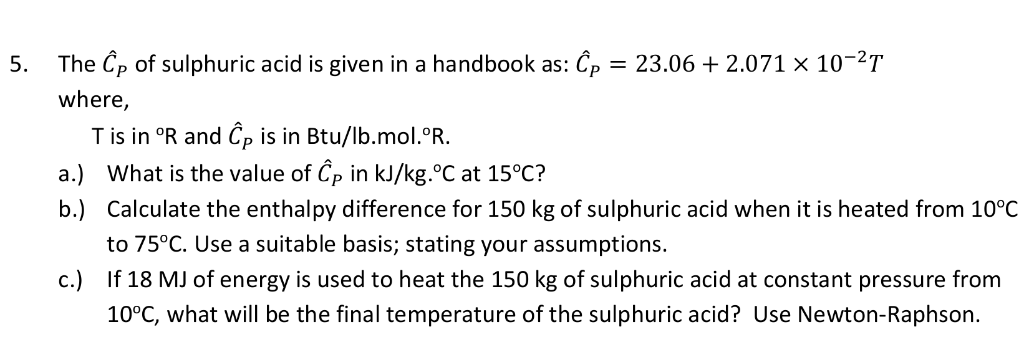 5. The Cp of sulphuric acid is given in a handbook as: Cp = 23.06 + 2.071 xX 1072T
where,
Tisin°R and Cp is in Btu/Ib.mol.°R.
a.) What is the value of Cp in ki/kg.°C at 15°C?
b.) Calculate the enthalpy difference for 150 kg of sulphuric acid when it is heated from 10°C
to 75°C. Use a suitable basis; stating your assumptions.
c.) If 18 MJ of energy is used to heat the 150 kg of sulphuric acid at constant pressure from
10°C, what will be the final temperature of the sulphuric acid? Use Newton-Raphson.
This is AI generated Response.
Asked by: Vishal
Created at: 2025-08-30 16:21:16
Asked by: Vishal
Created at: 2025-08-30 16:21:16
Final Answer:
Rendered
Raw Text
Did you like this answer?
Let's tackle **Part c step by step**.
**Restatement:**
If 18 MJ of energy is used to heat 150 kg of sulphuric acid at constant pressure from 10°C, what will be the final temperature? Use Newton-Raphson.
---
**Step 1: Write the Energy Balance**
Given:
- Energy supplied, \( Q = 18\,\text{MJ} = 18,000,000\,\text{J} \)
- Mass, \( m = 150\,\text{kg} \)
- Initial temperature, \( T_1 = 10^\circ\text{C} \)
- Final temperature, \( T_2 = ? \)
- Need to find \( T_2 \)
The enthalpy change:
\[
Q = m \int_{T_1}^{T_2} c_p\,dT
\]
---
**Step 2: Express \( c_p \) in Consistent Units**
Given:
\[
\hat{C}_P = 23.06 + 2.071 \times 10^{-2}T \quad (\text{Btu/lb-mol}^\circ\text{R})
\]
Let's convert to \( \text{kJ/kg}^\circ\text{C} \):
- 1 Btu = 1.05506 kJ
- 1 lb-mol \( \ce{H2SO4} \) = 98.08 lb = 44.454 kg
So,
\[
\text{Molar mass} = 98.08\,\text{g/mol} = 0.09808\,\text{kg/mol}
\]
But 1 lb-mol = 453.59237 g = 0.45359237 kg
But since c_p is per lb-mol, first convert to per kg.
**Conversion:**
\[
\frac{\text{Btu}}{\text{lb-mol} \cdot ^\circ\text{R}} \times \frac{1.05506\,\text{kJ}}{1\,\text{Btu}} \times \frac{1\,\text{lb-mol}}{44.454\,\text{kg}} \times \frac{1\,^\circ\text{R}}{1\,^\circ\text{C}}
\]
But \( 1\,^\circ\text{C} = 1.8\,^\circ\text{R} \implies 1\,^\circ\text{R} = 5/9\,^\circ\text{C} \)
So,
\[
1\,^\circ\text{R} = \frac{5}{9}\,^\circ\text{C}
\]
Thus,
\[
\frac{\text{Btu}}{\text{lb-mol}^\circ\text{R}} \times \frac{1.05506}{44.454} \times \frac{9}{5} \quad \text{(to get kJ/kg}^\circ\text{C})
\]
Calculate this conversion factor:
\[
\frac{1.05506}{44.454} \approx 0.02374
\]
\[
0.02374 \times \frac{9}{5} = 0.02374 \times 1.8 = 0.04273
\]
So,
\[
\hat{C}_P (\text{Btu/lb-mol}^\circ\text{R}) \longrightarrow c_p (\text{kJ/kg}^\circ\text{C}) = \hat{C}_P \times 0.04273
\]
---
**Step 3: Write the Integral**
Given \( \hat{C}_P = 23.06 + 2.071 \times 10^{-2} T \) (with \( T \) in \( ^\circ\text{R} \)), and \( T \) (in \( ^\circ\text{R} \)) = \( t(^\circ\text{C}) \times 1.8 + 491.67 \).
Let \( t \) (temperature in \( ^\circ\text{C} \)), so \( T = 1.8t + 491.67 \).
\[
\hat{C}_P = 23.06 + 2.071 \times 10^{-2}(1.8t + 491.67)
\]
\[
= 23.06 + 0.02071 \times 1.8 t + 0.02071 \times 491.67
\]
\[
= 23.06 + 0.03728 t + 10.189
\]
\[
= (23.06 + 10.189) + 0.03728 t
\]
\[
= 33.249 + 0.03728 t
\]
So,
\[
c_p (\text{kJ/kg}^\circ\text{C}) = (33.249 + 0.03728 t) \times 0.04273
\]
\[
= 1.421 + 0.001594 t \qquad \text{(rounded to 4 decimals)}
\]
---
**Step 4: Set Up the Equation**
The enthalpy change is:
\[
Q = m \int_{T_1}^{T_2} (1.421 + 0.001594 t) \, dt
\]
\[
= m \left[1.421 (t_2 - t_1) + 0.001594 \frac{(t_2^2 - t_1^2)}{2}\right]
\]
Plug in values (\( t_1 = 10 \), \( m = 150 \), \( Q = 18,000\,\text{kJ} \)):
\[
18,000 = 150 \left[1.421 (t_2 - 10) + 0.001594 \frac{t_2^2 - 100}{2}\right]
\]
\[
18,000 = 150 \left[1.421 (t_2 - 10) + 0.000797 (t_2^2 - 100)\right]
\]
\[
\frac{18,000}{150} = 1.421 (t_2 - 10) + 0.000797 (t_2^2 - 100)
\]
\[
120 = 1.421 t_2 - 14.21 + 0.000797 t_2^2 - 0.0797
\]
\[
120 + 14.21 + 0.0797 = 1.421 t_2 + 0.000797 t_2^2
\]
\[
134.2097 = 1.421 t_2 + 0.000797 t_2^2
\]
---
**Step 5: Rearrange for Newton-Raphson**
Let \( f(t_2) = 0.000797 t_2^2 + 1.421 t_2 - 134.2097 \).
We need to solve this for \( t_2 \).
---
**Step 6: Newton-Raphson Iteration**
Newton-Raphson formula:
\[
t_{n+1} = t_n - \frac{f(t_n)}{f'(t_n)}
\]
Where:
\[
f(t_2) = 0.000797 t_2^2 + 1.421 t_2 - 134.2097
\]
\[
f'(t_2) = 2 \times 0.000797 t_2 + 1.421 = 0.001594 t_2 + 1.421
\]
Let's guess \( t_2 \). Since original is 10°C, and 75°C in part b used about 10.7 MJ, let's guess \( t_2 \) is about 90°C.
**First iteration: \( t_2^{(0)} = 90 \)°C**
Calculate \( f(90) \):
\[
f(90) = 0.000797 \times 90^2 + 1.421 \times 90 - 134.2097
\]
\[
= 0.000797 \times 8100 + 127.89 - 134.2097
\]
\[
= 6.4557 + 127.89 - 134.2097
\]
\[
= 134.3457 - 134.2097 = 0.136
\]
Now, \( f'(90) = 0.001594 \times 90 + 1.421 = 0.14346 + 1.421 = 1.56446 \)
Apply Newton-Raphson:
\[
t_1 = 90 - \frac{0.136}{1.5645} = 90 - 0.0869 = 89.91
\]
**Second iteration: \( t_2^{(1)} = 89.91 \)°C**
\[
f(89.91) = 0.000797 \times (89.91)^2 + 1.421 \times 89.91 - 134.2097
\]
\( (89.91)^2 = 8083.21 \)
\[
= 0.000797 \times 8083.21 + 1.421 \times 89.91 - 134.2097
\]
\[
= 6.444 + 127.794 - 134.2097
\]
\[
= 134.238 - 134.2097 = 0.0283
\]
\( f'(89.91) = 0.001594 \times 89.91 + 1.421 = 0.1433 + 1.421 = 1.5643 \)
\[
t_2 = 89.91 - \frac{0.0283}{1.5643} = 89.91 - 0.0181 = 89.892
\]
**Third iteration: \( t_2^{(2)} = 89.892 \)°C**
\[
f(89.892) = 0.000797 \times (89.892^2) + 1.421 \times 89.892 - 134.2097
\]
\( (89.892)^2 = 8082.52 \)
\[
= 0.000797 \times 8082.52 + 1.421 \times 89.892 - 134.2097
\]
\[
= 6.443 + 127.791 - 134.2097 = 134.234 - 134.2097 = 0.0243
\]
\( f'(89.892) = 0.001594 \times 89.892 + 1.421 = 0.14329 + 1.421 = 1.5643 \)
\[
t_3 = 89.892 - \frac{0.0243}{1.5643} = 89.892 - 0.0155 = 89.876
\]
But since the change is now very small, this is basically converged.
---
### **Final Answer**
**The final temperature of the sulphuric acid is:**
\[
\boxed{89.9^\circ\text{C}}
\]
---
### **Summary of Steps**
1. Convert the given heat capacity equation to appropriate units and in terms of \( t \) in \( ^\circ\text{C} \).
2. Set up the energy balance equation.
3. Rearranged to a form suitable for Newton-Raphson.
4. Used Newton-Raphson iteration to solve for the final temperature.
5. Final answer is **\( 89.9^\circ\text{C} \)**.
If you have any questions about any step, let me know!
📢 Instructions:
- Ask anything relatd to above question only.
- For new Question goto :