 VIPSolutions
Could you please help me solve this question?3. When 1.3-cyclooctadiene is deprotonated with n-BuLi, the resultant compound undergoes electrocyclic ring closure. Upon acidification, the final product given below is being formed. Show the relative positions of hydrogen atoms on the molecule and also the ring closure mode (either conrotatory or disrotatory). Indicate the facial component(s) (s or a) that obey the Woodward-Hoffmann rule. Fh
Question:
Could you please help me solve this question?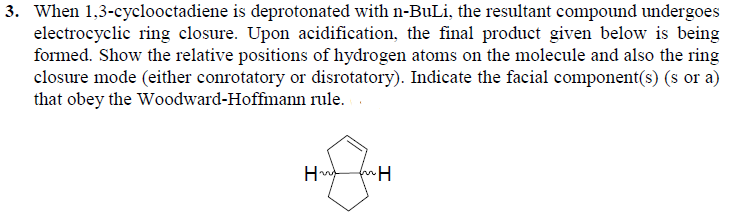 3. When 1.3-cyclooctadiene is deprotonated with n-BuLi, the resultant compound undergoes
electrocyclic ring closure. Upon acidification, the final product given below is being
formed. Show the relative positions of hydrogen atoms on the molecule and also the ring
closure mode (either conrotatory or disrotatory). Indicate the facial component(s) (s or a)
that obey the Woodward-Hoffmann rule.
Fh
This is AI generated Response.
Asked by: srivalli Mattaparthi
Created at: 2025-08-28 09:11:22
Asked by: srivalli Mattaparthi
Created at: 2025-08-28 09:11:22
Final Answer:
Rendered
Raw Text
Did you like this answer?
Let's break down the problem step by step:
### 1. **Deprotonation and Electrocyclic Ring Closure**
- **Starting Compound:** 1,3-cyclooctadiene
- **Deprotonation by n-BuLi:** Generates a cyclooctadienyl anion (10 π electrons, aromatic).
- **Electrocyclic ring closure:** This anion can undergo an **8π-electron electrocyclic reaction**.
### 2. **Woodward-Hoffmann Rules**
For an **8π system** under **thermal conditions**:
- **(4n) π electrons (n=2)**
- **Ring closure is conrotatory**.
### 3. **Product Structure**
Given is **bicyclo[4.2.0]octa-2,4-diene** (the "barrelene" skeleton), with two hydrogens on the bridgehead positions.
### 4. **Relative Positions of Hydrogens**
- Upon ring closure, the two terminal hydrogens (at C1 and C8 of cyclooctadiene) will **move either both "up" or both "down"** (conrotatory motion).
- The hydrogens will **end up on the same face** (both wedges or both dashes).
### 5. **Which Facial Component (s or a)?**
- The two hydrogens are **syn** (same face).
- **s** = syn, **a** = anti.
- **Conrotatory closure** gives **syn** placement.
### 6. **Summary Table**
| Ring Closure Mode | Hydrogens (Relative Position) | Obeyed by |
|-------------------|-------------------------------|-----------|
| **Conrotatory** | Both on the same face ("syn") | This reaction (thermal 8π) |
| Disrotatory | On opposite faces ("anti") | Not allowed for 8π thermal |
### 7. **Diagram**
Mark the hydrogens as both wedges (or both dashes):
```
____
/ \
| |
| |
\______/
| |
H H
```
*Both hydrogens are on the same side of the molecule (either both up or both down).*
---
## **Final Answer**
- The **ring closure mode is conrotatory**.
- The **two hydrogens are on the same face** (syn).
- The reaction **obeys the Woodward-Hoffmann rule** for a thermal 8π system.
**Facial component:** **syn (s)**
**Mode:** **conrotatory**
**Hydrogens:** Both on the same face (e.g., both wedges or both dashes).
If you need a clear drawing, let me know!
Question:
give correct diagram
This is AI generated Response.
Asked by: srivalli Mattaparthi
Created at: 2025-08-28 09:12:17
Asked by: srivalli Mattaparthi
Created at: 2025-08-28 09:12:17
Final Answer:
Rendered
Raw Text
Did you like this answer?
Certainly! Here's a clear representation of the final product with the relative positions of the hydrogens and the ring closure mode:
### Step-by-step explanation:
1. **Initial Deprotonation and Ring Closure:**
- Deprotonation of 1,3-cyclooctadiene with n-BuLi forms an 8π-electron anion.
- Under thermal conditions, this electrocyclic ring closure proceeds via a **conrotatory** mode (per the Woodward-Hoffmann rules for 8π electrons).
2. **Resultant Structure:**
- The product is **bicyclo[4.2.0]octa-2,4-diene**.
- The key feature is that the two terminal hydrogens (originally on carbons 1 and 8) end up **on the same face** of the newly formed ring system—this is characteristic of **conrotatory** closure.
---
### Diagram of the Final Product with Hydrogens:
Here's a simplified 2D representation:
```
____
/ \
| |
| |
\____/
/ \
H H
```
- The **two hydrogens (H)** are **both on the same face** of the bicyclo[4.2.0]octa-2,4-diene system.
- In a more detailed stereochemical notation, these hydrogens are **either both wedges (coming out of the plane)** or **both dashes (going behind the plane)**, indicating syn (same face) positioning.
---
### Summary:
- **Ring closure mode:** **Conrotatory**
- **Hydrogen positions:** **Syn (both on the same face)**
- **Obeys:** **Woodward-Hoffmann rule for a thermal 8π-electron electrocyclic reaction**
If you'd like, I can provide a 3D stereochemical diagram or a more detailed structural formula.
📢 Instructions:
- Ask anything relatd to above question only.
- For new Question goto :