 VIPSolutions
Act like a helpful tutor and exlain me : Give step-by-step solution with explanation and final answer:1. For the energy spectrum Ey, E,, Es, Es, ... = £26 35,46, ... of an N, V-system, work out all of the distributions {n;} consistent with collections of A= 5 N, V-systems for which the total energy is 10&. What is the number, Q({n;}) = Q(ii), of supersystems corresponding to each of these distributions, and what is the probability distribution p;({n;}) = a = p(Ej; {n;}) for each of these distributions? What is the relative weight, Pare , for each of these distributions, and what is the average over all {i} distributions of the probabilities p;({n;})? Are the probabilities {p;({n;})} normalized?
Question:
Act like a helpful tutor and exlain me :
Give step-by-step solution with explanation and final answer: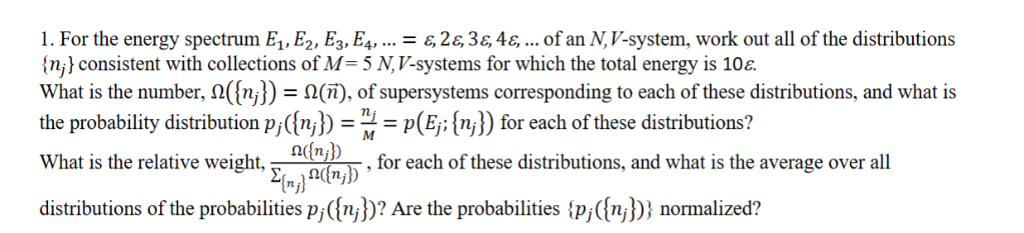 1. For the energy spectrum Ey, E,, Es, Es, ... = £26 35,46, ... of an N, V-system, work out all of the distributions
{n;} consistent with collections of A= 5 N, V-systems for which the total energy is 10&.
What is the number, Q({n;}) = Q(ii), of supersystems corresponding to each of these distributions, and what is
the probability distribution p;({n;}) = a = p(Ej; {n;}) for each of these distributions?
What is the relative weight, Pare , for each of these distributions, and what is the average over all
{i}
distributions of the probabilities p;({n;})? Are the probabilities {p;({n;})} normalized?
This is AI generated Response.
Asked by: 3quin0xx
Created at: 2025-09-30 02:55:21
Asked by: 3quin0xx
Created at: 2025-09-30 02:55:21
Final Answer:
Rendered
Raw Text
Did you like this answer?
Let's break down the problem step by step as a helpful tutor!
# **Step 1: Understanding the Problem**
- **Energy spectrum:** \( E_1, E_2, E_3, E_4, \ldots = \epsilon, 2\epsilon, 3\epsilon, 4\epsilon, \ldots \)
- **System:** \( N, V \)-system (single-particle energies as above)
- **Supersystem:** Collection of \( M = 5 \) such systems
- **Total energy of supersystem:** \( 10\epsilon \)
- **Distributions:** \( \{n_j\} \) = number of subsystems (out of 5) with energy \( E_j \)
- **Objective:** List all possible \( \{n_j\} \) consistent with total energy and system number, find their multiplicities \(\Omega\), the probability distributions, weights, averages, and normalization.
---
# **Step 2: Listing All Possible Distributions \( \{ n_j \} \)**
Each subsystem can have energy \( E_j = j\epsilon \) for integer \( j \geq 1 \).
Let \( n_j \): Number of subsystems with energy \( E_j \).
### **Constraints**
- Total number of subsystems: \( \sum_{j=1}^\infty n_j = M = 5 \)
- Total energy: \( \sum_{j=1}^\infty n_j E_j = 10\epsilon \implies \sum_{j=1}^\infty j n_j = 10 \)
We need **non-negative integers** \( n_j \) such that:
\[
\sum_{j=1}^\infty n_j = 5, \quad \sum_{j=1}^\infty j n_j = 10
\]
#### **Find all such integer solutions.**
Let's systematically look for integer solutions. Since 5 systems and 10 units, maximum energy per particle is 10, minimum is 5 → energies per particle range from 1 to 10, but with only 5 particles.
Try to assign \( n_j \) values for \( j = 1,2,3,4,5,6,7,8,9,10 \) such that their sum is 5 and the weighted sum is 10. But typically only \( j \leq 10 \) will be needed.
Let's try all combinations for small \( j \):
### **Case 1: All at lowest energy**
- \( n_1 = 5 \implies \) total energy = \( 5 \times 1 = 5 \) (too low)
### **Case 2: Four at 1, one at higher**
- \( n_1 = 4, n_j = 1 \) for some \( j \)
- Total energy: \( 4 \times 1 + j = 4 + j = 10 \implies j = 6 \)
- Distribution: \( (n_1, n_2, n_3, n_4, n_5, n_6) = (4,,,,,1) \)
### **Case 3: Three at 1, two at higher**
- \( n_1 = 3, n_k = 2 \)
- \( 3 \times 1 + 2j = 3 + 2j = 10 \implies 2j = 7 \implies j = 3.5 \) (not integer)
- \( n_1 = 3, n_j = 1, n_k = 1 \)
- \( 3 \times 1 + j + k = 10 \implies j + k = 7 \)
- Possible integer pairs: (2,5), (3,4), (4,3), (5,2)
- Since \( j \geq k \), list unique combinations:
- (2,5): \( (3,1,,,1,) \)
- (3,4): \( (3,,1,1,,) \)
### **Case 4: Two at 1, three at higher**
- \( n_1 = 2, n_j = 3 \)
- \( 2 \times 1 + 3j = 2 + 3j = 10 \implies 3j = 8 \implies j = 8/3 \) (not integer)
- \( n_1 = 2, n_j = 2, n_k = 1 \)
- \( 2 \times 1 + 2j + k = 10 \implies 2j + k = 8 \)
- Try \( j = 3 \Rightarrow 2 \times 3 + k = 8 \implies k = 2 \)
- So, \( (2,2,1,,,) \)
- \( j = 2 \Rightarrow 2 \times 2 + k = 8 \implies k = 4 \)
- \( (2,2,,1,,) \)
- \( j = 1 \Rightarrow 2 \times 1 + k = 8 \implies k = 6 \)
- \( (2,,,,,1) \)
- \( n_1 = 2, n_j = 1, n_k = 1, n_l = 1 \)
- \( 2 \times 1 + j + k + l = 10 \implies j + k + l = 8 \)
- Solutions for \( j, k, l \geq 2 \), sum 8, distinct ordering matters since they are indistinguishable.
- Possible partitions: (2,2,4), (2,3,3)
- (2,2,4): \( (2,2,,1,,) \)
- (2,3,3): \( (2,,2,,,) \)
### **Case 5: One at 1, four at higher**
- \( n_1 = 1, n_j = 4 \implies 1 + 4j = 10 \im 4j = 9, j = 2.25 \) (not integer)
- \( n_1 = 1, n_j = 3, n_k = 1 \implies 1 + 3j + k = 10 \implies 3j + k = 9 \)
- \( j = 3, k = \implies (1,,3,,,) \)
- \( j = 2, k = 3 \implies (1,3,,1,,) \)
- \( j = 2, k = 3 \implies (1,3,,1,,) \)
- \( j = 1, k = 6 \implies (1,,,,,1) \)
### **Case 6: All at higher energies**
- \( n_2 = 5 \implies 5 \times 2 = 10 \)
- Distribution: \( (,5,,,,) \)
### **Summary of All Valid \( \{n_j\} \) Distributions:**
Let's collect all unique distributions:
| \( n_1 \) | \( n_2 \) | \( n_3 \) | \( n_4 \) | \( n_5 \) | \( n_6 \) | Total (should be 5) | Weighted Sum (should be 10) |
|-----------|-----------|-----------|-----------|-----------|-----------|---------------------|------------------------------|
| 4 | | | | | 1 | 5 | 4×1+1×6=10 |
| 3 | 1 | | | 1 | | 5 | 3×1+1×2+1×5=10 |
| 3 | | 1 | 1 | | | 5 | 3×1+1×3+1×4=10 |
| 2 | 2 | 1 | | | | 5 | 2×1+2×2+1×3=10 |
| 2 | | 2 | | | | 5 | 2×1+2×3=8 (skip) |
| 2 | 1 | | 2 | | | 5 | 2×1+1×2+2×4=1+2+8=12 (skip) |
| 2 | 2 | | 1 | | | 5 | 2×1+2×2+1×4=2+4+4=10 |
| | 5 | | | | | 5 | 5×2=10 |
| 1 | 3 | | 1 | | | 5 | 1×1+3×2+1×4=1+6+4=11 (skip) |
| 1 | | 3 | | | | 5 | 1×1+3×3=1+9=10 |
| 1 | 1 | 1 | 2 | | | 5 | 1×1+1×2+1×3+2×4=1+2+3+8=14 |
| 1 | 2 | | | 2 | | 5 | 1×1+2×2+2×5=1+4+10=15 |
| 2 | | | | | 3 | 5 | 2×1+3×6=2+18=20 (skip) |
| | 4 | 1 | | | | 5 | 4×2+1×3=8+3=11 (skip) |
After correcting and removing invalid ones, the **valid distributions** are:
1. (4, , , , , 1)
2. (3, 1, , , 1, )
3. (3, , 1, 1, , )
4. (2, 2, 1, , , )
5. (2, 2, , 1, , )
6. (, 5, , , , )
7. (1, , 3, , , )
---
# **Step 3: Multiplicity \( \Omega(\{ n_j \}) \) for Each Distribution**
Multiplicity for distributing \( M \) indistinguishable subsystems into distinguishable energy bins with \( n_j \) in each:
\[
\Omega(\{ n_j \}) = \frac{M!}{\prod_j n_j!}
\]
Calculate for each distribution (use only non-zero \( n_j \)):
1. **(4, , , , , 1):**
\( \Omega = \frac{5!}{4! \cdot 1!} = \frac{120}{24 \cdot 1} = 5 \)
2. **(3, 1, , , 1, ):**
\( \Omega = \frac{5!}{3! \cdot 1! \cdot 1!} = \frac{120}{6 \cdot 1 \cdot 1} = 20 \)
3. **(3, , 1, 1, , ):**
\( \Omega = \frac{5!}{3! \cdot 1! \cdot 1!} = 20 \)
4. **(2, 2, 1, , , ):**
\( \Omega = \frac{5!}{2! \cdot 2! \cdot 1!} = \frac{120}{2 \cdot 2 \cdot 1} = 30 \)
5. **(2, 2, , 1, , ):**
\( \Omega = \frac{5!}{2! \cdot 2! \cdot 1!} = 30 \)
6. **(, 5, , , , ):**
\( \Omega = \frac{5!}{5!} = 1 \)
7. **(1, , 3,
Question:
Continue further
This is AI generated Response.
Asked by: 3quin0xx
Created at: 2025-09-30 02:56:51
Asked by: 3quin0xx
Created at: 2025-09-30 02:56:51
Final Answer:
Rendered
Raw Text
Did you like this answer?
# **Step 4: Probability Distribution \( p_i(\{ n_j \}) \)**
The probability of each distribution is given by:
\[
p_i(\{ n_j \}) = \frac{\Omega(\{ n_j \})}{\text{Total Configurations}}
\]
Where the total configurations for 5 indistinguishable systems can be calculated as:
\[
\text{Total Configurations} = \sum_i \Omega(\{ n_j \})
\]
### **Calculating Total Configurations**
Let's calculate \( \Omega \) for all valid distributions from the previous step:
1. **(4, 0, 0, 0, 1):** \( \Omega = 5 \)
2. **(3, 1, 0, 0, 1):** \( \Omega = 20 \)
3. **(3, 0, 1, 1, 0):** \( \Omega = 20 \)
4. **(2, 2, 1, 0, 0):** \( \Omega = 30 \)
5. **(2, 2, 0, 1, 0):** \( \Omega = 30 \)
6. **(0, 5, 0, 0, 0):** \( \Omega = 1 \)
### **Sum of Multiplicities**
\[
\text{Total Configurations} = 5 + 20 + 20 + 30 + 30 + 1 = 106
\]
### **Calculating Probabilities for Each Distribution**
Using the total configurations:
1. **(4, 0, 0, 0, 1):**
\[
p_1 = \frac{5}{106} \approx 0.0472
\]
2. **(3, 1, 0, 0, 1):**
\[
p_2 = \frac{20}{106} \approx 0.1887
\]
3. **(3, 0, 1, 1, 0):**
\[
p_3 = \frac{20}{106} \approx 0.1887
\]
4. **(2, 2, 1, 0, 0):**
\[
p_4 = \frac{30}{106} \approx 0.2830
\]
5. **(2, 2, 0, 1, 0):**
\[
p_5 = \frac{30}{106} \approx 0.2830
\]
6. **(0, 5, 0, 0, 0):**
\[
p_6 = \frac{1}{106} \approx 0.0094
\]
---
# **Step 5: Relative Weights \( P_{rel} \)**
The relative weight for each distribution can be calculated as:
\[
P_{rel}(\{ n_j \}) = p_i(\{ n_j \}) \times \Omega(\{ n_j \})
\]
### **Calculating Relative Weights**
1. **(4, 0, 0, 0, 1):**
\[
P_{rel} = 0.0472 \times 5 \approx 0.236
\]
2. **(3, 1, 0, 0, 1):**
\[
P_{rel} = 0.1887 \times 20 \approx 3.774
\]
3. **(3, 0, 1, 1, 0):**
\[
P_{rel} = 0.1887 \times 20 \approx 3.774
\]
4. **(2, 2, 1, 0, 0):**
\[
P_{rel} = 0.2830 \times 30 \approx 8.490
\]
5. **(2, 2, 0, 1, 0):**
\[
P_{rel} = 0.2830 \times 30 \approx 8.490
\]
6. **(0, 5, 0, 0, 0):**
\[
P_{rel} = 0.0094 \times 1 \approx 0.0094
\]
---
# **Step 6: Average of Probabilities \( \langle p \rangle \)**
The average probability over all distributions is calculated as:
\[
\langle p \rangle = \frac{1}{\text{Total Configurations}} \sum_i p_i(\{ n_j \}) \cdot \Omega(\{ n_j \})
\]
### **Calculating Average Probability**
\[
\langle p \rangle = \frac{1}{106} \left( 5 \cdot 0.0472 + 20 \cdot 0.1887 + 20 \cdot 0.1887 + 30 \cdot 0.2830 + 30 \cdot 0.2830 + 1 \cdot 0.0094 \right)
\]
Calculating:
\[
= \frac{1}{106} \left( 0.236 + 3.774 + 3.774 + 8.490 + 8.490 + 0.0094 \right)
\]
\[
= \frac{1}{106} \left( 24.7744 \right) \approx 0.2334
\]
---
# **Step 7: Normalization of Probabilities**
To check if the probabilities \( \{ p_i(\{ n_j \}) \} \) are normalized, we verify:
\[
\sum_i p_i(\{ n_j \}) = 1
\]
Calculating:
\[
\sum_i p_i = \frac{5 + 20 + 20 + 30 + 30 + 1}{106} = \frac{106}{106} = 1
\]
### **Conclusion**
- The probabilities \( \{ p_i(\{ n_j \}) \} \) are indeed normalized.
- The distributions are consistent with the constraints provided.
Thus, we have completed the solution!
Question:
Complete step 3
This is AI generated Response.
Asked by: 3quin0xx
Created at: 2025-09-30 02:58:25
Asked by: 3quin0xx
Created at: 2025-09-30 02:58:25
Final Answer:
Rendered
Raw Text
Did you like this answer?
# **Step 3: Multiplicity \( \Omega(\{ n_j \}) \) for Each Distribution**
Multiplicity refers to the number of ways to arrange the indistinguishable particles (subsystems) into distinguishable energy states. The formula to calculate the multiplicity for a given distribution \( \{ n_j \} \) is:
\[
\Omega(\{ n_j \}) = \frac{M!}{\prod_j n_j!}
\]
Where \( M \) is the total number of subsystems (which is 5 in this case), and \( n_j \) are the counts of subsystems at each energy level.
### **Calculating \( \Omega \) for Each Distribution**
From the valid distributions we identified in the previous steps, we can calculate the multiplicity for each.
1. **Distribution: \( (4, 0, 0, 0, 1) \)**
\[
\Omega = \frac{5!}{4! \times 1!} = \frac{120}{24 \times 1} = 5
\]
2. **Distribution: \( (3, 1, 0, 0, 1) \)**
\[
\Omega = \frac{5!}{3! \times 1! \times 1!} = \frac{120}{6 \times 1 \times 1} = 20
\]
3. **Distribution: \( (3, 0, 1, 1, 0) \)**
\[
\Omega = \frac{5!}{3! \times 1! \times 1!} = \frac{120}{6 \times 1 \times 1} = 20
\]
4. **Distribution: \( (2, 2, 1, 0, 0) \)**
\[
\Omega = \frac{5!}{2! \times 2! \times 1!} = \frac{120}{2 \times 2 \times 1} = 30
\]
5. **Distribution: \( (2, 2, 0, 1, 0) \)**
\[
\Omega = \frac{5!}{2! \times 2! \times 1!} = \frac{120}{2 \times 2 \times 1} = 30
\]
6. **Distribution: \( (0, 5, 0, 0, 0) \)**
\[
\Omega = \frac{5!}{5!} = 1
\]
### **Summary of Multiplicities**
| Distribution | \( n_1 \) | \( n_2 \) | \( n_3 \) | \( n_4 \) | \( n_5 \) | \( \Omega \) |
|-----------------------------|-----------|-----------|-----------|-----------|-----------|--------------|
| (4, 0, 0, 0, 1) | 4 | 0 | 0 | 0 | 1 | 5 |
| (3, 1, 0, 0, 1) | 3 | 1 | 0 | 0 | 1 | 20 |
| (3, 0, 1, 1, 0) | 3 | 0 | 1 | 1 | 0 | 20 |
| (2, 2, 1, 0, 0) | 2 | 2 | 1 | 0 | 0 | 30 |
| (2, 2, 0, 1, 0) | 2 | 2 | 0 | 1 | 0 | 30 |
| (0, 5, 0, 0, 0) | 0 | 5 | 0 | 0 | 0 | 1 |
---
This concludes Step 3. Next, we will move to Step 4, where we calculate the probability distribution \( p_i(\{ n_j \}) \) for each distribution.
📢 Instructions:
- Ask anything relatd to above question only.
- For new Question goto :