Act like a helpful tutor and exlain me :A manufacturing unit operates on a monthly production cycle to produce a single standardized product.
Demand is steady throughout the year, and inventory is maintained to ensure uninterrupted production and
dispatch. The management is reviewing its current inventory strategy and exploring ways to reduce total costs
through optimized ordering, storage, and scheduling processes.
Raw materials are procured in batches. The supplier delivers materials 4 working days after an order is placed.
There are 25 working days in a month. All units produced are sold, and there is no backlog. The
management wants to determine optimal inventory and ordering levels to minimize the combined cost of
ordering and holding.
Below is the available data:
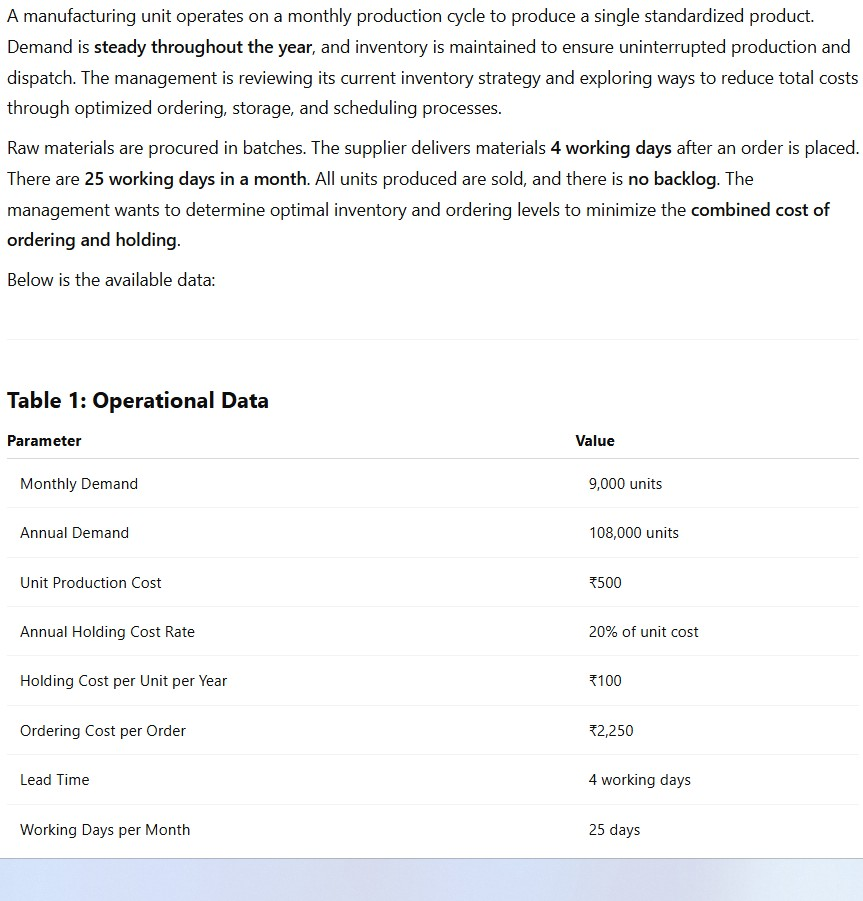
Table 1: Operational Data
Parameter Value
Monthly Demand 9,000 units
Annual Demand 108,000 units
Unit Production Cost 2500
Annual Holding Cost Rate 20% of unit cost
Holding Cost per Unit per Year 100
Ordering Cost per Order 2250
Lead Time 4 working days
Working Days per Month 25 days
Question:
Act like a helpful tutor and exlain me :A manufacturing unit operates on a monthly production cycle to produce a single standardized product.
Demand is steady throughout the year, and inventory is maintained to ensure uninterrupted production and
dispatch. The management is reviewing its current inventory strategy and exploring ways to reduce total costs
through optimized ordering, storage, and scheduling processes.
Raw materials are procured in batches. The supplier delivers materials 4 working days after an order is placed.
There are 25 working days in a month. All units produced are sold, and there is no backlog. The
management wants to determine optimal inventory and ordering levels to minimize the combined cost of
ordering and holding.
Below is the available data:
Table 1: Operational Data
Parameter Value
Monthly Demand 9,000 units
Annual Demand 108,000 units
Unit Production Cost 2500
Annual Holding Cost Rate 20% of unit cost
Holding Cost per Unit per Year 100
Ordering Cost per Order 2250
Lead Time 4 working days
Working Days per Month 25 days
This is AI generated Response.
Asked by: Alok Kumar
Created at: 2026-03-02 07:08:41
Final Answer:
RenderedRaw Text
Did you like this answer?
Absolutely! Let’s break down and explain the scenario and the data step by step:
---
## 1. **Scenario Overview**
A manufacturing unit:
- Makes one type of product.
- Has a **steady demand** (same every month).
- Wants to keep inventory costs low without running out of stock.
- Orders raw materials in batches (not continuously).
### **Key Goal:**
**Minimize the combined cost of ordering and holding inventory.**
---
## 2. **Key Terms Explained**
### **a. Holding Cost**
- **What is it?**
The cost to store and maintain inventory for a year.
- **Here:**
20% of the unit cost per year, which is ₹100 per unit per year.
### **b. Ordering Cost**
- **What is it?**
The cost every time an order is placed (admin, delivery, etc.).
- **Here:**
₹2,250 per order.
### **c. Lead Time**
- **What is it?**
The time between placing an order and receiving it.
- **Here:**
4 working days.
### **d. No Backlog**
- All demand must be met immediately (no late deliveries).
---
## 3. **Understanding the Data Table**
| **Parameter** | **Value** | **Explanation** |
|------------------------------- |---------------------|------------------------------------------------|
| Monthly Demand | 9,000 units | How many units needed per month |
| Annual Demand | 108,000 units | 9,000 x 12 months |
| Unit Production Cost | ₹500 | Cost to produce one unit |
| Annual Holding Cost Rate | 20% of unit cost | Cost to hold one unit per year |
| Holding Cost per Unit per Year | ₹100 | ₹500 x 20% |
| Ordering Cost per Order | ₹2,250 | Fixed cost per order |
| Lead Time | 4 working days | Time to receive materials after ordering |
| Working Days per Month | 25 days | Number of production days in a month |
---
## 4. **What Does Management Want?**
- **Find the best order quantity** (how many units to order at once)
- **Minimize total costs** (ordering + holding)
- **Ensure no stockouts** (always have inventory to meet demand)
---
## 5. **Next Steps: Inventory Optimization**
You’d typically use formulas like the **Economic Order Quantity (EOQ)** to find the best order size that minimizes costs. Here’s what you’d need to calculate:
### **EOQ Formula**
\[
EOQ = \sqrt{\frac{2DS}{H}}
\]
Where:
- \( D \) = Annual Demand (units/year)
- \( S \) = Ordering Cost per Order
- \( H \) = Holding Cost per Unit per Year
---
## 6. **Summary Table**
| **Cost Type** | **What it’s for** | **Given Value** |
|------------------|----------------------------|-------------------|
| Ordering Cost | Each order placed | ₹2,250/order |
| Holding Cost | Storing inventory yearly | ₹100/unit/year |
| Production Cost | Making each unit | ₹500/unit |
---
If you want, I can **walk you through the EOQ calculation** using these numbers—just let me know!
Question:
complete solution pls
This is AI generated Response.
Asked by: Alok Kumar
Created at: 2026-03-02 07:09:38
Final Answer:
RenderedRaw Text
Did you like this answer?
Sure! Let's calculate the Economic Order Quantity (EOQ) based on the available data.
---
## 1. **Calculate EOQ**
### **Given Data:**
- **Annual Demand (\(D\))**: 108,000 units
- **Ordering Cost (\(S\))**: ₹2,250 per order
- **Holding Cost (\(H\))**: ₹100 per unit per year
### **EOQ Formula:**
\[
EOQ = \sqrt{\frac{2DS}{H}}
\]
### **Step-by-Step Calculation:**
1. **Substitute the values into the formula:**
\[
EOQ = \sqrt{\frac{2 \times 108,000 \times 2,250}{100}}
\]
2. **Calculate the numerator:**
\[
2 \times 108,000 \times 2,250 = 486,000,000
\]
3. **Divide by the holding cost:**
\[
\frac{486,000,000}{100} = 4,860,000
\]
4. **Take the square root:**
\[
EOQ = \sqrt{4,860,000} \approx 2,204.16
\]
### **Result:**
- **EOQ ≈ 2,204 units** (You would typically round to the nearest whole unit, so 2,204 units)
---
## 2. **Calculate Total Costs**
### **Total Costs consists of:**
1. **Total Ordering Cost**
\[
\text{Total Ordering Cost} = \frac{D}{EOQ} \times S
\]
2. **Total Holding Cost**
\[
\text{Total Holding Cost} = \frac{EOQ}{2} \times H
\]
### **Step-by-Step Calculation:**
#### **a. Total Ordering Cost**
1. Calculate the number of orders per year:
\[
\text{Number of Orders} = \frac{D}{EOQ} = \frac{108,000}{2,204} \approx 49
\]
2. Calculate the total ordering cost:
\[
\text{Total Ordering Cost} = 49 \times 2,250 = ₹110,250
\]
#### **b. Total Holding Cost**
1. Calculate the total holding cost:
\[
\text{Total Holding Cost} = \frac{2,204}{2} \times 100 = ₹110,200
\]
---
## 3. **Total Cost Calculation**
### **Total Cost Formula:**
\[
\text{Total Cost} = \text{Total Ordering Cost} + \text{Total Holding Cost}
\]
### **Calculate Total Cost:**
\[
\text{Total Cost} = ₹110,250 + ₹110,200 = ₹220,450
\]
---
## 4. **Summary of Results**
- **Economic Order Quantity (EOQ)**: 2,204 units
- **Total Ordering Cost**: ₹110,250
- **Total Holding Cost**: ₹110,200
- **Total Cost**: ₹220,450
---
### **Conclusion**
By ordering **2,204 units** at a time, the manufacturing unit can minimize its total costs to **₹220,450 per year**. This approach will help balance the costs associated with holding inventory and placing orders, ensuring that production meets demand without excess costs.
If you need further assistance or clarification on any aspect, feel free to ask!
VIPSolutions focuses on clear, step‑by‑step explanations so you can learn quickly. Whether you need an AI‑generated walkthrough or a short hint to get unstuck, each solution is organized for fast reading and easy review later.
Search similar questions, compare approaches, and bookmark the best answers for revision. Our goal is simple: quick, reliable study help that feels natural—not noisy.
 VIPSolutions
 A manufacturing unit operates on a monthly production cycle to produce a single standardized product.
Demand is steady throughout the year, and inventory is maintained to ensure uninterrupted production and
dispatch. The management is reviewing its current inventory strategy and exploring ways to reduce total costs
through optimized ordering, storage, and scheduling processes.
Raw materials are procured in batches. The supplier delivers materials 4 working days after an order is placed.
There are 25 working days in a month. All units produced are sold, and there is no backlog. The
management wants to determine optimal inventory and ordering levels to minimize the combined cost of
ordering and holding.
Below is the available data:
Table 1: Operational Data
Parameter Value
Monthly Demand 9,000 units
Annual Demand 108,000 units
Unit Production Cost 2500
Annual Holding Cost Rate 20% of unit cost
Holding Cost per Unit per Year 100
Ordering Cost per Order 2250
Lead Time 4 working days
Working Days per Month 25 days