Act like a helpful tutor and exlain me :Ww Hide Assignment Information
Instructions
Mini-Case 2:
Application on Time Value of Money:
In order to earn full credit, you must
« Show work (write out your financial calculator steps: e.g. N=3; I=6; PMT=50, etc, or if using
excel, upload your excel file with the formulas, or if using formulas, write them out as well)
« Answer both numerical and conceptual questions correctly.
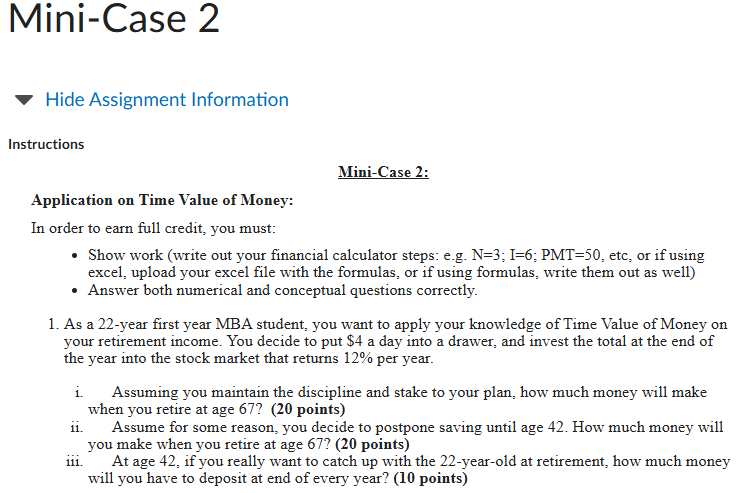
1. As a 22-year first year MBA student, you want to apply your knowledge of Time Value of Money on
your retirement income. You decide to put $4 a day info a drawer, and invest the total at the end of
the year into the stock market that returns 12% per year.
i Assuming you maintain the discipline and stake to your plan, how much money will make
when you retire at age 677 (20 points)
ii. Assume for some reason. you decide to postpone saving until age 42. How much money will
you make when you retire at age 672 (20 points)
iii.” Atage 42, if you really want to catch up with the 22-year-old at retirement, how much money
will you have to deposit at end of every year? (10 points)
Question:
Act like a helpful tutor and exlain me :Ww Hide Assignment Information
Instructions
Mini-Case 2:
Application on Time Value of Money:
In order to earn full credit, you must
« Show work (write out your financial calculator steps: e.g. N=3; I=6; PMT=50, etc, or if using
excel, upload your excel file with the formulas, or if using formulas, write them out as well)
« Answer both numerical and conceptual questions correctly.
1. As a 22-year first year MBA student, you want to apply your knowledge of Time Value of Money on
your retirement income. You decide to put $4 a day info a drawer, and invest the total at the end of
the year into the stock market that returns 12% per year.
i Assuming you maintain the discipline and stake to your plan, how much money will make
when you retire at age 677 (20 points)
ii. Assume for some reason. you decide to postpone saving until age 42. How much money will
you make when you retire at age 672 (20 points)
iii.” Atage 42, if you really want to catch up with the 22-year-old at retirement, how much money
will you have to deposit at end of every year? (10 points)
This is AI generated Response.
Asked by: Alok Kumar
Created at: 2026-02-02 10:17:27
Final Answer:
RenderedRaw Text
Did you like this answer?
Absolutely! Let's break down the **Mini-Case 2** on the **Time Value of Money (TVM)** step-by-step.
---
# Understanding the Problem
You're asked to:
- Use TVM concepts to solve retirement savings problems.
- Show your using formulas, calculator steps, or Excel.
- Answer all parts clearly.
**Scenario:**
- You are 22 years old.
- You save $4/day, collect it for a year, and invest it at the end of each year in the stock market.
- The market returns 12% per year.
- You want to know how much you’ll have at age 67 (45 years of savings).
- There are three parts:
1. Saving from age 22 to 67.
2. Delaying savings until age 42.
3. Catching up if you start at age 42.
---
# Step-by-Step Solution Guide
## 1. **How much will you have at age 67 if you start at 22?**
### **Given:**
- Annual deposit: $4 × 365 = $1,460
- Number of years (N): 67 - 22 = **45 years**
- Annual interest rate (I): **12%**
- Payment per period (PMT): $1,460 (at end of each year)
### **Formula to Use:**
This is a **Future Value of an Ordinary Annuity** problem:
\[
FV = PMT \times \frac{(1 + r)^N - 1}{r}
\]
Where:
- \( PMT = 1,460 \)
- \( r = .12 \)
- \( N = 45 \)
### **Plug in the numbers:**
\[
FV = 1,460 \times \frac{(1 + .12)^{45} - 1}{.12}
\]
#### **Step-by-step:**
1. Calculate \((1 + .12)^{45}\)
2. Subtract 1
3. Divide by .12
4. Multiply by $1,460
---
## 2. **How much will you have if you start saving at age 42?**
- Now you only save from age 42 to 67: **N = 25 years**
- Still deposit $1,460 at year-end.
- Interest rate is 12%.
### **Formula:**
\[
FV = 1,460 \times \frac{(1 + .12)^{25} - 1}{.12}
\]
---
## 3. **How much must you deposit per year if you start at 42 to end up with the same amount as if you started at 22?**
- You want the FV from part 1, but only have 25 years.
- Find PMT, given FV (from part 1), N = 25, r = 12%.
### **Rearrange the formula:**
\[
PMT = \frac{FV \times r}{(1 + r)^N - 1}
\]
- Plug the FV from part 1 into this formula.
---
# **Summary Table**
| Part | Years Saving | Formula | What to Find |
|------|-------------|---------|--------------|
| i | 45 | FV = PMT × [(1+r)^N – 1]/r | FV at age 67 |
| ii | 25 | FV = PMT × [(1+r)^N – 1]/r | FV at age 67 |
| iii | 25 | PMT = FV × r / [(1+r)^N – 1] | Needed annual PMT |
---
# **What to Show in Your Work**
- Write out **all formulas** used.
- Show **calculator or Excel steps** (e.g., N=45, I=12, PMT=146, FV=?).
- **Plug in numbers** clearly.
- Interpret your answers (what do they mean?).
---
# **Conceptual Takeaway**
This case shows that:
- **Starting early** allows your money to grow much more due to compounding.
- **Delaying saving** requires much higher yearly deposits to reach the same goal.
---
## **Need help with the actual calculations?**
Let me know if you want the calculations worked out step-by-step!
Question:
complete solution not in tabular form pls , in normal text form pls complete solution
This is AI generated Response.
Asked by: Alok Kumar
Created at: 2026-02-02 10:21:12
Final Answer:
RenderedRaw Text
Did you like this answer?
Sure! Let’s work through each part of the Mini-Case 2 step-by-step without using a table format.
---
# Step 1: Future Value Calculation for Age 67 Starting at 22
### Given Data:
- **Daily Savings**: $4
- **Annual Savings**: \( 4 \, \text{dollars/day} \times 365 \, \text{days} = 1,460 \, \text{dollars/year} \)
- **Years of Saving (N)**: \( 67 - 22 = 45 \) years
- **Annual Interest Rate (r)**: 12%
### Future Value Formula:
To find the future value (FV) of the annuity (regular savings), we use the formula:
\[
FV = PMT \times \frac{(1 + r)^N - 1}{r}
\]
Where:
- \( PMT = 1,460 \)
- \( r = 0.12 \)
- \( N = 45 \)
### Calculation Steps:
1. Calculate \( (1 + r)^{N} = (1 + 0.12)^{45} \).
2. Subtract 1 from this result.
3. Divide the result by \( r \) (0.12).
4. Multiply by \( PMT \) (1,460).
After performing these calculations, you will find the future value at retirement age 67.
---
# Step 2: Future Value Calculation for Age 67 Starting at 42
### Given Data:
- **Years of Saving (N)**: \( 67 - 42 = 25 \) years
- **Annual Savings**: Still $1,460
- **Annual Interest Rate (r)**: 12%
### Future Value Formula:
Using the same formula:
\[
FV = PMT \times \frac{(1 + r)^N - 1}{r}
\]
### Calculation Steps:
1. Set \( N = 25 \).
2. Use \( PMT = 1,460 \) and \( r = 0.12 \).
3. Follow the same steps as in Step 1 to find the future value at retirement age 67 for this scenario.
---
# Step 3: Catching Up at Age 42
### Given Data:
- You want to find the annual payment (PMT) required to match the amount saved if you started at age 22 by the time you retire at age 67.
- You need the FV amount from Step 1.
- **Years of Saving (N)**: 25 years (from age 42 to 67).
- **Annual Interest Rate (r)**: 12%.
### Rearranged Future Value Formula:
To find PMT, we rearrange the formula:
\[
PMT = \frac{FV \times r}{(1 + r)^N - 1}
\]
Here, \( FV \) is the final amount obtained from Step 1.
### Calculation Steps:
1. Plug the FV from Step 1 into the rearranged formula.
2. Set \( N = 25 \) and \( r = 0.12 \).
3. Calculate PMT to determine how much you need to save each year to catch up.
---
# Summary of Conceptual Takeaway
The exercises illustrate the importance of starting to save early. Due to the effects of compounding interest, starting at age 22 allows the initial savings to grow significantly more than if you start later. If you delay your savings, you will need to save a much larger amount annually to achieve the same retirement goal.
Feel free to ask if you need step-by-step numerical calculations for any of the parts!
Question:
pls provide me complete solution with calculation and all pls do
This is AI generated Response.
Asked by: Alok Kumar
Created at: 2026-02-02 10:22:48
Final Answer:
RenderedRaw Text
Did you like this answer?
Sure! Let's provide a complete solution with calculations for each part of the Mini-Case 2 on the Time Value of Money.
---
# Complete Solution with Calculations
## Step 1: Future Value Calculation for Age 67 Starting at 22
### Given Data:
- **Daily Savings**: $4
- **Annual Savings**:
\[
4 \, \text{dollars/day} \times 365 \, \text{days} = 1,460 \, \text{dollars/year}
\]
- **Years of Saving (N)**:
\[
67 - 22 = 45 \, \text{years}
\]
- **Annual Interest Rate (r)**:
\[
12\% = 0.12
\]
### Future Value Formula:
To find the future value (FV) of the annuity:
\[
FV = PMT \times \frac{(1 + r)^N - 1}{r}
\]
### Calculation Steps:
1. **Substitute values into the formula**:
- \( PMT = 1,460 \)
- \( r = 0.12 \)
- \( N = 45 \)
\[
FV = 1,460 \times \frac{(1 + 0.12)^{45} - 1}{0.12}
\]
2. **Calculate \((1 + 0.12)^{45}\)**:
\[
(1.12)^{45} \approx 36.435
\]
3. **Subtract 1**:
\[
36.435 - 1 = 35.435
\]
4. **Divide by \( r \)**:
\[
\frac{35.435}{0.12} \approx 295.29
\]
5. **Multiply by \( PMT \)**:
\[
FV \approx 1,460 \times 295.29 \approx 431,158.40
\]
### Result for Step 1:
If you start saving at age 22, you will have approximately **$431,158.40** at age 67.
---
## Step 2: Future Value Calculation for Age 67 Starting at 42
### Given Data:
- **Years of Saving (N)**:
\[
67 - 42 = 25 \, \text{years}
\]
- **Annual Savings**: Still $1,460
- **Annual Interest Rate (r)**:
\[
12\% = 0.12
\]
### Future Value Formula:
Using the same formula:
\[
FV = PMT \times \frac{(1 + r)^N - 1}{r}
\]
### Calculation Steps:
1. **Substitute values into the formula**:
- \( PMT = 1,460 \)
- \( r = 0.12 \)
- \( N = 25 \)
\[
FV = 1,460 \times \frac{(1 + 0.12)^{25} - 1}{0.12}
\]
2. **Calculate \((1 + 0.12)^{25}\)**:
\[
(1.12)^{25} \approx 10.892
\]
3. **Subtract 1**:
\[
10.892 - 1 = 9.892
\]
4. **Divide by \( r \)**:
\[
\frac{9.892}{0.12} \approx 82.433
\]
5. **Multiply by \( PMT \)**:
\[
FV \approx 1,460 \times 82.433 \approx 120,054.78
\]
### Result for Step 2:
If you start saving at age 42, you will have approximately **$120,054.78** at age 67.
---
## Step 3: Catching Up at Age 42
### Objective:
Determine how much you need to save annually starting at age 42 to have the same amount as if you started at age 22 (approximately $431,158.40).
### Rearranged Future Value Formula:
To find PMT:
\[
PMT = \frac{FV \times r}{(1 + r)^N - 1}
\]
### Calculation Steps:
1. **Use FV from Step 1**: \( FV \approx 431,158.40 \)
2. **Substitute values**:
- \( FV = 431,158.40 \)
- \( r = 0.12 \)
- \( N = 25 \)
\[
PMT = \frac{431,158.40 \times 0.12}{(1 + 0.12)^{25} - 1}
\]
3. **Calculate \((1 + 0.12)^{25}\)** (already calculated):
\[
(1.12)^{25} \approx 10.892
\]
4. **Subtract 1**:
\[
10.892 - 1 = 9.892
\]
5. **Calculate PMT**:
\[
PMT = \frac{431,158.40 \times 0.12}{9.892} \approx \frac{51,738.408}{9.892} \approx 5,223.43
\]
### Result for Step 3:
To catch up, you would need to save approximately **$5,223.43** at the end of every year starting at age 42.
---
# Summary of Results
1. **Savings from age 22 to 67**: Approximately **$431,158.40**.
2. **Savings from age 42 to 67**: Approximately **$120,054.78**.
3. **Annual savings needed at age 42 to catch up**: Approximately **$5,223.43**.
This breakdown provides a comprehensive understanding of your retirement savings scenarios using the Time Value of Money concept. If you have any further questions or need clarification, feel free to ask!
VIPSolutions focuses on clear, step‑by‑step explanations so you can learn quickly. Whether you need an AI‑generated walkthrough or a short hint to get unstuck, each solution is organized for fast reading and easy review later.
Search similar questions, compare approaches, and bookmark the best answers for revision. Our goal is simple: quick, reliable study help that feels natural—not noisy.
 VIPSolutions
 Ww Hide Assignment Information
Instructions
Mini-Case 2:
Application on Time Value of Money:
In order to earn full credit, you must
« Show work (write out your financial calculator steps: e.g. N=3; I=6; PMT=50, etc, or if using
excel, upload your excel file with the formulas, or if using formulas, write them out as well)
« Answer both numerical and conceptual questions correctly.
1. As a 22-year first year MBA student, you want to apply your knowledge of Time Value of Money on
your retirement income. You decide to put $4 a day info a drawer, and invest the total at the end of
the year into the stock market that returns 12% per year.
i Assuming you maintain the discipline and stake to your plan, how much money will make
when you retire at age 677 (20 points)
ii. Assume for some reason. you decide to postpone saving until age 42. How much money will
you make when you retire at age 672 (20 points)
iii.” Atage 42, if you really want to catch up with the 22-year-old at retirement, how much money
will you have to deposit at end of every year? (10 points)