 VIPSolutions
Act like a helpful tutor and exlain me :pe 1 Y - PI & § 3 g z HH i Ta. i 1. g Z El fs : 5 : F
Question:
Act like a helpful tutor and exlain me :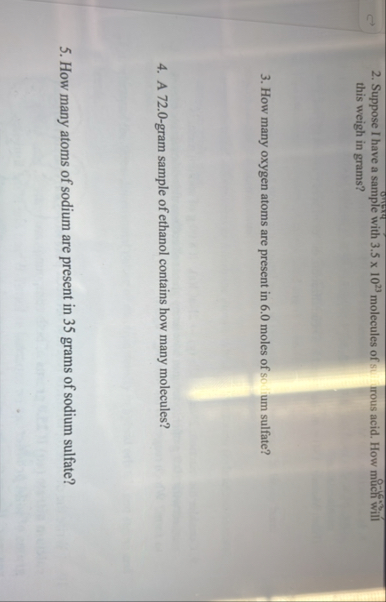 pe 1 Y -
PI
& § 3
g z HH
i Ta.
i 1.
g Z El fs
: 5 : F
This is AI generated Response.
Asked by: Alok Kumar
Created at: 2026-01-27 01:37:11
Asked by: Alok Kumar
Created at: 2026-01-27 01:37:11
Final Answer:
Rendered
Raw Text
Did you like this answer?
Sure! Let's go through each question step by step.
---
## 3. How many oxygen atoms are present in 6. moles of sodium sulfate?
**Step 1: Find the chemical formula for sodium sulfate.**
Sodium sulfate = **Na₂SO₄**
**Step 2: Count the number of oxygen atoms per molecule.**
Each molecule of Na₂SO₄ has **4 oxygen atoms**.
**Step 3: Find the total number of molecules in 6. moles.**
1 mole = \(6.022 \times 10^{23}\) molecules (Avogadro's number)
So, 6. moles = \(6. \times 6.022 \times 10^{23}\) molecules
= \(3.613 \times 10^{24}\) molecules
**Step 4: Find the total number of oxygen atoms:**
Each molecule has 4 oxygen atoms, so:
\(3.613 \times 10^{24} \text{ molecules} \times 4 = 1.445 \times 10^{25} \text{ oxygen atoms}\)
---
## 4. A 72.-gram sample of ethanol contains how many molecules?
**Step 1: Find the chemical formula and molar mass of ethanol.**
Ethanol = **C₂H₅OH**
Molar mass = \(2 \times 12.01 + 6 \times 1.01 + 1 \times 16.00 = 46.08 \text{ g/mol}\)
**Step 2: Convert grams to moles:**
\[
\text{Moles} = \frac{72. \text{ g}}{46.08 \text{ g/mol}} = 1.563 \text{ moles}
\]
**Step 3: Convert moles to molecules:**
\[
1.563 \text{ moles} \times 6.022 \times 10^{23} = 9.41 \times 10^{23} \text{ molecules}
\]
---
## 5. How many atoms of sodium are present in 3.5 grams of sodium sulfate?
**Step 1: Find the molar mass of sodium sulfate (Na₂SO₄):**
\[
2 \times 22.99 + 32.07 + 4 \times 16.00 = 142.05 \text{ g/mol}
\]
**Step 2: Convert grams to moles:**
\[
\text{Moles} = \frac{3.5 \text{ g}}{142.05 \text{ g/mol}} = .0246 \text{ moles}
\]
**Step 3: Find moles of sodium atoms:**
Each formula unit has 2 sodium atoms.
So, moles of sodium atoms = \(.0246 \times 2 = .0492\) moles
**Step 4: Convert moles of sodium atoms to atoms:**
\[
.0492 \text{ moles} \times 6.022 \times 10^{23} = 2.96 \times 10^{22} \text{ sodium atoms}
\]
---
### **Summary Table**
| Question | Calculation | Answer |
|----------|-------------|--------|
| 3 | \(6.\) moles × \(6.022 \times 10^{23}\) × 4 | \(1.45 \times 10^{25}\) oxygen atoms |
| 4 | \(72.\) g ÷ \(46.08\) g/mol × \(6.022 \times 10^{23}\) | \(9.41 \times 10^{23}\) molecules |
| 5 | \(3.5\) g ÷ \(142.05\) g/mol × 2 × \(6.022 \times 10^{23}\) | \(2.96 \times 10^{22}\) sodium atoms |
If you need more details or have questions about the steps, let me know!
Question:
cocpt explanation for this pls
This is AI generated Response.
Asked by: Alok Kumar
Created at: 2026-01-27 01:40:02
Asked by: Alok Kumar
Created at: 2026-01-27 01:40:02
Final Answer:
Rendered
Raw Text
Did you like this answer?
Certainly! Let's break down each section of the image you provided, focusing on the key concepts in chemistry.
---
## 1. Understanding Moles
**Definition of a Mole**
A mole is a unit of measurement in chemistry that represents \(6.022 \times 10^{23}\) particles (atoms, molecules, etc.). This number is known as Avogadro's number.
---
## 2. Chemical Formulas
### Example: Sodium Sulfate (Na₂SO₄)
- **Composition**:
- 2 Sodium (Na) atoms
- 1 Sulfur (S) atom
- 4 Oxygen (O) atoms
- **Total**: Each molecule of sodium sulfate has 7 atoms in total.
---
## 3. Calculating Atoms in a Compound
### Example: Oxygen Atoms in Sodium Sulfate
- **Step 1: Identify the number of oxygen atoms** in one molecule of sodium sulfate: **4**.
- **Step 2: Determine the number of molecules** in a given number of moles using Avogadro's number.
### Calculation
For \(n\) moles of Na₂SO₄:
\[
\text{Total oxygen atoms} = n \times 6.022 \times 10^{23} \times 4
\]
---
## 4. Molar Mass Calculations
### Example: Ethanol (C₂H₅OH)
- **Step 1: Calculate the molar mass**:
- Carbon (C): \(12.01 \, \text{g/mol} \times 2 = 24.02 \, \text{g/mol}\)
- Hydrogen (H): \(1.01 \, \text{g/mol} \times 6 = 6.06 \, \text{g/mol}\)
- Oxygen (O): \(16.00 \, \text{g/mol} \times 1 = 16.00 \, \text{g/mol}\)
- **Total Molar Mass**: \(46.08 \, \text{g/mol}\)
### Step 2: Converting Grams to Moles
Using the formula:
\[
\text{Moles} = \frac{\text{mass (g)}}{\text{molar mass (g/mol)}}
\]
### Step 3: Converting Moles to Molecules
Using Avogadro's number:
\[
\text{Molecules} = \text{moles} \times 6.022 \times 10^{23}
\]
---
## 5. Summary of Calculations
To summarize, always remember:
- Use the chemical formula to determine the number of each type of atom.
- Convert grams to moles using molar mass.
- Use Avogadro's number to convert moles to actual particles.
If you have specific parts of the image you would like to clarify further, feel free to ask!
📢 Instructions:
- Ask anything relatd to above question only.
- For new Question goto :