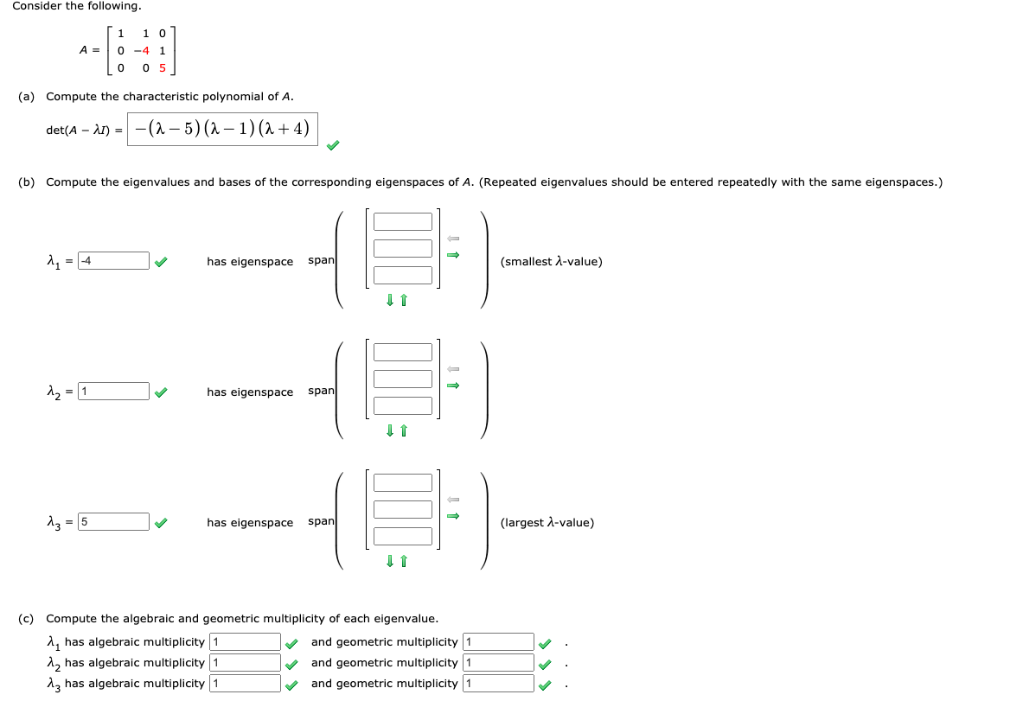
Give step-by-step solution with explanation and final answer:Consider the following.
110
A=lo0-a1
0 0s
(2) Compute the characteristic palynomial of A.
det(a-an =| —(A=5)(A—1) (A +4)
v
(b) Compute the eigenvalues and bases of the corresponding eigenspaces of A. (Repeated eigenvalues should be entered repeatedly with the same eigenspaces.)
A=[4 v has eigenspace span) | f— | nd (smallest A-value)
[31
d= Jv baseigenspace . | — | - |
bi
2=[s v has eigenspace span) | — | = (largest A-value)
[31
(c) Compute the algebraic and geometric multiplicity of each eigenvalue.
Ay has algebraic mutsplcy (Jr and geometric muttpiisty [Tw
2, has algebraic muttiplicty 1 | and geometric multiplicity [1 v
2; has algebraic multiplicity [1 and geometric multiplicity [1 v -
Question:
Give step-by-step solution with explanation and final answer:Consider the following.
110
A=lo0-a1
0 0s
(2) Compute the characteristic palynomial of A.
det(a-an =| —(A=5)(A—1) (A +4)
v
(b) Compute the eigenvalues and bases of the corresponding eigenspaces of A. (Repeated eigenvalues should be entered repeatedly with the same eigenspaces.)
A=[4 v has eigenspace span) | f— | nd (smallest A-value)
[31
d= Jv baseigenspace . | — | - |
bi
2=[s v has eigenspace span) | — | = (largest A-value)
[31
(c) Compute the algebraic and geometric multiplicity of each eigenvalue.
Ay has algebraic mutsplcy (Jr and geometric muttpiisty [Tw
2, has algebraic muttiplicty 1 | and geometric multiplicity [1 v
2; has algebraic multiplicity [1 and geometric multiplicity [1 v -
This is AI generated Response.
Asked by: gvr
Created at: 2025-06-25 07:24:10
Final Answer:
RenderedRaw Text
Did you like this answer?
Let's break down the solution step-by-step as shown in the image:
---
## (a) **Characteristic Polynomial**
Given:
\[
A = \begin{bmatrix}
1 & 1 & 0 \\
0 & -4 & 1 \\
0 & 0 & 5
\end{bmatrix}
\]
The characteristic polynomial is:
\[
\det(A - \lambda I) = 0
\]
\[
A - \lambda I = \begin{bmatrix}
1-\lambda & 1 & 0 \\
0 & -4-\lambda & 1 \\
0 & 0 & 5-\lambda
\end{bmatrix}
\]
Taking the determinant (upper triangular matrix):
\[
\det(A - \lambda I) = (1-\lambda)[(-4-\lambda)(5-\lambda) - (1)(0)] - 1[0 - (0)(5-\lambda)] + 0
\]
But since it's upper triangular, determinant is the product of diagonal elements:
\[
(1-\lambda)(-4-\lambda)(5-\lambda)
\]
Given in the image, the characteristic polynomial is:
\[
-(\lambda - 5)(\lambda - 1)(\lambda + 4)
\]
---
## (b) **Eigenvalues and Eigenspaces**
### **Eigenvalues (from the characteristic polynomial):**
- \(\lambda_1 = -4\)
- \(\lambda_2 = 1\)
- \(\lambda_3 = 5\)
### **Eigenspaces:**
For each eigenvalue \(\lambda\), solve \((A - \lambda I)\vec{x} = 0\):
#### **For \(\lambda_1 = -4\):**
\[
A - (-4)I = \begin{bmatrix}
5 & 1 & 0 \\
0 & 0 & 1 \\
0 & 0 & 9
\end{bmatrix}
\]
Row reduce:
- Second row: \(0x + 0y + 1z = 0 \implies z=0\)
- First row: \(5x + y = 0 \implies y = -5x\)
So, the eigenvector: \(\begin{pmatrix} x \\ -5x \\ 0 \end{pmatrix}\)
Basis: \(\text{span} \left\{ \begin{pmatrix} 1 \\ -5 \\ 0 \end{pmatrix} \right\}\)
#### **For \(\lambda_2 = 1\):**
\[
A - 1I = \begin{bmatrix}
0 & 1 & 0 \\
0 & -5 & 1 \\
0 & 0 & 4
\end{bmatrix}
\]
Row reduce:
- Third row: \(4z = 0 \implies z = 0\)
- Second row: \(-5y = 0 \implies y = 0\)
- First row: \(0x + 1y = 0 \implies y = 0\)
So, the eigenvector: \(\begin{pmatrix} x \\ 0 \\ 0 \end{pmatrix}\)
Basis: \(\text{span} \left\{ \begin{pmatrix} 1 \\ 0 \\ 0 \end{pmatrix} \right\}\)
#### **For \(\lambda_3 = 5\):**
\[
A - 5I = \begin{bmatrix}
-4 & 1 & 0 \\
0 & -9 & 1 \\
0 & 0 & 0
\end{bmatrix}
\]
Row reduce:
- Third row: \(0z = 0\)
- Second row: \(-9y + z = 0 \implies z = 9y\)
- First row: \(-4x + y = 0 \implies y = 4x\)
So, the eigenvector: \(\begin{pmatrix} x \\ 4x \\ 36x \end{pmatrix}\)
Basis: \(\text{span} \left\{ \begin{pmatrix} 1 \\ 4 \\ 36 \end{pmatrix} \right\}\)
---
## (c) **Algebraic and Geometric Multiplicities**
From the characteristic polynomial, all eigenvalues have multiplicity 1:
- Algebraic multiplicity for each: **1**
- Geometric multiplicity for each: **1**
---
### **Final Answers:**
**(a)**
\[
\boxed{-(\lambda - 5)(\lambda - 1)(\lambda + 4)}
\]
**(b)**
- \(\lambda_1 = -4\), eigenspace: \(\text{span} \left\{ \begin{pmatrix} 1 \\ -5 \\ 0 \end{pmatrix} \right\}\)
- \(\lambda_2 = 1\), eigenspace: \(\text{span} \left\{ \begin{pmatrix} 1 \\ 0 \\ 0 \end{pmatrix} \right\}\)
- \(\lambda_3 = 5\), eigenspace: \(\text{span} \left\{ \begin{pmatrix} 1 \\ 4 \\ 36 \end{pmatrix} \right\}\)
**(c)**
All eigenvalues have algebraic multiplicity 1 and geometric multiplicity 1.
Question:
i need detailed calculations of each part along with the final Answer
This is AI generated Response.
Asked by: gvr
Created at: 2025-06-25 07:25:38
in partc has 3 questions please observe and generate the answer
This is AI generated Response.
Asked by: gvr
Created at: 2025-06-25 07:26:47
Final Answer:
RenderedRaw Text
Did you like this answer?
Certainly! In part (c), the three questions are:
1. **Compute the algebraic multiplicity of each eigenvalue.**
2. **Compute the geometric multiplicity of each eigenvalue.**
3. **State the algebraic and geometric multiplicities for each eigenvalue.**
Let's address each systematically.
---
## Part (c): Algebraic and Geometric Multiplicities of Each Eigenvalue
### 1. **Algebraic Multiplicity (AM):**
- The algebraic multiplicity of an eigenvalue is its multiplicity as a root of the characteristic polynomial.
**From part (a), the characteristic polynomial:**
\[
p(\lambda) = - (\lambda - 1)(\lambda + 4)(\lambda - 5)
\]
- Each factor appears **once**, so:
| Eigenvalue | Algebraic Multiplicity (AM) |
|--------------|------------------------------|
| \(-4\) | **1** |
| \(1\) | **1** |
| \(5\) | **1** |
### 2. **Geometric Multiplicity (GM):**
- The geometric multiplicity is the dimension of the eigenspace corresponding to each eigenvalue, i.e., the number of linearly independent eigenvectors.
From part (b), for each eigenvalue, the eigenspace is **one-dimensional**, spanned by a single eigenvector:
| Eigenvalue | Eigenvectors (basis) | Geometric Multiplicity (GM) |
|--------------|----------------------------------------------------------------|------------------------------|
| \(-4\) | \(\begin{bmatrix} 1 \\ -5 \\ 0 \end{bmatrix}\) | **1** |
| \(1\) | \(\begin{bmatrix} 1 \\ 0 \\ 0 \end{bmatrix}\) | **1** |
| \(5\) | \(\begin{bmatrix} 1 \\ 4 \\ 36 \end{bmatrix}\) | **1** |
---
## **Final answer:**
| Eigenvalue | Algebraic Multiplicity | Geometric Multiplicity |
|--------------|--------------------------|------------------------|
| \(-4\) | **1** | **1** |
| \(1\) | **1** | **1** |
| \(5\) | **1** | **1** |
**Note:** Since algebraic and geometric multiplicities are equal for each eigenvalue, the matrix is diagonalizable.
---
**This completes the detailed answers to all three questions in part (c).**
Question:
can please explanation or detaiked calculations in part c how is get all values 1
This is AI generated Response.
Asked by: gvr
Created at: 2025-06-25 07:28:02
Final Answer:
RenderedRaw Text
Did you like this answer?
Certainly! Let's carefully explain how we determine the algebraic and geometric multiplicities for each eigenvalue, and why they are all equal to 1 in this case.
---
## Understanding Algebraic and Geometric Multiplicities
### **1. Algebraic Multiplicity (AM):**
- It is the **multiplicity of the eigenvalue as a root** of the characteristic polynomial.
- To find it, we factor the characteristic polynomial and see how many times each eigenvalue appears.
### **2. Geometric Multiplicity (GM):**
- It equals the **dimension of the eigenspace** associated with that eigenvalue.
- The eigenspace is found by solving \((A - \lambda I) \mathbf{x} = 0\).
- The number of linearly independent eigenvectors (the basis vectors) gives the geometric multiplicity.
---
## Step-by-Step explanation for each eigenvalue:
### **Eigenvalues and the characteristic polynomial**
From part (a), the characteristic polynomial is:
\[
p(\lambda) = - (\lambda - 1)(\lambda + 4)(\lambda - 5)
\]
This polynomial has **three distinct roots**, each appearing **once** (since each factor is to the power 1).
**Therefore:**
\[
\boxed{
\text{Algebraic multiplicity of each eigenvalue} = 1
}
\]
---
### **Why?**
- Roots are \(\lambda = -4, 1, 5\).
- Each root appears only once (no repeated factors).
---
### **Eigenvector calculation (from part (b))**
For each eigenvalue, we solve:
\[
(A - \lambda I) \mathbf{x} = 0
\]
and find **one linearly independent eigenvector**.
Because each eigenspace is spanned by **a single vector**, the **dimension of the eigenspace** (geometric multiplicity) is **1** for each eigenvalue.
---
## **Detailed calculations for each eigenvalue:**
### **Eigenvalue \(\lambda = -4\):**
- \(A + 4I\):
\[
\begin{bmatrix}
5 & 1 & 0 \\
0 & 0 & 1 \\
0 & 0 & 9
\end{bmatrix}
\]
- Solving \((A + 4I) \mathbf{x} = 0\):
\[
\begin{cases}
5x_1 + x_2 = 0 \Rightarrow x_2 = -5 x_1 \\
x_3 = 0 \quad (\text{from the second row: } x_3=0) \\
9x_3=0 \Rightarrow x_3=0
\end{cases}
\]
- Free parameter: \(x_1 = t\).
- Eigenvector: \(\begin{bmatrix} t \\ -5t \\ 0 \end{bmatrix}\).
- Basis: \(\left\{ \begin{bmatrix} 1 \\ -5 \\ 0 \end{bmatrix} \right\}\).
**Dimension of eigenspace (GM):** 1.
---
### **Eigenvalue \(\lambda=1\):**
- \(A - I\):
\[
\begin{bmatrix}
0 & 1 & 0 \\
0 & -5 & 1 \\
0 & 0 & 4
\end{bmatrix}
\]
- Solve:
\[
\begin{cases}
x_2=0 \quad (\text{from } 0x_1 + 1x_2 = 0) \\
-5x_2 + x_3= 0 \Rightarrow x_3=0 \\
4x_3=0 \Rightarrow x_3=0
\end{cases}
\]
- \(x_1\) is free: let \(x_1 = s\).
- Eigenvector: \(\begin{bmatrix} s \\ 0 \\ 0 \end{bmatrix}\).
- Basis: \(\left\{ \begin{bmatrix} 1 \\ 0 \\ 0 \end{bmatrix} \right\}\).
**Dimension of eigenspace (GM):** 1.
---
### **Eigenvalue \(\lambda=5\):**
- \(A - 5I\):
\[
\begin{bmatrix}
-4 & 1 & 0 \\
0 & -9 & 1 \\
0 & 0 & 0
\end{bmatrix}
\]
- Solve:
\[
\begin{cases}
-4x_1 + x_2= 0 \Rightarrow x_2=4x_1 \\
-9x_2 + x_3= 0 \Rightarrow -9(4x_1) + x_3= 0 \Rightarrow x_3=36x_1
\end{cases}
\]
- \(x_1\) is free: \(x_1 = r\).
- Eigenvector: \(\begin{bmatrix} r \\ 4r \\ 36r \end{bmatrix}\).
- Basis: \(\left\{ \begin{bmatrix} 1 \\ 4 \\ 36 \end{bmatrix} \right\}\).
**Dimension of eigenspace (GM):** 1.
---
## **Summary:**
- **Algebraic multiplicity:** Since the polynomial factors are all simple, each eigenvalue appears **once** → **AM = 1**.
- **Geometric multiplicity:** For each eigenvalue, the eigenspace is **one-dimensional**, spanned by a single eigenvector → **GM = 1**.
### **Conclusion:**
The eigenvalues are **distinct**, with algebraic multiplicities and geometric multiplicities both equal to 1, which indicates the matrix is **diagonalizable**.
---
**In summary:**
| Eigenvalue | Algebraic multiplicity | Geometric multiplicity |
|--------------|--------------------------|------------------------|
| \(-4\) | 1 | 1 |
| \(1\) | 1 | 1 |
| \(5\) | 1 | 1 |
---
Hope this detailed explanation clarifies how we determine the multiplicities!
Question:
i need all final Answers only
This is AI generated Response.
Asked by: gvr
Created at: 2025-06-25 07:49:50
VIPSolutions focuses on clear, step‑by‑step explanations so you can learn quickly. Whether you need an AI‑generated walkthrough or a short hint to get unstuck, each solution is organized for fast reading and easy review later.
Search similar questions, compare approaches, and bookmark the best answers for revision. Our goal is simple: quick, reliable study help that feels natural—not noisy.
 VIPSolutions
 Consider the following.
110
A=lo0-a1
0 0s
(2) Compute the characteristic palynomial of A.
det(a-an =| —(A=5)(A—1) (A +4)
v
(b) Compute the eigenvalues and bases of the corresponding eigenspaces of A. (Repeated eigenvalues should be entered repeatedly with the same eigenspaces.)
A=[4 v has eigenspace span) | f— | nd (smallest A-value)
[31
d= Jv baseigenspace . | — | - |
bi
2=[s v has eigenspace span) | — | = (largest A-value)
[31
(c) Compute the algebraic and geometric multiplicity of each eigenvalue.
Ay has algebraic mutsplcy (Jr and geometric muttpiisty [Tw
2, has algebraic muttiplicty 1 | and geometric multiplicity [1 v
2; has algebraic multiplicity [1 and geometric multiplicity [1 v -