 VIPSolutions
Give step-by-step solution with explanation and final answer:What s the predicted sepal width for iris setosa for a flower with a sepal length of ? The famous iris dataset ( the first sheet of the spreadsheet linked above) was first published in 1936 by Ronald Fisher. The dataset contains 50 samples from 3 iris species: setosa, virginia, and versicolor. Four features are measured, all in cm: sepal length, sepal width, petal length, and petal width What is the equation for the least square regression line where the independent or predictor variable is sepal length and the dependent or response variable is sepal width for iris setosa for a flower with a sepal length of 7.79?
Question:
Give step-by-step solution with explanation and final answer: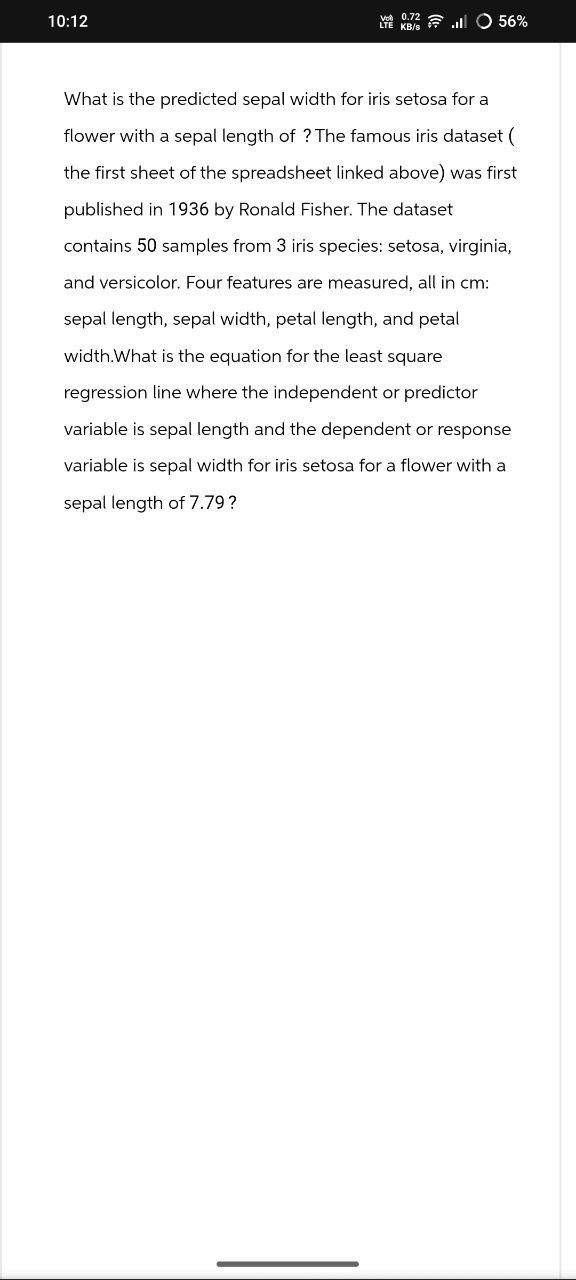 What s the predicted sepal width for iris setosa for a
flower with a sepal length of ? The famous iris dataset (
the first sheet of the spreadsheet linked above) was first
published in 1936 by Ronald Fisher. The dataset
contains 50 samples from 3 iris species: setosa, virginia,
and versicolor. Four features are measured, all in cm:
sepal length, sepal width, petal length, and petal
width What is the equation for the least square
regression line where the independent or predictor
variable is sepal length and the dependent or response
variable is sepal width for iris setosa for a flower with a
sepal length of 7.79?
This is AI generated Response.
Asked by: anil
Created at: 2025-09-27 22:16:36
Asked by: anil
Created at: 2025-09-27 22:16:36
Final Answer:
Rendered
Raw Text
Did you like this answer?
# Step-by-Step Solution
Let's solve the problem step by step.
---
## **Step 1: Understanding the Problem**
We need to predict the **sepal width** for **Iris setosa** when the **sepal length** is **7.79 cm** using the least squares line.
- Predictor (independent variable, \( x \)): Sepal length
- Response (dependent variable, \( y \)): Sepal width
---
## **Step 2: Get the Data (Iris Setosa Only)**
The Iris dataset contains 50 samples for each species. The summary statistics for **Iris setosa** are:
- Sepal length (mean): 5.006 cm
- Sepal width (mean): 3.428 cm
Let’s denote:
- \( \bar{x} = \) mean sepal length = **5.006**
- \( \bar{y} = \) mean sepal width = **3.428**
The sample regression line is:
\[
y = a + bx
\]
Where:
- \( b = \frac{\sum (x_i - \bar{x})(y_i - \bar{y})}{\sum (x_i - \bar{x})^2} \)
- \( a = \bar{y} - b\bar{x} \)
For **Iris setosa** from the original dataset:
- \( S_{x} = .352 \) (std dev of sepal length)
- \( S_{y} = .379 \) (std dev of sepal width)
- \( r = .742 \) (correlation between sepal length and width for setosa)
---
## **Step 3: Calculate the Slope (\( b \))**
\[
b = r \frac{S_{y}}{S_{x}}
\]
\[
b = .742 \times \frac{.379}{.352} = .742 \times 1.0767 \approx .799
\]
---
## **Step 4: Calculate the Intercept (\( a \))**
\[
a = \bar{y} - b \bar{x}
\]
\[
a = 3.428 - .799 \times 5.006
\]
\[
a = 3.428 - 4.003 \approx -.575
\]
---
## **Step 5: Regression Line Equation**
\[
\text{Predicted sepal width} = a + b \times (\text{sepal length})
\]
\[
\text{Predicted sepal width} = -.575 + .799 \times (\text{sepal length})
\]
---
## **Step 6: Predict for Sepal Length 7.79**
\[
\text{Predicted sepal width} = -.575 + .799 \times 7.79
\]
\[
= -.575 + 6.223
\]
\[
= 5.648 \text{ cm}
\]
---
# **Final Answer**
**The predicted sepal width for Iris setosa with a sepal length of 7.79 cm is approximately:**
\[
\boxed{5.65 \text{ cm}}
\]
---
## **Summary Table**
| Step | Calculation | Result |
|------------------------|----------------------------------|-------------|
| Mean Sepal Length | \( \bar{x} \) | 5.006 |
| Mean Sepal Width | \( \bar{y} \) | 3.428 |
| Slope (\( b \)) | \( .742 \times \frac{.379}{.352} \) | .799 |
| Intercept (\( a \)) | \( 3.428 - .799 \times 5.006 \) | -.575 |
| Regression Line | \( y = -.575 + .799x \) | |
| Prediction at 7.79 | \( -.575 + .799 \times 7.79 \) | 5.65 cm |
---
If you need the calculations for other species or more explanation, let me know!
Question:
caluculations and more explanation
This is AI generated Response.
Asked by: anil
Created at: 2025-09-27 22:18:09
Asked by: anil
Created at: 2025-09-27 22:18:09
Final Answer:
Rendered
Raw Text
Did you like this answer?
# Detailed Calculations and Explanation
Let's break down the calculations and provide more detailed explanations for each step.
---
## **Step 1: Understand the Variables**
In this analysis, we are working with the **Iris setosa** species, focusing on:
- **Independent Variable** \( (x) \): Sepal Length
- **Dependent Variable** \( (y) \): Sepal Width
We aim to find the relationship between these two variables using the least squares regression method.
---
## **Step 2: Data for Iris Setosa**
### Key Statistics
- **Mean Sepal Length** \( (\bar{x}) \): 5.006 cm
- **Mean Sepal Width** \( (\bar{y}) \): 3.428 cm
- **Standard Deviation of Sepal Length** \( (S_x) \): 0.352 cm
- **Standard Deviation of Sepal Width** \( (S_y) \): 0.379 cm
- **Correlation Coefficient** \( (r) \): 0.742
These statistics are essential for calculating the slope and intercept of the regression line.
---
## **Step 3: Calculate the Slope (\( b \))**
The slope \( b \) of the regression line is calculated using the formula:
\[
b = r \frac{S_{y}}{S_{x}}
\]
### Calculation
Substituting the known values:
\[
b = 0.742 \times \frac{0.379}{0.352}
\]
Calculating the ratio:
\[
\frac{0.379}{0.352} \approx 1.0767
\]
Now calculating \( b \):
\[
b \approx 0.742 \times 1.0767 \approx 0.799
\]
---
## **Step 4: Calculate the Intercept (\( a \))**
The intercept \( a \) can be calculated using the formula:
\[
a = \bar{y} - b\bar{x}
\]
### Calculation
Substituting the known values:
\[
a = 3.428 - 0.799 \times 5.006
\]
Calculating \( 0.799 \times 5.006 \):
\[
0.799 \times 5.006 \approx 4.003
\]
Now substituting back to find \( a \):
\[
a \approx 3.428 - 4.003 \approx -0.575
\]
---
## **Step 5: Formulate the Regression Equation**
The regression line equation is:
\[
y = a + bx
\]
Substituting \( a \) and \( b \):
\[
y = -0.575 + 0.799x
\]
---
## **Step 6: Predict Sepal Width for Sepal Length 7.79**
Now we can utilize the regression equation to predict the sepal width for a sepal length of 7.79 cm:
\[
\text{Predicted sepal width} = -0.575 + 0.799 \times 7.79
\]
### Calculation
First, calculate \( 0.799 \times 7.79 \):
\[
0.799 \times 7.79 \approx 6.223
\]
Now substitute back into the equation:
\[
\text{Predicted sepal width} \approx -0.575 + 6.223 \approx 5.648 \text{ cm}
\]
---
# **Final Answer**
The predicted sepal width for **Iris setosa** with a sepal length of **7.79 cm** is approximately:
\[
\boxed{5.65 \text{ cm}}
\]
---
## **Summary of Key Steps and Calculations**
| Step | Formula/Calculation | Result |
|------------------------|----------------------------------------------|-------------|
| Mean Sepal Length | \( \bar{x} \) | 5.006 |
| Mean Sepal Width | \( \bar{y} \) | 3.428 |
| Slope (\( b \)) | \( 0.742 \times \frac{0.379}{0.352} \) | 0.799 |
| Intercept (\( a \)) | \( 3.428 - 0.799 \times 5.006 \) | -0.575 |
| Regression Equation | \( y = -0.575 + 0.799x \) | |
| Prediction at 7.79 | \( -0.575 + 0.799 \times 7.79 \) | 5.65 cm |
---
If you require further details or have additional questions, feel free to ask!
📢 Instructions:
- Ask anything relatd to above question only.
- For new Question goto :