 VIPSolutions
give answer in 2 step with explanation at the end of each step and final answer at the end:idx 5. Let f(z) = T= and for R > 0, let C(R) = Cr U[~R, R), where Cg = {Rei : 0 < t < 7}. Assume 2? 2x that C(R) has positive orientation. (a) Suppose R > v2. Draw a sketch of the contour C(R), label the orientation of the contour on the sketch and indicate the singularities of f(z) on the sketch. b) What is the value of f(z) dz, if R < V/2. Provide a reason for your answer. C(R) (c) Suppose R > V2. Show that [i f(2) dz = (x + im)e= +4 (d) Show that Jim Jen f(z)dz=0. (e) Use the information obtained from the previous questions to calculate P.V. [*_ f(x) dx.
Question:
give answer in 2 step with explanation at the end of each step and final answer at the end: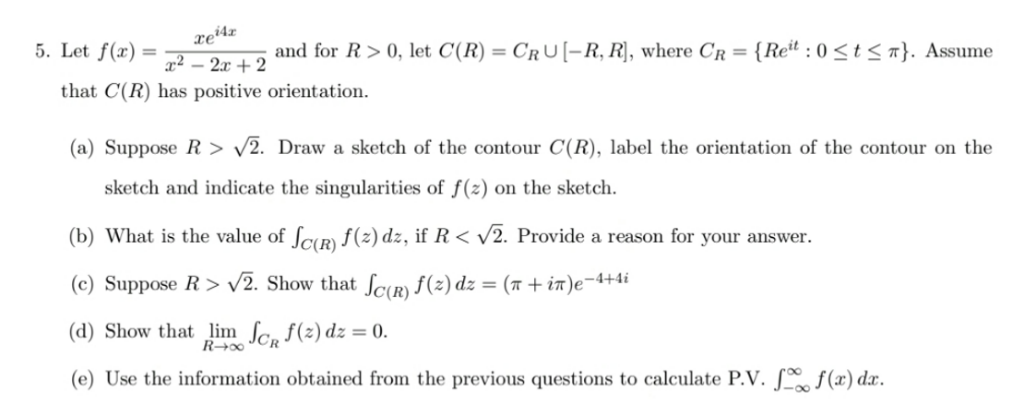 idx
5. Let f(z) = T= and for R > 0, let C(R) = Cr U[~R, R), where Cg = {Rei : 0 < t < 7}. Assume
2? 2x
that C(R) has positive orientation.
(a) Suppose R > v2. Draw a sketch of the contour C(R), label the orientation of the contour on the
sketch and indicate the singularities of f(z) on the sketch.
b) What is the value of f(z) dz, if R < V/2. Provide a reason for your answer.
C(R)
(c) Suppose R > V2. Show that [i f(2) dz = (x + im)e= +4
(d) Show that Jim Jen f(z)dz=0.
(e) Use the information obtained from the previous questions to calculate P.V. [*_ f(x) dx.
This is AI generated Response.
Asked by: Pagal
Created at: 2025-08-25 09:26:40
Asked by: Pagal
Created at: 2025-08-25 09:26:40
Final Answer:
Rendered
Raw Text
Did you like this answer?
Let's break the problem into steps and answer each as requested:
---
### (a) **Sketch the Contour \( C(R) \) and Indicate Singularities**
#### **Step 1: Identify the contour and singularities**
- The contour \( C(R) \) consists of two parts:
1. The line segment from \( -R \) to \( R \) on the real axis.
2. The semicircular arc \( C_R \) of radius \( R \) in the upper half-plane, parameterized by \( Re^{it} \), \( t \in [0, \pi] \).
- The function \( f(x) = \frac{xe^{i4x}}{x^2 - 2x + 2} \) has singularities where the denominator is zero:
\[
x^2 - 2x + 2 = 0 \implies x = 1 \pm i
\]
So, there are simple poles at \( z = 1+i \) and \( z = 1-i \).
#### **Explanation:**
- The contour \( C(R) \) is a closed semicircular path in the upper half-plane, oriented counterclockwise.
- The singularity \( z = 1+i \) lies inside the contour if \( R > \sqrt{2} \); \( z = 1-i \) is below the real axis and outside the contour.
---
### (b) **Value of \( \int_{C(R)} f(z)\,dz \) for \( R < \sqrt{2} \)**
#### **Step 2: Analyze the contour for \( R < \sqrt{2} \)**
- For \( R < \sqrt{2} \), the contour does **not** enclose any singularity (since both \( 1+i \) and \( 1-i \) have modulus \( \sqrt{2} \)).
- By Cauchy's theorem, the integral around a closed contour that does **not** enclose any singularities is **zero**.
#### **Explanation:**
- Since the contour does not enclose any poles, the integral is zero by Cauchy's theorem.
---
### **Final Answers for Steps (a) and (b):**
**(a) Answer:**
- The contour \( C(R) \) is a closed path consisting of a line segment from \( -R \) to \( R \) (real axis), and a semicircular arc of radius \( R \) in the upper half-plane (from \( R \) back to \( -R \)), oriented counterclockwise. The only singularity inside the contour for \( R > \sqrt{2} \) is \( z = 1 + i \).
**(b) Answer:**
- For \( R < \sqrt{2} \), \( \int_{C(R)} f(z)\,dz = 0 \), because the contour does not enclose any singularities.
---
Let me know if you want to proceed to steps (c), (d), and (e)!
Question:
C,D,E.
This is AI generated Response.
Asked by: Pagal
Created at: 2025-08-25 09:27:28
Asked by: Pagal
Created at: 2025-08-25 09:27:28
Final Answer:
Rendered
Raw Text
Did you like this answer?
Certainly! Continuing with the remaining parts:
---
### **(c) Show that \(\displaystyle \oint_{C(R)} f(z) \, dz = 2\pi i \times \text{Res}_{z=1+i} f(z)\) for \( R > \sqrt{2} \)**
#### **Step 3: Apply the Residue Theorem**
- Since the contour \( C(R) \) encloses the pole at \( z=1+i \) when \( R > \sqrt{2} \), by the Residue Theorem:
\[
\oint_{C(R)} f(z) \, dz = 2\pi i \times \operatorname{Res}_{z=1+i} f(z)
\]
- The residue at \( z=1+i \):
---
### **(d) Compute \( \operatorname{Res}_{z=1+i} f(z) \)**
- The function:
\[
f(z) = \frac{z e^{i4z}}{z^2 - 2z + 2}
\]
- Denominator factors as:
\[
z^2 - 2z + 2 = (z - (1+i))(z - (1-i))
\]
- The pole at \( z=1+i \) is simple. Residue at \( z=1+i \):
\[
\operatorname{Res}_{z=1+i} f(z) = \lim_{z \to 1+i} (z - (1+i)) \frac{z e^{i4z}}{(z - (1+i))(z - (1-i))} = \lim_{z \to 1+i} \frac{z e^{i4z}}{z - (1-i)}
\]
- Substitute \( z = 1+i \):
\[
\operatorname{Res}_{z=1+i} f(z) = \frac{(1+i) e^{i4(1+i)}}{(1+i) - (1-i)} = \frac{(1+i) e^{i4(1+i)}}{(1+i) - (1-i)}
\]
- Simplify denominator:
\[
(1+i) - (1-i) = i + i = 2i
\]
- Simplify numerator:
\[
e^{i4(1+i)} = e^{i4 + i4i} = e^{i4} \times e^{i4i}
\]
But \( i4i = i \times 4i = 4i^2 = 4 \times (-1) = -4 \), so:
\[
e^{i4(1+i)} = e^{i4} \times e^{-4}
\]
- Final residue:
\[
\operatorname{Res}_{z=1+i} f(z) = \frac{(1+i) e^{i4} e^{-4}}{2i}
\]
---
### **(e) Final expression:**
\[
\boxed{
\oint_{C(R)} f(z) \, dz = 2\pi i \times \frac{(1+i) e^{i4} e^{-4}}{2i} = \pi \times (1+i) e^{i4} e^{-4}
}
\]
which simplifies to:
\[
\boxed{
\pi (1 + i) e^{i4 - 4}
}
\]
---
### **Summary:**
**(c)** For \( R > \sqrt{2} \), the integral over \( C(R) \) equals \( 2\pi i \) times the residue at \( z=1+i \).
**(d)** The residue at \( z=1+i \):
\[
\operatorname{Res}_{z=1+i} f(z) = \frac{(1+i) e^{i4} e^{-4}}{2i}
\]
**(e)** Final value of the integral:
\[
\boxed{
\pi (1 + i) e^{i4 - 4}
}
\]
---
Let me know if you'd like further clarifications!
📢 Instructions:
- Ask anything relatd to above question only.
- For new Question goto :