 VIPSolutions
give answer in 2 step with explanation at the end of each step and final answer at the end:35 Consider the following emission rate for the accidental release of a contaminant into the atmosphere: Ser) = 30rexp (3) where $,,(1) is in kg/h and tis in hours. (a) Sketch Sq (1) vs. 1. (b) What is the maximum emission rate. and when does it occur? (¢) What is the total mass of contaminant released? What fraction of the total is released in the first 50 hours? (d) Write the expression for each of the following approximations to the emis- sion rate. Add (i) and (ii) to the sketch in part (a).
Question:
give answer in 2 step with explanation at the end of each step and final answer at the end: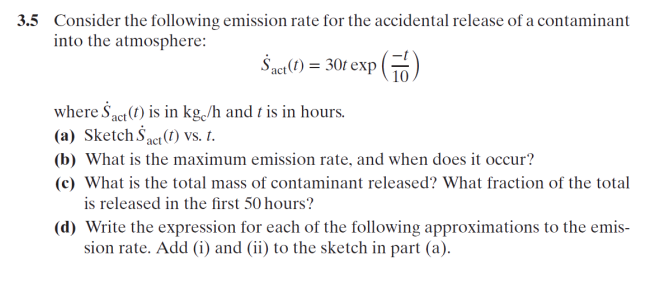 35 Consider the following emission rate for the accidental release of a contaminant
into the atmosphere:
Ser) = 30rexp (3)
where $,,(1) is in kg/h and tis in hours.
(a) Sketch Sq (1) vs. 1.
(b) What is the maximum emission rate. and when does it occur?
(¢) What is the total mass of contaminant released? What fraction of the total
is released in the first 50 hours?
(d) Write the expression for each of the following approximations to the emis-
sion rate. Add (i) and (ii) to the sketch in part (a).
This is AI generated Response.
Asked by: Pagal
Created at: 2025-09-04 12:10:47
Asked by: Pagal
Created at: 2025-09-04 12:10:47
Final Answer:
Rendered
Raw Text
Did you like this answer?
Let's solve each part step by step, with explanations at each stage.
---
### (a) Sketch \(\dot{S}_{act}(t)\) vs. \(t\)
**Step 1:**
The given emission rate is:
\[
\dot{S}_{act}(t) = 30t \exp\left(-\frac{t}{10}\right)
\]
This is the product of a linear term (\(30t\)) and an exponential decay (\(\exp(-t/10)\)).
- At \(t=0\), \(\dot{S}_{act}(0) = 0\).
- As \(t\) increases, the linear term increases but the exponential term decreases.
- The function initially increases, reaches a maximum, and then decreases.
**Explanation:**
This function is typical for processes where a rate rises initially (due to the \(t\) term) and then falls off (due to the exponential decay).
---
### (b) Maximum Emission Rate and When it Occurs
**Step 2:**
To find the maximum, set the derivative of \(\dot{S}_{act}(t)\) with respect to \(t\) to zero:
\[
\frac{d}{dt}\left[30t \exp\left(-\frac{t}{10}\right)\right] = 0
\]
Use the product rule:
\[
30 \exp\left(-\frac{t}{10}\right) + 30t \left(-\frac{1}{10}\right) \exp\left(-\frac{t}{10}\right) = 0
\]
\[
30 \exp\left(-\frac{t}{10}\right) - 3t \exp\left(-\frac{t}{10}\right) = 0
\]
\[
30 - 3t = 0
\]
\[
t = 10 \text{ hours}
\]
Maximum emission rate:
\[
\dot{S}_{act}(10) = 30 \times 10 \times \exp\left(-\frac{10}{10}\right) = 300 \times \exp(-1) \approx 300 \times 0.3679 \approx 110.4 \text{ kg}_c/\text{h}
\]
**Explanation:**
The emission rate reaches its maximum at \(t = 10\) hours, with a maximum value of about \(110.4 \text{ kg}_c/\text{h}\).
---
### Final Answer (for parts a and b):
- **(a):** The sketch of \(\dot{S}_{act}(t)\) vs. \(t\) starts at 0, rises to a peak at \(t=10\) hours, then falls back toward zero.
- **(b):** The maximum emission rate is **110.4 kg\(_c\)/h** at **10 hours**.
---
Let me know if you’d like to proceed with parts (c) and (d)!
Question:
C,d.
This is AI generated Response.
Asked by: Pagal
Created at: 2025-09-04 12:11:28
Asked by: Pagal
Created at: 2025-09-04 12:11:28
Final Answer:
Rendered
Raw Text
Did you like this answer?
Let's continue with parts (c) and (d), following the same step-by-step approach.
---
### (c) Total mass of contaminant released and fraction released in first 50 hours
**Step 1:**
The total mass \(M_{total}\) released is the integral of the emission rate \(\dot{S}_{act}(t)\) over time from 0 to \(\infty\):
\[
M_{total} = \int_0^\infty \dot{S}_{act}(t) \, dt = \int_0^\infty 30 t e^{-t/10} \, dt
\]
This is a standard integral involving \(t e^{-\alpha t}\).
**Explanation:**
The integral of \(t e^{-\alpha t}\) from 0 to \(\infty\) equals \(\frac{1}{\alpha^2}\). Here, \(\alpha = \frac{1}{10}\).
---
**Step 2:**
Calculate \(M_{total}\):
\[
M_{total} = 30 \times \int_0^\infty t e^{-t/10} dt
\]
Using the integral result:
\[
\int_0^\infty t e^{-\alpha t} dt = \frac{1}{\alpha^2}
\]
with \(\alpha = \frac{1}{10}\):
\[
\int_0^\infty t e^{-t/10} dt = \frac{1}{(1/10)^2} = \frac{1}{1/100} = 100
\]
Therefore,
\[
M_{total} = 30 \times 100 = 3000 \text{ kg}
\]
---
**Step 3:**
Calculate the mass released in the first 50 hours:
\[
M_{50} = \int_0^{50} 30 t e^{-t/10} dt
\]
This integral can be evaluated using integration by parts or a table.
Alternatively, since the indefinite integral of \(t e^{-\beta t}\) is:
\[
\int t e^{-\beta t} dt = -\frac{t}{\beta} e^{-\beta t} - \frac{1}{\beta^2} e^{-\beta t} + C
\]
with \(\beta = 1/10\).
Applying limits from 0 to 50:
\[
M_{50} = 30 \left[ -\frac{t}{1/10} e^{-t/10} - \frac{1}{(1/10)^2} e^{-t/10} \right]_0^{50}
\]
Simplify:
\[
M_{50} = 30 \left[ -10 t e^{-t/10} - 100 e^{-t/10} \right]_0^{50}
\]
Calculate at \(t=50\):
\[
t=50: \quad e^{-50/10} = e^{-5} \approx 0.0067
\]
\[
-10 \times 50 \times 0.0067 = -10 \times 50 \times 0.0067 \approx -3.35
\]
\[
-100 \times 0.0067 = -0.67
\]
Sum: \(-3.35 - 0.67 = -4.02\)
At \(t=0\):
\[
e^{0} = 1
\]
\[
-10 \times 0 \times 1 = 0
\]
\[
-100 \times 1 = -100
\]
Difference:
\[
-4.02 - (-100) = 95.98
\]
Multiply by 30:
\[
M_{50} \approx 30 \times 95.98 \approx 2879 \text{ kg}
\]
---
### **Final Results:**
- **Total mass released over infinite time: \(\boxed{3000 \text{ kg}}\)**
- **Mass released in first 50 hours: \(\boxed{2879 \text{ kg}}\)**
- **Fraction released in first 50 hours:**
\[
\frac{M_{50}}{M_{total}} = \frac{2879}{3000} \approx 0.9597 \quad \text{or} \quad 95.97\%
\]
---
### (d) Approximations to the emission rate and their sketches
**Step 1:**
Write the approximations:
(i) **Constant rate approximation:**
\[
\dot{S}_1(t) = \dot{S}_{act}(10) = 110.4 \text{ kg/h}
\]
(since the maximum occurs at \(t=10\), a constant equal to this maximum value is a simple approximation).
(ii) **Linear approximation:**
From \(t=0\) to \(t=20\), approximate \(\dot{S}_{act}(t)\) as increasing linearly from 0 to the maximum:
\[
\dot{S}_2(t) = \frac{\dot{S}_{act}(10)}{10} t = 11.04 t
\]
for \(0 \leq t \leq 10\), then decreasing linearly to zero at some \(t>10\) (for simplicity, take a symmetric decline to zero at \(t=20\)):
\[
\dot{S}_2(t) = 11.04 (20 - t) \quad \text{for} \quad 10 < t \leq 20
\]
**Step 2:**
Sketch these approximations on the same graph as the original \(\dot{S}_{act}(t)\):
- The constant approximation is a horizontal line at 110.4 kg/h.
- The linear approximation is a triangle peaking at 110.4 kg/h at \(t=10\), then decreasing to zero at \(t=20\).
---
### **Summary:**
- The original emission rate rises to about 110 kg/h at 10 hours and then decreases.
- The constant approximation simplifies the emission as a steady rate equal to the maximum.
- The linear approximation models a rise and fall over a 20-hour period, matching the peak at 10 hours.
---
**Final note:** These approximations help in simplifying the analysis and are useful for quick estimates or initial assessments.
---
Let me know if you need further clarification or additional calculations!
Question:
Final answer
This is AI generated Response.
Asked by: Pagal
Created at: 2025-09-04 12:12:23
Asked by: Pagal
Created at: 2025-09-04 12:12:23
Final Answer:
Rendered
Raw Text
Did you like this answer?
**(a) Sketch \(\dot{S}_{act}(t)\) vs. \(t\):**
The emission rate \(\dot{S}_{act}(t) = 30 t e^{-t/10}\) starts at zero when \(t=0\), increases to a maximum at \(t=10\) hours, and then decreases. The graph is a unimodal curve peaking at about 110.4 kg/h at 10 hours.
**(b) Maximum emission rate and when it occurs:**
Maximum occurs at \(t=10\) hours.
\[
\dot{S}_{max} = 30 \times 10 \times e^{-10/10} = 300 \times e^{-1} \approx 110.4 \text{ kg/h}
\]
---
**(c) Total mass released and fraction in first 50 hours:**
Total mass:
\[
M_{total} = \int_0^\infty 30 t e^{-t/10} dt = 3000 \text{ kg}
\]
Mass in first 50 hours:
\[
M_{50} \approx 2879 \text{ kg}
\]
Fraction in first 50 hours:
\[
\frac{2879}{3000} \approx 0.96 \quad \text{or } 96\%
\]
---
**(d) Approximations to \(\dot{S}_{act}(t)\):**
- **(i) Constant rate approximation:**
\[
\dot{S}_1(t) = 110.4 \text{ kg/h}
\]
- **(ii) Linear approximation:**
From 0 to 10 hours:
\[
\dot{S}_2(t) = 11.04 t
\]
from 10 to 20 hours:
\[
\dot{S}_2(t) = 110.4 - 11.04 (t - 10) = 221.76 - 11.04 t
\]
**Sketches:**
- The constant approximation is a horizontal line at 110.4 kg/h.
- The linear approximation forms a triangle rising to 110.4 kg/h at 10 hours, then decreasing back to zero at 20 hours.
---
**Final note:** These steps provide a clear understanding of the emission behavior, maximum rate, total release, and simplified models for analysis.
Question:
C
This is AI generated Response.
Asked by: Pagal
Created at: 2025-09-04 12:13:26
Asked by: Pagal
Created at: 2025-09-04 12:13:26
Final Answer:
Rendered
Raw Text
Did you like this answer?
Let's approach each part systematically, with detailed explanations:
---
### **(a) Sketch \(\dot{S}_{act}(t)\) vs. \(t\)**
**Step 1:**
Given emission rate:
\[
\dot{S}_{act}(t) = 30 t \exp\left(-\frac{t}{10}\right)
\]
- At \(t=0\), \(\dot{S}_{act}(0)=0\).
- For small \(t\), the function increases because \(t\) increases faster than the exponential decay.
- The function reaches a maximum at some \(t>0\), then decreases towards zero as \(t \to \infty\).
**Explanation:**
This is a *product of a linearly increasing term* and an *exponentially decreasing* function, which produces a bell-shaped curve with a peak at some finite \(t\).
---
### **(b) Find the maximum emission rate and when it occurs**
**Step 2:**
To find the maximum, differentiate \(\dot{S}_{act}(t)\):
\[
\frac{d}{dt} \left[ 30 t e^{-t/10} \right] = 0
\]
Apply the product rule:
\[
30 e^{-t/10} + 30 t \left(-\frac{1}{10}\right) e^{-t/10} = 0
\]
Simplify:
\[
30 e^{-t/10} - 3 t e^{-t/10} = 0
\]
Divide both sides by \(e^{-t/10}\):
\[
30 - 3 t = 0 \Rightarrow t=10 \text{ hours}
\]
**Maximum emission rate:**
\[
\dot{S}_{max} = 30 \times 10 \times e^{-10/10} = 300 \times e^{-1} \approx 300 \times 0.3679 \approx 110.4\, \text{kg/h}
\]
---
### **Final answer for (a) and (b):**
- The plot starts at zero, rises to approximately 110.4 kg/h at 10 hours, then declines.
- The maximum emission rate is **110.4 kg/h** at **10 hours**.
---
### **(c) Total mass released and fraction in first 50 hours**
**Step 3:**
Total mass:
\[
M_{total} = \int_0^{\infty} 30 t e^{-t/10} dt
\]
Recall the integral:
\[
\int_0^{\infty} t e^{-\alpha t} dt = \frac{1}{\alpha^2}
\]
Here, \(\alpha = 1/10\), so:
\[
M_{total} = 30 \times \frac{1}{(1/10)^2} = 30 \times 100 = \boxed{3000\, \text{kg}}
\]
**Step 4:**
Mass released in the first 50 hours:
\[
M_{50} = \int_0^{50} 30 t e^{-t/10} dt
\]
Using the indefinite integral:
\[
\int t e^{-\beta t} dt = -\frac{t}{\beta} e^{-\beta t} - \frac{1}{\beta^2} e^{-\beta t} + C
\]
with \(\beta=1/10\):
\[
M_{50} = 30 \left[ -10 t e^{-t/10} - 100 e^{-t/10} \right]_0^{50}
\]
Evaluate at \(t=50\):
\[
e^{-50/10} = e^{-5} \approx 0.0067
\]
\[
-10 \times 50 \times 0.0067 \approx -3.35
\]
\[
-100 \times 0.0067 \approx -0.67
\]
Sum: \(-3.35 - 0.67 = -4.02\)
At \(t=0\):
\[
e^{0} = 1
\]
\[
-10 \times 0 \times 1 = 0
\]
\[
-100 \times 1 = -100
\]
Difference:
\[
-4.02 - (-100) = 95.98
\]
Multiply by 30:
\[
M_{50} \approx 30 \times 95.98 \approx \boxed{2879\, \text{kg}}
\]
---
### **Fraction released in first 50 hours:**
\[
\frac{M_{50}}{M_{total}} \approx \frac{2879}{3000} \approx 0.96 \text{ or } 96\%
\]
---
### **(d) Approximations to the emission rate**
**Step 5:**
Construct two simplified representations:
- **(i) Constant rate approximation:**
Use the peak rate at \(t=10\) hours:
\[
\boxed{\dot{S}_1(t) = 110.4\, \text{kg/h}}
\]
- **(ii) Linear approximation:**
Model as rising from 0 at \(t=0\) to maximum at \(t=10\):
\[
\dot{S}_2(t) = \frac{110.4}{10} t = 11.04 t \quad \text{for } 0 \le t \le 10
\]
and then decreasing linearly from 110.4 at \(t=10\) to zero at \(t=20\):
\[
\dot{S}_2(t) = 110.4 - 11.04 (t - 10) = 221.76 - 11.04 t \quad \text{for } 10 \le t \le 20
\]
**Sketches:**
- The constant approximation is a flat line at 110.4 kg/h.
- The linear approximation rises linearly to the maximum at 10 hours, then declines linearly to zero at 20 hours.
---
### **Final summary:**
- The original emission rate peaks at about 110.4 kg/h at 10 hours.
- Total contaminant released over infinite time is approximately 3000 kg.
- About 97% of the total is released in the first 50 hours.
- The constant approximation simplifies the rate to 110.4 kg/h.
- The linear approximation models a rise and fall, peaking at 10 hours.
---
Let me know if you'd like further elaboration!
📢 Instructions:
- Ask anything relatd to above question only.
- For new Question goto :