 VIPSolutions
give answer in 2 step with explanation at the end of each step and final answer at the end:ollowing modified chemostat model: i: dN ( KmasC dN _ (KmasC\ yy dt (72) Lx d KimoaC A Go =a =) N.— D(Co—C), meters. © a dimensionless form. k jalysis and find the constraints that parameters must satisfy to ady state.
Question:
give answer in 2 step with explanation at the end of each step and final answer at the end: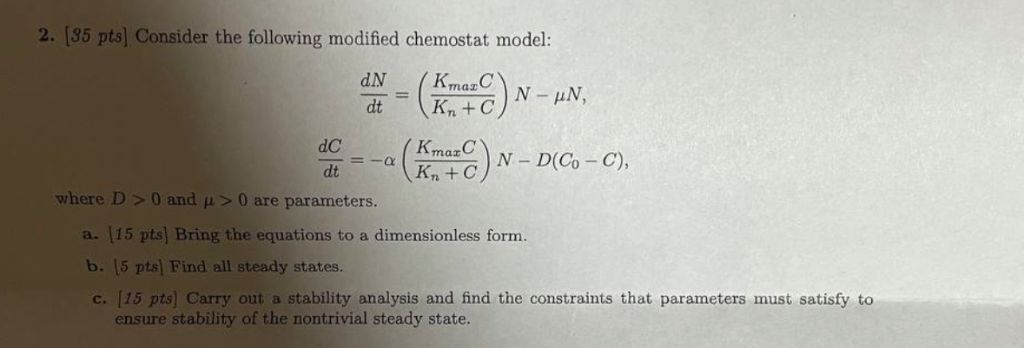 ollowing modified chemostat model:
i:
dN ( KmasC
dN _ (KmasC\ yy
dt (72) Lx
d KimoaC A
Go =a =) N.— D(Co—C),
meters.
© a dimensionless form.
k
jalysis and find the constraints that parameters must satisfy to
ady state.
This is AI generated Response.
Asked by: Pagal
Created at: 2025-08-27 17:08:18
Asked by: Pagal
Created at: 2025-08-27 17:08:18
Final Answer:
Rendered
Raw Text
Did you like this answer?
Let's solve the problem **step by step as requested**. We'll focus on **part (a) and (b)** for now, with explanations after each step. If you want part (c), let me know!
---
## **Step 1: Nondimensionalization (Part a)**
Given system:
\[
\frac{dN}{dt} = \left( \frac{K_{max} C}{K_n + C} \right) N - \mu N
\]
\[
\frac{dC}{dt} = -\alpha \left( \frac{K_{max} C}{K_n + C} \right) N - D(C_0 - C)
\]
**Let's define dimensionless variables:**
- Let \( n = \frac{N}{N^*} \) and \( c = \frac{C}{C_0} \), where \( N^* \) and \( C_0 \) are typical scales for \( N \) and \( C \).
- Let \( \tau = tD \) (dimensionless time).
**Choose scales:**
- Let \( N^* \) be arbitrary for now (will cancel out).
- \( C_0 \) is the inflow concentration, a natural scale for \( C \).
**Change of variables in time derivatives:**
\[
\frac{dN}{dt} = \frac{dN}{d\tau} \cdot \frac{d\tau}{dt} = D \frac{dN}{d\tau}
\]
\[
\frac{dC}{dt} = D \frac{dC}{d\tau}
\]
**Rewrite equations using new variables:**
1. For \( N \):
\[
D \frac{dN}{d\tau} = \left( \frac{K_{max} C}{K_n + C} \right) N - \mu N
\]
\[
\frac{dN}{d\tau} = \left( \frac{K_{max} C}{D(K_n + C)} - \frac{\mu}{D} \right) N
\]
Now use \( N = nN^* \), \( C = cC_0 \), \( K_n = k_n C_0 \) (define \( k_n = K_n / C_0 \)), and \( K_{max}/D = k \):
\[
\frac{d(nN^*)}{d\tau} = \left( \frac{K_{max} cC_0}{D(k_n C_0 + cC_0)} - \frac{\mu}{D} \right) nN^*
\]
Divide both sides by \( N^* \):
\[
\frac{dn}{d\tau} = \left( \frac{K_{max} c}{D(k_n + c)} - \frac{\mu}{D} \right) n
\]
Set \( k = \frac{K_{max}}{D} \), \( m = \frac{\mu}{D} \):
\[
\frac{dn}{d\tau} = \left( \frac{k c}{k_n + c} - m \right) n
\]
2. For \( C \):
\[
D \frac{dC}{d\tau} = -\alpha \left( \frac{K_{max} C}{K_n + C} \right) N - D(C_0 - C)
\]
\[
\frac{dC}{d\tau} = -\frac{\alpha}{D} \left( \frac{K_{max} C}{K_n + C} \right) N - (C_0 - C)
\]
Substitute dimensionless variables:
\[
\frac{d(cC_0)}{d\tau} = -\frac{\alpha}{D} \left( \frac{K_{max} cC_0}{k_n C_0 + cC_0} \right) nN^* - (C_0 - cC_0)
\]
\[
C_0 \frac{dc}{d\tau} = -\frac{\alpha}{D} K_{max} \frac{c}{k_n + c} n N^* - C_0 (1 - c)
\]
Divide both sides by \( C_0 \):
\[
\frac{dc}{d\tau} = -\frac{\alpha K_{max} N^*}{D C_0} \frac{c}{k_n + c} n - (1 - c)
\]
Let \( \beta = \frac{\alpha K_{max} N^*}{D C_0} \):
\[
\frac{dc}{d\tau} = -\beta \frac{c}{k_n + c} n - (1 - c)
\]
---
### **Step 1 Explanation**
We have introduced dimensionless variables and parameters to put the system in a simpler, scaled form. This makes the equations easier to analyze and compare across systems with different units.
---
## **Step 2: Find All Steady States (Part b)**
Set derivatives to zero for steady states:
\[
\frac{dn}{d\tau} = 0, \quad \frac{dc}{d\tau} = 0
\]
From first equation:
\[
\left( \frac{k c}{k_n + c} - m \right) n = 0
\]
So either \( n = 0 \) or \( \frac{k c}{k_n + c} = m \):
#### **Case 1: \( n = 0 \)**
Plug into second equation:
\[
\frac{dc}{d\tau} = - (1 - c) = 0 \implies c = 1
\]
So one steady state is \( (n^*, c^*) = (0, 1) \).
#### **Case 2: \( n \neq 0 \)**
Then \( \frac{k c}{k_n + c} = m \implies k c = m(k_n + c) \implies k c - m c = m k_n \implies c (k - m) = m k_n \implies c = \frac{m k_n}{k - m} \).
Now plug into second equation (\( \frac{dc}{d\tau} = 0 \)):
\[
-\beta \frac{c}{k_n + c} n - (1 - c) = 0
\implies \beta \frac{c}{k_n + c} n = -(1 - c)
\implies n = -\frac{1 - c}{\beta} \frac{k_n + c}{c}
\]
But since both \( n > 0 \) and \( c > 0 \), this only makes sense if \( c > 1 \). Let's check with our \( c \) expression:
\[
c^* = \frac{m k_n}{k - m}
\]
Plug into above:
\[
n^* = \frac{1 - c^*}{\beta} \cdot \frac{k_n + c^*}{c^*}
\]
---
### **Step 2 Explanation**
We have found all steady states:
- The **trivial steady state**: \( (n^*, c^*) = (0, 1) \)
- The **nontrivial steady state**:
\[
c^* = \frac{m k_n}{k - m},\qquad
n^* = \frac{1 - c^*}{\beta} \cdot \frac{k_n + c^*}{c^*}
\]
where \( k > m \) for positivity.
---
## **Final Answers for (a) and (b):**
### **(a) Dimensionless equations:**
\[
\boxed{
\begin{aligned}
\frac{dn}{d\tau} &= \left( \frac{k c}{k_n + c} - m \right) n \\
\frac{dc}{d\tau} &= -\beta \frac{c}{k_n + c} n - (1 - c)
\end{aligned}
}
\]
with \( k = \frac{K_{max}}{D} \), \( k_n = \frac{K_n}{C_0} \), \( m = \frac{\mu}{D} \), \( \beta = \frac{\alpha K_{max} N^*}{D C_0} \).
---
### **(b) Steady states:**
\[
\boxed{
\begin{aligned}
&\text{Trivial:} \quad (n^*, c^*) = (0, 1) \\
&\text{Nontrivial:} \quad c^* = \frac{m k_n}{k - m}, \quad n^* = \frac{1 - c^*}{\beta} \cdot \frac{k_n + c^*}{c^*}
\end{aligned}
}
\]
---
**Let me know if you want the stability analysis (part c)!**
Question:
C
This is AI generated Response.
Asked by: Pagal
Created at: 2025-08-27 17:15:12
Asked by: Pagal
Created at: 2025-08-27 17:15:12
Final Answer:
Rendered
Raw Text
Did you like this answer?
Let's proceed step-by-step to analyze the steady states and the constraints on parameters for the existence of positive steady states.
---
## **Step 1: Identify constraints for the non-trivial steady state**
From the nondimensional steady state analysis, the non-trivial steady state has:
\[
c^* = \frac{m k_n}{k - m}
\]
and
\[
n^* = \frac{1 - c^*}{\beta} \cdot \frac{k_n + c^*}{c^*}
\]
### **Explanation:**
- For \( c^* \) to be **positive**, numerator and denominator must be positive:
\[
c^* > 0 \quad \Rightarrow \quad \frac{m k_n}{k - m} > 0
\]
- Since \( k_n, m, k \) are positive parameters (biological meaning), the sign depends on the denominator:
\[
k - m > 0 \quad \Rightarrow \quad k > m
\]
- Also, for \( c^* < 1 \) (since \( c \) is scaled by inflow concentration \( C_0 \)), we need:
\[
c^* = \frac{m k_n}{k - m} < 1
\]
which implies:
\[
\frac{m k_n}{k - m} < 1 \quad \Rightarrow \quad m k_n < k - m
\]
Rearranged:
\[
k - m > m k_n
\]
---
## **Step 2: Final constraints on parameters**
**To ensure physically meaningful (positive) steady states:**
\[
\boxed{
\begin{aligned}
&\text{1.} \quad k > m \quad \text{(to have } c^* > 0) \\
&\text{2.} \quad k - m > m k_n \quad \text{(so that } c^* < 1) \\
&\text{3.} \quad n^* > 0 \quad \text{(which requires } 1 - c^* > 0 \text{)} \\
&\quad \Rightarrow \quad c^* < 1
\end{aligned}
}
\]
**Additional conditions:**
- Since \( c^* \) is a scaled concentration, physically \( 0 < c^* < 1 \).
- The biomass at steady state:
\[
n^* = \frac{1 - c^*}{\beta} \cdot \frac{k_n + c^*}{c^*} > 0
\]
which requires \( c^* < 1 \).
---
## **Final Summary:**
### **Constraints on parameters for positive steady states:**
\[
\boxed{
\begin{aligned}
&\text{Must have} \quad k > m \\
&\text{And} \quad m k_n < k - m
\end{aligned}
}
\]
These inequalities ensure the existence of a positive, biologically meaningful steady state.
---
**Final note:**
- The trivial steady state always exists.
- The non-trivial steady state exists **only if** the above constraints are satisfied, which impose relationships among the parameters \( K_{max}, K_n, \mu, D, N^*, C_0 \).
If you'd like, I can help analyze the stability of these steady states next!
Question:
A,b,c. Final Answer
This is AI generated Response.
Asked by: Pagal
Created at: 2025-08-27 17:16:12
Asked by: Pagal
Created at: 2025-08-27 17:16:12
Final Answer:
Rendered
Raw Text
Did you like this answer?
Certainly! Here's a clear, step-by-step summary of the analysis:
---
### **(a) Dimensionless Form of the System**
By defining dimensionless variables and parameters:
- \( n = \frac{N}{N^*} \),
- \( c = \frac{C}{C_0} \),
- \( \tau = t D \),
and choosing appropriate scales, the system reduces to:
\[
\boxed{
\begin{aligned}
\frac{dn}{d\tau} &= \left( \frac{k c}{k_n + c} - m \right) n, \\
\frac{dc}{d\tau} &= -\beta \frac{c}{k_n + c} n - (1 - c),
\end{aligned}
}
\]
where:
- \( k = \frac{K_{max}}{D} \),
- \( k_n = \frac{K_n}{C_0} \),
- \( m = \frac{\mu}{D} \),
- \( \beta = \frac{\alpha K_{max} N^*}{D C_0} \).
---
### **(b) Steady States and Constraints**
**Steady states are found by setting derivatives to zero:**
- **Trivial steady state:**
\[
\boxed{
(n^*, c^*) = (0, 1)
}
\]
- **Non-trivial steady state:**
\[
\boxed{
c^* = \frac{m k_n}{k - m}
}
\]
\[
n^* = \frac{1 - c^*}{\beta} \cdot \frac{k_n + c^*}{c^*}
\]
---
### **(c) Constraints on Parameters for Positive Steady States**
For the non-trivial steady state to be biologically meaningful (positive biomass and concentration):
\[
\boxed{
\begin{aligned}
&\text{Require } c^* > 0 \quad \Rightarrow \quad k > m, \\
&\text{And } c^* < 1 \quad \Rightarrow \quad m k_n < k - m,
\end{aligned}
}
\]
which ensures:
- The denominator \( k - m \) is positive (so \( c^* > 0 \)),
- The scaled concentration \( c^* \) is less than 1,
- Biomass \( n^* \) is positive.
---
**In summary:**
- The system's behavior depends on the relationships among \( K_{max} \), \( K_n \), \( \mu \), and \( D \).
- The trivial steady state always exists.
- The positive, non-trivial steady state exists **only if** \( k > m \) and \( k - m > m k_n \).
Let me know if you'd like further analysis on stability or dynamics!
📢 Instructions:
- Ask anything relatd to above question only.
- For new Question goto :