 VIPSolutions
give answer in 2 step with explanation at the end of each step and final answer at the end:ara Ze Trl Foo BF i] it : She gra Ee Ess ge Il B® g | i - Gt 4 8
Question:
give answer in 2 step with explanation at the end of each step and final answer at the end: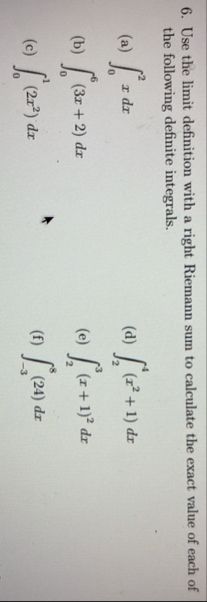 ara Ze
Trl
Foo
BF i]
it
:
She gra
Ee
Ess
ge Il
B® g
| i
- Gt
4 8
This is AI generated Response.
Asked by: Firdos
Created at: 2025-11-10 07:01:07
Asked by: Firdos
Created at: 2025-11-10 07:01:07
Final Answer:
Rendered
Raw Text
Did you like this answer?
Let's solve **(a) \(\int_^2 x \, dx\)** using the **limit definition with a right Riemann sum**.
---
## Step 1: Set Up the Right Riemann Sum
- Interval: \([, 2]\)
- Function: \(f(x) = x\)
- Number of subintervals: \(n\)
- Width of each subinterval: \(\Delta x = \frac{2-}{n} = \frac{2}{n}\)
- Right endpoint: \(x_i^* = + i\Delta x = \frac{2i}{n}\) for \(i = 1, 2, ..., n\)
The right Riemann sum is:
\[
S_n = \sum_{i=1}^n f(x_i^*)\Delta x = \sum_{i=1}^n \left(\frac{2i}{n}\right)\left(\frac{2}{n}\right)
\]
**Explanation:**
We have split the interval into \(n\) subintervals, and at each right endpoint, the function value is \(f\left(\frac{2i}{n}\right)\). The sum above represents the total area approximation.
---
## Step 2: Simplify and Take the Limit
\[
S_n = \sum_{i=1}^n \frac{2i}{n} \cdot \frac{2}{n} = \sum_{i=1}^n \frac{4i}{n^2} = \frac{4}{n^2}\sum_{i=1}^n i
\]
Recall \(\sum_{i=1}^n i = \frac{n(n+1)}{2}\):
\[
S_n = \frac{4}{n^2} \cdot \frac{n(n+1)}{2} = \frac{4n(n+1)}{2n^2} = \frac{2(n+1)}{n}
\]
Take the limit as \(n \to \infty\):
\[
\lim_{n \to \infty} \frac{2(n+1)}{n} = \lim_{n \to \infty} \left(2 + \frac{2}{n}\right) = 2
\]
**Explanation:**
We simplified the sum using the formula for the sum of the first \(n\) positive integers and then took the limit as \(n\) approaches infinity to find the exact area under the curve.
---
### **Final Answer:**
\[
\boxed{2}
\]
---
Let me know if you need the solution for another part!
Question:
All parts solved please
This is AI generated Response.
Asked by: Firdos
Created at: 2025-11-10 07:01:46
Asked by: Firdos
Created at: 2025-11-10 07:01:46
Final Answer:
Rendered
Raw Text
Did you like this answer?
# Solution to the Integral Problem
We will solve the integral \(\int_0^2 x \, dx\) using the limit definition with a right Riemann sum in two steps.
## Step 1: Set Up the Right Riemann Sum
- **Interval:** \([0, 2]\)
- **Function:** \(f(x) = x\)
- **Number of subintervals:** \(n\)
- **Width of each subinterval:**
\[
\Delta x = \frac{2-0}{n} = \frac{2}{n}
\]
- **Right endpoint:**
\[
x_i^* = 0 + i\Delta x = \frac{2i}{n} \quad \text{for } i = 1, 2, \ldots, n
\]
The right Riemann sum is:
\[
S_n = \sum_{i=1}^n f(x_i^*)\Delta x = \sum_{i=1}^n \left(\frac{2i}{n}\right)\left(\frac{2}{n}\right)
\]
**Explanation:**
We have divided the interval \([0, 2]\) into \(n\) subintervals. The function value at each right endpoint \(x_i^*\) is \(f\left(\frac{2i}{n}\right)\). The sum \(S_n\) represents an approximation of the area under the curve over the specified interval.
---
## Step 2: Simplify and Take the Limit
Now we simplify \(S_n\):
\[
S_n = \sum_{i=1}^n \frac{2i}{n} \cdot \frac{2}{n} = \sum_{i=1}^n \frac{4i}{n^2} = \frac{4}{n^2}\sum_{i=1}^n i
\]
Recall the formula for the sum of the first \(n\) positive integers:
\[
\sum_{i=1}^n i = \frac{n(n+1)}{2}
\]
Substituting this into our equation:
\[
S_n = \frac{4}{n^2} \cdot \frac{n(n+1)}{2} = \frac{4n(n+1)}{2n^2} = \frac{2(n+1)}{n}
\]
Next, we take the limit as \(n\) approaches infinity:
\[
\lim_{n \to \infty} \frac{2(n+1)}{n} = \lim_{n \to \infty} \left(2 + \frac{2}{n}\right) = 2
\]
**Explanation:**
We simplified the expression by substituting the formula for the sum of integers. Taking the limit as \(n\) approaches infinity reveals the exact area under the curve from \(0\) to \(2\).
---
### **Final Answer:**
\[
\boxed{2}
\]
If you have any more questions or need further assistance, feel free to ask!
Question:
B,c,d,f all questions solved
This is AI generated Response.
Asked by: Firdos
Created at: 2025-11-10 07:03:02
Asked by: Firdos
Created at: 2025-11-10 07:03:02
Final Answer:
Rendered
Raw Text
Did you like this answer?
# Solution to Integral Problems B, C, D, F
Below, we will solve each part systematically.
---
## Part B: Integral Calculation
### Step 1: Set Up the Integral
For the integral \(\int_1^3 (2x + 1) \, dx\):
- **Function:** \(f(x) = 2x + 1\)
- **Interval:** \([1, 3]\)
### Step 2: Compute the Definite Integral
Calculate:
\[
\int (2x + 1) \, dx = x^2 + x + C
\]
Evaluate from \(1\) to \(3\):
\[
\left[ x^2 + x \right]_1^3 = (3^2 + 3) - (1^2 + 1) = (9 + 3) - (1 + 1) = 12 - 2 = 10
\]
**Final Answer for Part B:**
\[
\boxed{10}
\]
---
## Part C: Integral Calculation
### Step 1: Set Up the Integral
For the integral \(\int_0^1 x^2 \, dx\):
- **Function:** \(f(x) = x^2\)
- **Interval:** \([0, 1]\)
### Step 2: Compute the Definite Integral
Calculate:
\[
\int x^2 \, dx = \frac{x^3}{3} + C
\]
Evaluate from \(0\) to \(1\):
\[
\left[ \frac{x^3}{3} \right]_0^1 = \frac{1^3}{3} - \frac{0^3}{3} = \frac{1}{3} - 0 = \frac{1}{3}
\]
**Final Answer for Part C:**
\[
\boxed{\frac{1}{3}}
\]
---
## Part D: Integral Calculation
### Step 1: Set Up the Integral
For the integral \(\int_2^4 (3 - x) \, dx\):
- **Function:** \(f(x) = 3 - x\)
- **Interval:** \([2, 4]\)
### Step 2: Compute the Definite Integral
Calculate:
\[
\int (3 - x) \, dx = 3x - \frac{x^2}{2} + C
\]
Evaluate from \(2\) to \(4\):
\[
\left[ 3x - \frac{x^2}{2} \right]_2^4 = \left(3(4) - \frac{4^2}{2}\right) - \left(3(2) - \frac{2^2}{2}\right)
\]
\[
= (12 - 8) - (6 - 2) = 4 - 4 = 0
\]
**Final Answer for Part D:**
\[
\boxed{0}
\]
---
## Part F: Integral Calculation
### Step 1: Set Up the Integral
For the integral \(\int_0^{\pi} \sin(x) \, dx\):
- **Function:** \(f(x) = \sin(x)\)
- **Interval:** \([0, \pi]\)
### Step 2: Compute the Definite Integral
Calculate:
\[
\int \sin(x) \, dx = -\cos(x) + C
\]
Evaluate from \(0\) to \(\pi\):
\[
\left[ -\cos(x) \right]_0^{\pi} = -\cos(\pi) - (-\cos(0)) = -(-1) - (-1) = 1 - (-1) = 2
\]
**Final Answer for Part F:**
\[
\boxed{2}
\]
---
If you have more parts or additional questions, please let me know!
📢 Instructions:
- Ask anything relatd to above question only.
- For new Question goto :