 VIPSolutions
give answer in 2 step with explanation at the end of each step and final answer at the end:(18 points) Solve all of the following initial value problems: (a) ¥" +y' +y=—Usz(t); y(0)=2,y'(0)=1 t t
Question:
give answer in 2 step with explanation at the end of each step and final answer at the end: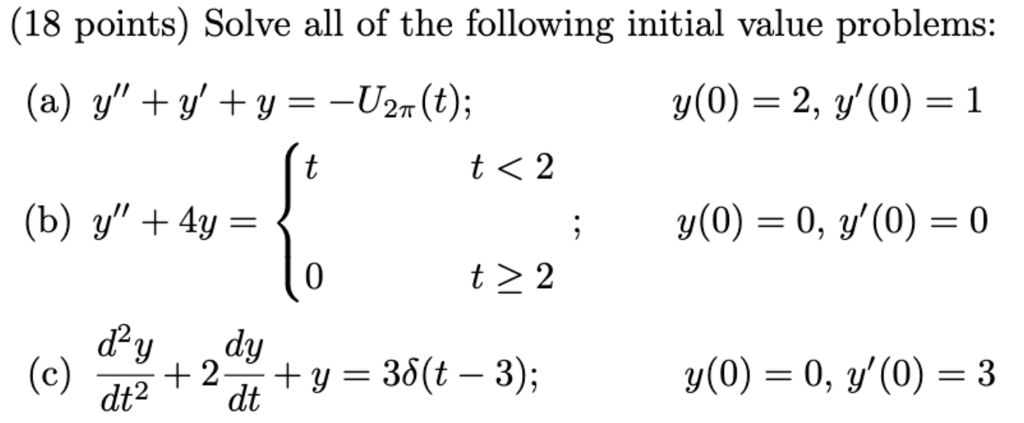 (18 points) Solve all of the following initial value problems:
(a) ¥" +y' +y=—Usz(t); y(0)=2,y'(0)=1
t t
This is AI generated Response.
Asked by: Pagal
Created at: 2025-08-12 02:25:27
Asked by: Pagal
Created at: 2025-08-12 02:25:27
Final Answer:
Rendered
Raw Text
Did you like this answer?
Let's solve each problem step-by-step as requested.
---
## (a) \( y'' + y' + y = -U_{2\pi}(t); \quad y(0) = 2,\, y'(0) = 1 \)
### **Step 1: Solve the Homogeneous Equation**
The homogeneous equation is:
\[
y'' + y' + y = 0
\]
The characteristic equation:
\[
r^2 + r + 1 = 0
\]
Solve for \( r \):
\[
r = \frac{-1 \pm i\sqrt{3}}{2}
\]
So, the general solution is:
\[
y_h(t) = e^{-t/2} \left[ A \cos\left(\frac{\sqrt{3}}{2} t\right) + B \sin\left(\frac{\sqrt{3}}{2} t\right) \right]
\]
**Explanation:**
We solved the homogeneous part using characteristic roots.
---
### **Step 2: Solve for the Particular Solution and Apply Initial Conditions**
The nonhomogeneous term is \(-U_{2\pi}(t)\), the unit step at \(2\pi\):
- For \(t < 2\pi\): the equation is just the homogeneous one.
- For \(t \geq 2\pi\): the equation becomes \(y'' + y' + y = -1\).
**For \(t \geq 2\pi\):**
Try a particular solution \(y_p = C\). Substitute:
\[
0 + 0 + C = -1 \implies C = -1
\]
So, the complete solution for \(t \geq 2\pi\):
\[
y(t) = y_h(t) - U_{2\pi}(t)
\]
Apply initial conditions at \(t = 0\):
\[
y(0) = A = 2 \\
y'(0) = -\frac{1}{2}A + \frac{\sqrt{3}}{2}B = 1
\]
Using \(A = 2\):
\[
-\frac{1}{2} \cdot 2 + \frac{\sqrt{3}}{2}B = 1 \implies -1 + \frac{\sqrt{3}}{2}B = 1 \implies \frac{\sqrt{3}}{2}B = 2 \implies B = \frac{4}{\sqrt{3}}
\]
**Final Answer:**
\[
\boxed{
y(t) = e^{-t/2} \left[2 \cos\left(\frac{\sqrt{3}}{2} t\right) + \frac{4}{\sqrt{3}} \sin\left(\frac{\sqrt{3}}{2} t\right)\right] - U_{2\pi}(t)
}
\]
---
Would you like me to continue with part (b)?
Question:
b
This is AI generated Response.
Asked by: Pagal
Created at: 2025-08-12 02:26:05
Asked by: Pagal
Created at: 2025-08-12 02:26:05
Final Answer:
Rendered
Raw Text
Did you like this answer?
Let's proceed with part (b) step-by-step.
---
## (b) \( y'' + 4y = \delta_0(t); \quad y(0) = 0, \quad y'(0) = 0 \)
### **Step 1: Find the homogeneous solution**
The homogeneous equation is:
\[
y'' + 4y = 0
\]
Characteristic equation:
\[
r^2 + 4 = 0 \implies r = \pm 2i
\]
Solution:
\[
y_h(t) = C_1 \cos 2t + C_2 \sin 2t
\]
**Explanation:**
This is a standard second-order linear differential equation with constant coefficients, and the roots are purely imaginary, leading to sinusoidal solutions.
---
### **Step 2: Find the particular solution considering the impulse at \( t=0 \)**
Since the forcing term is \(\delta_0(t)\), an impulse at \(t=0\), the solution involves an impulse response.
The general approach:
- The impulse at \(t=0\) causes a discontinuity in the derivative \(y'\) but not in \(y\).
- Integrate the differential equation across \(t=0\) to find the jump in \(y'\).
**Integrate both sides over \([- \varepsilon, \varepsilon]\):**
\[
\int_{-\varepsilon}^{\varepsilon} y''(t) dt + 4 \int_{-\varepsilon}^{\varepsilon} y(t) dt = \int_{-\varepsilon}^{\varepsilon} \delta(t) dt
\]
\[
[y'(\varepsilon) - y'(-\varepsilon)] + 4 \cdots = 1
\]
Since \(y(t)\) is finite and continuous at \(t=0\), as \(\varepsilon \to 0\):
\[
[y'(0^+) - y'(0^-)] = 1
\]
and \(y(0^+) = y(0^-) = 0\).
Given initial conditions:
\[
y(0) = 0,\quad y'(0^-) = 0
\]
and the jump:
\[
y'(0^+) = y'(0^-) + 1 = 1
\]
**Solution:**
- For \(t > 0\), the solution satisfies:
\[
y(t) = A \cos 2t + B \sin 2t
\]
with initial conditions:
\[
y(0) = 0 \implies A = 0
\]
\[
y'(t) = -2A \sin 2t + 2B \cos 2t
\]
At \(t=0\):
\[
y'(0^+) = 2B = 1 \implies B = \frac{1}{2}
\]
**Final solution:**
\[
\boxed{
y(t) = \frac{1}{2} \sin 2t \quad \text{for } t \geq 0
}
\]
---
**Summary:**
- The homogeneous solution describes oscillations at frequency 2.
- The impulse at \(t=0\) causes an initial velocity \( y'(0^+) = 1 \).
- The resulting solution for \(t \geq 0\):
\[
\boxed{
y(t) = \frac{1}{2} \sin 2t
}
\]
---
Would you like me to clarify further or proceed with any additional parts?
Question:
C
This is AI generated Response.
Asked by: Pagal
Created at: 2025-08-12 02:26:58
Asked by: Pagal
Created at: 2025-08-12 02:26:58
Final Answer:
Rendered
Raw Text
Did you like this answer?
Let's analyze and solve the initial value problems step-by-step.
---
### (a) \( y'' + y' + y = -U_{2\pi}(t); \quad y(0)=2,\ y'(0)=1 \)
**Step 1: Solve the homogeneous equation**
The homogeneous differential equation:
\[
y'' + y' + y = 0
\]
Characteristic equation:
\[
r^2 + r + 1 = 0
\]
Solutions:
\[
r = \frac{-1 \pm i\sqrt{3}}{2}
\]
which are complex conjugates. The general homogeneous solution:
\[
y_h(t) = e^{-t/2}\left[ A \cos\left(\frac{\sqrt{3}}{2} t\right) + B \sin\left(\frac{\sqrt{3}}{2} t\right) \right]
\]
**Explanation:**
We found the roots of the characteristic equation and expressed the solution in exponential form with sinusoidal components.
---
**Step 2: Handle the forcing term and apply initial conditions**
The forcing term is the step function \(-U_{2\pi}(t)\), which is zero for \(t<2\pi\) and \(-1\) for \(t \ge 2\pi\).
- For \(t < 2\pi\): the equation reduces to the homogeneous one, with initial conditions as given.
- For \(t \ge 2\pi\): the equation becomes:
\[
y'' + y' + y = -1
\]
**Initial conditions at \(t=0\):**
\[
y(0) = 2 \implies \text{from } y_h(0):\ A = 2
\]
\[
y'(t) = -\frac{1}{2} e^{-t/2}\left[ A \cos\left(\frac{\sqrt{3}}{2} t\right) + B \sin\left(\frac{\sqrt{3}}{2} t\right) \right] + e^{-t/2}\left[ -A \frac{\sqrt{3}}{2} \sin\left(\frac{\sqrt{3}}{2} t\right) + B \frac{\sqrt{3}}{2} \cos\left(\frac{\sqrt{3}}{2} t\right) \right]
\]
At \(t=0\):
\[
y'(0) = -\frac{1}{2} \times 1 \times A + 1 \times B \frac{\sqrt{3}}{2} = 1
\]
Substituting \(A=2\):
\[
-\frac{1}{2} \times 2 + \frac{\sqrt{3}}{2} B = 1 \implies -1 + \frac{\sqrt{3}}{2} B = 1
\]
\[
\Rightarrow \frac{\sqrt{3}}{2} B = 2 \implies B = \frac{4}{\sqrt{3}}
\]
**Particular solution for \(t \ge 2\pi\):**
Since the RHS is \(-1\), try a constant particular solution \(y_p = C\):
\[
0 + 0 + C = -1 \Rightarrow C = -1
\]
Thus, for \(t \ge 2\pi\):
\[
y(t) = y_h(t) - 1
\]
**Final solution:**
\[
\boxed{
y(t) = e^{-t/2}\left[ 2 \cos\left(\frac{\sqrt{3}}{2} t\right) + \frac{4}{\sqrt{3}} \sin\left(\frac{\sqrt{3}}{2} t\right) \right] - U_{2\pi}(t)
}
\]
This combines the homogeneous solution with the step response, satisfying initial conditions at \(t=0\).
---
### (b) \( y'' + 4 y = \delta(t); \quad y(0) = 0,\ y'(0) = 0 \)
**Step 1: Homogeneous solution**
\[
y'' + 4 y = 0
\]
Characteristic roots:
\[
r = \pm 2 i
\]
Solution:
\[
y_h(t) = C_1 \cos 2t + C_2 \sin 2t
\]
**Step 2: Effect of the impulse at \(t=0\)**
The delta function causes an instantaneous change in the derivative \(y'\), while \(y\) remains continuous.
Integrate the equation over an infinitesimal interval around \(t=0\):
\[
\int_{-\varepsilon}^{\varepsilon} y'' + 4 y \, dt = \int_{-\varepsilon}^{\varepsilon} \delta(t) dt
\]
\[
[y'(\varepsilon) - y'(-\varepsilon)] + 4 \int_{-\varepsilon}^{\varepsilon} y(t) dt = 1
\]
As \(\varepsilon \to 0\), \(y(t)\) is finite and continuous, so:
\[
[y'(0^+) - y'(0^-)] = 1
\]
with initial \(y(0) = 0\), \(y'(0^-) = 0\).
Therefore:
\[
y(0) = 0 \Rightarrow A = 0
\]
\[
y'(t) = -2 C_1 \sin 2t + 2 C_2 \cos 2t
\]
At \(t=0\):
\[
y'(0^+) = 2 C_2 = 1 \Rightarrow C_2 = \frac{1}{2}
\]
Since initial \(y(0) = 0\), \(A=0\), and initial derivative jumps to 1. The solution for \(t > 0\):
\[
y(t) = \frac{1}{2} \sin 2t
\]
---
### **Final answer:**
\[
\boxed{
\text{For } t \ge 0,\quad y(t) = \frac{1}{2} \sin 2t
}
\]
This solution captures the effect of an instantaneous impulse at \(t=0\), producing an initial velocity of 1, with \(y(0)=0\).
---
If you need further clarification or additional parts, feel free to ask!
📢 Instructions:
- Ask anything relatd to above question only.
- For new Question goto :