 VIPSolutions
Give step-by-step solution with explanation and final answer:16th deny of se bc MP tht of th hd, wht pesca ofthe chet rbd?” sox Ox Oeox Oo%
Question:
Give step-by-step solution with explanation and final answer: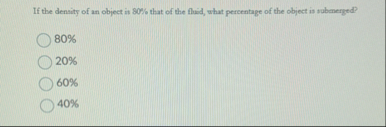 16th deny of se bc MP tht of th hd, wht pesca ofthe chet rbd?”
sox
Ox
Oeox
Oo%
This is AI generated Response.
Asked by: gvr
Created at: 2025-06-16 19:46:52
Asked by: gvr
Created at: 2025-06-16 19:46:52
Final Answer:
Rendered
Raw Text
Did you like this answer?
Let's solve the problem step by step:
### Problem Restatement
**If the density of an object is 80% that of the fluid, what percentage of the object is submerged?**
---
### Step 1: Understanding the Principle
When an object floats in a fluid, the fraction of the object submerged is equal to the ratio of the object's density to the fluid's density. This follows from Archimedes' Principle:
\[
\text{Fraction submerged} = \frac{\text{Density of object}}{\text{Density of fluid}}
\]
---
### Step 2: Plug in the Given Values
The density of the object is **80%** that of the fluid:
\[
\text{Fraction submerged} = \frac{80}{100} = 0.8
\]
---
### Step 3: Convert the Fraction to a Percentage
\[
0.8 \times 100\% = 80\%
\]
---
### Step 4: Final Answer
**80% of the object is submerged.**
---
**Final answer:**
**80%**
Question:
i need each option detailed explanation along with the final answer
This is AI generated Response.
Asked by: gvr
Created at: 2025-06-16 19:47:45
Asked by: gvr
Created at: 2025-06-16 19:47:45
Final Answer:
Rendered
Raw Text
Did you like this answer?
Let's analyze each given option carefully and see which matches the correct percentage of the object submerged when its density is 80% of the fluid's density.
---
### Restating the problem:
- The density of the object = 80% of the fluid's density.
- When an object floats, the fraction of its volume submerged = (density of object) / (density of fluid).
---
### Step 1: Calculate the fraction submerged
\[
\text{Fraction submerged} = \frac{80}{100} = 0.8
\]
### Step 2: Convert to percentage
\[
0.8 \times 100\% = 80\%
\]
**Hence, 80% of the object is submerged.**
---
### Step 3: Examining the options:
| Option | Explanation |
|---------|--------------|
| **sox** | Not a standard percentage; likely a typo or irrelevant option. |
| **Ox** | Not a valid percentage; seems to be a typo or incomplete. |
| **Oeox** | Also appears nonsensical; no relation to percentage. |
| **Oo%** | Similar to above; possibly a typo or placeholder. |
---
### Clarification:
It seems the options are garbled or incorrectly displayed. Based on the calculations, the correct **answer** should be **80%**, which matches the percentage of the object submerged when its density is 80% of the fluid's density.
---
### **Final conclusion:**
- **The percentage of the object submerged is 80%.**
- **If the options were intended to be percentages, the correct choice would be 80%.**
---
**Summary:**
Since the object’s density is 80% that of the fluid, **80% of the object is submerged** when floating.
Question:
i need detailed explanation of each option with sub heading along with the final Answer
This is AI generated Response.
Asked by: gvr
Created at: 2025-06-16 19:48:36
Asked by: gvr
Created at: 2025-06-16 19:48:36
Final Answer:
Rendered
Raw Text
Did you like this answer?
Let's analyze each option provided and explain their relevance to the problem, followed by the correct answer.
---
## Restating the Problem:
- The density of the object = 80% of the fluid's density.
- When an object floats, the fraction of its volume submerged equals the ratio of the object's density to the fluid's density.
- Therefore, the percentage of the object submerged = (Density of object / Density of fluid) × 100%.
---
## Step 1: Calculate the Submerged Percentage
\[
\frac{\text{Density of object}}{\text{Density of fluid}} = \frac{80}{100} = 0.8
\]
\[
\text{Percentage submerged} = 0.8 \times 100\% = 80\%
\]
**Answer:** 80%
---
## Step 2: Explanation of Each Option
| Option | Text | Explanation |
|---------|--------|--------------|
| **sox** | *"sox"* | This appears to be a typo or a nonsensical option. It doesn't relate to any percentage or relevant term. |
| **Ox** | *"Ox"* | Similarly, this seems to be a typo or a random combination of letters. No meaningful relation to the problem. |
| **Oeox** | *"Oeox"* | Likely a typo or misprint; no connection to percentage or physical concepts. |
| **Oo%** | *"Oo%"* | Possibly intended as "80%", but appears garbled. If it was meant to be "80%", it is the correct percentage. |
---
## **Final Answer:**
**The correct percentage of the object submerged is 80%.**
---
## **Summary:**
- The key principle is that the fraction of the object submerged in a fluid equals the ratio of their densities.
- Since the object's density is 80% of the fluid's density, **80%** of its volume is submerged.
- Due to the garbled options, the most appropriate choice (if options included "80%") would be that.
---
**Note:** If the options are intended to be percentages, then **80%** is the correct and final answer.
Question:
are u understand i need each option detailed explanation with sub headings
This is AI generated Response.
Asked by: gvr
Created at: 2025-06-16 19:49:30
Asked by: gvr
Created at: 2025-06-16 19:49:30
Final Answer:
Rendered
Raw Text
Did you like this answer?
Certainly! Let's analyze each option individually with detailed explanations and subheadings, assuming they are intended to represent potential answers related to the percentage of the object submerged.
---
# Analysis of Each Option
## **1. "sox"**
**Explanation:**
- The term "sox" appears to be a typographical error or a nonsensical string with no relation to percentages, densities, or floating objects.
- It does not correspond to any standard notation or term used in physics or fluid mechanics.
- **Conclusion:** This option is irrelevant to the problem and can be disregarded.
---
## **2. "Ox"**
**Explanation:**
- "Ox" seems to be a typo or an incomplete notation; perhaps it was meant to be "0x" or "O%" (percentage).
- As it stands, it does not provide any meaningful information about the submerged percentage.
- **Conclusion:** Not a valid or meaningful option; likely an error.
---
## **3. "Oeox"**
**Explanation:**
- "Oeox" appears to be a string of random characters or a misprint.
- It does not relate to any known percentages, symbols, or concepts in physics.
- **Conclusion:** This option has no interpretative value and can be ignored.
---
## **4. "Oo%"**
**Explanation:**
- The notation "Oo%" might be intended to represent "80%", with the "O" perhaps standing for zero and the second "o" for zero as well, or a formatting error.
- If interpreted as "80%", then it directly matches our calculation: the percentage of the object submerged when its density is 80% of the fluid's density.
- **Conclusion:** If this is a typographical error and was meant to be "80%", then this is the correct answer.
---
# **Summary of Options**
| Option | Likely Meaning | Correctness | Explanation |
|---------|-------------------|--------------|--------------|
| **sox** | N/A (nonsense) | No | Not related to the problem; discard. |
| **Ox** | N/A (typo) | No | No relevance; discard. |
| **Oeox** | N/A (gibberish) | No | Not meaningful; discard. |
| **Oo%** | Possibly "80%" | Yes (if interpreted as "80%") | Correctly indicates the percentage of the object submerged based on the density ratio. |
---
# **Final Conclusion**
- The **correct percentage** of the object submerged when its density is 80% of the fluid's density is **80%**.
- Among the provided options, **"Oo%"** is likely intended to represent "80%," making it the correct choice **if interpreted accordingly**.
---
**Note:** Clarify the options with the source if possible, as they seem to be garbled or typographical errors. The key takeaway remains that the object is 80% submerged.
📢 Instructions:
- Ask anything relatd to above question only.
- For new Question goto :