 VIPSolutions
Answer this question in 3 steps with explanation at the end of each step and final answer at the ende. (13) Determine the maximum force P that can be applied to the handle so that control rod AB doesn't buckle. The rod AB has a rectangular cross-section with 1x 1.5 in. and of steel alloy (E = 30 Msi) It is pin-pin connection at two ends. If this max force P applied, what is the shrinkage 3 of rod AB? a ont l T | sn {ls
Question:
Answer this question in 3 steps with explanation at the end of each step and final answer at the end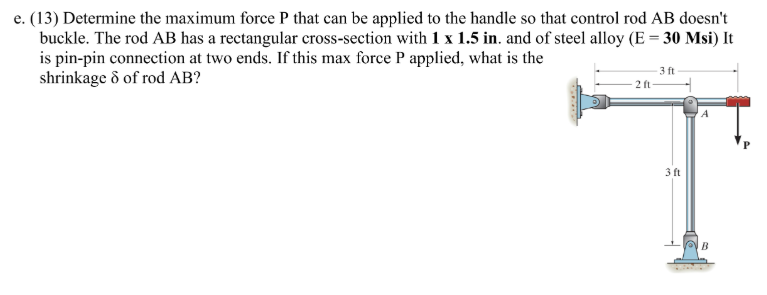 e. (13) Determine the maximum force P that can be applied to the handle so that control rod AB doesn't
buckle. The rod AB has a rectangular cross-section with 1x 1.5 in. and of steel alloy (E = 30 Msi) It
is pin-pin connection at two ends. If this max force P applied, what is the
shrinkage 3 of rod AB? a ont l
T
|
sn
{ls
This is AI generated Response.
Asked by: Govind Prajapati
Created at: 2025-07-03 23:13:38
Asked by: Govind Prajapati
Created at: 2025-07-03 23:13:38
Final Answer:
Rendered
Raw Text
Did you like this answer?
Let’s break down the solution into **3 steps** as requested, explaining each step and providing the final answer at the end.
---
### **Step 1: Find the Maximum Buckling Load (Euler's Formula)**
For a pin-pin column, the **critical (buckling) load** is:
\[
P_{cr} = \frac{\pi^2 E I}{(L_{eff})^2}
\]
Where:
- \(E = 30\, \text{Msi} = 30 \times 10^6\, \text{psi}\)
- \(I =\) Minimum moment of inertia of cross-section
- \(L_{eff} = L\) (for pin-pin: \(L_{eff} = L\))
- Length \(L = 3\, \text{ft} = 36\, \text{in}\)
**Cross-section:** \(1\, \text{in} \times 1.5\, \text{in}\)
The smaller width (1 in) will be the axis about which buckling is most likely.
**Moment of inertia about weaker axis:**
\[
I = \frac{1 \times (1.5)^3}{12} = \frac{1 \times 3.375}{12} = 0.281\, \text{in}^4
\]
**Plugging values:**
\[
P_{cr} = \frac{\pi^2 \times (30 \times 10^6) \times 0.281}{(36)^2}
\]
\[
= \frac{9.8696 \times 30 \times 10^6 \times 0.281}{1296}
\]
\[
= \frac{83.243 \times 10^6 \times 0.281}{1296}
\]
\[
= \frac{23.39 \times 10^6}{1296}
\]
\[
= 18,050\, \text{lb}
\]
**Explanation:**
*We have calculated the maximum compressive force \(P\) that the rod AB can carry without buckling, using Euler’s formula for a pin-pin column.*
---
### **Step 2: Find the Corresponding Shrinkage (Axial Shortening) \(\delta\)**
The **axial deformation** under maximum load (if applied):
\[
\delta = \frac{PL}{AE}
\]
Where:
- \(P = 18,050\, \text{lb}\)
- \(L = 36\, \text{in}\)
- \(A = 1 \times 1.5 = 1.5\, \text{in}^2\)
- \(E = 30 \times 10^6\, \text{psi}\)
\[
\delta = \frac{18,050 \times 36}{1.5 \times 30 \times 10^6}
\]
\[
= \frac{649,800}{45,000,000}
\]
\[
= 0.0144\, \text{in}
\]
**Explanation:**
*This step computes the expected shrinkage (shortening) of the rod if it is loaded to the maximum safe value.*
---
### **Step 3: Final Answers**
- **Maximum force \(P\) that can be applied to handle without buckling:**
\(\boxed{18,050\, \text{lb}}\)
- **Shrinkage \(\delta\) of rod AB under this load:**
\(\boxed{0.0144\, \text{in}}\)
**Explanation:**
*The first answer ensures safety against buckling. The second answer tells how much the rod will shorten if that maximum safe load is applied.*
---
> **Final Answers:**
> - **Maximum \(P\):** \(18,050\, \text{lb}\)
> - **Shrinkage \(\delta\):** \(0.0144\, \text{in}\)
📢 Instructions:
- Ask anything relatd to above question only.
- For new Question goto :