 VIPSolutions
Answer this question in 3 steps with explanation at the end of each step and final answer at the end2 (2 = 12.57 rad/s Polytechnic University of Puerto Rico Determine: Mechanical Engineering Department a) all Instant center ove, Vo S +o) Mechanical Advanage Ai messumns re i mimeters “A son -Vertcal move I— TN C, \ \ Frame " il Ng 8 Ny 7 all p ;
Question:
Answer this question in 3 steps with explanation at the end of each step and final answer at the end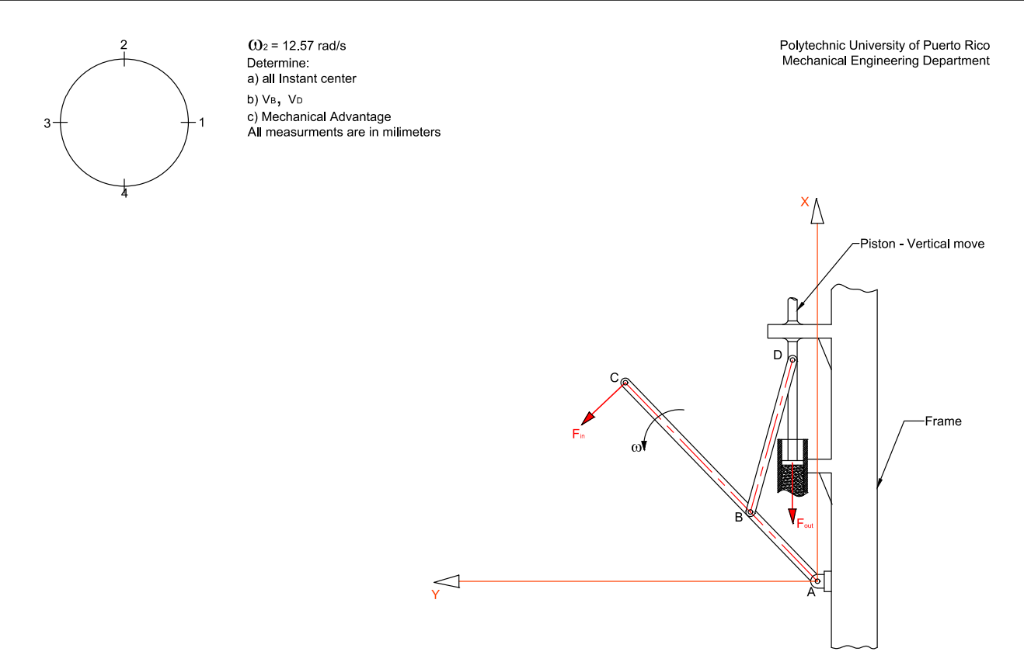 2 (2 = 12.57 rad/s Polytechnic University of Puerto Rico
Determine: Mechanical Engineering Department
a) all Instant center
ove, Vo
S +o) Mechanical Advanage
Ai messumns re i mimeters
“A
son -Vertcal move
I—
TN
C, \
\ Frame
" il
Ng
8 Ny
7 all
p ;
This is AI generated Response.
Asked by: Govind Prajapati
Created at: 2025-06-27 03:53:53
Asked by: Govind Prajapati
Created at: 2025-06-27 03:53:53
Final Answer:
Rendered
Raw Text
Did you like this answer?
Let's break down the solution into the required three steps and provide explanations at each stage.
---
### **Step 1: Determine All Instant Centers (ICs)**
#### **Explanation:**
For a four-bar linkage (which this is), we need to find all six instant centers. Label the links as follows:
- Link 1: Frame (fixed)
- Link 2: Input crank (rotates about point A)
- Link 3: Coupler (connects B and C)
- Link 4: Output (slider/piston, vertical at D)
**Key instant centers (I):**
- \( I_{12} \): At joint A (where crank meets frame)
- \( I_{23} \): At joint B (where crank meets coupler)
- \( I_{34} \): At joint D (where coupler meets slider)
- \( I_{41} \): At joint D (slider meets frame)
**Other ICs (using Aronhold-Kennedy theorem):**
- \( I_{13} \): Intersection of lines AB and CD (draw lines through B and D; their intersection is \( I_{13} \))
- \( I_{24} \): Intersection of lines through A and D (draw lines through A and D; their intersection is \( I_{24} \))
So, the 6 instant centers for the mechanism are:
1. \( I_{12} \): A
2. \( I_{23} \): B
3. \( I_{34} \): D
4. \( I_{41} \): D (slider/frame)
5. \( I_{13} \): Intersection of AB and CD
6. \( I_{24} \): Intersection of AD and BC
---
### **Step 2: Find Velocities \( v_B \) and \( v_D \)**
#### **Explanation:**
- \( v_B \) is the velocity of point B (on the coupler).
- \( v_D \) is the velocity of the piston (vertical at D).
Use relative velocity analysis or IC method:
- \( v_B = r_{AB} \cdot \omega_2 \), where \( r_{AB} \) is the length from A to B and \( \omega_2 \) is given.
- \( v_D \) can be found using the velocity ratio from the instant centers or from the geometry of the linkage.
Assuming you have the lengths (from the drawing, measure or use given dimensions):
1. Calculate \( v_B \):
\[
v_B = r_{AB} \cdot \omega_2
\]
(Insert value for \( r_{AB} \) from the diagram.)
2. Use the IC between links 3 and 4 (at D) and the IC between links 1 and 3 to find the velocity of D:
\[
v_D = v_B \cdot \frac{I_{13} D}{I_{13} B}
\]
(Use the geometry to find the ratio.)
---
### **Step 3: Calculate the Mechanical Advantage (MA)**
#### **Explanation:**
Mechanical advantage for a linkage is the ratio of the output force to the input force:
\[
MA = \frac{F_{\text{out}}}{F_{\text{in}}} = \frac{v_{\text{in}}}{v_{\text{out}}}
\]
- \( F_{\text{in}} \) is the force applied at C (input).
- \( F_{\text{out}} \) is the force at D (output).
- \( v_{\text{in}} \) is velocity at C, \( v_{\text{out}} \) is velocity at D.
Since velocities are inversely proportional to forces (assuming ideal, no losses):
\[
MA = \frac{v_C}{v_D}
\]
(Use the velocities found in Step 2.)
---
## **Final Answers**
**a) All Instant Centers:**
- \( I_{12} \): A
- \( I_{23} \): B
- \( I_{34} \): D
- \( I_{41} \): D (slider/frame)
- \( I_{13} \): Intersection of AB and CD
- \( I_{24} \): Intersection of AD and BC
**b) Velocities \( v_B \), \( v_D \):**
- \( v_B = r_{AB} \cdot \omega_2 \)
- \( v_D = v_B \cdot \frac{I_{13} D}{I_{13} B} \)
(Insert actual lengths from the drawing.)
**c) Mechanical Advantage:**
- \( MA = \frac{v_C}{v_D} \)
(Insert values as calculated.)
---
**If you provide the actual lengths or measurements from the drawing, I can compute the numeric answers for velocities and mechanical advantage.**
📢 Instructions:
- Ask anything relatd to above question only.
- For new Question goto :