 VIPSolutions
Answer this question in 3 steps with explanation at the end of each step and final answer at the endRequired information AA drum of 80-mm radius is attached to a disk of 160-mm radius. The disk and drum have a combined mass of 8.50 kg and ‘a combined radius of gyration of 120 mm. A cord is attached as shown and pulled with a force P of magnitude 20 N. Know that the coefficients of static and kinetic friction are ju, = 0.25 and pu, = 0.2, respectively. o Determine the angular acceleration of the disk. (Round the final answer to three decimal places.) The angular acceleration of the disk is[ | rad/s” -
Question:
Answer this question in 3 steps with explanation at the end of each step and final answer at the end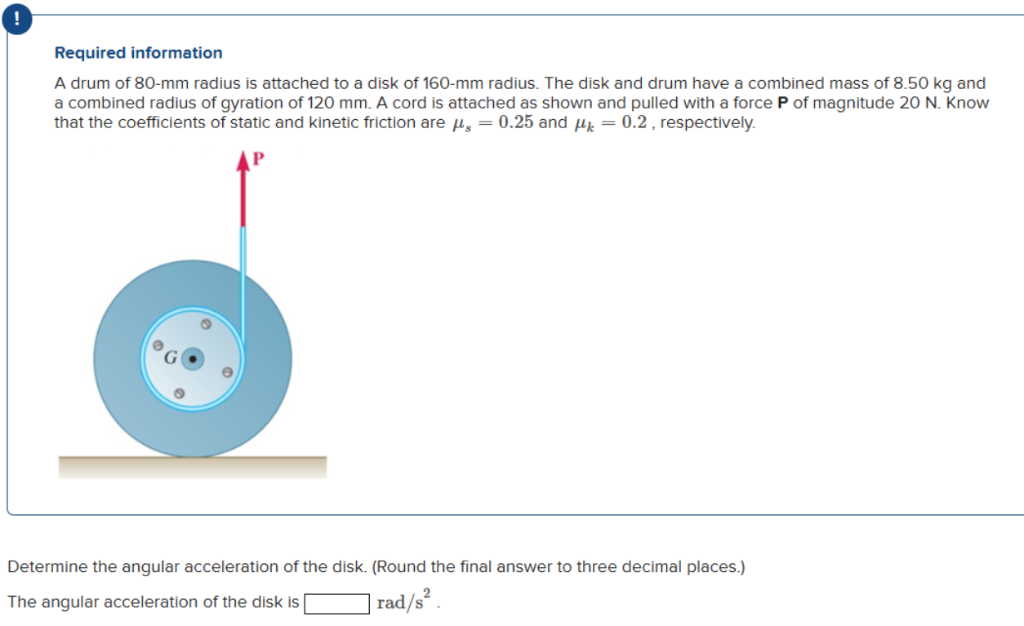 Required information
AA drum of 80-mm radius is attached to a disk of 160-mm radius. The disk and drum have a combined mass of 8.50 kg and
‘a combined radius of gyration of 120 mm. A cord is attached as shown and pulled with a force P of magnitude 20 N. Know
that the coefficients of static and kinetic friction are ju, = 0.25 and pu, = 0.2, respectively.
o
Determine the angular acceleration of the disk. (Round the final answer to three decimal places.)
The angular acceleration of the disk is[ | rad/s” -
This is AI generated Response.
Asked by: Govind Prajapati
Created at: 2025-06-27 02:49:52
Asked by: Govind Prajapati
Created at: 2025-06-27 02:49:52
Final Answer:
Rendered
Raw Text
Did you like this answer?
Let's solve the problem step by step:
---
### **Step 1: Draw the Free-Body Diagram and Write Equations**
- **Given:**
- Radius of drum \( r_1 = 80 \) mm \( = 0.08 \) m
- Radius of disk \( r_2 = 160 \) mm \( = 0.16 \) m
- Mass \( m = 8.5 \) kg
- Radius of gyration \( k = 120 \) mm \( = 0.12 \) m
- Force \( P = 20 \) N
- Coefficients: \( \mu_s = 0.25 \), \( \mu_k = 0.2 \)
- **Forces acting:**
- Tension \( P \) upward on drum at radius \( r_1 \)
- Friction force \( f \) at the ground, at radius \( r_2 \), direction opposes motion
- **Moment of inertia:**
\[
I = m k^2 = 8.5 \times (0.12)^2 = 0.1224 \text{ kg} \cdot \text{m}^2
\]
**Explanation:**
We identify all forces and moments acting on the disk and calculate the moment of inertia using the radius of gyration.
---
### **Step 2: Check for Rolling Without Slipping**
For rolling without slipping, friction must be enough to prevent slipping:
- Maximum static friction: \( f_{s,\text{max}} = \mu_s N = \mu_s m g \)
\[
f_{s,\text{max}} = 0.25 \times 8.5 \times 9.81 = 20.86 \text{ N}
\]
**Now, write equations of motion:**
- Translational: \( P - f = m a \)
- Rotational (about center): \( P r_1 + f r_2 = I \alpha \)
- For rolling without slipping: \( a = r_2 \alpha \)
**Explanation:**
We calculate the maximum static friction and set up the equations for translation and rotation, considering non-slipping motion.
---
### **Step 3: Solve Simultaneous Equations**
From the above:
- \( P - f = m a \)
- \( P r_1 + f r_2 = I \alpha \)
- \( a = r_2 \alpha \implies \alpha = \frac{a}{r_2} \)
**Substitute \(\alpha\) in the torque equation:**
\[
P r_1 + f r_2 = I \frac{a}{r_2}
\]
Now, solve for \( f \):
\[
P - f = m a \implies f = P - m a
\]
\[
P r_1 + (P - m a) r_2 = I \frac{a}{r_2}
\]
\[
P r_1 + P r_2 - m a r_2 = I \frac{a}{r_2}
\]
\[
P (r_1 + r_2) - m a r_2 = I \frac{a}{r_2}
\]
\[
P (r_1 + r_2) = m a r_2 + I \frac{a}{r_2}
\]
\[
P (r_1 + r_2) = a \left( m r_2 + \frac{I}{r_2} \right)
\]
\[
a = \frac{P (r_1 + r_2)}{m r_2 + \frac{I}{r_2}}
\]
Plug in values:
- \( P = 20 \) N
- \( r_1 = 0.08 \) m
- \( r_2 = 0.16 \) m
- \( m = 8.5 \) kg
- \( I = 0.1224 \) kg·m²
Calculate denominator:
\[
m r_2 = 8.5 \times 0.16 = 1.36
\]
\[
\frac{I}{r_2} = \frac{0.1224}{0.16} = 0.765
\]
\[
\text{Denominator} = 1.36 + 0.765 = 2.125
\]
\[
r_1 + r_2 = 0.08 + 0.16 = 0.24
\]
\[
P(r_1 + r_2) = 20 \times 0.24 = 4.8
\]
\[
a = \frac{4.8}{2.125} = 2.259 \text{ m/s}^2
\]
Now, angular acceleration:
\[
\alpha = \frac{a}{r_2} = \frac{2.259}{0.16} = 14.119 \text{ rad/s}^2
\]
**Check friction force:**
\[
f = P - m a = 20 - (8.5 \times 2.259) = 20 - 19.202 = 0.798 \text{ N}
\]
Since \( 0.798 \text{ N} < 20.86 \text{ N} \), rolling without slipping is valid.
---
### **Final Answer:**
\[
\boxed{14.119 \ \text{rad}/\text{s}^2}
\]
---
**Summary of Steps:**
1. Identified forces, moments, and calculated moment of inertia.
2. Checked for rolling without slipping and wrote equations.
3. Solved equations and verified friction condition; calculated final angular acceleration.
📢 Instructions:
- Ask anything relatd to above question only.
- For new Question goto :