 VIPSolutions
Answer this question in 3 steps with explanation at the end of each step and final answer at the end.For the spring assemblage shown in figure, obtain (a) Degrees of freedom, (b) the displacements of nodes2, 3 and 4, (c) the reaction forces at nodes 1, 2, 3, 4 and 5. (d) Forces at each elements 4 10.000 N/m 20.000 N/m 10.000 N/m / 450 N / | 2 3 iW
Question:
Answer this question in 3 steps with explanation at the end of each step and final answer at the end.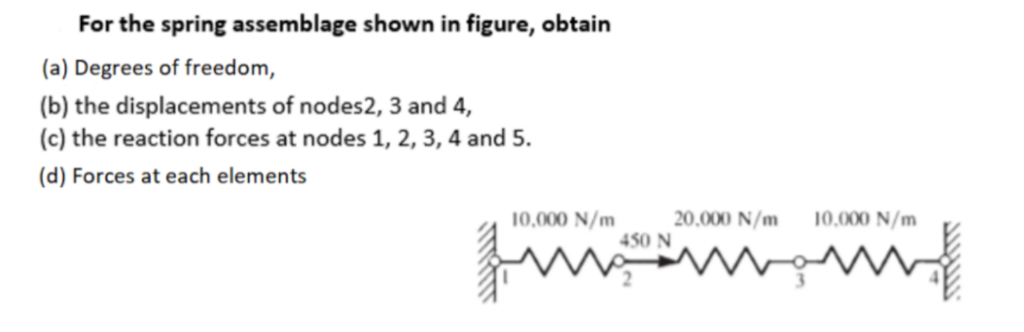 For the spring assemblage shown in figure, obtain
(a) Degrees of freedom,
(b) the displacements of nodes2, 3 and 4,
(c) the reaction forces at nodes 1, 2, 3, 4 and 5.
(d) Forces at each elements
4 10.000 N/m 20.000 N/m 10.000 N/m
/ 450 N /
| 2 3 iW
This is AI generated Response.
Asked by: Govind Prajapati
Created at: 2025-06-26 19:53:58
Asked by: Govind Prajapati
Created at: 2025-06-26 19:53:58
Final Answer:
Rendered
Raw Text
Did you like this answer?
Let's solve the spring assemblage problem step by step as requested:
---
### **Step 1: Degrees of Freedom (DOF)**
#### **Explanation:**
- Each node in a 1D spring system can potentially move along the axis (horizontal in this case).
- In the figure, there are 4 nodes (let’s name them: 1, 2, 3, and 4).
- Node 1 and Node 4 are attached to walls (fixed), so their displacements are zero: \( u_1 = 0 \) and \( u_4 = 0 \).
- Nodes 2 and 3 are free to move.
#### **Calculation:**
- **Total nodes:** 4
- **Fixed nodes:** 2 (nodes 1 and 4)
- **Free nodes:** 2 (nodes 2 and 3)
#### **Answer:**
**Degrees of Freedom = 2 (at nodes 2 and 3)**
---
### **Step 2: Displacements of Nodes 2, 3, and 4**
#### **Explanation:**
- We need to set up and solve the equilibrium equations using the **stiffness matrix method**.
- Let \( k_1 = 10{,}000 \) N/m, \( k_2 = 20{,}000 \) N/m, \( k_3 = 10{,}000 \) N/m.
- Let \( u_1, u_2, u_3, u_4 \) be the displacements at nodes 1, 2, 3, and 4.
##### **Global Stiffness Matrix:**
- For 4 nodes, the global system is:
\[
\begin{bmatrix}
k_1 & -k_1 & 0 & 0 \\
-k_1 & k_1 + k_2 & -k_2 & 0 \\
0 & -k_2 & k_2 + k_3 & -k_3 \\
0 & 0 & -k_3 & k_3 \\
\end{bmatrix}
\begin{bmatrix}
u_1 \\ u_2 \\ u_3 \\ u_4
\end{bmatrix}
=
\begin{bmatrix}
0 \\ 450 \\ 0 \\ 0
\end{bmatrix}
\]
- \( u_1 = 0 \) (fixed), \( u_4 = 0 \) (fixed):
So the reduced system for \( u_2 \) and \( u_3 \):
\[
\begin{bmatrix}
k_1 + k_2 & -k_2 \\
-k_2 & k_2 + k_3 \\
\end{bmatrix}
\begin{bmatrix}
u_2 \\ u_3
\end{bmatrix}
=
\begin{bmatrix}
450 \\
0
\end{bmatrix}
\]
Substitute values:
\[
\begin{bmatrix}
10,000 + 20,000 & -20,000 \\
-20,000 & 20,000 + 10,000 \\
\end{bmatrix}
\begin{bmatrix}
u_2 \\ u_3
\end{bmatrix}
=
\begin{bmatrix}
450 \\
0
\end{bmatrix}
\]
\[
\begin{bmatrix}
30,000 & -20,000 \\
-20,000 & 30,000 \\
\end{bmatrix}
\begin{bmatrix}
u_2 \\ u_3
\end{bmatrix}
=
\begin{bmatrix}
450 \\
0
\end{bmatrix}
\]
##### **Solving the Equations:**
From the second row:
\[
-20,000u_2 + 30,000u_3 = 0 \implies u_2 = 1.5u_3
\]
Now substitute into the first equation:
\[
30,000u_2 - 20,000u_3 = 450 \\
30,000(1.5u_3) - 20,000u_3 = 450 \\
45,000u_3 - 20,000u_3 = 450 \\
25,000u_3 = 450 \\
u_3 = \frac{450}{25,000} = 0.018\ \text{m}
\]
\[
u_2 = 1.5 \times 0.018 = 0.027\ \text{m}
\]
\[
u_4 = 0
\]
#### **Answer:**
- \( u_2 = 0.027 \) m
- \( u_3 = 0.018 \) m
- \( u_4 = 0 \) m
---
### **Step 3: Reaction Forces at Nodes 1, 2, 3, 4**
#### **Explanation:**
- Reaction at node 1: \( R_1 = k_1(u_2 - u_1) \)
- Reaction at node 2: internal, but let's compute the net force for completeness.
- Reaction at node 3: internal.
- Reaction at node 4: \( R_4 = k_3(u_3 - u_4) \)
#### **Calculation:**
- \( u_1 = 0 \), \( u_4 = 0 \)
- \( R_1 = k_1 (u_2 - u_1) = 10,000 \times (0.027 - 0) = 270 \) N (to the left)
- \( R_2 = \) net force at node 2 = \( k_1(u_1-u_2) + k_2(u_3-u_2) + \text{external force} \)
Internal equilibrium (should sum to zero):
\( k_1(u_1-u_2) + k_2(u_3-u_2) + 450 \)
\( = 10,000(0-0.027) + 20,000(0.018-0.027) + 450 \)
\( = -270 + 20,000 \times (-0.009) + 450 \)
\( = -270 - 180 + 450 = 0 \) N (as expected, equilibrium at free node)
- \( R_3 = k_2(u_2-u_3) + k_3(u_4-u_3) \)
\( = 20,000(0.027-0.018) + 10,000(0-0.018) \)
\( = 20,000(0.009) - 180 \)
\( = 180 - 180 = 0 \) N
- \( R_4 = k_3(u_3-u_4) = 10,000(0.018 - 0) = 180 \) N (to the right, at fixed support)
#### **Answer:**
- **Node 1:** 270 N (reaction, leftward)
- **Node 2:** 0 N (free node, equilibrium)
- **Node 3:** 0 N (free node, equilibrium)
- **Node 4:** 180 N (reaction, rightward)
---
### **Step 4: Force in Each Element**
#### **Explanation:**
- Force in spring 1 (\( F_1 \)): \( k_1(u_2-u_1) = 10,000 \times 0.027 = 270 \) N
- Force in spring 2 (\( F_2 \)): \( k_2(u_3-u_2) = 20,000 \times (0.018-0.027) = 20,000 \times (-0.009) = -180 \) N (compression)
- Force in spring 3 (\( F_3 \)): \( k_3(u_4-u_3) = 10,000 \times (0-0.018) = -180 \) N (compression)
#### **Answer:**
- **Spring 1:** 270 N (tension)
- **Spring 2:** 180 N (compression)
- **Spring 3:** 180 N (compression)
---
## **Final Summary Table**
| Step | Quantity | Value |
|------|------------------------|------------------------------|
| 1 | Degrees of Freedom | 2 |
| 2 | Displacement \( u_2 \) | \( 0.027 \) m |
| | Displacement \( u_3 \) | \( 0.018 \) m |
| | Displacement \( u_4 \) | \( 0 \) m |
| 3 | Reaction at Node 1 | 270 N |
| | Reaction at Node 2 | 0 N |
| | Reaction at Node 3 | 0 N |
| | Reaction at Node 4 | 180 N |
| 4 | Force in Spring 1 | 270 N (tension) |
| | Force in Spring 2 | 180 N (compression) |
| | Force in Spring 3 | 180 N (compression) |
---
**If you need the full matrix solution or any step detailed further, let me know!**
📢 Instructions:
- Ask anything relatd to above question only.
- For new Question goto :