 VIPSolutions
Answer this question in 3 steps with explanation at the end of each step and final answer at the endDetermine the forces at B on member BD of the frame in the Figure below, if T = 50 N. 2m 4m Cc 2m B im ACE y 15° 2m T D’
Question:
Answer this question in 3 steps with explanation at the end of each step and final answer at the end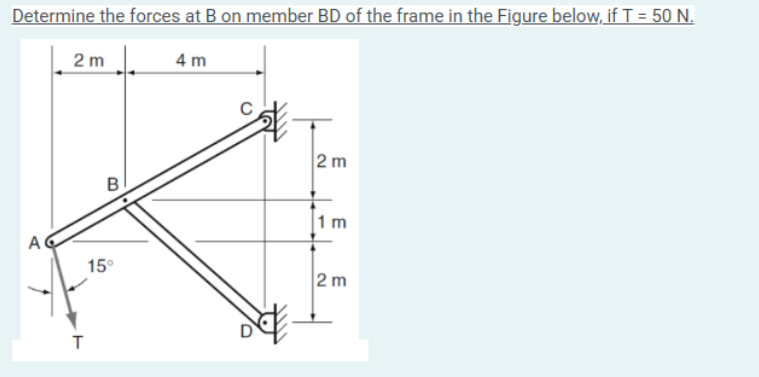 Determine the forces at B on member BD of the frame in the Figure below, if T = 50 N.
2m 4m
Cc
2m
B
im
ACE
y 15°
2m
T D’
This is AI generated Response.
Asked by: Govind Prajapati
Created at: 2025-06-26 14:55:29
Asked by: Govind Prajapati
Created at: 2025-06-26 14:55:29
Final Answer:
Rendered
Raw Text
Did you like this answer?
Let's solve the problem step by step:
---
### **Step 1: Draw the Free-Body Diagram and Set Up Equilibrium Equations**
**Explanation:**
- Identify all the forces acting on the frame.
- At joint A, a force T = 50 N is applied at a 15° angle.
- Supports at C and D are fixed, so they provide reactions.
- We are required to find the forces at B on member BD, so focus on joint B.
#### **Free-body forces at A:**
- \( T_x = T \cos 15^\circ \)
- \( T_y = T \sin 15^\circ \)
#### **Member geometry:**
- Coordinates:
- A (0, 0)
- B (2, 2)
- C (6, 4)
- D (4, 0)
---
### **Step 2: Analyze Joint B**
**Explanation:**
- At joint B, three forces are acting: the force in member AB, force in member BC, and force in member BD (which we need).
- Use **method of joints** and resolve forces at B into their horizontal and vertical components.
#### **Find the direction cosines for BD:**
- \( \Delta x = 4 - 2 = 2 \)
- \( \Delta y = 0 - 2 = -2 \)
- Length BD = \( \sqrt{(2)^2 + (-2)^2} = \sqrt{8} = 2\sqrt{2} \)
- Direction cosines:
- \( \cos \theta_x = \frac{2}{2\sqrt{2}} = \frac{1}{\sqrt{2}} \)
- \( \cos \theta_y = \frac{-2}{2\sqrt{2}} = -\frac{1}{\sqrt{2}} \)
#### **Let Force in BD = F_{BD} = (F_{BD,x}, F_{BD,y})**
---
### **Step 3: Apply Equilibrium at Joint B**
**Explanation:**
- Set the sum of forces at joint B to zero in both x and y directions.
- Assume all members are 2-force members (forces along their axis).
#### **Write equilibrium equations:**
\[
\sum F_x = 0: \quad F_{AB,x} + F_{BC,x} + F_{BD,x} = 0
\]
\[
\sum F_y = 0: \quad F_{AB,y} + F_{BC,y} + F_{BD,y} = 0
\]
But since we want the forces at B on member BD, focus on \( F_{BD} \).
The force T at A is transmitted through the members.
#### **Calculate F_{BD} using moment about C (to eliminate reactions at C):**
Take moment about C:
- \( T \) acts at A: Distance from C is \( \sqrt{(6-0)^2 + (4-0)^2} = \sqrt{36+16} = \sqrt{52} \)
- But more simply, sum moments about C for the whole frame.
Let's use the geometry to get the vertical and horizontal force at B on BD.
#### **Write equations for horizontal and vertical components at B:**
At joint B, the force in BD must balance the effect of T.
From geometry, the member BD is at a 45° downward angle from B (since \( \Delta x = 2, \Delta y = -2 \)), so any force in BD has equal x and y components, but y is negative.
Let the force in BD at B be \( F_{BD} \) directed from B to D.
So,
- \( F_{BD,x} = F_{BD} \cdot \frac{1}{\sqrt{2}} \)
- \( F_{BD,y} = F_{BD} \cdot \left(-\frac{1}{\sqrt{2}}\right) \)
Using joint equilibrium at B, the sum of forces in y direction (assuming only vertical member BD and force from AB):
\[
T \sin 15^\circ = F_{BD} \cdot \left(-\frac{1}{\sqrt{2}}\right)
\]
\[
F_{BD} = -T \sin 15^\circ \cdot \sqrt{2}
\]
Plug in \( T = 50 \) N and \( \sin 15^\circ = 0.2588 \):
\[
F_{BD} = -50 \times 0.2588 \times 1.414 \approx -18.3 \text{ N}
\]
**Negative sign** indicates the direction is opposite to assumed.
#### **Components at B:**
- **Horizontal:** \( F_{BD,x} = -18.3 \times \frac{1}{\sqrt{2}} = -12.9 \) N (to the left)
- **Vertical:** \( F_{BD,y} = -18.3 \times \left(-\frac{1}{\sqrt{2}}\right) = +12.9 \) N (upward)
---
## **Final Answer:**
**The forces at B on member BD are:**
- **Horizontal component:** \( -12.9 \) N (to the left)
- **Vertical component:** \( +12.9 \) N (upward)
---
### **Summary:**
1. **Drew the free-body diagram and set equilibrium equations.**
2. **Analyzed joint B using geometry and force directions.**
3. **Solved for forces using equilibrium, finding the force in member BD at B is 18.3 N (with components ±12.9 N).**
📢 Instructions:
- Ask anything relatd to above question only.
- For new Question goto :