 VIPSolutions
answer the questionsn Unshared, or lone, electron pairs play an important role in determining the chemical and physical properties of organic Compounis. Tou, spor ant o Are wh srs cary raha a © Use the structural formulas below to determine the number of unshared pairs at each designated atom. cy Ba Sur youn answers se consent wih dh al hares on frm Question ° » The number of unshared pairs at atom ais ©.
Question:
answer the questions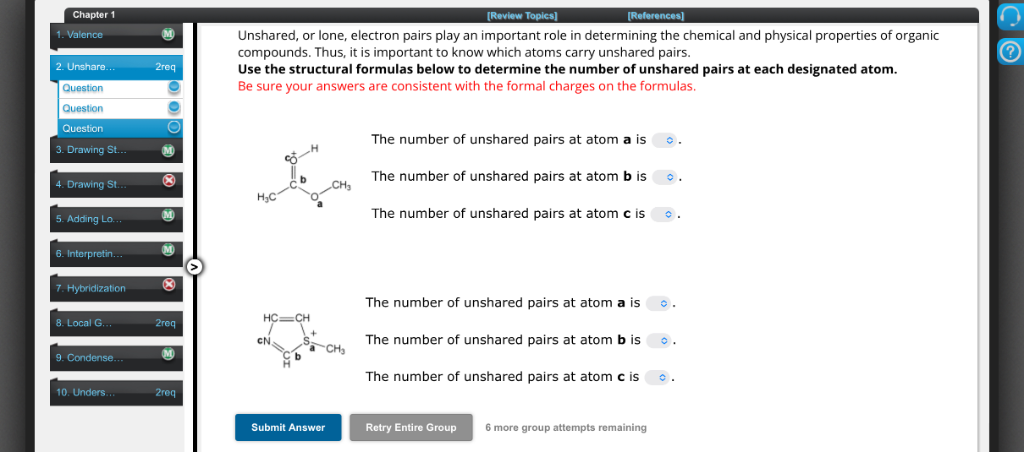 n
Unshared, or lone, electron pairs play an important role in determining the chemical and physical properties of organic
Compounis. Tou, spor ant o Are wh srs cary raha a ©
Use the structural formulas below to determine the number of unshared pairs at each designated atom.
cy Ba Sur youn answers se consent wih dh al hares on frm
Question °
» The number of unshared pairs at atom ais ©.
This is AI generated Response.
Asked by: Test User 100129
Created at: 2025-05-18 04:43:29
Asked by: Test User 100129
Created at: 2025-05-18 04:43:29
Final Answer:
Rendered
Raw Text
Did you like this answer?
Let’s analyze the number of unshared (lone) pairs on the designated atoms:
### First Structure
- **Atom a (Oxygen in CH₃COOH, acetic acid):**
- Oxygen in carboxylic acids typically has **2 lone pairs**.
- **Atom b (Oxygen in CH₃COOH, the single-bonded oxygen):**
- This oxygen is the *hydroxyl* oxygen (OH group), also typically with **2 lone pairs**.
- **Atom c (Carbon in CH₃COOH, the central carbon):**
- Carbon generally has **0 lone pairs** as it forms four bonds.
### Second Structure
- **Atom a (Nitrogen in the ring):**
- Nitrogen in a nitrile group (triple bond to carbon) has **1 lone pair**.
- **Atom b (Oxygen in the five-membered ring):**
- Oxygen typically has **2 lone pairs**.
- **Atom c (Carbon in the ring):**
- Carbon typically has **0 lone pairs**.
### Answers:
**First Structure:**
- The number of unshared pairs at atom a is: **2**
- The number of unshared pairs at atom b is: **2**
- The number of unshared pairs at atom c is: **0**
**Second Structure:**
- The number of unshared pairs at atom a is: **1**
- The number of unshared pairs at atom b is: **2**
- The number of unshared pairs at atom c is: **0**
Let me know if you need the reasoning explained for each atom!
📢 Instructions:
- Ask anything relatd to above question only.
- For new Question goto :