 VIPSolutions
Answer like this. In step 1 : Provide Given, Objective and explanation of 40 words. Then main answer in step 2 with explanation of 40 words in last and then provide final answer of maximum 30 words“The mechanical response of skeletal muscle can be roughly approximated as a modified Hil model, 2s showin the figure below. [SO his model contact element (CE is arranged in paralel with a pring (S) and dashpot PD). which are arranged nseres with another spring (SEL. Th contractile lement (CE) represents the muscle’ internal force generation capabilities, and produces nonzero force only when the muscle is activated i. when it receives one or more action potentials). For the following problems (1.11.3), use the following fundamental relationships: + The total length change of the muscle s)s equal to the sum of th displacements of th parallel ‘component (zp) and series 3) component: zap tas + The total force produced by the muscle is equivalent to the force produced in cach of the series elements: FeR-Fs + The force generated by the parallel components is cqual to the sum of the forces produced by each component: Fp = Fog + Fes + Fen + Springs generate force proportional to their applied displacement. and dashpots generate force proportional Lo ther displacement velocities: Frias = ks Fi = 1 Upload your work for ll PROBLEM 1 Questions (below) here. wos | Choose a File ‘Question 1.1 (12 pts) Using the following element constants: Jy =PS spring stfiness n= "PD coefcient Fy = SE spring stifncss P= total force produced by the muscle ‘= total change in length of the muscle Fy, = force produced by the CE contract clement Use Laplace Transforms to show thatthe force-length relationship of the muscle is given by: (ky + ka) F+ nF + ka Fy = Kiko + kam. Assume that the muscle starts completely from is resting length (0) = 0)
Question:
Answer like this. In step 1 : Provide Given, Objective and explanation of 40 words. Then main answer in step 2 with explanation of 40 words in last and then provide final answer of maximum 30 words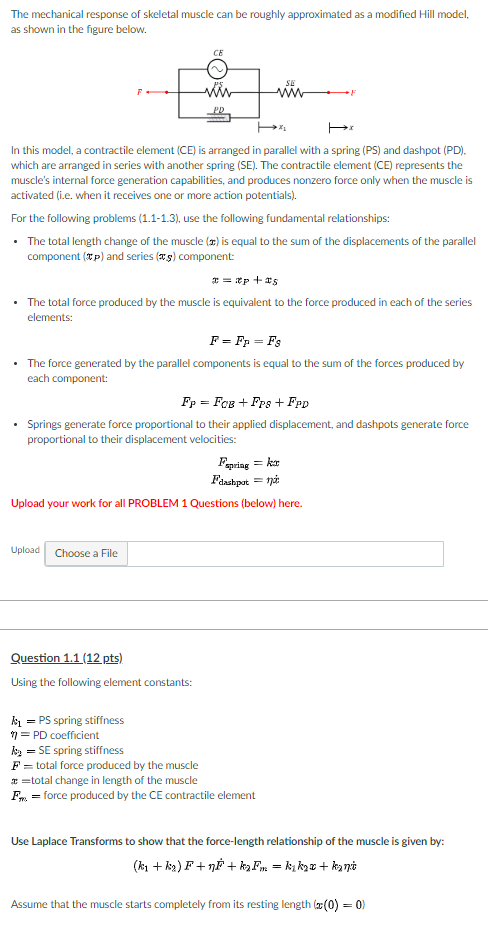 “The mechanical response of skeletal muscle can be roughly approximated as a modified Hil model,
2s showin the figure below.
[SO
his model contact element (CE is arranged in paralel with a pring (S) and dashpot PD).
which are arranged nseres with another spring (SEL. Th contractile lement (CE) represents the
muscle’ internal force generation capabilities, and produces nonzero force only when the muscle is
activated i. when it receives one or more action potentials).
For the following problems (1.11.3), use the following fundamental relationships:
+ The total length change of the muscle s)s equal to the sum of th displacements of th parallel
‘component (zp) and series 3) component:
zap tas
+ The total force produced by the muscle is equivalent to the force produced in cach of the series
elements:
FeR-Fs
+ The force generated by the parallel components is cqual to the sum of the forces produced by
each component:
Fp = Fog + Fes + Fen
+ Springs generate force proportional to their applied displacement. and dashpots generate force
proportional Lo ther displacement velocities:
Frias = ks
Fi = 1
Upload your work for ll PROBLEM 1 Questions (below) here.
wos | Choose a File
‘Question 1.1 (12 pts)
Using the following element constants:
Jy =PS spring stfiness
n= "PD coefcient
Fy = SE spring stifncss
P= total force produced by the muscle
‘= total change in length of the muscle
Fy, = force produced by the CE contract clement
Use Laplace Transforms to show thatthe force-length relationship of the muscle is given by:
(ky + ka) F+ nF + ka Fy = Kiko + kam.
Assume that the muscle starts completely from is resting length (0) = 0)
Asked by: Gurubindra Singh
Created at: 2025-07-13 22:03:32
Final Answer:
📢 Instructions:
- Ask anything relatd to above question only.
- For new Question goto :