VIPSolutions logo ✨ VIPSolutions

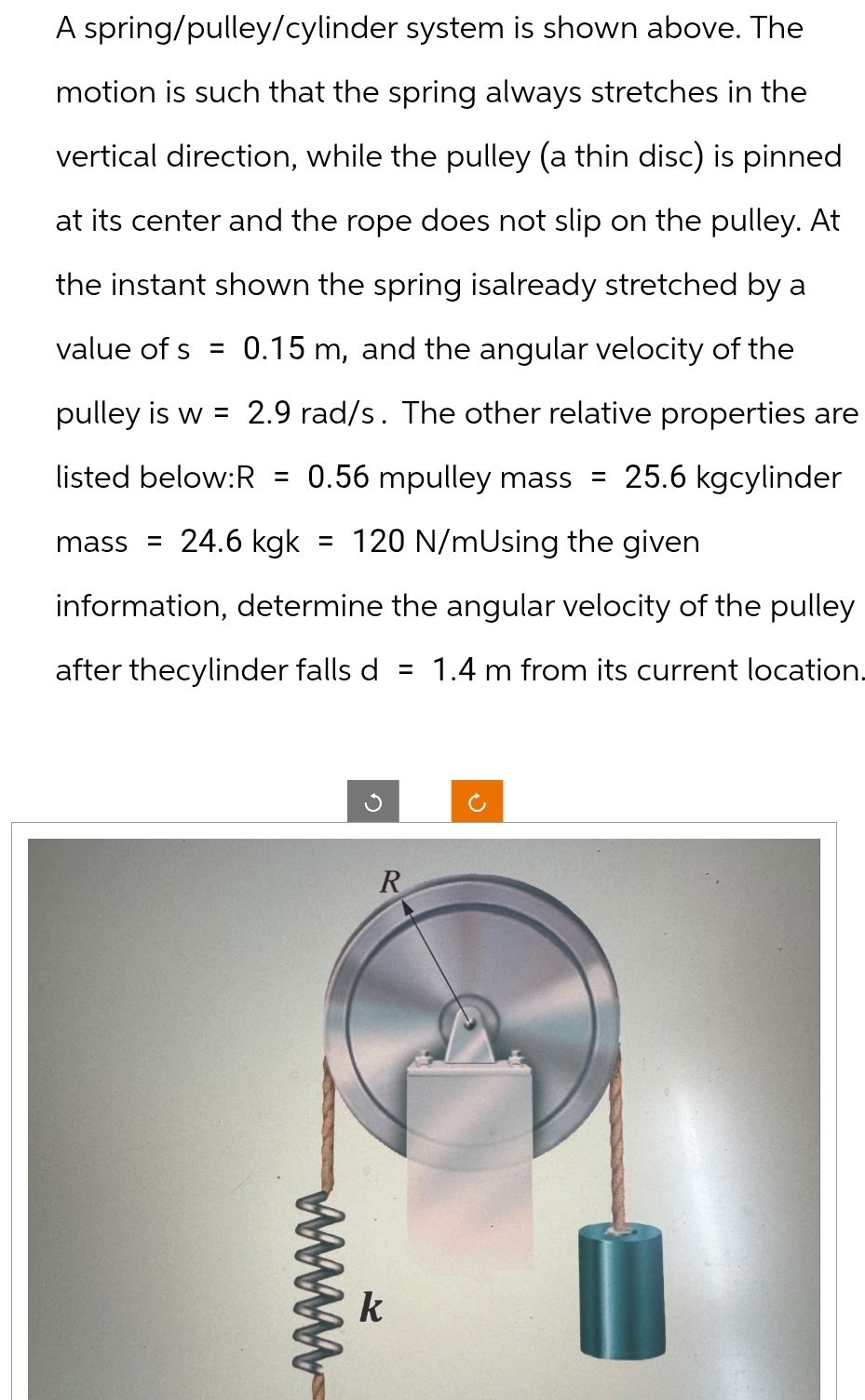
Answer like this. In step 1 : Provide Given, Objective and explanation of 40 words. Then main answer in step 2 with explanation of 40 words in last and then provide final answer of maximum 30 wordsA spring/pulley/cylinder system is shown above. The motion is such that the spring always stretches in the vertical direction, while the pulley (a thin disc) is pinned at its center and the rope does not slip on the pulley. At the instant shown the spring isalready stretched by a value of s = 0.15 m, and the angular velocity of the pulley is w = 2.9 rad/s. The other relative properties are listed below:R = 0.56 mpulley mass = 25.6 kgcylinder mass = 24.6 kgk = 120 N/mUsing the given information, determine the angular velocity of the pulley after thecylinder falls d = 1.4 m from its current location. 3 1
Question:

Answer like this. In step 1 : Provide Given, Objective and explanation of 40 words. Then main answer in step 2 with explanation of 40 words in last and then provide final answer of maximum 30 wordsUploaded ImageA spring/pulley/cylinder system is shown above. The motion is such that the spring always stretches in the vertical direction, while the pulley (a thin disc) is pinned at its center and the rope does not slip on the pulley. At the instant shown the spring isalready stretched by a value of s = 0.15 m, and the angular velocity of the pulley is w = 2.9 rad/s. The other relative properties are listed below:R = 0.56 mpulley mass = 25.6 kgcylinder mass = 24.6 kgk = 120 N/mUsing the given information, determine the angular velocity of the pulley after thecylinder falls d = 1.4 m from its current location. 3 1

This is AI generated Response.
Asked by: Gurubindra Singh
Created at: 2025-07-11 22:16:36

Final Answer:

Rendered Raw Text
Did you like this answer?
**Step 1:** - **Given:** Spring stretched by \( s = 0.15\,m \), angular velocity \( \omega_1 = 2.9\,rad/s \), pulley radius \( R = 0.56\,m \), pulley mass \( 25.6\,kg \), cylinder mass \( 24.6\,kg \), spring constant \( k = 120\,N/m \), drop distance \( d = 1.4\,m \). - **Objective:** Find the angular velocity of the pulley after the cylinder falls \( d = 1.4\,m \). - **Explanation:** Use conservation of energy, accounting for gravitational potential, spring potential, and rotational/translational kinetic energy, to relate the angular velocity before and after the cylinder falls. --- **Step 2:** **Energy Equation:** Initial energy (E₁): \[ E_1 = mgh_1 + \frac{1}{2}ks^2 + \frac{1}{2}I\omega_1^2 \] Final energy (E₂): \[ E_2 = mg(h_1-d) + \frac{1}{2}k(s+d)^2 + \frac{1}{2}I\omega_2^2 \] Where \( I = \frac{1}{2}MR^2 \), \( h_1 \) cancels, and \(\omega_2 = v_2/R\) (with no slip). Set \( E_1 = E_2 \) and solve for \( \omega_2 \): \[ mgd + \frac{1}{2}k[(s + d)^2 - s^2] + \frac{1}{2}I(\omega_2^2 - \omega_1^2) = 0 \] Calculate each term: - \( mgd = 24.6 \times 9.81 \times 1.4 = 338.1\,J \) - \( (s+d)^2 - s^2 = (0.15+1.4)^2 - (0.15)^2 = 1.55^2 - 0.0225 = 2.4025 - 0.0225 = 2.38 \) - \( \frac{1}{2}k \times 2.38 = 60 \times 2.38 = 142.8\,J \) - \( I = \frac{1}{2} \times 25.6 \times (0.56)^2 = 4.012\,kg\,m^2 \) - Initial rotational kinetic energy: \( \frac{1}{2}I\omega_1^2 = 0.5 \times 4.012 \times (2.9)^2 = 16.9\,J \) Now, combine: \[ 338.1 + 142.8 + 4.012 \frac{\omega_2^2 - (2.9)^2}{2} = 0 \] \[ 338.1 + 142.8 = \frac{4.012}{2} (\omega_2^2 - 8.41) \] \[ 480.9 = 2.006 (\omega_2^2 - 8.41) \] \[ \frac{480.9}{2.006} = \omega_2^2 - 8.41 \] \[ 239.81 = \omega_2^2 - 8.41 \] \[ \omega_2^2 = 239.81 + 8.41 = 248.22 \] \[ \omega_2 = \sqrt{248.22} = 15.76\,rad/s \] **Explanation:** The energy lost from the spring and gain in height converts into rotational kinetic energy of the pulley, using the conservation of energy equation. All values are substituted stepwise for clarity. --- **Final Answer:** The angular velocity of the pulley after the cylinder falls \( 1.4\,m \) is **15.76 rad/s**.

📢 Instructions:

  • Ask anything relatd to above question only.
  • For new Question goto :

Study Help, Fast Answers

VIPSolutions focuses on clear, step‑by‑step explanations so you can learn quickly. Whether you need an AI‑generated walkthrough or a short hint to get unstuck, each solution is organized for fast reading and easy review later.

Search similar questions, compare approaches, and bookmark the best answers for revision. Our goal is simple: quick, reliable study help that feels natural—not noisy.