A soil has c' = 5 kPa and phi = 32 deg The effective stress at a point in the soil is 125 kPa.
a. Compute the shear strength normal to this stress at this point.
b. By drawing Mohr's circle of the given effective stress, determine the principal stresses σ and 2 and the maximum shear stress t.
This is AI generated Response.
Asked by: Md Israrul Haque
Created at: 2025-09-16 03:15:16
Final Answer:
RenderedRaw Text
Did you like this answer?
# Shear Strength and Mohr's Circle Analysis
## Given Data
- Cohesion \( c' = 5 \, \text{kPa} \)
- Angle of internal friction \( \phi = 32^\circ \)
- Effective stress \( \sigma' = 125 \, \text{kPa} \)
---
## Part A: Compute Shear Strength
### Shear Strength Formula
The shear strength \( \tau \) of the soil can be calculated using the Mohr-Coulomb failure criterion:
\[
\tau = c' + \sigma' \tan(\phi)
\]
### Calculation
1. **Convert angle to radians for calculation:**
\[
\phi \text{ (in radians)} = \frac{32 \times \pi}{180} \approx 0.5585 \, \text{radians}
\]
2. **Calculate \( \tan(\phi) \):**
\[
\tan(\phi) = \tan(32^\circ) \approx 0.6249
\]
3. **Substitute values into shear strength formula:**
\[
\tau = 5 + 125 \times 0.6249
\]
\[
\tau = 5 + 78.1125 = 83.1125 \, \text{kPa}
\]
### Result
\[
\boxed{\tau = 83.11 \, \text{kPa}}
\]
---
## Part B: Mohr's Circle Analysis
### Definitions
- **Effective Stress (\( \sigma' \))**: \( 125 \, \text{kPa} \)
- **Shear Stress (\( \tau \))**: \( 83.11 \, \text{kPa} \)
### Step 1: Principal Stresses Calculation
1. **Center of Mohr's Circle:**
\[
\sigma_{avg} = \sigma' = 125 \, \text{kPa}
\]
2. **Radius of Mohr's Circle:**
\[
R = \tau = 83.11 \, \text{kPa}
\]
3. **Principal Stresses:**
\[
\sigma_1 = \sigma_{avg} + R = 125 + 83.11 = 208.11 \, \text{kPa}
\]
\[
\sigma_2 = \sigma_{avg} - R = 125 - 83.11 = 41.89 \, \text{kPa}
\]
### Step 2: Maximum Shear Stress
The maximum shear stress \( \tau_{max} \) is equal to the radius \( R \):
\[
\tau_{max} = R = 83.11 \, \text{kPa}
\]
### Result
- **Principal Stresses:**
\[
\sigma_1 = 208.11 \, \text{kPa} \quad \text{and} \quad \sigma_2 = 41.89 \, \text{kPa}
\]
- **Maximum Shear Stress:**
\[
\tau_{max} = 83.11 \, \text{kPa}
\]
### Summary
\[
\boxed{\sigma_1 = 208.11 \, \text{kPa}, \quad \sigma_2 = 41.89 \, \text{kPa}, \quad \tau_{max} = 83.11 \, \text{kPa}}
\]
Question:
An owner who needs to build a new corporate building project is concerned about the overall cost of the project as the design progresses. The owner also wishes to minimize the number of direct contracts to reduce the management risk and can carry out design work in
-
house. What delivery method should the owner choose? A
.
Design
-
Build
(
D
-
B
)
B
.
Design
-
Bid
-
Build
(
D
-
B
-
B
)
C
.
Construction Manager At Risk D
.
Construction Manager As Agency
This is AI generated Response.
Asked by: Md Israrul Haque
Created at: 2025-09-18 03:47:32
Final Answer:
RenderedRaw Text
Did you like this answer?
# Suitable Delivery Method for the Owner
## Considerations:
- Minimizing overall project cost
- Reducing management risk by limiting the number of contracts
- Ability to conduct design work in-house
## Analysis of Options:
### A. Design-Build (D-B)
- Single contract for design and construction
- **Advantages:** Reduced interface issues, faster delivery
- **Disadvantages:** Less owner control over design details, reliance on a single entity
### B. Design-Bid-Build (D-B-B)
- Separate contracts for design and construction
- **Advantages:** Greater owner control, competitive bidding
- **Disadvantages:** Multiple contracts increase management complexity and risk
### C. Construction Manager At Risk (CMAR)
- Construction manager acts as consultant during design and then as general contractor during construction
- **Advantages:** Owner retains more control, early cost estimates
- **Disadvantages:** Potentially higher management effort, more complex process
### D. Construction Manager As Agency
- Construction manager acts solely as an agent, overseeing and coordinating work
- **Advantages:** High owner control, flexible
- **Disadvantages:** No direct contract with trade contractors, may increase owner management burden
## Recommended Choice:
**Design-Build (D-B)**
- Aligns with owner's goal to minimize management complexity (single contract)
- Facilitates in-house design work integration
- Potentially reduces overall project cost and delivery time
---
# **Final Answer:**
**A. Design-Build (D-B)**
VIPSolutions focuses on clear, step‑by‑step explanations so you can learn quickly. Whether you need an AI‑generated walkthrough or a short hint to get unstuck, each solution is organized for fast reading and easy review later.
Search similar questions, compare approaches, and bookmark the best answers for revision. Our goal is simple: quick, reliable study help that feels natural—not noisy.
 VIPSolutions
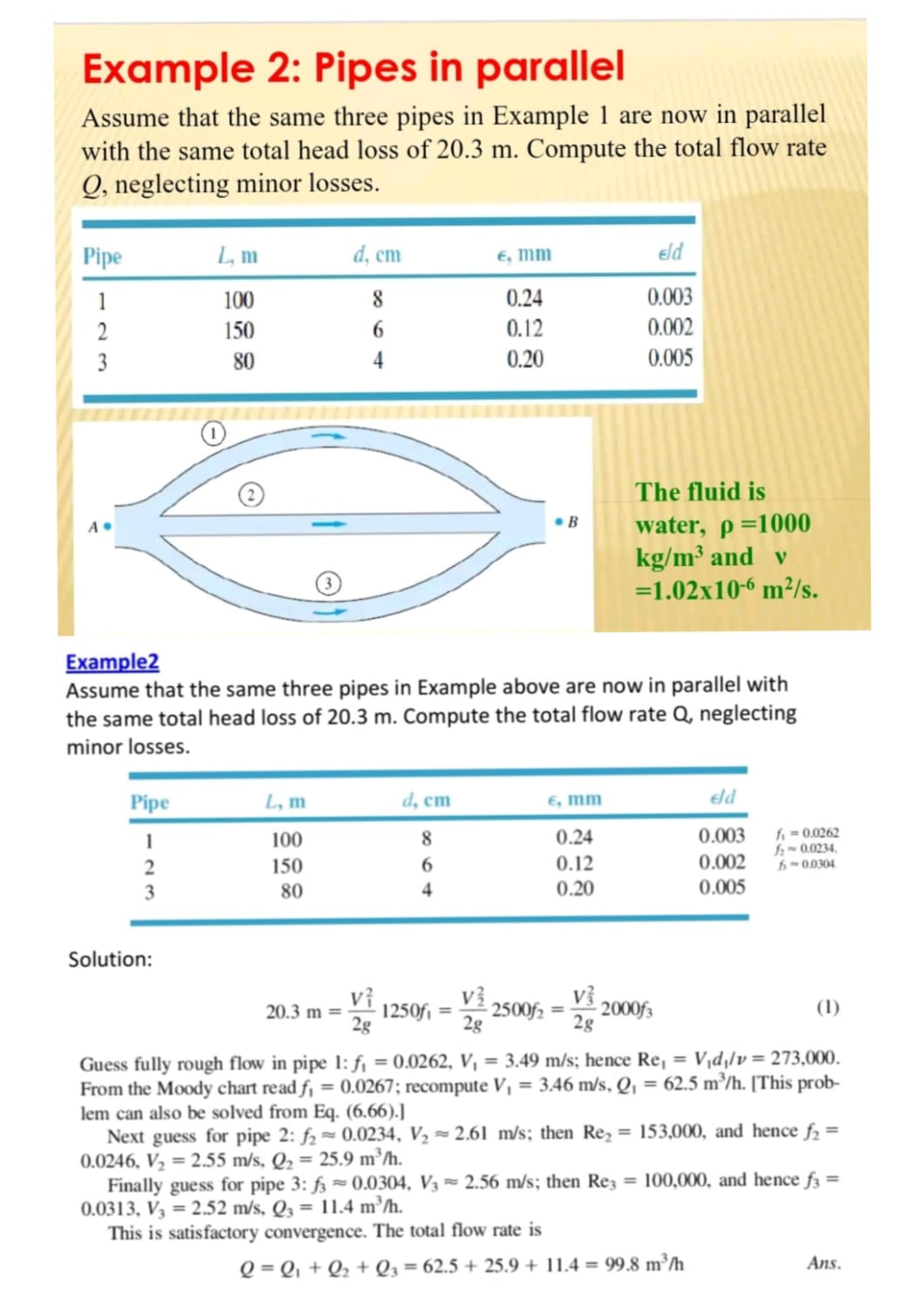 Example 2: Pipes in parallel
Assume that the same three pipes in Example 1 are now in parallel
with the same total head loss of 20.3 m. Compute the total flow rate
0, neglecting minor losses.
Er ee a a Sa
Pipe Lom d, em € mm eld
——————————————————————————
1 100 8 0.24 0.003
2 150 6 0.12 0.002
3 80 4 0.20 0.005
————— er eet.
O_——
Zs ©) nu The fluid is
ae oy eee *B water, p=1000
Ng o_o” kg/m* and v
® =1.02x10"° m?/s.
eae
Example2
Assume that the same three pipes in Example above are now in parallel with
the same total head loss of 20.3 m. Compute the total flow rate Q, neglecting
minor losses.
———————————————————————————————————
Pipe L,m d, em € mm eld
cf i ———————
1 100 8 0.24 0.003 f= ome:
2 150 6 0.12 0.002 5-00
3 80 4 0.20 0.005
—————————————————————————————————————————
Solution:
203m = ¥1 12507, = ¥2 2500 = ¥* 20007 0)
2g 8 “8
Guess fully rough flow in pipe 1: f, = 0.0262, V, = 3.49 m/s; hence Re, = Vid,/v = 273,000.
From the Moody chart read f, = 0.0267; recompute V, = 3.46 m/s, Q; = 62.5 mh. [This prob-
lem can also be solved from Eq. (6.66).]
Next guess for pipe 2: f> = 0.0234, V, = 2.61 mvs; then Re; = 153,000, and hence f, =
0.0246, V, = 2.55 m/s, Q; = 25.9 m*/h.
Finally guess for pipe 3: fy = 0.0304, V3 = 2.56 mvs; then Re; = 100,000, and hence hi=
0.0313, Vy = 2.52 més, Qs = 11.4 mh.
This is satisfactory convergence. The total flow rate is
0=0 +0: +0,=625+259+ 11.4=998m'h Ans.