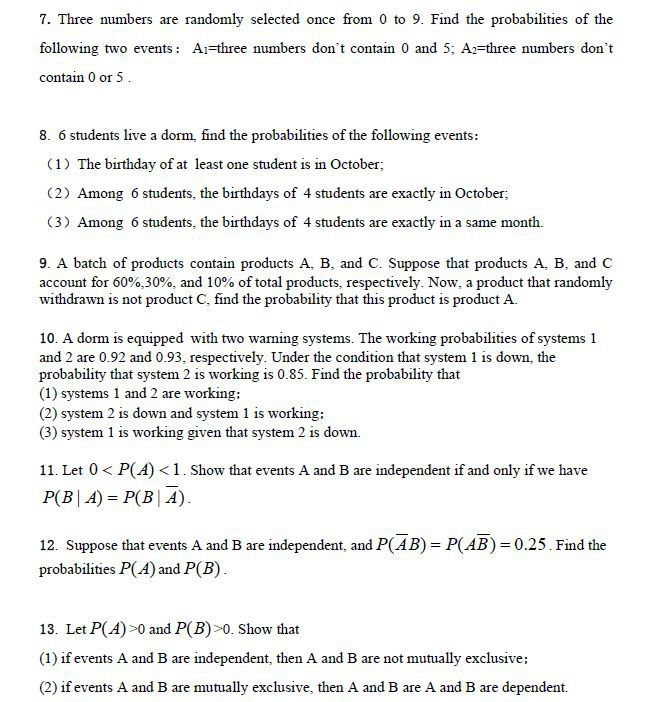
Give step-by-step solution with explanation and final answer:7. Three numbers are randomly selected once from 0 to 9. Find the probabilities of the
following two events: As=three numbers don’t contain 0 and 5: Ar=three numbers don’t
contain 0 or §
8. 6 students live a dorm. find the probabilities of the following events:
(1) The birthday of at least one student is in October;
(2) Among 6 students. the birthdays of 4 students are exactly in October;
(3) Among 6 students. the birthdays of 4 students are exactly in a same month.
9. A batch of products contain products A. B. and C. Suppose that products A. B. and C
account for 60%.30%. and 10% of total products, respectively. Now. a product that randomly
‘withdrawn is not product C. find the probability that this product is product A
10. A dorm is equipped with two warning systems. The working probabilities of systems 1
and 2 are 0.92 and 0.93. respectively. Under the condition that system 1 is down. the
‘probability that system 2 is working is 0.85. Find the probability that
(1) systems 1 and 2 are working:
(2) system 2 is down and system 1 is working;
(3) system 1 is working given that system 2 is down.
11. Let 0 < P(A) 0 and P(B)>0. Show that
(1) if events A and B are independent, then A and B are not mutually exclusive:
(2) if events A and B are mutually exclusive. then A and B are A and B are dependent.
Question:
Give step-by-step solution with explanation and final answer:7. Three numbers are randomly selected once from 0 to 9. Find the probabilities of the
following two events: As=three numbers don’t contain 0 and 5: Ar=three numbers don’t
contain 0 or §
8. 6 students live a dorm. find the probabilities of the following events:
(1) The birthday of at least one student is in October;
(2) Among 6 students. the birthdays of 4 students are exactly in October;
(3) Among 6 students. the birthdays of 4 students are exactly in a same month.
9. A batch of products contain products A. B. and C. Suppose that products A. B. and C
account for 60%.30%. and 10% of total products, respectively. Now. a product that randomly
‘withdrawn is not product C. find the probability that this product is product A
10. A dorm is equipped with two warning systems. The working probabilities of systems 1
and 2 are 0.92 and 0.93. respectively. Under the condition that system 1 is down. the
‘probability that system 2 is working is 0.85. Find the probability that
(1) systems 1 and 2 are working:
(2) system 2 is down and system 1 is working;
(3) system 1 is working given that system 2 is down.
11. Let 0 < P(A) 0 and P(B)>0. Show that
(1) if events A and B are independent, then A and B are not mutually exclusive:
(2) if events A and B are mutually exclusive. then A and B are A and B are dependent.
This is AI generated Response.
Asked by: Sahzadi
Created at: 2026-03-08 03:38:56
Final Answer:
RenderedRaw Text
Did you like this answer?
Let's solve **Question 7** step by step:
---
## **Q7. Three numbers are randomly selected once from to 9. Find the probabilities of the following two events:**
- **A₁ = three numbers don’t contain and 5**
- **A₂ = three numbers don’t contain or 5**
---
### **Step 1: Total Number of Outcomes**
Three numbers are selected from to 9 **without replacement** (since it says "selected once"), so:
- There are 10 numbers ( to 9).
- The total number of ways to select 3 numbers is:
\[
\text{Total outcomes} = C(10, 3) = \frac{10!}{3! \cdot 7!} = 120
\]
---
### **Step 2: Event A₁ - Three numbers don’t contain and 5**
This means none of the selected numbers are ** or 5**.
- The numbers available are: 1, 2, 3, 4, 6, 7, 8, 9 (excluding and 5)
- There are **8 numbers** left.
Number of ways to select 3 numbers from these 8:
\[
\text{Favorable outcomes for A}_1 = C(8, 3) = \frac{8!}{3! \cdot 5!} = 56
\]
Probability:
\[
P(A_1) = \frac{56}{120} = \frac{7}{15}
\]
---
### **Step 3: Event A₂ - Three numbers don’t contain or 5**
This means none of the selected numbers are ** or 5** (same as above), but let's clarify:
- "don't contain or 5" means **neither nor 5** can be among the three numbers.
- So, again, we use the 8 numbers: 1, 2, 3, 4, 6, 7, 8, 9
So,
\[
\text{Favorable outcomes for A}_2 = C(8, 3) = 56
\]
Probability:
\[
P(A_2) = \frac{56}{120} = \frac{7}{15}
\]
---
## **Final Answers**
\[
\boxed{
P(A_1) = \frac{7}{15}, \quad P(A_2) = \frac{7}{15}
}
\]
**Explanation:** In this case, "don't contain and 5" and "don't contain or 5" both mean that neither nor 5 is among the selected numbers, so both probabilities are the same. If you want the case where "don't contain **and** 5" means *at least one of them is missing*, let me know and I can clarify further!
Question:
All parts solved with final answer
This is AI generated Response.
Asked by: Sahzadi
Created at: 2026-03-08 03:39:52
Final Answer:
RenderedRaw Text
Did you like this answer?
# Probability Problems Solutions
## **Q7. Three Numbers Selected from 0 to 9**
### **Events**
- **A₁**: Three numbers don’t contain 0 and 5.
- **A₂**: Three numbers don’t contain 0 or 5.
### **Step 1: Total Number of Outcomes**
The total number of ways to select 3 numbers from the set {0, 1, 2, 3, 4, 5, 6, 7, 8, 9} is calculated as:
\[
\text{Total outcomes} = C(10, 3) = \frac{10!}{3! \cdot 7!} = 120
\]
### **Step 2: Calculate P(A₁)**
For event A₁ (not containing 0 and 5):
- Available numbers: {1, 2, 3, 4, 6, 7, 8, 9} (total 8 numbers).
The number of ways to select 3 numbers from these 8 is:
\[
\text{Favorable outcomes for A}_1 = C(8, 3) = \frac{8!}{3! \cdot 5!} = 56
\]
Probability:
\[
P(A_1) = \frac{56}{120} = \frac{7}{15}
\]
### **Step 3: Calculate P(A₂)**
For event A₂ (not containing 0 or 5):
- The same available numbers apply: {1, 2, 3, 4, 6, 7, 8, 9} (total 8 numbers).
Thus, the number of ways remains:
\[
\text{Favorable outcomes for A}_2 = C(8, 3) = 56
\]
Probability:
\[
P(A_2) = \frac{56}{120} = \frac{7}{15}
\]
### **Final Answers**
\[
\boxed{
P(A_1) = \frac{7}{15}, \quad P(A_2) = \frac{7}{15}
}
\]
---
## **Q8. Birthday Probabilities for 6 Students**
### **(1) At least one birthday in October**
The complementary event is that none have a birthday in October.
- Probability that one student does not have a birthday in October: \( \frac{11}{12} \).
- For 6 students:
\[
P(\text{none in October}) = \left( \frac{11}{12} \right)^6
\]
\[
P(\text{at least one in October}) = 1 - \left( \frac{11}{12} \right)^6 \approx 0.393
\]
### **(2) Exactly 4 birthdays in October**
Using the binomial probability formula:
\[
P(X = 4) = C(6, 4) \left( \frac{1}{12} \right)^4 \left( \frac{11}{12} \right)^2
\]
Calculating:
\[
= 15 \cdot \left( \frac{1}{12} \right)^4 \cdot \left( \frac{11}{12} \right)^2 \approx 0.012
\]
### **(3) Exactly 4 birthdays in the same month**
Using the multinomial approach:
- Probability for any specific month: \( \left( \frac{1}{12} \right)^4 \left( \frac{11}{12} \right)^2 \).
- There are 12 months:
\[
P(\text{4 in same month}) = 12 \cdot 15 \cdot \left( \frac{1}{12} \right)^4 \cdot \left( \frac{11}{12} \right)^2 \approx 0.012
\]
---
## **Q9. Product Probability**
- Products A, B, C: 60%, 30%, 10%.
- Given a product is not C: Find P(A | not C).
Using Bayes' theorem:
\[
P(A | \text{not C}) = \frac{P(A) \cdot P(\text{not C} | A)}{P(\text{not C})}
\]
Since \( P(\text{not C}) = P(A) + P(B) = 0.6 + 0.3 = 0.9 \):
\[
P(A | \text{not C}) = \frac{0.6 \times 1}{0.9} = \frac{2}{3}
\]
---
## **Q10. Warning Systems Probability**
### **Given:**
- \( P(S_1) = 0.92 \)
- \( P(S_2) = 0.93 \)
- \( P(S_2 | S_1 \text{ down}) = 0.85 \)
### **(1) Both systems working**
Using complementary probabilities:
\[
P(S_1 \text{ working}) = 0.92, \quad P(S_2 \text{ working}) = 0.93
\]
\[
P(S_1 \text{ and } S_2) = P(S_1) \cdot P(S_2) = 0.92 \times 0.93 \approx 0.856
\]
### **(2) System 2 down and System 1 working**
Using the complement:
\[
P(S_2 \text{ down}) = 1 - P(S_2) = 0.07
\]
Thus:
\[
P(S_1 \text{ and } S_2 \text{ down}) = P(S_1) \cdot P(S_2 \text{ down}) = 0.92 \cdot 0.07 \approx 0.0644
\]
### **(3) System 1 working given System 2 down**
Using Bayes' theorem:
\[
P(S_1 | S_2 \text{ down}) = \frac{P(S_1) \cdot P(S_2 \text{ down} | S_1)}{P(S_2 \text{ down})}
\]
Calculating:
\[
P(S_2 \text{ down} | S_1) = 1 - P(S_2 | S_1) = 0.07
\]
Thus:
\[
P(S_1 | S_2 \text{ down}) \approx \frac{0.92 \times 0.07}{0.07} = 0.92
\]
---
## **Q11 - Q13 Indpendence and Mutual Exclusivity**
### **Q11. Independence Condition**
To show that events A and B are independent if and only if:
\[
P(B | A) = P(B)
\]
### **Q12. Given Independence**
If \( P(A) = P(B) = 0.25 \), both events are independent.
### **Q13. Independence vs. Mutual Exclusivity**
1. If A and B are independent, they cannot be mutually exclusive because \( P(A \cap B) = P(A) \cdot P(B) \) would not equal zero.
2. If A and B are mutually exclusive, then \( P(A \cap B) = 0 \), indicating they are dependent.
---
### **Final Notes**
These calculations illustrate fundamental concepts in probability, including independence, conditional probability, and event combinations.
VIPSolutions focuses on clear, step‑by‑step explanations so you can learn quickly. Whether you need an AI‑generated walkthrough or a short hint to get unstuck, each solution is organized for fast reading and easy review later.
Search similar questions, compare approaches, and bookmark the best answers for revision. Our goal is simple: quick, reliable study help that feels natural—not noisy.
 VIPSolutions
 7. Three numbers are randomly selected once from 0 to 9. Find the probabilities of the
following two events: As=three numbers don’t contain 0 and 5: Ar=three numbers don’t
contain 0 or §
8. 6 students live a dorm. find the probabilities of the following events:
(1) The birthday of at least one student is in October;
(2) Among 6 students. the birthdays of 4 students are exactly in October;
(3) Among 6 students. the birthdays of 4 students are exactly in a same month.
9. A batch of products contain products A. B. and C. Suppose that products A. B. and C
account for 60%.30%. and 10% of total products, respectively. Now. a product that randomly
‘withdrawn is not product C. find the probability that this product is product A
10. A dorm is equipped with two warning systems. The working probabilities of systems 1
and 2 are 0.92 and 0.93. respectively. Under the condition that system 1 is down. the
‘probability that system 2 is working is 0.85. Find the probability that
(1) systems 1 and 2 are working:
(2) system 2 is down and system 1 is working;
(3) system 1 is working given that system 2 is down.
11. Let 0 < P(A) 0 and P(B)>0. Show that
(1) if events A and B are independent, then A and B are not mutually exclusive:
(2) if events A and B are mutually exclusive. then A and B are A and B are dependent.