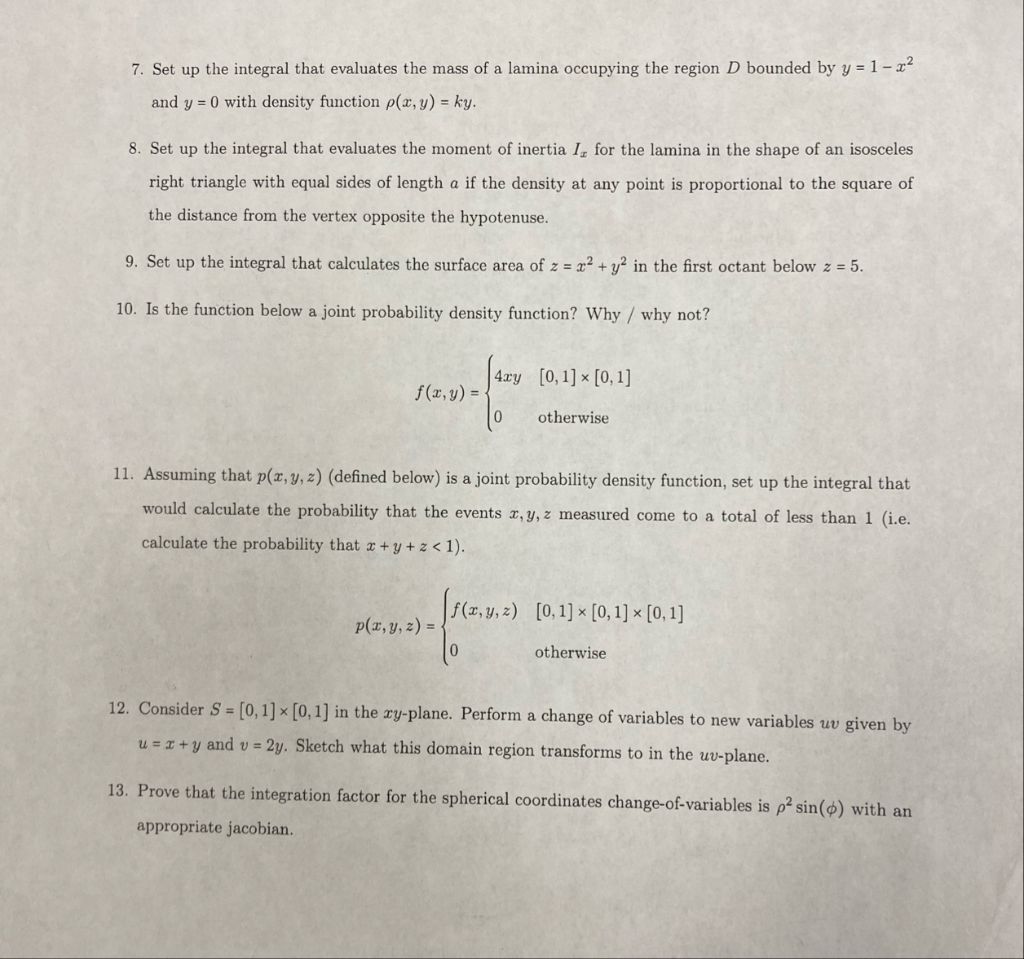
give answer in 2 step with explanation at the end of each step and final answer at the end:7. Set up the integral that evaluates the mass of a lamina occupying the region D bounded by y = 1-22
and y = 0 with density function p(2,y) = ky.
8. Set up the integral that evaluates the moment of inertia I, for the lamina in the shape of an isosceles
right triangle with equal sides of length a if the density at any point is proportional to the square of
the distance from the vertex opposite the hypotenuse.
9. Set up the integral that calculates the surface area of z = 2? +? in the first octant below 2 = 5.
10. Is the function below a joint probability density function? Why / why not?
4zy [0,1]x[0,1]
fz,9) =
3 : 0 otherwise
11. Assuming that ; p(z,9:2) (defined below) is a joint probability density function, set up the integral that
ee Yh the probability that the events ,y, > measured come to a total of less than 1 (i.
~~ calculate the probability that z +y + 2
Question:
give answer in 2 step with explanation at the end of each step and final answer at the end:7. Set up the integral that evaluates the mass of a lamina occupying the region D bounded by y = 1-22
and y = 0 with density function p(2,y) = ky.
8. Set up the integral that evaluates the moment of inertia I, for the lamina in the shape of an isosceles
right triangle with equal sides of length a if the density at any point is proportional to the square of
the distance from the vertex opposite the hypotenuse.
9. Set up the integral that calculates the surface area of z = 2? +? in the first octant below 2 = 5.
10. Is the function below a joint probability density function? Why / why not?
4zy [0,1]x[0,1]
fz,9) =
3 : 0 otherwise
11. Assuming that ; p(z,9:2) (defined below) is a joint probability density function, set up the integral that
ee Yh the probability that the events ,y, > measured come to a total of less than 1 (i.
~~ calculate the probability that z +y + 2
This is AI generated Response.
Asked by: Rahul
Created at: 2025-11-20 03:58:58
Final Answer:
RenderedRaw Text
Did you like this answer?
Let's answer **Question 10** in two steps, with explanations:
---
### Step 1: ** if \( f(x, y) \geq \) everywhere**
- The function \( f(x, y) = 4xy \) for \( (x, y) \in [,1] \times [,1] \) and \( f(x, y) = \) otherwise.
- Since for \( x, y \in [,1]), both \( x \geq \) and \( y \geq \), so \( 4xy \geq \).
- **Explanation:** The function is non-negative everywhere, satisfying the first property of a joint probability density function.
---
### Step 2: **Check if the integral over the entire domain equals 1**
- Compute the double integral over the domain:
\[
\int_^1 \int_^1 4xy \, dx\,dy
\]
- Integrate with respect to \( x \) first:
\[
\int_^1 \left[ 4y \int_^1 x \, dx \right] dy = \int_^1 4y \left( \frac{1}{2} \right) dy = \int_^1 2y\,dy = \left[ y^2 \right]_^1 = 1
\]
- **Explanation:** The total integral is 1, so the function is properly normalized.
---
### **Final Answer**
**Yes, \( f(x, y) \) is a joint probability density function because it is non-negative everywhere and integrates to 1 over its domain.**
Question:
All parts solved please
This is AI generated Response.
Asked by: Rahul
Created at: 2025-11-20 03:59:39
Final Answer:
RenderedRaw Text
Did you like this answer?
# Solutions to the Given Questions
## Question 7: Mass of a Lamina
### Step 1: Set up the integral
The mass \( M \) of the lamina can be calculated using the formula:
\[
M = \int \int_D p(x,y) \, dA
\]
Given the density function \( p(x,y) = ky \) and the region bounded by \( y = 1 - 2x \) and \( y = 0 \), we need to find the limits of integration for \( x \) and \( y \).
### Explanation
The line \( y = 1 - 2x \) intersects the x-axis at \( x = 0.5 \). Thus, the limits are:
- \( y \) ranges from \( 0 \) to \( 1 - 2x \)
- \( x \) ranges from \( 0 \) to \( 0.5 \)
So, the integral becomes:
\[
M = \int_0^{0.5} \int_0^{1 - 2x} ky \, dy \, dx
\]
---
## Question 8: Moment of Inertia \( I \)
### Step 1: Set up the integral
The moment of inertia \( I \) for a lamina with density proportional to the square of the distance from the vertex can be expressed as:
\[
I = \int \int_D r^2 \, p(x,y) \, dA
\]
where \( r \) is the distance from the vertex and \( p(x,y) = k(x^2 + y^2) \).
### Explanation
For an isosceles right triangle, the limits for \( x \) and \( y \) are:
- \( x \) ranges from \( 0 \) to \( a \)
- \( y \) ranges from \( 0 \) to \( a - x \)
Thus, the integral becomes:
\[
I = \int_0^a \int_0^{a-x} k(x^2 + y^2) \, dy \, dx
\]
---
## Question 9: Surface Area Calculation
### Step 1: Set up the integral
The surface area \( S \) of the surface \( z = 2x + y \) in the first octant below \( z = 5 \) can be calculated using the formula:
\[
S = \iint_D \sqrt{1 + \left( \frac{\partial z}{\partial x} \right)^2 + \left( \frac{\partial z}{\partial y} \right)^2} \, dA
\]
Here, \( \frac{\partial z}{\partial x} = 2 \) and \( \frac{\partial z}{\partial y} = 1 \).
### Explanation
Thus, we have:
\[
S = \iint_D \sqrt{1 + 2^2 + 1^2} \, dA = \iint_D \sqrt{6} \, dA
\]
The region \( D \) is bounded by \( x \geq 0 \), \( y \geq 0 \), and \( z = 5 \) leading to:
\[
S = \int_0^{5/2} \int_0^{5 - 2x} \sqrt{6} \, dy \, dx
\]
---
## Question 10: Joint Probability Density Function
### Step 1: Check non-negativity
The function given is:
\[
f(x, y) =
\begin{cases}
4xy & \text{for } (x, y) \in [0, 1] \times [0, 1] \\
0 & \text{otherwise}
\end{cases}
\]
We check if \( f(x, y) \geq 0 \).
### Explanation
Since \( x \) and \( y \) are both in the interval \([0, 1]\), it follows that \( 4xy \geq 0 \).
### Step 2: Check normalization
Now, calculate:
\[
\int_0^1 \int_0^1 4xy \, dx \, dy
\]
### Explanation
Calculating the integral, we find:
\[
\int_0^1 \left( 4y \int_0^1 x \, dx \right) dy = \int_0^1 2y \, dy = 1
\]
### **Final Answer**
**Yes, \( f(x, y) \) is a joint probability density function because it is non-negative everywhere and integrates to 1 over its domain.**
VIPSolutions focuses on clear, step‑by‑step explanations so you can learn quickly. Whether you need an AI‑generated walkthrough or a short hint to get unstuck, each solution is organized for fast reading and easy review later.
Search similar questions, compare approaches, and bookmark the best answers for revision. Our goal is simple: quick, reliable study help that feels natural—not noisy.
 VIPSolutions
 7. Set up the integral that evaluates the mass of a lamina occupying the region D bounded by y = 1-22
and y = 0 with density function p(2,y) = ky.
8. Set up the integral that evaluates the moment of inertia I, for the lamina in the shape of an isosceles
right triangle with equal sides of length a if the density at any point is proportional to the square of
the distance from the vertex opposite the hypotenuse.
9. Set up the integral that calculates the surface area of z = 2? +? in the first octant below 2 = 5.
10. Is the function below a joint probability density function? Why / why not?
4zy [0,1]x[0,1]
fz,9) =
3 : 0 otherwise
11. Assuming that ; p(z,9:2) (defined below) is a joint probability density function, set up the integral that
ee Yh the probability that the events ,y, > measured come to a total of less than 1 (i.
~~ calculate the probability that z +y + 2